Developing a strong workforce requires collaboration
Good morning everyone and welcome. My name is Roberto Coronado, and I’m a senior vice president and senior economist at the Federal Reserve Bank of Dallas. In my role, I’m responsible for the bank’s community engagement and development function, the team that builds deep, strategic partnerships with community and business leaders to help shape our understanding of the economy.
At the Dallas Fed, we are working to build a strong economy together. Our goal is for everyone in our region to have the opportunity to participate in the economy and thrive. That is why we think the work you all do to connect individuals and communities to educational opportunities and viable career pathways is so important.
Thank you to the team at The Texas Tribune for inviting me to join you this morning. It’s an honor to be here with you and this impressive group of business, education and civic leaders.
I’d also like to acknowledge the team at the Dallas Fed who helped me put this presentation together. Many of them are here in the room – Anna Crockett, Jane Santa Cruz, Isabel Brizuela, Elizabeth Souder, Kseniya Benderskaya and Molly Hubbert Doyle .
Today I’m going to share some Texas labor market data and some of the Dallas Fed’s research and initiatives focused on workforce development to help frame the rest of the program. Before I get into that, though, I’d like to provide a little background on the Federal Reserve.
But first, the usual disclaimer from a central banker: The views expressed today are my own and do not necessarily reflect official positions of the Fed system.
How the Federal Reserve serves communities
The Dallas Fed is your regional reserve bank, one of 12 within the Federal Reserve System, the central bank of the United States. Each regional bank serves its own specific region with oversight from the Fed’s Board of Governors in Washington. Our decentralized structure is designed to better serve local communities across the country.
The Federal Reserve has five key functions to support the U.S. economy and financial system.
First, and I’ll go into a bit of detail on this one: Conducting the nation's monetary policy to maintain our dual mandate of stable prices and maximum employment. The Federal Open Market Committee, made up of the presidents of the 12 Reserve Banks and seven governors from the Federal Reserve Board, is responsible for monetary policy. Each Reserve Bank conducts economic research and engages the communities they serve to gather insights about local economic conditions. This helps ensure monetary policy decisions are informed by a wide range of economic perspectives and experiences across all regions of the United States.
The other four functions are:
- Supervising and regulating banks and other financial institutions.
- Maintaining a stable financial system by monitoring risks among financial institutions and markets.
- Supplying U.S. currency to banks and supporting a safe electronic payments system in order to promote payment system safety and efficiency.
- Protecting consumers and fostering community development, which I’ll talk more about in a bit.
At the Dallas Fed, we advance all the functions of our central bank in the Eleventh Federal Reserve district, which covers Texas, southern New Mexico and northern Louisiana. We have branch offices in San Antonio, Houston and El Paso and also a regional presence in the Austin area.
Through our ongoing engagements with local communities, industry and banking partners, business leaders and government officials, we gain real-time understanding of how people in our region are experiencing the economy, which ultimately enhances our contributions to monetary policy.
Texas continues to outperform U.S. in job growth
Now I’ll share some recent Texas labor market data to help set the stage for today’s discussions. Chart 1 shows U.S. and Texas annual job growth over the last decade. Texas historically outperforms the U.S. in job growth.
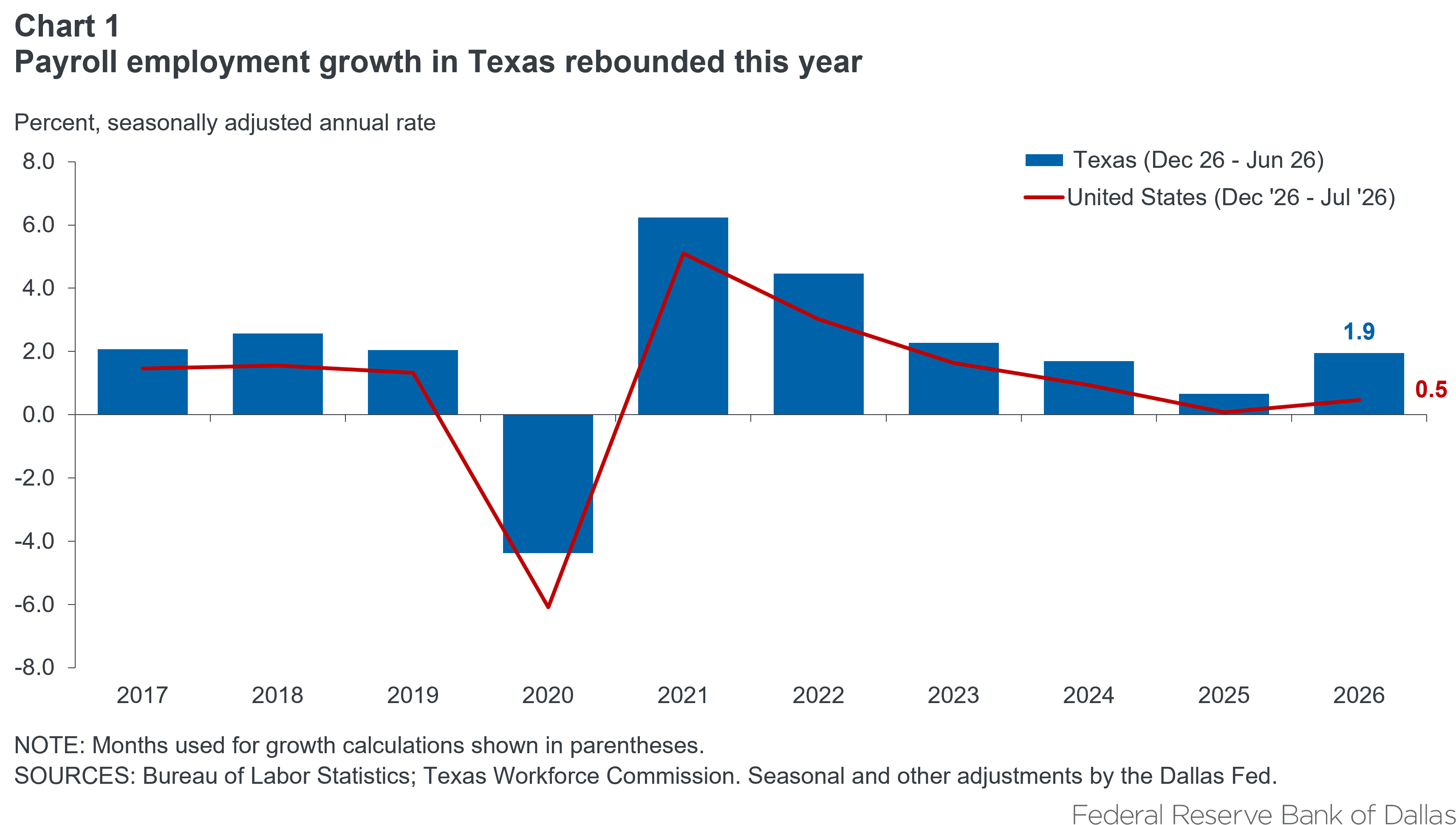
Texas employment, on average, grows at about 1.9 percent per year while the U.S. adds jobs at 1 percent per year. Last year U.S. job growth slowed down to essentially zero. Texas also had very weak payroll employment growth partially due to falling immigration, federal government cutbacks and widespread policy uncertainty.
So far this year, Texas payroll employment has rebounded and is now more in-line with 1.9 percent, which is its average growth rate. Another interesting aspect of the Texas labor market is that the unemployment rate is low and stable (hovering around 4.5 percent), suggesting the labor market is balanced between employers seeking workers and workers seeking jobs.
In Chart 2, we show year-to-date job growth by industry for both the U.S. (in red) and Texas (in blue).
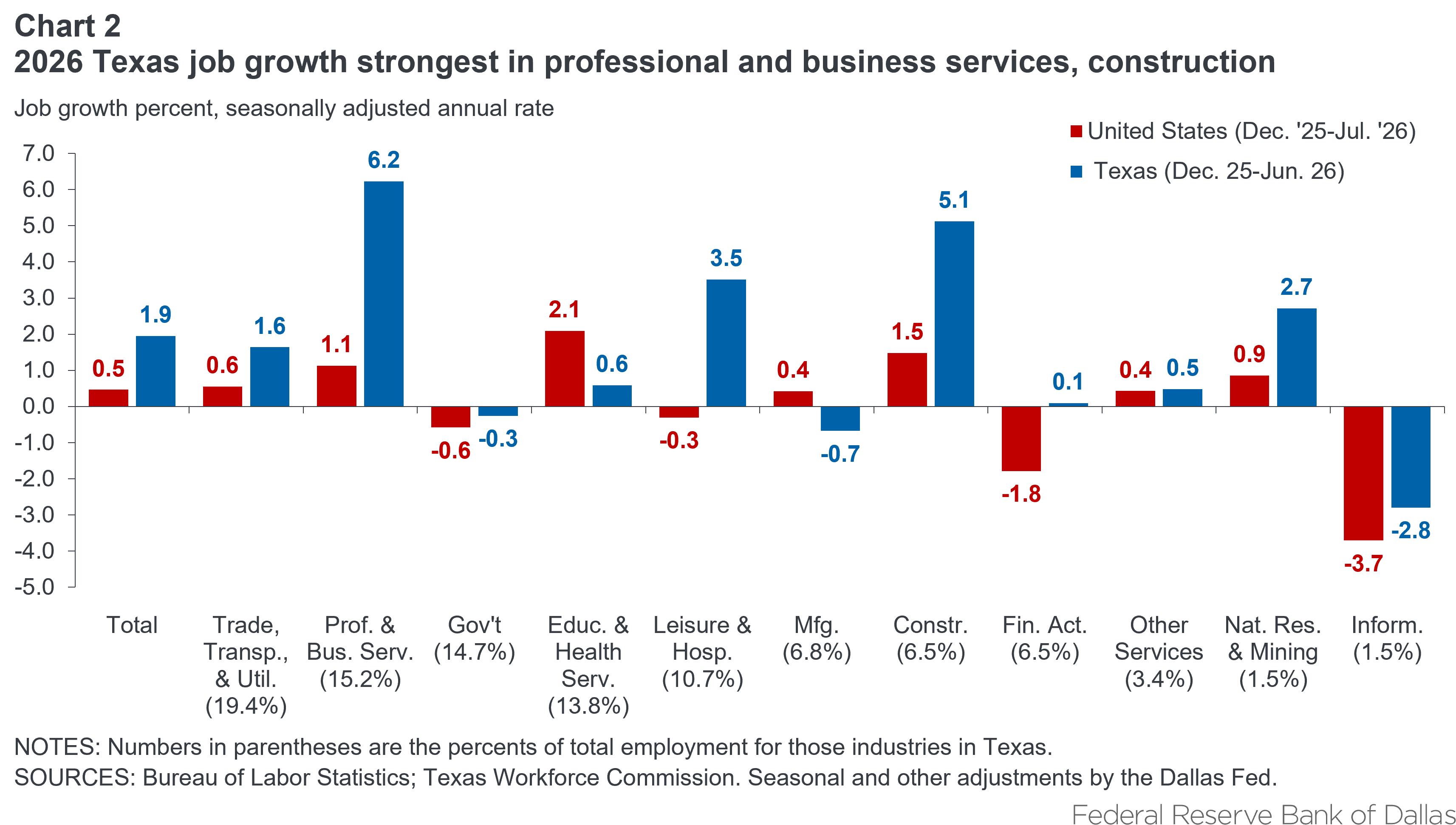
So far this year, Texas job growth has been concentrated in four standout sectors: professional and business services, leisure and hospitality, construction, and energy. It is particularly worthwhile to highlight two industries. The state has seen a pickup in growth in professional and business services, largely from staffing services, which we’ve seen rebound this year. Staffing services are typically a leading indicator of employment growth. And the construction sector is also growing rapidly, mostly due to the pickup in data center construction across the state.
The Dallas Fed conducts a series of business outlook surveys to get timely and in-depth insights into business conditions across the state. In Chart 3, we show the employment index from our Texas manufacturing outlook survey (in yellow) and the service sector outlook survey (in green). In these indexes, any reading above zero means growth and anything below zero indicates contraction.
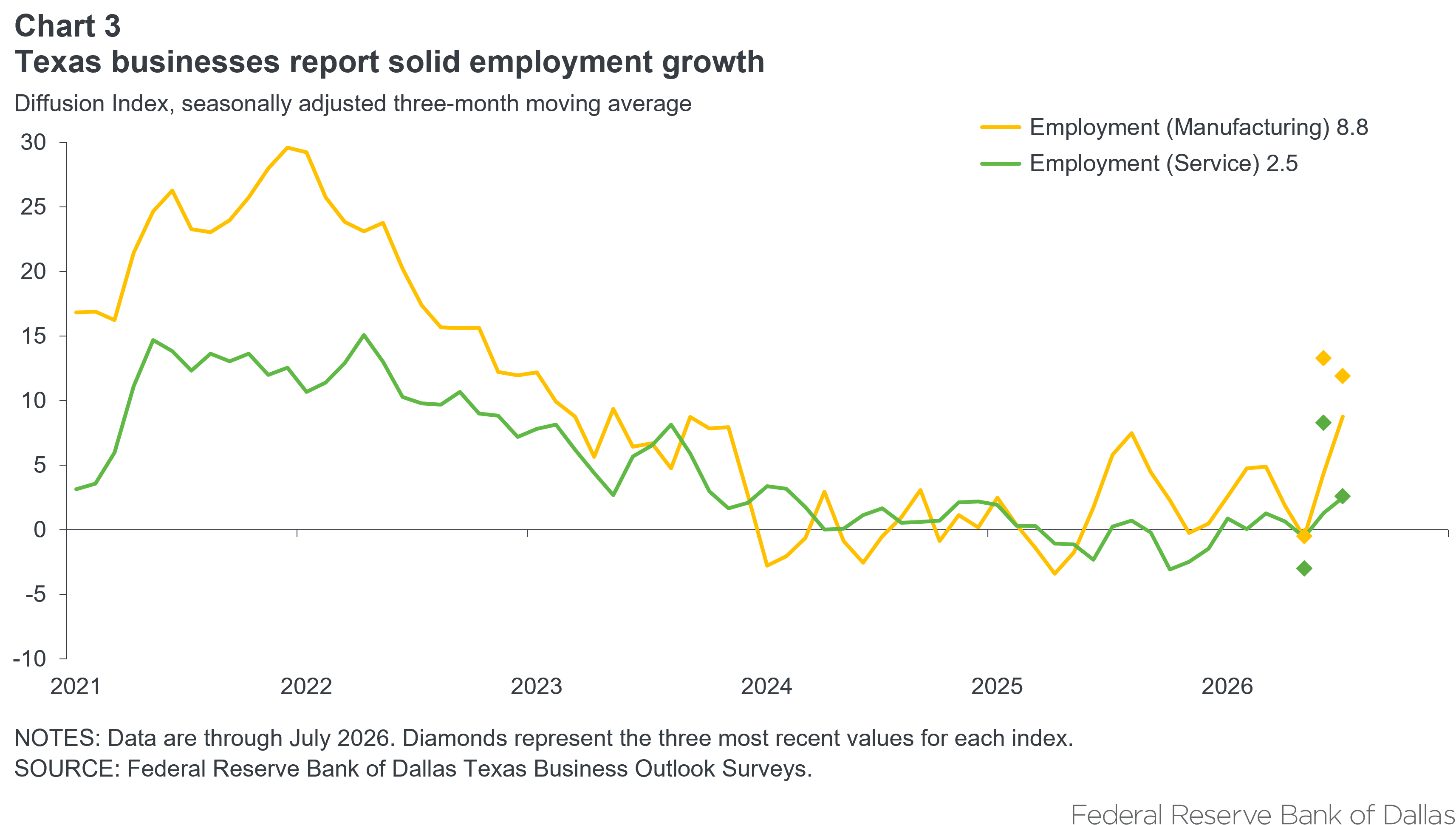
The diamonds here represent the latest data points for employment indexes, which were strong for both manufacturing and service sector firms in our latest survey. We interpret this as an indication that perhaps the labor market in Texas is likely to accelerate in coming months.
Our economists at the Dallas Fed produce a forecast for Texas job growth. The latest Texas Employment Forecast indicates jobs will increase 2.0 percent in 2026, with an 80 percent confidence band of 1.5 to 2.5 percent.
How AI affects jobs that don’t require college degrees
Next, I’d like to talk about some recent trends we’re keeping our eye on through the Dallas Fed’s research in community development. This team is focused on understanding and unpacking barriers to work and the economic mobility of low- and moderate-income communities.
As you’ve heard, everyone is talking about artificial intelligence these days, and we know it has the potential for profound impact (both positive and negative) on the labor market.
Most economic research and media attention on AI and its impact on jobs ends up focusing on high-income workers with college degrees. But what about those jobs that don’t require a college education? After all, about half of workers don’t have college degrees. Surely AI will still affect them to some extent.
My colleagues decided to take a look at the impact of AI on jobs that don’t require bachelor’s degrees but still pay self-sustaining wages—also known as good jobs. They found a range of possible outcomes. Some jobs, such as administrative or IT jobs, may be greatly affected by AI, while others, such as truck drivers and auto mechanics, may see less immediate change.
Jobs with high AI exposure scores still require skills and work activities that AI cannot do well at this point, such as active listening and establishing interpersonal relationships. Investing in soft skills may be an effective strategy to either offset negative AI exposure or complement the technical tasks AI may take off our plates.
Short-term credentials connect people to jobs
Now, when it comes to potential tools that can connect people to good jobs, short-term credentials are worth a look.
Short-term credentials, or those earned by completing programs requiring fewer than two years of study, are increasingly seen as an alternative path to good jobs. My colleagues spent some time understanding the return on investment of short-term credentials. Their research found that these types of credentials generally improve wages, especially for those without college degrees.
In this short-term credentials research, the authors used Census data to account for things like demographical characteristics, as well as education and years of experience.
For someone with a high school diploma or an associate’s degree, a credential adds on average about $5,000 per year to wages. The average wage bump for someone with a bachelor’s degree is about half that, at $2,600 per year (Chart 4).
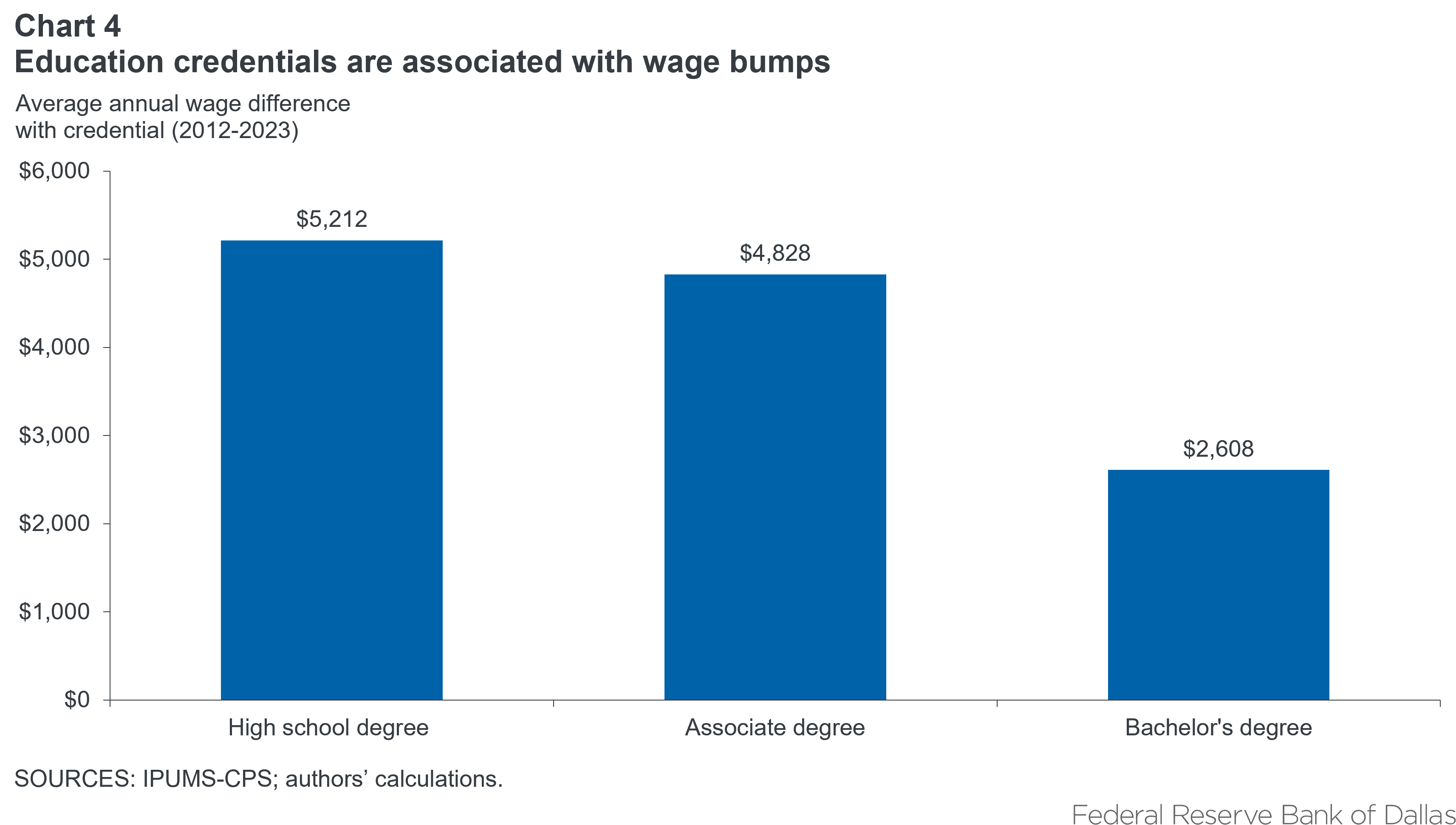
Those bumps in wages are averages; increased earnings are not guaranteed. My colleagues found that not all industries or employers value credentials to the same degree, and the value of credentials can also shift over time based on industry and business needs. This shows why it’s important for workforce programs to be tailored to the needs of local workers and employers.
Community development work expands access to opportunity
As I shared previously, I lead the bank’s external engagement and outreach. This includes a large portfolio of work in community development. Through all of our community development outreach, research and initiatives, we interact directly with community stakeholders to ultimately understand the opportunities and challenges that can either promote communities' participation in the nation's economic growth or hinder it.
Across Texas, regardless of region, many lower-income households lack the resources to build financial security. We know that improving access to educational opportunities and quality jobs helps boost long-term economic resilience and mobility for families. That’s why one of the focal areas of our community development work is workforce development, which includes a signature community initiative of the Dallas Fed called Advance Together.
Community collaboration is key
Advance Together is a program for regional coalitions in Texas that are working to improve access to educational opportunities and quality jobs in their communities.
We launched the initiative in 2020 in response to many local and state leaders who told us over the years that in their regions, the K-12 schools, training providers, higher-ed and employers aren't on the same page about what it would take to prepare students for the jobs of today and tomorrow. In short, the workforce development system is fragmented.
Our goal with Advance Together was to help communities reduce institutional silos that are getting in the way of effective education-to-employment pathways in high growth industries. Our effort tackles that problem by providing a range of support for selected partnerships. We offer three years of customized technical assistance that helps coalitions break down silos across organizations, enhance their strategy, develop progress metrics and test their interventions. The program provides the coalitions with grants through external funding partners. And we offer a peer learning network, so that the coalitions get to learn from one another as a cohort.
Participants must be partnerships or collaboratives of multiple organizations. They represent the public sector, including school districts, community colleges, universities, government agencies and workforce; the private sector, such as employers, businesses, chambers; and the nonprofit sector, that is, community service providers.
We wrapped up our first round of Advance Together in 2024. Overall, the four pilot sites made a lot of progress toward their goals and have attracted over $10 million in follow-on investment from other sources, which is helping them expand their work and reach.
Building on this progress, we launched the current three-year round of Advance Together in 2025, supporting four communities across the state focused on connecting more Texans to quality jobs. Through both cohorts, we’ve partnered with eight communities in total. Our goal is to take lessons learned and proofs of concepts from both cohorts and share them with others, aiming to move the needle on similar workforce outcomes in our district and beyond.
To give you a sense of what a local Advance Together project looks like, I’d like to share more about our team here in McLennan County, Upskill Waco.
What Advance Together looks like in Waco
Prosper Waco, a local organization working to improve health, education and economic mobility through community partnerships, launched Upskill Waco in 2021 to address a critical problem in McLennan County. Many residents are stuck in low-wage, low-skill work, while local employers in industries such as manufacturing, healthcare and construction can’t find enough qualified workers to fill well-paying jobs. The question wasn't whether training programs for these industries existed, but how to build a coordinated system that actually connects people to these quality jobs through accessible pathways.
What makes Upskill Waco compelling is its truly cross-sector approach. Prosper Waco serves as the backbone organization, bringing together a variety of stakeholders. That includes educational partners including McLennan Community College and Texas State Technical College to deliver skills training and credentialing; nonprofit partners that provide case management, financial assistance and community connections for students; business leaders, including chambers of commerce, that help connect folks to jobs; and government partners including the city of Waco, which serves as a thought and funding partner.
By coordinating among partners and aligning training opportunities with local labor market demands, UpSkill Waco helps residents complete the postsecondary workforce training that opens doors to higher-paying, more secure employment.
For participants looking for better job opportunities, including young adults ages 18 to 24, the experience is seamless: personalized case management, scholarships that often cover the full cost of training, quality training with ongoing support and connections to hiring employers. Some of the adult learners UpSkill Waco supports even receive a $15-per-hour stipend in addition to scholarships to help them meet their financial obligations while they complete training.
One participant completed a construction training program and now earns over $800 a week at his construction job with a clear path to six-figure positions. Another earned her medical office certification and got a job at McLennan Community College as a student resource specialist, recruiting others into these same programs.
Upskill Waco’s goal has remained constant, connecting people to quality postsecondary training and job opportunities while meeting industry needs. But their understanding of how change happens has evolved significantly.
Through their work with Advance Together, which included undergoing a baseline evaluation, strategizing with partners and peer-learning with other communities, several critical insights emerged.
First, sequence matters. The partnership realized that strong employer engagement isn't something that happens alongside other work. It's a prerequisite. Second, navigation is more than just a support service. By learning from peer communities in the Advance Together network, Upskill Waco saw that robust navigator roles, the people who help participants stay on track and connect partners across the system, are important to success. Upskill Waco is exploring how to leverage this model in supporting students. And third, alignment requires intention. Even with Waco's strong culture of collaboration, the partnership became more deliberate about calling out where systems need to shift and who's best positioned to create that change.
The partnership continues to refine its approach and is working to expand its offerings. Informed by regional labor market data, they’ve increased the industries included in the training scholarships. The team is also contemplating some ongoing questions. What truly supports persistence and completion for adult learners? How do we sustain meaningful employer engagement beyond sporadic participation? And what changes to policy, practices and resource flows would have the greatest payoff?
What can other communities learn from Upskill Waco?
- Build partnerships in which people can be honest about tensions and challenges, not just celebrate successes.
- Be willing to try new things, iterate and adapt. Learn from what works and doesn’t. Sometimes clarity is more valuable than rapid expansion.
- And leverage your local culture. Waco's willingness to collaborate across sectors is the city’s superpower.
Upskill Waco demonstrates that with the right partnerships, infrastructure and support, communities can build sustainable pathways to opportunity.
I’d now like to acknowledge Jessica Attas, the team at Prosper Waco and their partners through Upskill Waco. Please stand if you’re here with us today.
Communities should start with some critical questions
Thank you for letting me share the Dallas Fed's work in community development and our flagship program, Advance Together. The lessons from Upskill Waco and our other Advance Together participants point to what's possible when communities work differently: when you move beyond coordination to true collaboration, when you're willing to examine not just what you're doing but whether it's actually creating the change you want, and when you build the infrastructure to sustain that work over time.
So I'll leave you with a challenge to start answering some critical questions:
- Who's missing from your table?
- What silos do you need to break down?
- Where could combining resources and influence actually shift outcomes, not just for individual program participants, but for your region's education and workforce system as a whole?
Each of you has a significant role to play in improving economic outcomes for your community. The work you're doing matters, and we're grateful to partner with you in building a strong economy together.
We have a great lineup of experts today, and I am looking forward to a rich discussion. Thank you.
About the speaker
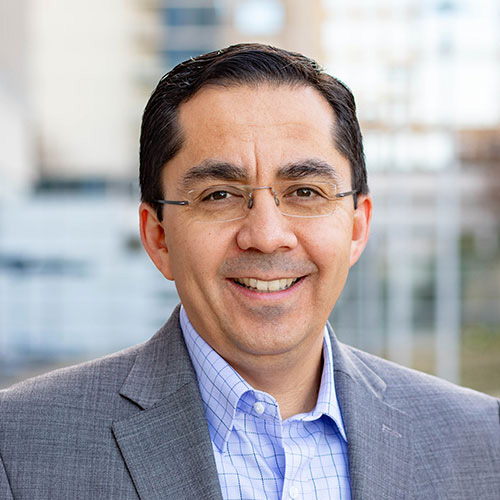
Roberto A. Coronado is senior vice president and senior economist at the Federal Reserve Bank of Dallas.