Commencement Address
I'm honored to be here. It's "way cool!" Your national-champion Fed Challenge team invited me, which touched me to the quick. I was there in Washington for the finals. They were awesome. Good enough to make the football team proud. Thanks to the Class of 2000 for not turning thumbs-down.
Well, congratulations—to more than 600 graduates! That number is hard for me to fathom. I had 33 people in my graduating class 40 years ago. Incidentally, we were the Fairmount Bulldogs. In college, I was a Georgia Bulldog. So, go Midland Bulldogs!
High school graduation is special. Savor it. Use all your film. Get your friends to sign your yearbook, and get their e-mail addresses. Stay in touch. Have class reunions often; attend them all. If nothing else, it'll help you keep your weight down.
There are no friends like old friends—high school friends. You'll have many more friends over the years. But after you become rich and famous, you may question their motives. But not your friends here. They've seen you at your worst and like you anyway.
Graduating from high school is like winning the first set in a tennis match. The match isn't over, but you've locked in a major advantage that can't be taken away. That will give you a leg up going forward.
We should thank your parents for their many sacrifices in helping you get this far—unbroken. Thank them for putting up with all your loud music, dirty laundry, moods and whiny-assing. Forgive them their shortcomings as they have yours. It's okay to be seen with them in public.
You appreciate your parents now, but you'll appreciate them even more when your own kids show you what your parents had to put up with. You'll be amazed to hear your parents' words coming out of your mouth.
I know you've heard all this before, and you know it's true. So why wait? Why not get ahead of the curve, and act now on what you already know you'll know then? Got that?
High school is a memory factory. I think more about memories than I used to because my mother has Alzheimer's. She doesn't recognize me. She was born a few years too early. There'll probably be a prevention or a cure soon.
Biotechnology and modern medicine are working their miracles at a faster and faster pace. Eubie Blake said if he'd known he was going to live as long as he did, he would have taken better care of himself. You take care of yourself, and be ready to benefit from 21st century miracles. Yours may be the first generation in history to live forever.
Some people tell us we are what we eat, and we are. Some say we are what we read. That's true, too.
We are many things, some under our control, some not. But mainly, we are our memories, the sum of all we've seen, done, read and watched on television—and remembered.
Here's a tip for you—and your memory: When you read a book, highlight it. Later you'll be able to reread the good parts. Clip and save newspaper and magazine articles. Keep a journal, or diary, to refresh your memory.
Given my job, people usually expect me to talk about the economy. I'll spare you too much of that today, except to say that Midland's economy has seen the best of times and the worst of times. Your parents remember the bumper stickers from the oil bust of the '80s: "Chapter 11 in '87" and "The Fat Lady Is Singing in Midland, Texas."
Well, the fat lady is singing no longer. The worst thing happening in Midland, Texas, today is "the fat man talking." But not much longer.
The national economy has been doing well for a number of years, especially the past four years—your high school years. About the only thing wrong with the economy lately is high energy prices, and Midland may not be the place to complain about that.
Today's labor market is the best ever. It's an excellent time to get a job. But don't do it yet if college is an option. Alan Greenspan and I promise to keep the economy humming until you finish your formal education.
Last month the national unemployment rate fell to 3.9 percent, the lowest level in over 30 years. But 3.9 is an average. And averages are like bikinis: what they reveal is interesting, but what they conceal is vital.
Here's what that 3.9 percent unemployment rate is by education level. Listen carefully, now. The unemployment rate last month was:
- 6.1 percent for less than high school graduates.
- 3.4 percent for high school graduates with no college.
- 2.6 percent for those with some college.
- 1.5 percent for college graduates.
The pattern would be the same for income levels. More education means a higher income and wealth, not to mention a fuller life. Furthermore, as education and incomes rise, people become healthier and they live longer. Crime falls. People even look better. (If you don't believe me, go to Dallas or Houston and check out Neiman's.)
I was supposed to be in San Francisco today, attending the Texas Bankers convention. Their entertainment tonight is Duck Soup, a Texas band. I'll catch Duck Soup later. What I would like to talk about here is "Rainbow Stew." Several years ago, Merle Haggard had a song titled "Rainbow Stew." One verse goes as follows:
When they find out how to burn water
and the gasoline car is gone,
When an airplane flies without any fuel
and the sunlight heats our home,
One of these days when the air clears up
and the sun comes shining through,
We'll all be drinkin' that free bubble up
and eatin' that rainbow stew.
Merle's utopia may not happen overnight, but our remarkable free enterprise economy is cooking up rainbow stew every day. What we buy may not become free, but that's the direction it's moving. Things are becoming cheaper every day, not necessarily in terms of money but in terms of our work. An hour of work, or a week of work, keeps buying more and more as our productivity grows. Productivity growth has doubled in recent years from the '70s and '80s.
As we work, save, invest, invent, innovate and trade, our growing productivity makes the unaffordable affordable. Today's luxuries become tomorrow's necessities. Tomorrow's luxuries we can hardly imagine today, but they, too, will become necessities, by and by.
As Robert Earl Keen says, "The road goes on forever, and the party never ends."
Now that I've worked in Merle Haggard and Robert Earl Keen, let me quote another of my favorite picker-poets—John Anderson. John was thinking of high school when he sang
I was voted most likely, back in '79.
I was headed right for the top,
All I needed was time.
Do you think John made it to the top? After all, all he needed was time. Not likely. You need more than time. In fact, the title of the song is "Goin' Down Hill." I think the opposite sex might have been involved in his downward slide.
He got distracted. Don't get distracted.
The best way to predict your future is to create it. Plan it, and work your plan. But here's a caution: As you strive for the top, or just a higher rung on the ladder, it's often hard to know how well you're doing. Success often comes disguised as failure, and setbacks often lead to better things. It's hard to tell.
When Waylan Jennings gave up his seat on Buddy Holly's chartered plane that night to the Big Bopper, he thought he'd lost out—until the plane crashed.
When Buddy Holly insisted on performing in his glasses—his horn-rimmed glasses—despite everyone's advice not to do it, he performed a great service, to himself and to the world. He not only succeeded doing it his way, but according to Paul McCartney, of the Beatles, Buddy's example inspired John Lennon to wear his glasses on stage. (Given what later happened to John, I don't know if that was a good thing or a bad thing for John.)
My point is, you never know. As Forest Gump said so eloquently, "Life is like a box of chocolates. You never know what you're going to get."
So don't get too high over your apparent successes or too low over perceived failures. Rudyard Kipling called them "triumphs" and "disasters" and suggested we treat those two imposters just the same.
One final application of the you-never-know principle: If any of you guys got dumped by your girlfriend this past year, you may be lucky. A better one will likely come along. Plus, she'll be sorry when at the reunions she sees how well you turned out compared with that turkey she took up with.
As Fats Domino put it, "You're going to be a wheel some day; you're going to be somebody. You're going to be a wheel someday; then you won't want her."
Let me close with Ted Turner's rule for success: "Early to bed, early to rise, work like hell and advertise." (To that, my wife, Suzanne, would add—especially for you girls— "Moisturize.")
But success isn't everything. Life is for living, for being happy. As the late, great Roger Miller said, you can't roller skate in a buffalo herd, and you can't take a shower in a parakeet cage. But you can be happy if you've a mind to. So be happy.
Congratulations. Good luck. Godspeed. And go Bulldogs!
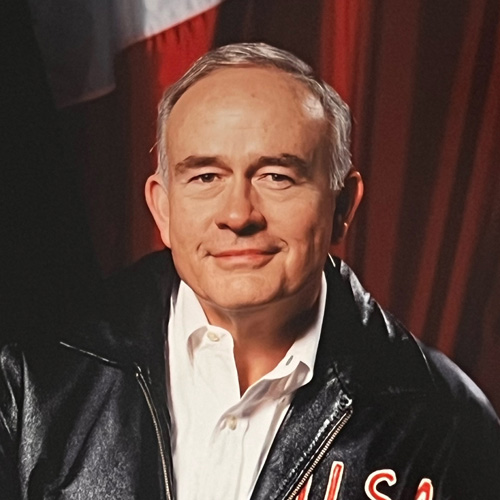
Robert D. McTeer Jr. was president and CEO of the Federal Reserve Bank of Dallas from 1991 to 2004.
The views expressed are my own and do not necessarily reflect official positions of the Federal Reserve System.