Commencement Address: Texas Lutheran University
It's an honor to share this important occasion with the class of 2000—this major milestone in your life. Congratulations to the graduates and thanks to your Moms and Dads and other long-suffering supporters.
I feel some kinship with Texas Lutheran. The chairman of your Board of Regents, Roger Hemminghaus, is also the chairman of my Board of Directors at the Dallas Fed. Roger will preside over his last meeting at the Dallas Fed on Thursday, and Alan Greenspan is coming for the occasion. Now you know who to blame for inviting me.
But, don't worry. I understand my role. It's similar to that of the corpse at a funeral: his presence is required for the occasion, but he's not expected to say too much.
Graduating is like winning the first set in a tennis match. The match isn't over. The game goes on. But you've locked in an advantage that can't be taken away. Graduating from a quality university—like Texas Lutheran—gives you a leg up on the rest of your life.
I bring you good news and bad news. Good news first: out in the real world, you'll find there's no such thing as algebra. And you'll never have to diagram a sentence. It was all a joke. The bad news is that you will have to write more term papers than ever. Except they'll be called memos, reports, speeches and briefs.
More bad news for any of you operating under the misconception that your educational experience is now behind you. With the world spinning faster than ever, the shelf life of formal education is getting shorter and shorter. Commence—as in commencement—means "to begin," not "to end."
The end of the formal phase of your education is just the first step in your lifelong learning. That cliche has always been true, but these days it's really true.
More good news: you're graduating into the best economy in decades. Labor markets are tight. Job growth is rapid. Unemployment is low. Our New Economy has increased the already existing premium on education.
Last Friday, we learned that the unemployment rate in November was 4 percent. The fine print revealed the following. Unemployment was:
- 6.7 percent for those without a high school diploma.
- 3.6 percent for high school graduates, with no college.
- 2.7 percent for those with some college, but no degree.
- 1.5 percent for college graduates.
It's probably lower still for those with graduate or professional degrees. So if that's an option, take it. I believe it was Mae West who said, "Too much of a good thing is just about right." I assume she was thinking of education.
Moms and Dads, if they can't get a good job in this economy, they're not trying. Yes, that includes liberal arts majors.
Some people say liberal arts majors are well rounded but not pointed in any useful direction. If that was ever true, it's less true today. My take on it is that liberal arts majors have been preparing for life and for later in their careers, rather than for the beginning.
Let's take our mutual chairman, Roger Hemminghaus, as an example. I believe Roger majored in chemical engineering at Auburn. Now, I assume Auburn's not a very good school because it has a good football team, but that's beside the point.
My point is that Roger's "practical" major got him off to a good start, but my guess is that he ended up as CEO of Ultramar Diamond Shamrock because of the humanities he picked up along the way and because of his own considerable humanity.
I've seen him interact with other CEOs in various circumstances over the years, and technical aspects of their businesses rarely came up. I've seen him run board meetings with a wide range of esoteric topics, not to mention esoteric people. He's done deals with people of different cultures in faraway places and dealt effectively with extremes of personalities, all the way from the classical Alan Greenspan to the rock 'n' roll Bob McTeer. There's a lesson for you in Roger's example. And for me.
Of course, I've just demonstrated another important component of career success: the ability to suck up shamelessly to the boss. You'll find that a pervasive practice in any field of endeavor, but it's best done in a more private setting than this.
Earlier, I called our economy a new economy. By new economy, I mean our new, third wave, service, information, knowledge, digital, Internet, point-and-click economy.
Our new economy features opportunity and competition at the global level, which raises the stakes at the local level. In a larger, global market, the rewards for success are greater, but so are the penalties for failure to prepare and the standards for preparation. As the world's only economic superpower, our routine jobs will increasingly succumb to technology, or go abroad, while we produce and consume higher up on the food chain.
Some wags have said that the factory of the future will have only two employees—a man and a dog, or a woman and a dog. In any case, the person's job will be to feed the dog. The dog's job will be to keep the person from touching the computer.
A couple of years ago, investment guru John Templeton wrote a book with the title Is Progress Speeding Up? The answer was yes. It still is.
Real GDP has grown much faster in recent years, with lower unemployment and less inflation than expected. So, progress is speeding up by traditional measures. But increasingly, traditional measures understate our progress.
It's easy to count the widgets of an industrial economy, but harder to count units of information in an information economy—software, entertainment, new medicine and medical procedures. At the dawn of the human genome era, old diseases will be cured or prevented and our lives will be made easier and longer. Eubie Blake said that if he'd known he was going to live as long as he did, he would have taken better care of himself. If you can just hang on to your health for a while longer, the Class of 2000 may be the first in history to live forever. But all the miracles of biotech may not show up as faster GDP growth. The diseases may generate more GDP than the cures.
Recently, the biggest thing going in the economy is a resurgence in productivity growth. Productivity growth is important because it's a proxy for our standard of living. Productivity, or output per hour worked, stagnated from the early 1970s to the early 1990s. Then, driven by an investment boom in new cost-saving, labor-saving, productivity-enhancing technology—primarily information technology—productivity growth has at least doubled since the mid-'90s, probably more than doubled. It has boosted growth and made growth less inflationary.
Prosperity, of course, is a moving target. Most people are content if they make more money than their brother-in-law. And we all know about the Joneses. We try to keep up with them, but every time we get close, they refinance.
You may have been too close to the rapidly changing economy to realize the extent of change. Let's review it from a student's perspective.
In 1960—over 40 years ago—I graduated from Fairmount High School in rural north Georgia and entered the University of Georgia, another school with a good football team. I went from being a Fairmount Bulldog to a Georgia Bulldog. As an honorary graduate of Midland High School—long story—I'm also a Midland Bulldog. So, now you really know why I'm here: it's fate. It's a bulldog thing.
Anyway, when I moved into the freshman boys' dorm at the University of Georgia in 1960, my only toy was a portable radio. The only bathroom was at the end of the hall near the only pay phone. There was no TV, no computer—therefore no Internet—no e-mail, no word processing. There was no microwave, no private phone, no cell phone or beeper. No car. No girls in the dorm. The girls were locked in their own dorms at 11 p.m. And Georgia wasn't even Lutheran.
I'm not pleading poverty in 1960. I'm just reminding you that many things you took for granted during your college years weren't even available then. Those that were available were affordable only by the rich kids. Don't resent the rich. We need them to buy their expensive luxuries until they become our affordable necessities.
A few years back, Merle Haggard, who was on the cover of Sunday's Parade Magazine, had a song titled "Rainbow Stew." One verse goes as follows:
When they find out how to burn water
and the gasoline car is gone,
When an airplane flies without any fuel
and the sunlight heats our home,
One of these days when the air clears up
and the sun comes shining through,
We'll all be drinkin' that free bubble up
and eatin' that rainbow stew.
Merle's utopia may not be fully realized, but our remarkable free enterprise economy is cooking up rainbow stew every day, in the sense that our necessities—and our luxuries—are getting cheaper all the time. Not necessarily cheaper in terms of dollars, but in terms of how much work it takes to afford them. We did an essay on that in our 1997 annual report, titled "Time Well Spent: The Declining Real Cost of Living in America."
Based on the average hourly wage for production workers in manufacturing—which is less than you'll be making soon—we get these comparisons:
- An air conditioner that cost 213 hours of work in 1952 cost only 45 hours in 1970 and was down to 23 hours in 1997.
- A cell phone went from 456 hours of work in 1984 to 40 minutes in 2000.
- A VCR went from 365 hours in 1972 to five hours in 2000.
Tom Wolfe puts the rise of the standard of living of the middle class much more colorfully in his new book, Hooking Up. Let me read you the first paragraph of that book:
By the year 2000, the term "working class" had fallen into disuse in the United States, and "proletariat" was so obsolete it was known only to a few bitter old Marxist academics with wire hair sprouting out of their ears. The average electrician, air conditioning mechanic, or burglar-alarm repairman lived a life that would have made the Sun King blink. He spent his vacations in Puerto Vallarta, Barbados, or St. Kitts. Before dinner he would be out on the terrace of some resort hotel with his third wife, wearing his Ricky Martin cane-cutter shirt open down to the sternum, the better to allow his gold chains to twinkle in his chest hairs. The two of them would have just ordered a round of Quibel sparkling water, from the state of West Virginia, because by 2000 the once-favored European sparkling waters Perrier and San Pellegrino seemed so tacky.
The cycle goes like this: neat stuff is invented. It's new and affordable only to the rich. Production grows and unit cost falls, until eventually, middle-income people can afford it, then the poor. Yesterday's luxuries become today's necessities. Tomorrow's luxuries we can hardly imagine. As Robert Earl Keen says, "The road goes on forever and the party never ends."
The cycle goes on because we let it. We fret that income distribution isn't more nearly equal, but the majority of us remember the lesson of the goose that lays the golden eggs. Some countries have cooked their goose and cut off their egg supply. We've been tempted. We're guilty of goose abuse. But so far, our goose is still loose and laying.
(I'll skip over babies and bathwater for brevity. You can fill in the blanks.)
Our goose, of course, is free enterprise—relatively free, anyway. In the battle of the isms, capitalism won. Communism and hard-core socialism have been discredited. So have more diluted forms of capitalism. Recent crises have revealed the limitations of state-planned and state-directed capitalism, as in Japan and East Asia. The limitations of Europe's nanny-state version of capitalism have also been revealed.
Many Europeans say they don't want U.S.-style harsh, unadulterated capitalism. But their kinder, gentler, adulterated capitalism has given them unemployment rates twice as high as ours, caused, ironically, by their efforts to protect their workers from market forces. It turns out that the job security of a strong dynamic economy is better than the job security of government protection and regulation.
The people in rich countries aren't better people than people in poor countries. They just have a better economic system, one that translates individual freedom and individual striving to general prosperity. Adam Smith called it the "invisible hand." Friederich von Hayek called it the "spontaneous order." Free enterprise is not run by anybody. It's just what happens naturally when people are free. Of course, the ultimate form of capitalism is "cowboy capitalism," Texas style. So, if you can, stay in Texas and join the party.
Let me close with Ted Turner's rule for success: "Early to bed, early to rise, work like hell and advertise." (To that my wife, Suzanne, would add, especially for you women, "moisturize.")
But life, ultimately, isn't about success. It's about living—about being happy.
As the late, great Roger Miller said, you can't roller skate in a buffalo herd, and you can't take a shower in a parakeet cage. But you can be happy if you've a mind to.
So, be happy. Live fast, love hard and leave beautiful memories. Enjoy your rainbow stew.
Again, congratulations, good luck and Godspeed.
And go Bulldogs!
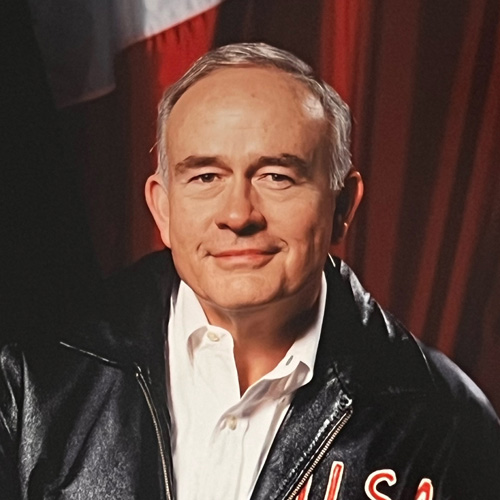
Robert D. McTeer Jr. was president and CEO of the Federal Reserve Bank of Dallas from 1991 to 2004.
The views expressed are my own and do not necessarily reflect official positions of the Federal Reserve System.