Opening remarks for the Eleventh District Banking Conference
On behalf of the Federal Reserve Bank of Dallas and in partnership with the Texas Department of Banking I want to welcome you to the third annual Eleventh District Banking Conference. Personal thanks to Commissioner Charles Cooper and Deputy Commissioner Jared Whitson for their continued collaboration in putting on this event. As our state-member banks can attest, we are quite fortunate in the Eleventh District to have such a strong working relationship between our state and federal supervisors that truly delivers a best-in-class model of how to work together on our shared mission.
I also want to acknowledge our leadership team from Washington. Vice Chair of Supervision Miki Bowman, Director of Supervision Randy Guynn, Deputy Directors Julie Williams and Francisco Covas, thank you for being here and the commitment you continue to make to supervision and the banking industry. We are also fortunate to have had our Community Depository Institution Advisory Council meeting yesterday, chaired by Cindy Blankenship, with some of our Dallas Fed board of directors in attendance.
As I get started, I should be clear that the views I express today are my own, and do not necessarily reflect official positions of the Federal Reserve.
When we started this conference our goals were simple: to increase transparency and outreach to our district banks. Today, we continue to execute on that purpose. Our content is shaped by our interactions with all of you throughout the year, as we take the time to hear what is on your mind and what topics you find valuable for this conference. Today affords us a chance to create space to build on those connections and provide candor to discuss topics relevant to all of you.
The Eleventh District covers the entire state of Texas, northern Louisiana, and southern New Mexico. Data from our district show the state of Texas remains the state with the largest population of community banks. Data also show some powerful ways in which these community banks contribute to our district performance. As our team highlighted in August 2025, community banks provide 73 percent of small business lending in our Eleventh District. It’s important to recognize that community banks show up and invest in the communities they serve and contribute to our regional economy in a meaningful way.
Turning to our agenda today, I want to highlight three banking topics we are monitoring in our region, particularly our community and regional banks given their footprint: commercial real estate, deposit competition and fraud.
Commercial real estate continues to fuel loan growth in the region. Our latest banking conditions survey from our economic research department reports banks are enjoying strong demand for commercial real estate. Growth appears to be stemming from Texas’ large and growing state economy, which has been bolstered by expansion of some companies’ operations and migrations of other companies to the state.
There’s a lot of opportunity within commercial real estate, and at the same time some pockets show signs of deterioration. Office and industrial in the major metro areas of the district have softened. This trend is particularly acute in Austin, where rents are also on the decline. As one of our banker roundtable participants noted, the donut effect is happening to some of our cities, where suburban deals continue to flourish while city centers face big headwinds.
Given economic performance drives banking activity, we look forward to hearing from Dallas Fed Economist Pia Orrenius later this morning about insights into the regional economy. This should help set the stage for our panel discussions, where we’ll hear about commercial real estate both in our financial risk and banker panels..
Deposit competition remains fierce, with large money center banks spending large volumes on digital marketing nationwide and new deposit-like products such as stablecoin entering into the landscape. As we face more uncertainty on the dual mandate, with labor fragility and ongoing conflict globally disrupting energy sectors, deposit behavior may also be challenging to model as it relates to interest rate risk. For instance, depositors may become more sensitive to rate increases with more alternatives for consumers to switch among, looking for yield. Our financial risk panel today will also discuss deposit behavior as it relates to interest rate risk and liquidity.
Finally, we’ve been to a lot of events with bankers this year, and the one constant topic that every single one brings up is fraud. Community banks report to us they are frustrated with the largest banks and a perceived lack of coordination and urgency in working together to recover and prevent illicit activity. At the Federal Reserve Board we put out a request for information on fraud with the other federal regulators in 2025 and continue to work through those comments to enact real change. We are excited this year to have both the Texas Financial Crimes Investigation Center and the FBI join us today to talk about what they are seeing, how the state of Texas is leading the way in banks working with law enforcement to stop organized financial crime, and what more can be done to combat this as an industry.
Outside of our agenda topics, across the Federal Reserve, Office of the Comptroller of the Currency and Federal Deposit Insurance Corp., we’re seeing a clear and coordinated shift in banking supervision. As with our supervisory operating principles laid out at the Federal Reserve, we as supervisors are working to sharpen our risk-focused supervision, enhance tailoring and recalibrate our approach to standardized rules that ultimately should lead to greater economic growth. These are lasting changes that ensure we ground our work in regulation, and I encourage the audience to read the speeches the vice chair has given as she sets out a clear vision for the future. I look forward to continuing to help advance her agenda..
As I mentioned earlier, besides discussing relevant banking risks and topics, building connections during this conference is a key outcome for each of us. The conversation you have between sessions, over coffee, or after a panel─those are the ones that stay with you. They’re where our ideas sharpen, our perspectives broaden, and solutions begin to take shape.
When supervisors are part of the conversation─not just across the aisle from you during an exam─but engaged participants at events like these, it strengthens the entire system. It creates better alignment, improves understanding and leads to better outcomes for the institutions we serve and the communities that rely on us.
One of the benefits of having a federated structure here at the Federal Reserve is that our examiners live and work in the communities they serve. We are your neighbors. We know how many Buc-ee’s stops it takes to get from Dallas to Houston (two, for those wondering,) and that driving three hours for good barbeque is something you can find yourself doing on a weekend. Living in the communities we serve also affords us the ability to form trusted relationships and gather intelligence from the region to complement and inform national trends.
We all share the same objective: to create a safe and sound banking system and support economic growth by lending to the communities you serve. So my ask today is simple─be present. Be open. Ask questions. Get to know someone new. The value of today isn’t just the agenda, it is in the exchange.
To close, I want to just take a moment to recognize our record crowd today. In an increasingly digital and distant world, we have purposely made this conference largely in-person. We see that people are hungry for real, face-to-face conversations. Not surface level or scripted, but the kind that move our industry forward. All of you cared enough to show up to share, challenge and learn from each other. We are better for having you in this room today. Let’s get started.
About the speaker
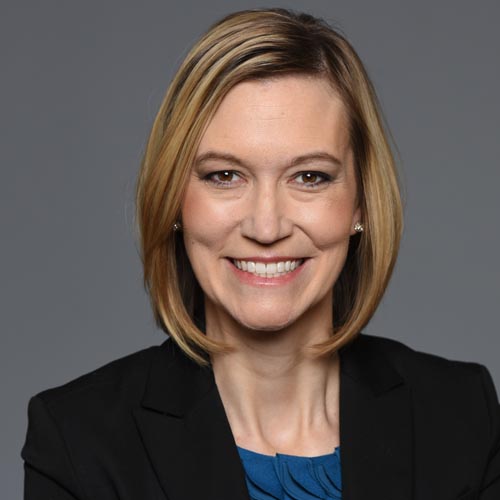
Emily Greenwald is senior vice president with responsibility for Banking Supervision and Regulation, and Credit, Risk and Reserves Management.