Oil and gas and renewable energy projects demand tailored risk management approaches
The upstream oil and gas sector and renewable energy sector tend to follow opposite trajectories. Oil and gas lending peaked during the U.S. shale boom, while wind and solar financing has surged recently. Both require massive upfront investment, making bank lending critical to their growth.
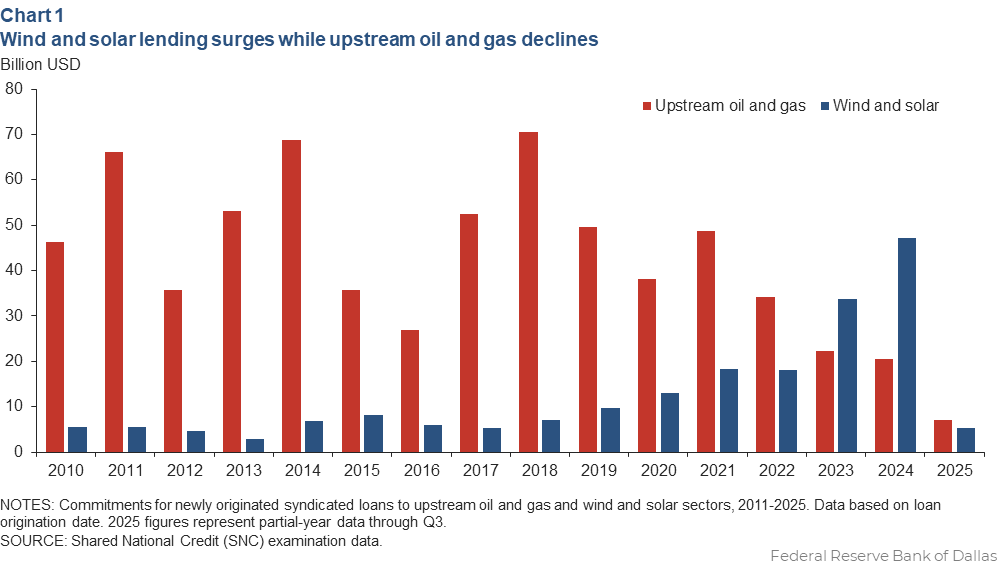
Syndicated loan data from the Shared National Credit Program reveals this divergence clearly. The upstream oil and gas sector received approximately $51 billion in syndicated loans annually from 2011–2019 but then declined steadily from 2020 to 2024. By contrast, wind and solar syndicated loans grew at 32 percent annually from 2020 to 2024 (Chart 1).
Both sectors now face distinct vulnerabilities. The oil and gas sector faces transition pressures and the potential for stranded assets. On the other hand, the renewable energy sector is very sensitive to legislative changes affecting tax incentives and subsidies.
In 2016, the Federal Reserve produced SR Letter 16–17, which offers energy lending guidance around reserves-based lending activities. While there is no published guidance around renewables-based energy lending, understanding each sector’s unique risk profile is essential for lenders and bank examiners. This knowledge shapes lending decisions, risk management strategies and portfolio performance.
Many banks organize both oil and gas and renewable lending under a single Energy or Specialized Lending group. While operationally efficient, this structure can lead to inappropriate application of similar underwriting standards across fundamentally different assets. Lenders must recognize that expertise in one sector does not automatically translate to the other.
Upstream loans fund operations while renewable loans finance specific projects
The financing purposes in these sectors differ significantly due to operational differences and project lifecycles.
In the upstream oil and gas sector, financing supports high-risk exploration and production activities. General corporate purposes (60 percent) and working capital (25 percent) collectively represent the majority of loan purposes (Chart 2). This broad approach provides flexible capital for drilling, exploration and production.
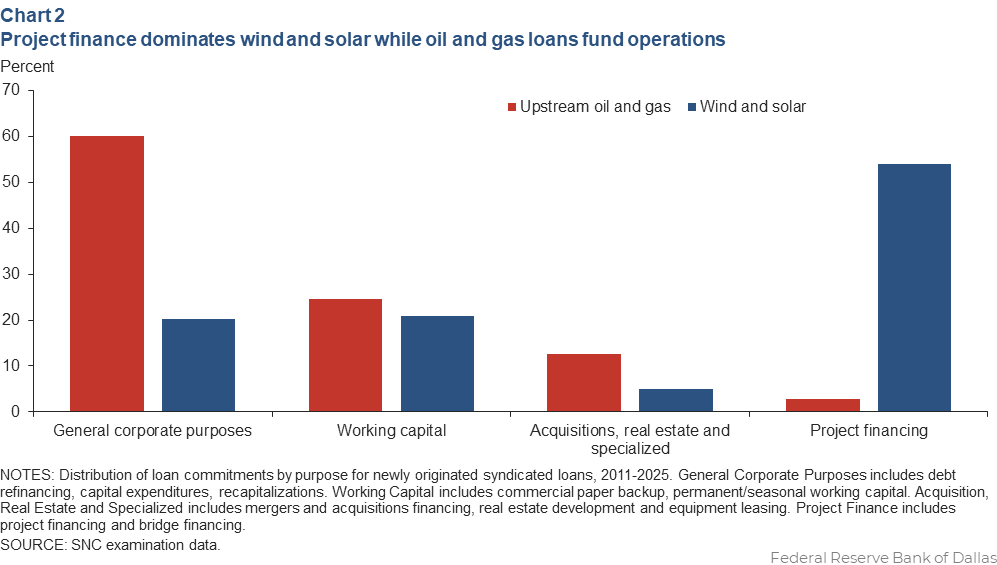
Unlike the oil and gas sector, renewable energy financing focuses on long-term, capital-intensive projects. Bank loans primarily support construction of solar and wind installations. Project financing accounts for 54 percent of wind and solar loans, with working capital (21 percent) and general corporate purposes (20 percent) comprising most of the remainder (Chart 2).
These different purposes create fundamentally different risk exposures. Upstream oil and gas operations face volatile commodity price risk. Wind and solar projects benefit from government incentives and predictable cash flows, often secured by long-term Power Purchase Agreements (PPAs).
Upstream uses balance-sheet financing while renewables rely on special purpose vehicles
The capital structures in these sectors reflect their distinct operational and risk profiles.
The upstream oil and gas sector typically uses balance-sheet financing. Loans are secured against the company’s overall assets and creditworthiness. This approach provides flexibility but exposes lenders to commodity price swings, operational failures and corporate financial health.
The renewable energy sector predominantly uses non-recourse project financing. Specific projects are funded through Special Purpose Vehicles (SPVs) that rely solely on the project’s future cash flows for repayment. The debt stays off the sponsor’s balance sheet, limiting lender recourse to the project’s assets only.
This structural difference fundamentally changes credit analysis. Upstream lenders analyze corporate financial statements and overall company creditworthiness. Renewable lenders focus almost exclusively on project-level metrics and cash flow models.
Collateral requirements reflect the nature of each sector’s assets
Oil and gas reserves are depleting assets with uncertain extraction timelines. Solar and wind projects are fixed installations with predictable generation profiles. The decisions by these two sectors to finance themselves differently are a result of the fundamentally different risk of their assets.
For upstream oil and gas loans, collateral primarily comprises the oil and gas reserves themselves. The security package covers licenses, production equipment and project accounts. The borrowing base is determined by the present value of future cash flows from proven reserves.
Renewable energy project financing relies on a comprehensive collateral package. This includes all project assets (both physical and intangible), revenue streams and contractual rights. The sponsor often pledges its equity interests in the SPV, providing lenders with a straightforward foreclosure route if needed.
Revolving credits dominate upstream lending, term loans prevail in renewables
Separate from the degree of collateral, the types of financing facilities used also differ markedly.
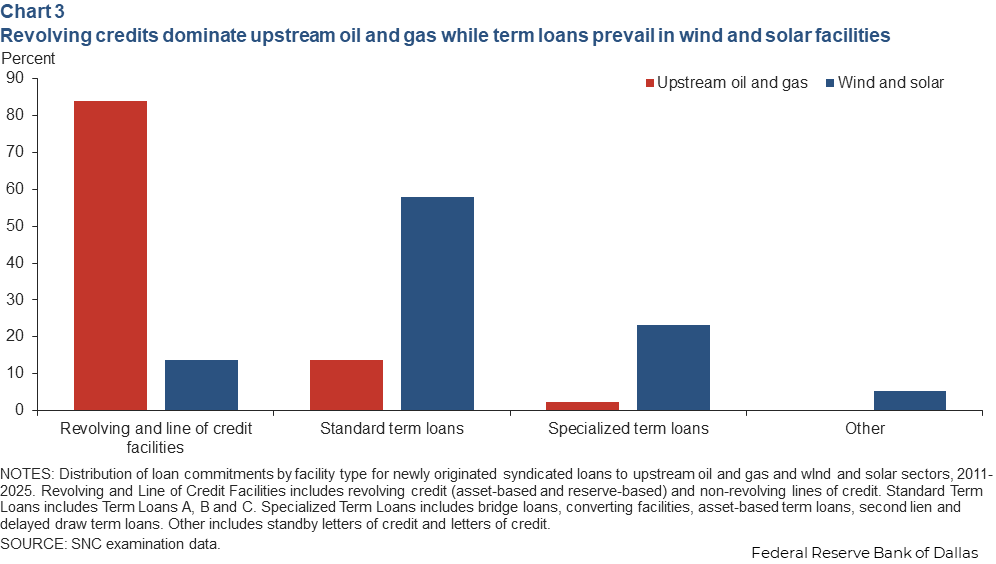
In the upstream oil and gas sector, reserve-based loans (RBLs) are common. Borrowing limits depend on proven and probable reserve values, making them sensitive to commodity price fluctuations. Upstream companies need ongoing capital access for continuous drilling, so these loans are primarily structured as revolving credit facilities and lines of credit, accounting for 84 percent of upstream facilities (Chart 3).
In the wind and solar sector, financing follows a two-stage approach. Construction loans provide short-term, interest-only financing during the build phase. These convert to long-term (e.g. 25–30 years) amortizing loans when projects reach commercial operation and begin generating steady revenue.
Standard term loans (58 percent) and specialized term loans (23 percent), including cash and tax equity bridge loans, account for two-thirds of wind and solar facilities (Chart 3). Project finance packages typically combine term loans with smaller revolving credits (14 percent) that support operations or provide credit enhancement.
Solar asset-backed securities are mainstream while oil and gas securitization remains niche
Securitization plays different roles in each sector.
In renewable energy, solar Asset-Backed Securities (ABS) have become mainstream. These structures bundle predictable future cash flows from solar projects into bonds sold to investors.
In upstream oil and gas, Proved Developed Producing (PDP) ABS represents a growing but still niche instrument. These securitizations offer higher advance rates and longer maturities than traditional reserve-based lending but remain less common.
The difference reflects underlying cash flow characteristics. Solar projects generate highly predictable revenue streams ideal for fixed-income investors. Oil and gas production faces commodity price volatility that complicates securitization. Both ABS types offer alternative financing with longer maturities and higher advance rates than traditional bank facilities.
Commodity price risk dominates upstream while project execution risk drives renewable lending
Lenders and bank examiners must recognize these sectors require fundamentally different risk assessment frameworks.
For upstream oil and gas lending, commodity price risk management is paramount. Lenders should closely monitor reserve valuations, production decline curves and hedging strategies. Price volatility demands regular borrowing base redeterminations and robust stress testing.
For wind and solar project financing, focus shifts to project execution risk during construction and operational performance thereafter. Lenders must assess technology risk, contractor capabilities and interconnection agreements. The evaluation of long-term PPAs—including off-taker creditworthiness—becomes critical, as these contracts often determine project viability.
Cross-cutting risks require attention in both sectors
Despite their differences, both sectors share critical portfolio-level risks that lenders and examiners must monitor carefully.
Third-party risk affects both industries significantly. Both involve numerous external parties—equipment suppliers, contractors, off-takers and operators—whose financial health and operational capabilities directly impact project outcomes. For renewable projects, key dependencies include equipment manufacturers, construction firms and power off-takers under long-term contracts. For upstream companies, critical third parties include drilling contractors, midstream operators and hedging counterparties.
Concentration risk also deserves close attention. Banks heavily exposed to either sector face significant portfolio risk from industry-wide shocks, such as commodity price crashes in oil and gas or renewable policy changes. Banks with concentrated upstream portfolios learned this painfully during the 2014–2016 oil price collapse.
Lenders should implement comprehensive third-party risk assessment procedures, including evaluation of contractual relationships, financial stability assessments and scenario analysis of third-party failures. Examiners should verify that banks have appropriate concentration limits, diversification strategies and risk management practices tailored to their energy lending portfolios.
Understanding these differences is critical for managing energy lending risk
The financing landscapes of upstream oil and gas and renewable energy, while both capital-intensive, present distinct challenges and risk profiles for lenders.
Upstream financing depends on volatile commodity prices, reserve-based lending structures and exploration and production risks. Renewable energy financing offers more predictable cash flows through long-term PPAs, though it faces technology, grid integration and policy risks.
Lenders must navigate these sector-specific risks with careful consideration of financing structures, cash flow predictability and the physical and regulatory environments. The capital structures, collateral packages and facility types appropriate for each sector differ substantially.
By integrating sector-specific risk frameworks—including third-party risk evaluation—into loan review procedures, lenders can better safeguard their investments. This tailored approach enables banks to support development in both sectors while managing portfolio risk effectively.
As the energy landscape evolves, a sophisticated understanding of these differences can protect energy lenders from unexpected losses. This knowledge is essential for banks to assess their risk management practices in their energy portfolios.
About the author

Sung Je Byun is a senior research economist in the Supervisory Risk, Policy and Surveillance division at the Federal Reserve Bank of Dallas.