Can AI navigate qualms about data centers, long-term debt?
Q. When we speak about data centers, what exactly are we talking about?
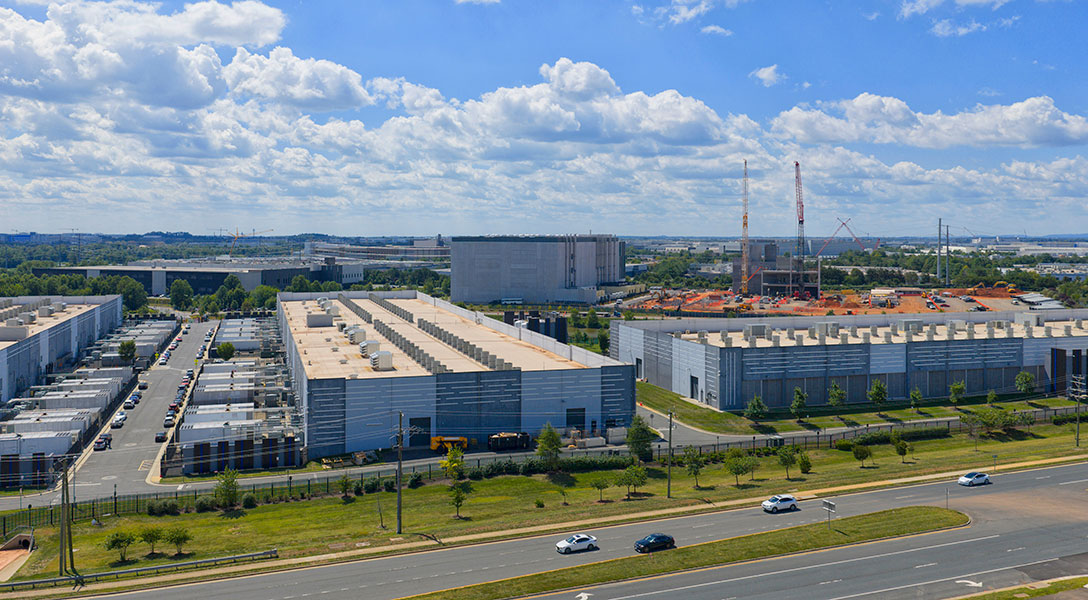
A data center is basically an industrial-scale computer farm. It's a large facility with a whole bunch of servers, storage and networking gear. The concept really predates AI. If you're storing your data in the cloud, you're basically a data center consumer in some sense. You're consuming storage and data retrieval services from a data center.
The difference with AI is that AI dramatically increases the amount and consumption of these services. It's no longer just storing your data in the cloud and retrieving it when you want, but it's also actually doing computational work. For that reason, the scale of the infrastructure needed is enormously larger.
For AI in particular, it needs really high-tech chips made by Nvidia and others. Also with large-scale computing, you need large-scale power and cooling infrastructure. All of that comes together in these data center projects. None of that is new, but the scale of it is new because of how much AI increases consumption.
Q. How do data centers make money?
It’s useful to think of the data center operator as an entity that finances the construction of all of that infrastructure and then monetizes it by leasing that computing capacity to a consumer. The consumer might be a large tech firm. Sometimes these data center operators are affiliated with one of the large tech firms. From our perspective, it's just useful to think of the data center operator as the part of the enterprise that builds out these data centers and leases out computing capacity.
Q. The scale of data center construction appears to be unprecedented. Exactly how big is it?
This is where you sort of forget the billions and you move into the trillions. There are many estimates of the cumulative CapEx (capital expenditures). If you look at the cumulative amount of CapEx that these firms will end up making over the remainder of this decade [roughly five years], the numbers are of the order of magnitude of $5 trillion. If you look at the cost of a data center, it seems to be in the ballpark of $30 billion to $40 billion per gigawatt used. So, a good way to measure the scale of these data centers is by the amount of power they consume. A gigawatt, by the way, is the equivalent electricity consumption of about 800,000 average homes.
It seems that about half of that cost, maybe 60 percent, is the actual servers, chips and so on. The remainder is physical infrastructure, [providing electrical] power and the physical buildings.
It's good to think of it as a [cumulative] run rate of $1 trillion a year, certainly not insignificant in the context of the overall economy, certainly not insignificant in the context of the amount of financing that needs to be raised.
Q. Who has been funding the data center build-out?
In the early stages of the build-out, it was mostly self-financed from the operating cash flow [of such firms as Meta, Microsoft and Amazon]. The numbers are now so large that you really have to tap into every available source of financing and then some.
Wall Street research analysts have estimated where this money might come from. It's a combination of sources—20 percent of the overall CapEx might be operating cash flow and/or some sort of equity, maybe 30 percent will be in the form of unsecured debt in the high-grade debt markets. There will be some fraction coming from private lenders—private debt, potentially foreign investors.
Then there's sort of a TBD [to be determined] fraction of it. Some of this is getting figured out as the build-out happens because this is a rapidly evolving landscape. If you just look at projections of debt supply in November [2025] versus now [September 2026], you know it keeps going up. This year, for instance, there's been about $200 billion in high-grade bond issuance to finance this. And about 70 percent of that is actually in the U.S. These borrowers are also tapping non-dollar currencies, the European bond markets, [the] yen and Swiss franc markets.
A main takeaway is probably that the scale of this financing is large and, therefore, every possible avenue can and will be tapped. The positive side of that story is that tech firms have historically been very light on their debt footprint.

Even though it's growing rapidly, at least in the initial stages, our contacts tell us that there's a lot of demand for this debt because a typical corporate bond investor is rather light on tech names. They're actually quite happy to take that issuance because in a sense, they're diversifying by buying debt from tech firms.
Of course, there's a limit to that, and at some point, we'll get through that and the dynamic might change. But certainly, we seem to be in the relatively early stages, and there’s a willingness on the part of investors to buy tech company AI-related debt.
Q. With so much AI debt going to market, what’s that doing to bond rates?
Perhaps the best way to answer that is to look at what's happening among longer-term maturities [largely 10-year maturities]. The question of whether other borrowers are getting crowded out is difficult to answer at this stage of the game, but the impacts on long maturity sectors are becoming somewhat clearer.
In general, there are a lot fewer issuers in the long end of the [yield] curve. Predominantly, the supplier of that debt is the [Department of the] Treasury—sovereign debt. Most firms tend to borrow shorter than that. Data center operators seem to prefer longer-term debt financing right now. Part of the reason could be the long-lived nature of the infrastructure. It could be issuers’ willingness or desire to just lock in financials for a longer period of time. It's hard to tell precisely why, but that's the observed dynamic.
You could say, at least from the perspective of supplying very long duration bonds, that it [the data center business] is a new entrant into this sector of the market that was predominantly the home base of the U.S. Treasury.
Are you seeing an impact on interest rates? I think the answer is yes. You can see that the term premium has been going up. Investors have an expectation when investing in the long term what rates are going to be. And then you add a premium on top of it because you're tying up your capital [and don’t know what future market rates will be].
The [term premium is the] excess return that investors in the aggregate want in order to buy those bonds. There are many different model-based estimates of term premium. They're all telling us that the term premium has generally been on the rise. Most of that—perhaps even more than 100 percent of that rise in the premium is actually the result of AI.
The Treasury has not [been] increasing issuance at the long end. AI firms are issuing a lot at the [long] end [about 10 years out]. And if anything, the Treasury has actually recently bought back some long-term debt. This dynamic should not be too surprising because what you are seeing, in fact, is that all the marginal supply is really coming from these [new AI debt].
Q. Is the term premium likely to increase even more?
There's a lot that's unknowable because this whole phenomenon is fairly recent. And projections [have] become a little harder to do, but I think you could say that the answer is likely yes.
All signs seem to say that we are extremely constrained right now in terms of the capacity to actually build these [data centers]—the [electric] power capacity and all these other sorts of constraints [limit expansion]. So, to the extent that the AI CapEx has a long runway ahead, to the extent that it needs to be financed, to the extent that it is financed with fairly long-term borrowings, then yes, the dynamic will continue.
Q. Public debate about data centers seems to have increased. Has this affected funding for them?
I think the sense [from our contacts] seems to be that it's not really slowing down the financing or the borrowings. You raise what financing you can, and you execute the investments as they come online.
I think project timelines may be getting a bit slower because of resistance to data centers. But the financing itself in the capital markets seems like it's still very much “foot on the gas pedal.”
Q. Is the AI boom vulnerable to becoming a bust, like dot-coms in 2001, or is it on a different kind of trajectory?
There's a set of ancillary questions one can ask. But it's really a question of whether all of this investment can be monetized in a way that pays off right now. Very crude, back-of-the-envelope math would tell you that if you have a cumulative $5 trillion investment, 15 percent typical return on investment—a very, very ballpark number—[it would total] about $750 billion a year. That's 2.5 percent of GDP. Something like that is not small in a new sector. You could say that number is large and question whether that can be realized, but you could also say maybe it's not that large.
This is a transformative technology, and we are just in the early stages of adopting it. It's a big question that we don't quite know the answer to. And, therefore, the biggest question of them all is: Will this be monetized in a way that pays off?
When we speak to our contacts, they tell us that we are still in the “picks-and-shovels” stage of the game. We're still in the stage of the game where a lot of money is going to the build-out. You could say whether or not you believe that firm X or firm Y will be successful in AI in the long run. Data center financing is a bit safer because it's in a sense collateralized by the compute capacity itself. Now, that's the theory. It requires AI as a technology to be successfully adopted in the broader economy for that statement to be true. But the sense seems to be that we are not yet at that overbuilt stage of the game.
The other thing that we've heard from contacts is that, yes, at some point this might become overbuilt, but it's really hard to say that you're overbuilding if you're so bound by [the availability of electric] power, permitting and all of these other constraints.
There are things to watch, like what is the pricing power of these AI firms? Are there going to be new models emerging from other parts of the world that cause the marginal pricing power for tokens—the unit of AI consumption—to go down? What if so-called open models or open access models take off, and then you start to have AI on your own home computer to at least handle the simple cases and only use big data centers for more complex cases?
There's a lot of these elements that can impact eventual pricing power such that we don't know how things will shake out because it is just so early in the game.
It will potentially slow adoption. And it might spur the emergence of new and more efficient ways of consuming AI. Will the big AI firms be able to maintain their pricing power, as they continue these sort of very large CapEx investments?
Q. Is there a way to gauge the overall health of AI investments?
We look at three things. We look at term premium because it's very close to the heart. It tells you something about the impact that the supply is having at the [long] end of the yield curve. We look at credit spreads on these firms [to compare their bond yields against comparable Treasuries]. By the way, it's very, very healthy right now.
And then the last is stock prices. Even though stock prices fluctuate all the time, you could say that stock prices are the best signal you have about the aggregate markets’ view of how much these tech firms will be able to monetize their AI investments.
It's the best signal we have for that purpose. It's material for the economy as a whole, because in a sense, AI as a sector is not just driving the stock markets or the financial markets in general. You know, it's really contributing in a significant way to economic growth.
This is an edited and abridged version of a conversation available on the Southwest Economy Podcast.