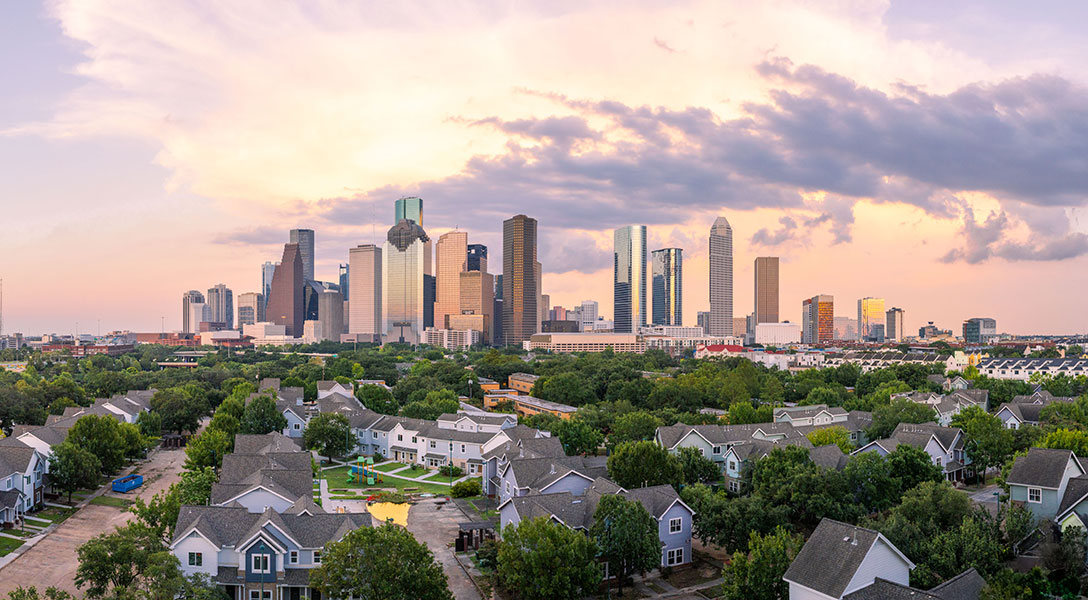
Is Houston’s decades-long growth spurt winding down?
Q. What drew your attention to the impact of demographics on public policy?
During the pandemic, I became obsessed with understanding COVID. It was as much a math problem as it was a medical problem. I pretty quickly realized, if you're going to understand something about epidemiology, you needed to understand something about demography.
Demographers had been talking for the past two or three decades about the fact that world population was about to top out, and that it will likely start declining in the second half of this century.
I thought that was kind of remarkable. [Former Stanford professor and environmentalist] Paul R. Ehrlich wrote the book Population Bomb [in 1968] and made such a huge impact on all of us. It was still kind of stuck in my mind. [The book predicted overpopulation leading to global famine.]
As I started bringing up population topping and talking to people about it, I found out that hardly anybody understands that we're in this truly unique demographic moment, and it has tremendous implications.
The work I do at the Baker Institute at Rice is on government finances, and demographics also have a huge impact on that.
Q. Among the nation’s large metros, Houston is one of the biggest and grew the fastest in 2025. How unusual is this kind of growth for such a large metro?
Texas metropolitan areas have been at the top, comparatively speaking, in the country for decades. Last year was really not that unusual. What was remarkably noteworthy is how much that growth slowed down from the year before. [The Houston–The Woodlands–Sugar Land metropolitan area gained 126,720 residents from 2024–25, 190,261 residents from 2023-24 and 181,361 residents from 2022–23, according to Census Bureau data.]
Relatively speaking, Texas, Houston and Dallas are all still doing very well. But it gets back to the fact that depopulation is a worldwide phenomenon. It's affecting everybody across the entire globe, and it's going to affect Texas, and it's already affecting us locally.
There has been a huge amount of international immigration into the Houston area for the last several years. It is responsible for the great majority of our population growth. And now, all of a sudden, we have a dramatic change at the federal level in immigration policy. We are beginning to see the results of that.
Q. If Texas metros are growing relatively slowly, what could change things?
I hate to be too certain about this, but look, there's only two ways to get population growth. One is that women start having more babies. [And that’s not] likely to be the case.
And the other is people moving into your area from some other place, and for the most part that's been people moving here from other countries. Right now, the U.S. is not in the mood to continue that, at least for the time being. It's hard to imagine how we're going to have robust population growth.
Texas has also been one of the beneficiaries of people moving here from other states. That really ramped up during the pandemic. We had incredibly high levels of domestic migration. But that has also collapsed over the past three years. Everything we see in the data indicates that we're going to be trending toward slower population growth.
Q. There's a difference in migration flows in the city of Houston and the greater metropolitan area. What’s the dynamic there?
Harris County, which is the principal county in this [metropolitan] area and where most of the cities are located, had negative domestic migration for the past decade. More people have been moving out of Harris County than moving into it. That has been masked by a huge influx of international immigration.
This is typical around the United States. Urban cores have not been growing very much, while the suburban rings around almost every city have been growing quite robustly.
The city of Houston's population hasn't changed significantly in the past decade. It's been stuck right around 2.3 million for about the past 10 years. There's been a little fluctuation up and down. If you look at the population of the city of Houston inside Loop 610 today, it's about the same as it was in 1960.
It doesn't seem intuitive. If you look around the westside and the Galleria, you see these big, tall high-rises going up and people all along Washington Avenue. It’s different if you get over to the neighborhoods on the south and eastside that back in the ’50s and ’60s and ’70s had block after block after block of tract houses—1,500 and 1,600 square feet with a mom and dad and three or four or five kids living there. That's disappeared.
When you go into those neighborhoods today, there are no children. It’s one of the reasons that the Houston Independent School District is suffering so much declining enrollment right now.
Q. Apart from school closures, what other effects are we seeing locally as a result of slower population growth?
I think there's been a lot of discussion about this being a big calamity. But there are some benefits. Traffic congestion is no longer a top three issue as it had been for 20 years. If you look at the travel speeds on the freeways in Houston, they've actually held up very well over the past three years. Now, some of that's the pandemic and the work-from-home phenomenon. It's also that we're just not constantly adding more people to what are already overstretched infrastructure systems.
For a place like Houston, where we built in a big hurry because it was growing so fast for so many decades, this is a little bit of a pause. It gives us a chance to catch up and fix some of the stuff that we didn't do well the first time around.
Q. If there’s less population growth, revenue growth for cities will slow. What are the consequences?
I think that's absolutely going to be the case; hopefully, there will be less demand for services as well. I think one of the challenges arises because this goes against the grain of so much of what we've been accustomed to for so long. I think changing our policy focus and getting it right is going to be really important.
For example, there's no need to build any new elementary school capacity in Harris County ever again. We have as many school-age children as we will ever have in Harris County unless a whole lot of immigrants come in from another country. Now, you might need to tear down an elementary school and replace it with a new building.
There's a study about building a new toll road on Hempstead Highway, out to the northwest [the U.S. 290 Corridor]. We're not going to need that either. There's not going to be the population there to support that. But when you look at models that people build, they always have some kind of population growth constant built in because that's all we've ever known.
Trying to change our mindset about this, making good policy decisions and good investment decisions going forward is going to be really important.
Q. If there's less growth including in the labor force, how are we going to continue to attract the kind of firms that have been moving to Texas and hiring here?
This is where we have this very interesting intersection of the revolution in technology of robotics and artificial intelligence, along with slowing population growth. The question, I think, is how are those two going to mesh up?
Economic growth is the sum of the change of population and the sum of the change in productivity. If the population growth goes to zero, but we're able to get big increases in productivity, we could still have economic growth without relying on population increases all the time.
We've had this demographic tailwind for decades. All of a sudden, we're not going to have it. It's going to force us to rely much more heavily on productivity.
Q. There are certain industries that are completely focused on a bigger population, like the construction industry and homebuilding. What happens to them?
I think they will transition to a replacement model. Obviously, things wear out and have to be replaced. So, there's going to be replacement, but there's not going to be growth. I spoke to the Greater Houston Homebuilders Association the other day. I explained to them that you're not going to see acres of new developments spreading out from Houston like we've had for all of our lifetimes.
There are not going to be any people to populate those areas. What you need to be focused on is how do we do infill? How do we go back and rebuild things?
Q. What’s going to become of the occupations that have traditionally relied on low-skilled immigrant labor? For example, we have a rapidly aging population that will increasingly rely on elder care.
The truth of the matter is that advanced economies like the United States need immigrants, and we're going to need more in the future. We've got to somehow figure out how we do that in a way that's not disruptive. I think there'll be a point in time when countries are actively competing for immigrants around the world.
But here's the thing that is important to understand: Immigration is a temporary solution. There is not an infinite global migrant stock. The birth rate in all Latin American countries is already at or below the replacement birth rate. In the past, [those countries] produced millions of people who flocked to America. It is not going to exist anymore because their populations are not going to be growing either.
The idea that there's always going to be an endless supply of immigrants coming into the United States is going to be sorely tested in the future.
Q. How do you see Houston 20 or 30 years from now given demographic trends?
I think the Houston region will be a little bit bigger than it is now, 10 to 20 percent bigger with regard to population. But it's not going to grow past that. If you look at the Houston-Galveston Area Council population projections, you’d believe it's going to be 50 percent bigger by 2050. That's just not going to happen.
I think it's going to be a larger area but not dramatically larger. I think almost all the growth is going to occur in the suburbs. It will also be a much older and a much more diverse population.
One of the most interesting phenomena to me is that the fastest-growing race/ethnic group right now is multi-race/multi-ethnic, people that have parents of a different race and/or ethnicity.
Houston is on the leading edge of all that. Houston is the most diverse city in the United States. We're one of the very few places in the world where there's not a [single] ethnic majority, and there hasn't been for quite a while.
This is an edited and abridged version of a conversation available on the Southwest Economy Podcast.