Texas Employment Forecast

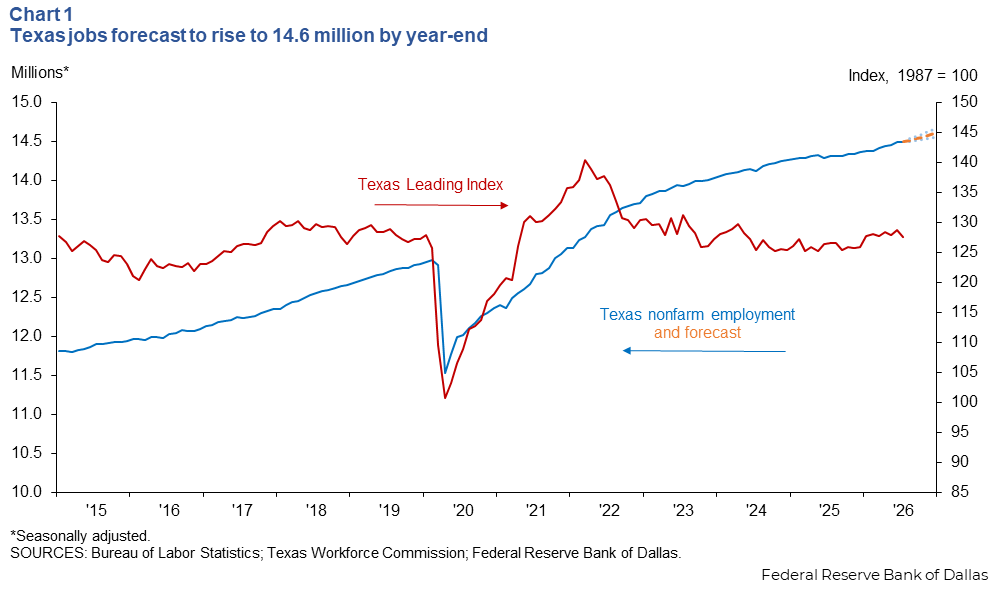
The Texas Employment Forecast indicates jobs will increase 1.7 percent in 2026, with an 80 percent confidence band of 1.3 to 2.1 percent. Based on an average of four models that include projected U.S. gross domestic product, oil futures prices and the Texas and U.S. leading indexes, the forecast implies 241,300 jobs will be added in the state this year, and employment in December 2026 will be 14.6 million (Chart 1).
Texas employment fell an annualized 0.1 percent in July, losing 1,480 jobs. Meanwhile, June employment growth was revised slightly down to 3.3 percent.
“Texas employment fell in July, bringing year-to-date job growth down to 1.6 percent—below the state’s long-run average of 2 percent. Nevertheless, Texas job growth has remained surprisingly strong given ongoing labor supply constraints,” said Luis Torres, Dallas Fed senior business economist.
“Job losses in July were concentrated in construction, financial activities and manufacturing. Additionally, government, information services and trade and transportation services recorded job losses. In contrast, professional and business services registered strong job gains, followed by education and health services, and leisure and hospitality. Other services and oil and gas also reported job gains.”
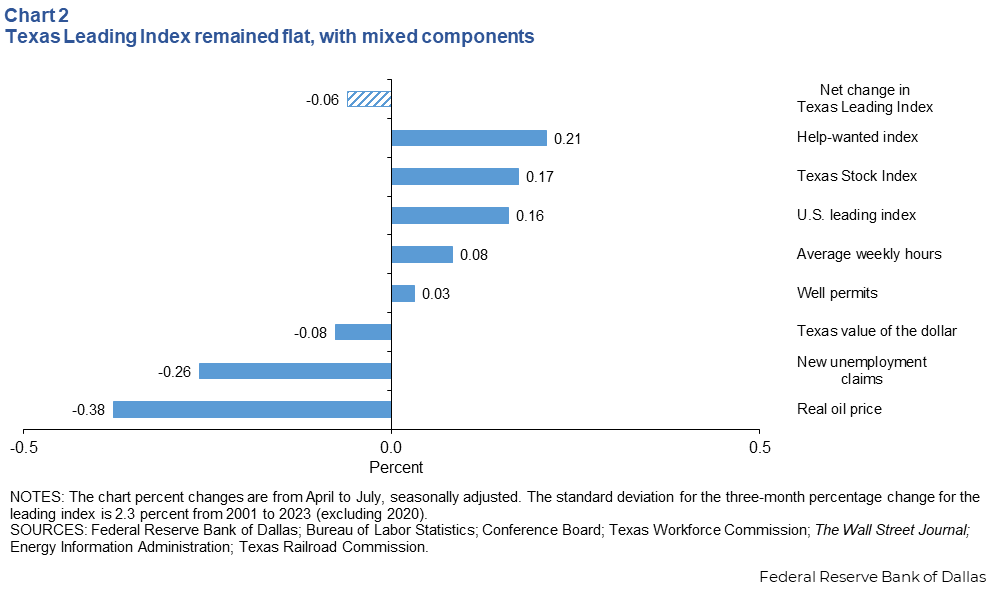
The Texas Leading Index remained flat over the three months ending in July, with mixed contributions across components (Chart 2). The index was pushed down by a decline in the real oil price and by increases in new unemployment claims and the Texas value of the dollar. Meanwhile, increases in the help-wanted index, the Texas stock index, the U.S. leading index, average weekly hours and well permits contributed positively to the overall index.
Next release: Sept. 18
Methodology
The Dallas Fed’s Texas Employment Forecast projects job growth for the calendar year and is estimated as the 12-month change in payroll employment from December to December.
The forecast incorporates early benchmarked Texas employment data and is based on the average of four models. Three models are vector autoregressions for which Texas payroll employment is regressed on the lags of West Texas Intermediate (WTI) oil prices, the U.S. leading index and the Texas Leading Index. The fourth model is an autoregressive distributed lag model with regression of payroll employment on lags of payroll employment, current and lagged values of U.S. GDP growth and WTI oil prices, and Texas COVID-19 hospitalizations through March 2023. Forecasts of Texas payroll employment from this model also use forecasts of U.S. GDP growth from Blue Chip Economic Indicators and WTI oil price futures as inputs. All models include four COVID-19 dummy variables (March–June 2020).
Learn more about the Texas Employment Forecast.
Contact Information
For more information about the Texas Employment Forecast, contact Luis Torres at luis.torres@dal.frb.org.