Banking Conditions Survey


For this survey, Eleventh District banking executives were asked supplemental questions on credit standards and loan demand. Read the special questions results.
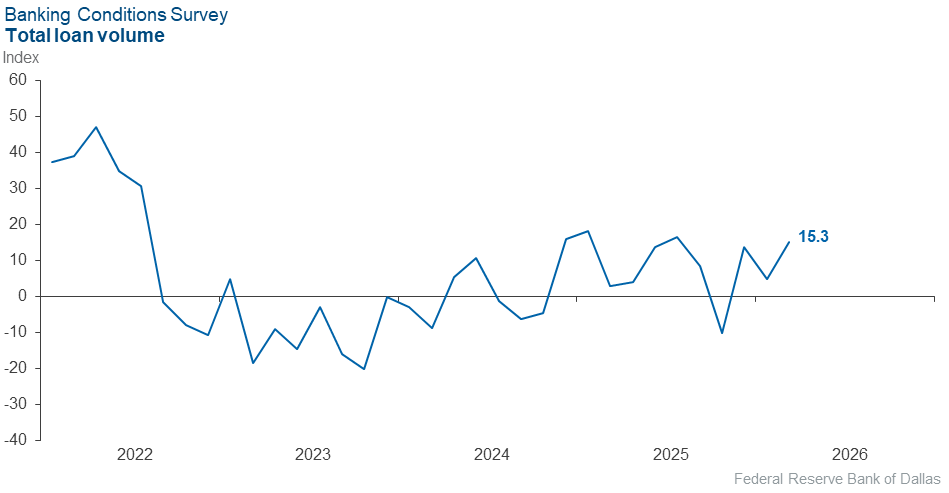
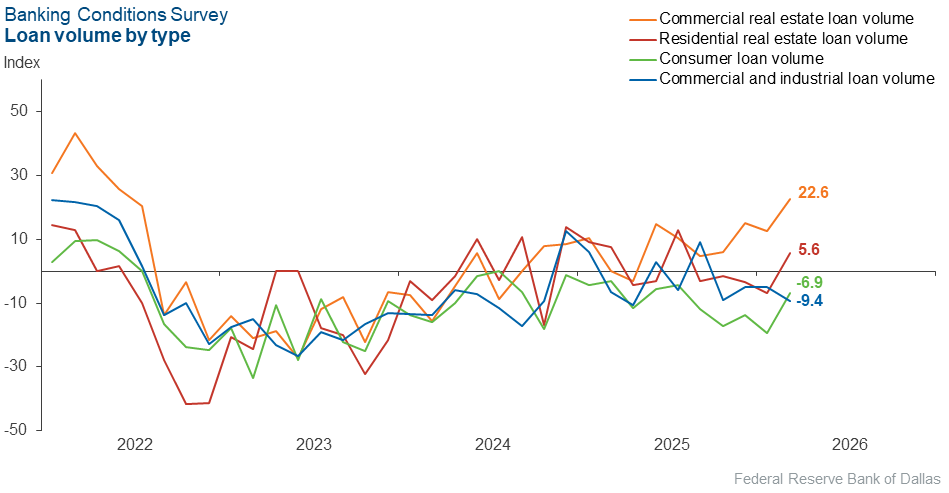
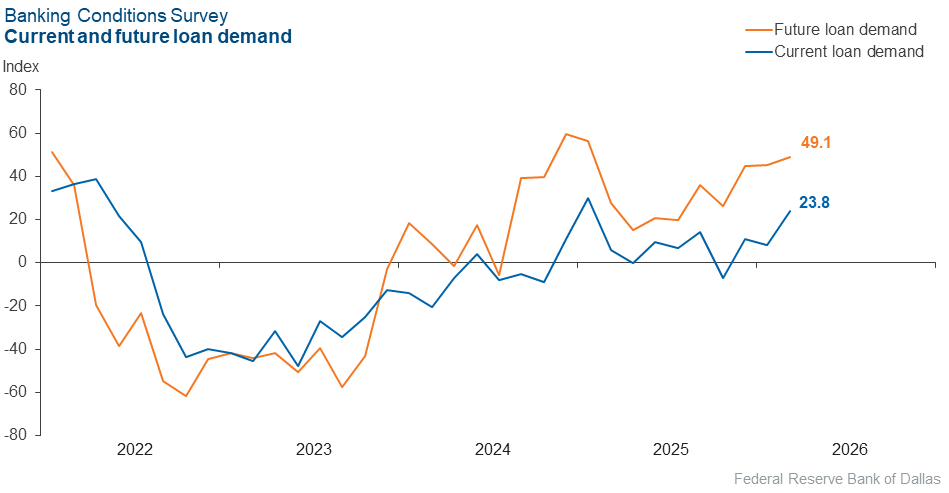
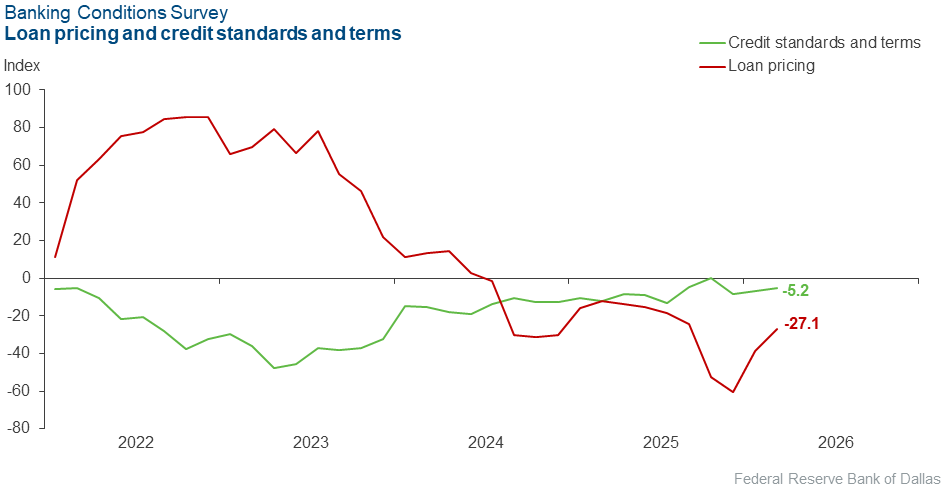
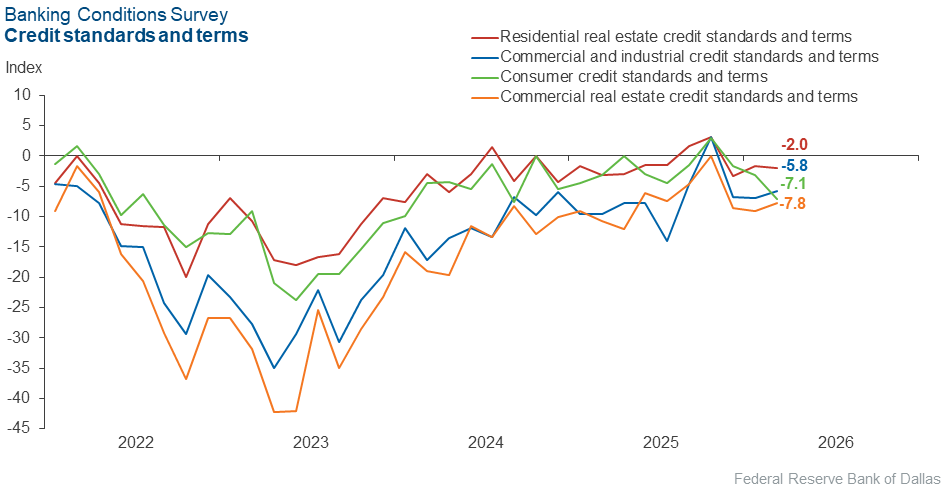
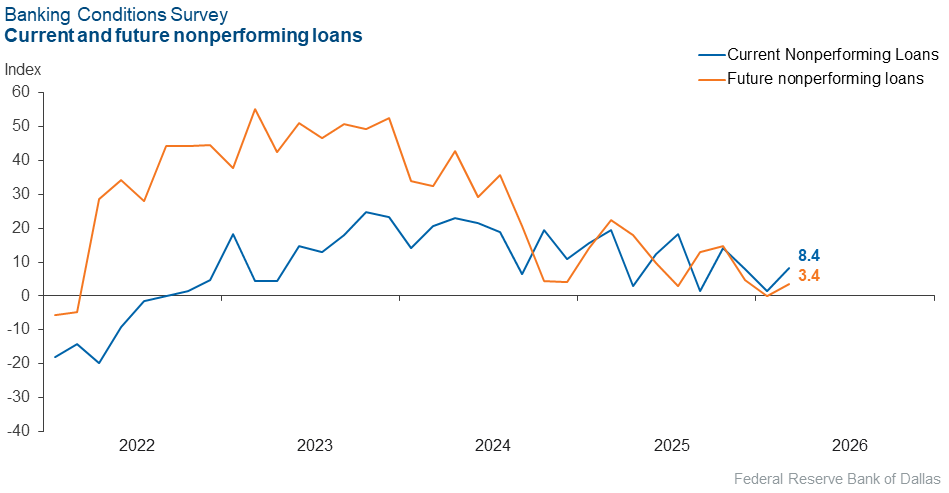
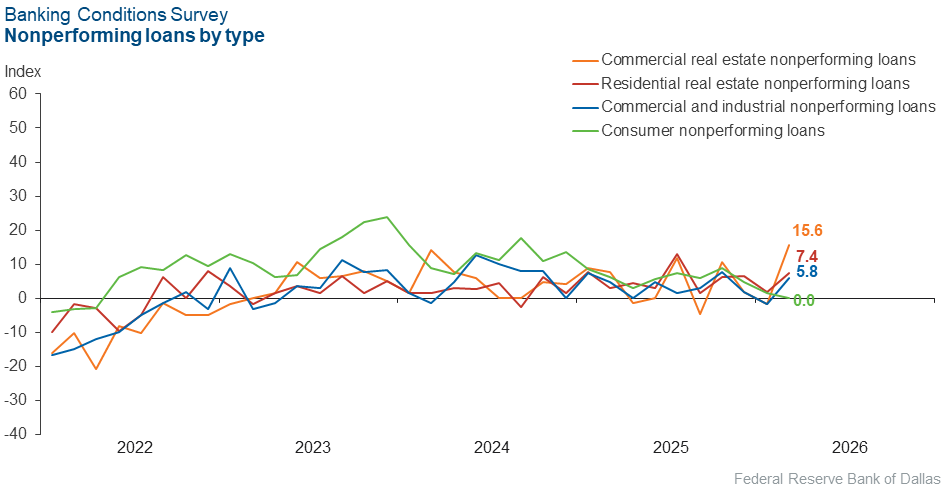
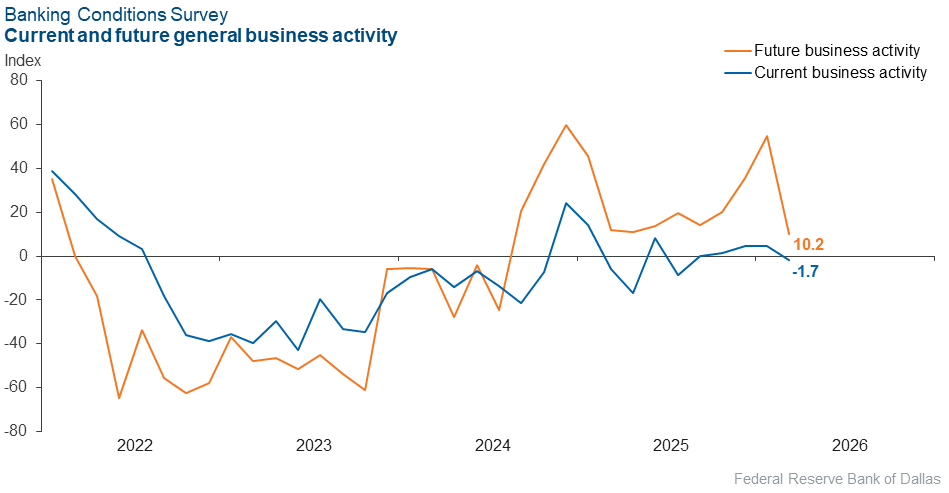
Loan volume and demand notably accelerated in March. The upward momentum was driven by real estate loans, especially commercial real estate. Credit standards and terms tightened slightly, but loan pricing continued to decline. Overall loan performance deteriorated. Bankers reported slight declines in general business activity. Outlooks were a bit less optimistic overall than the prior survey. Survey respondents still expect growth in loan demand and business activity six months from now but also expect worsening loan performance.
Next release: May 18, 2026
Data were collected March 17–25, and 59 financial institutions responded to the survey. The Federal Reserve Bank of Dallas conducts the Banking Conditions Survey twice each quarter to obtain a timely assessment of activity at banks and credit unions headquartered in the Eleventh Federal Reserve District. CEOs or senior loan officers of financial institutions report on how conditions have changed for indicators such as loan volume, nonperforming loans and loan pricing. Respondents are also asked to report on their banking outlook and their evaluation of general business activity.
Survey responses are used to calculate an index for each indicator. Each index is calculated by subtracting the percentage of respondents reporting a decrease (or tightening) from the percentage reporting an increase (or easing). When the share of respondents reporting an increase exceeds the share reporting a decrease, the index will be greater than zero, suggesting the indicator has increased over the prior reporting period. If the share of respondents reporting a decrease exceeds the share reporting an increase, the index will be below zero, suggesting the indicator has decreased over the prior reporting period. An index will be zero when the number of respondents reporting an increase is equal to the number reporting a decrease.
Results summary
Historical data are available from March 2017.
| Total Loans: Over the past six weeks, how have the following changed? | |||||
| Indicator | Current Index | Previous Index | % Reporting Increase | % Reporting No Change | % Reporting Decrease |
Loan volume | 15.3 | 4.9 | 40.7 | 33.9 | 25.4 |
Loan demand | 23.8 | 8.2 | 42.4 | 39.0 | 18.6 |
Nonperforming loans | 8.4 | 1.6 | 18.6 | 71.2 | 10.2 |
Loan pricing | –27.1 | –38.4 | 3.4 | 66.1 | 30.5 |
| Indicator | Current Index | Previous Index | % Reporting Eased | % Reporting No Change | % Reporting Tightened |
Credit standards and terms | –5.2 | –6.9 | 1.7 | 91.4 | 6.9 |
| Commercial and Industrial Loans: Over the past six weeks, how have the following changed? | |||||
| Indicator | Current Index | Previous Index | % Reporting Increase | % Reporting No Change | % Reporting Decrease |
Loan volume | –9.4 | –5.1 | 13.2 | 64.2 | 22.6 |
Nonperforming loans | 5.8 | –1.7 | 7.7 | 90.4 | 1.9 |
| Indicator | Current Index | Previous Index | % Reporting Eased | % Reporting No Change | % Reporting Tightened |
Credit standards and terms | –5.8 | –7.0 | 1.9 | 90.4 | 7.7 |
| Commercial Real Estate Loans: Over the past six weeks, how have the following changed? | |||||
| Indicator | Current Index | Previous Index | % Reporting Increase | % Reporting No Change | % Reporting Decrease |
Loan volume | 22.6 | 12.5 | 35.8 | 50.9 | 13.2 |
Nonperforming loans | 15.6 | –1.8 | 17.6 | 80.4 | 2.0 |
| Indicator | Current Index | Previous Index | % Reporting Eased | % Reporting No Change | % Reporting Tightened |
Credit standards and terms | –7.8 | –9.1 | 2.0 | 88.2 | 9.8 |
| Residential Real Estate Loans: Over the past six weeks, how have the following changed? | |||||
| Indicator | Current Index | Previous Index | % Reporting Increase | % Reporting No Change | % Reporting Decrease |
Loan volume | 5.6 | –6.9 | 24.1 | 57.4 | 18.5 |
Nonperforming loans | 7.4 | 1.7 | 9.3 | 88.9 | 1.9 |
| Indicator | Current Index | Previous Index | % Reporting Eased | % Reporting No Change | % Reporting Tightened |
Credit standards and terms | –2.0 | –1.7 | 0.0 | 98.0 | 2.0 |
| Consumer Loans: Over the past six weeks, how have the following changed? | |||||
| Indicator | Current Index | Previous Index | % Reporting Increase | % Reporting No Change | % Reporting Decrease |
Loan volume | –6.9 | –19.3 | 13.8 | 65.5 | 20.7 |
Nonperforming loans | 0.0 | 1.6 | 8.6 | 82.8 | 8.6 |
| Indicator | Current Index | Previous Index | % Reporting Eased | % Reporting No Change | % Reporting Tightened |
Credit standards and terms | –7.1 | –3.2 | 1.8 | 89.3 | 8.9 |
| Banking Outlook: What is your expectation for the following items six months from now? | |||||
| Indicator | Current Index | Previous Index | % Reporting Increase | % Reporting No Change | % Reporting Decrease |
Total loan demand | 49.1 | 45.2 | 59.3 | 30.5 | 10.2 |
Nonperforming loans | 3.4 | 0.0 | 22.4 | 58.6 | 19.0 |
| General Business Activity: What is your evaluation of the level of activity? | |||||
| Indicator | Current Index | Previous Index | % Reporting Better | % Reporting No Change | % Reporting Worse |
Over the past six weeks | –1.7 | 4.8 | 23.7 | 50.8 | 25.4 |
Six months from now | 10.2 | 54.8 | 33.9 | 42.4 | 23.7 |
Survey participants are given the opportunity to submit comments on current issues that may be affecting their businesses. Some comments have been edited for grammar and clarity.
- It’s imperative that the stabilization of the price of oil occurs quickly (30 to 60 days) so that it doesn’t create a long-term economic drain on businesses and consumers.
- There is a tremendous amount of uncertainty in the economy at the moment. It is difficult for customers to have a positive business attitude. The partisan politics, spiking energy cost, international conflict, uncertainty at the Federal Reserve due to political pressure all add to an economic decision stagnation. Some stability on some fronts would be helpful to grow this economy.
- Recent events in Iran and surrounding countries have created uncertainty in the domestic economy while dramatically increasing the price of fuel. Persistent personal consumption expenditures reports above 2.5 percent make it difficult to determine what the Federal Open Market Committee will do in the short term.
- Loan demand has been increasing due to a major project in the Monroe market. Commercial loan nonperformance seems to have leveled out. Consumer, residential real estate and consumer nonperformance are increasing. We will plan to tighten underwriting and hold rates due to liquidity pressure on the balance sheet.
- We are seeing some opportunities for commercial real estate and commercial and industrial lending in some of our markets. All of our commercial customers are now wanting floating rate loans in anticipation of continued rate cuts. I am not so optimistic because of inflation pressures associated with oil and gas due to the Iran conflict.
Historical data can be downloaded dating back to March 2017. For the definitions, see data definitions.
NOTE: The following series were discontinued in May 2020: volume of core deposits, cost of funds, non-interest income and net interest margin.
Questions regarding the Banking Conditions Survey can be addressed to Mariam Yousuf at mariam.yousuf@dal.frb.org.
Sign up for our email alert to be automatically notified as soon as the latest Banking Conditions Survey is released on the web.