
Surveys

Special Questions

Texas Business Outlook Surveys
March 30, 2026

Special Questions

For this month’s survey, Texas business executives were asked supplemental questions on wages, prices and outlook concerns. Results below include responses from participants from both the Texas Manufacturing Outlook Survey and Texas Service Sector Outlook Survey.

Texas Business Outlook Surveys

Data were collected March 17–25, and 315 Texas business executives responded to the surveys.

1a. What percent change in wages, input prices and selling prices did your firm experience over the past 12 months?

Wage growth held steady while price growth accelerated. Texas firms surveyed report wage growth of 3.5 percent over the past 12 months, on average, 4.3 percent growth in input prices and 2.7 percent growth in selling prices. The recent pickup in price growth is largely driven by the manufacturing sector.
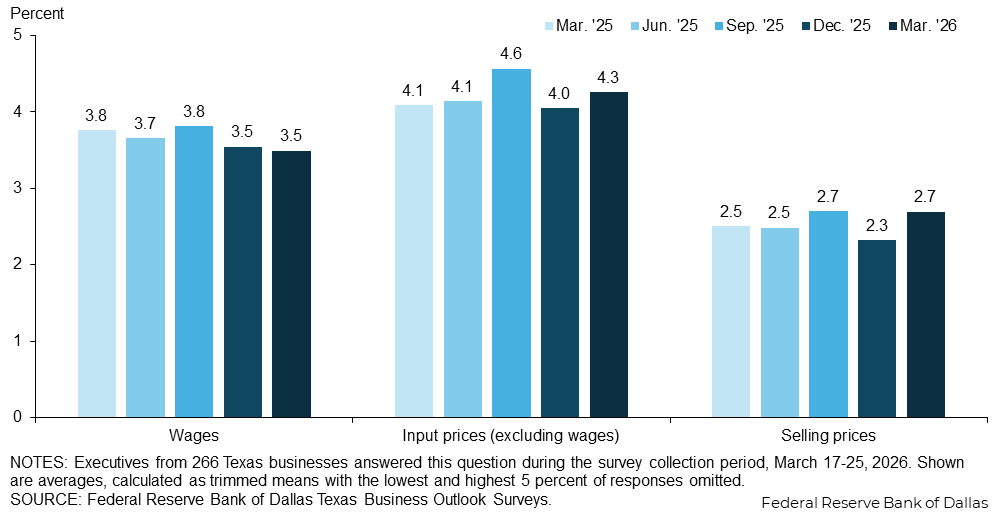
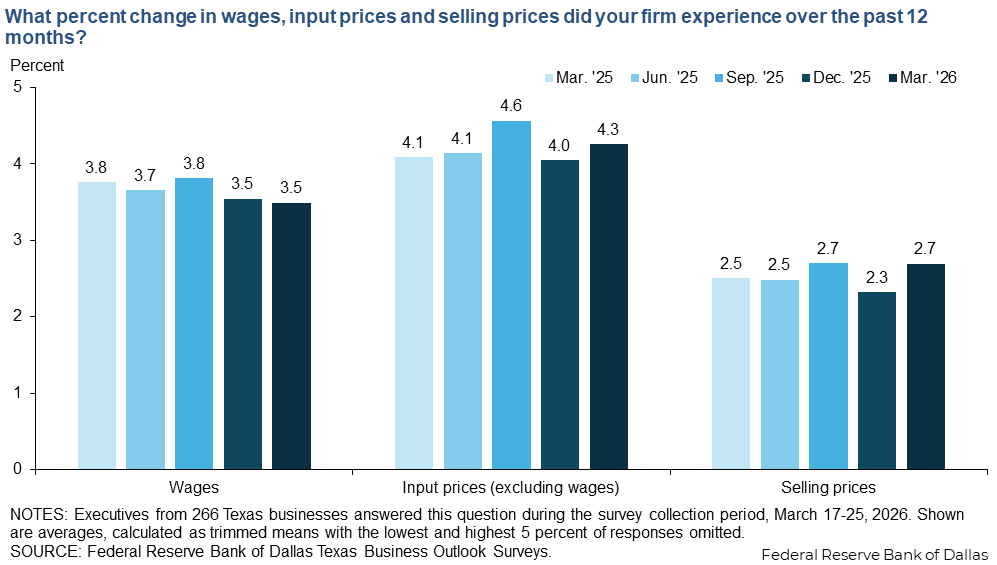
Chart 1
1b. What percent change in wages, input prices and selling prices do you expect over the next 12 months?

Wage growth expectations continued to ease while price growth expectations reversed trend and moved up. Texas firms surveyed expect wages to increase 3.1 percent over the next 12 months, on average. They expect input prices to increase 3.9 percent and selling prices to increase 2.8 percent. The pickup in expectations for input price growth was broad based across sectors, while the uptick in expectations for selling price growth was limited to the manufacturing sector.
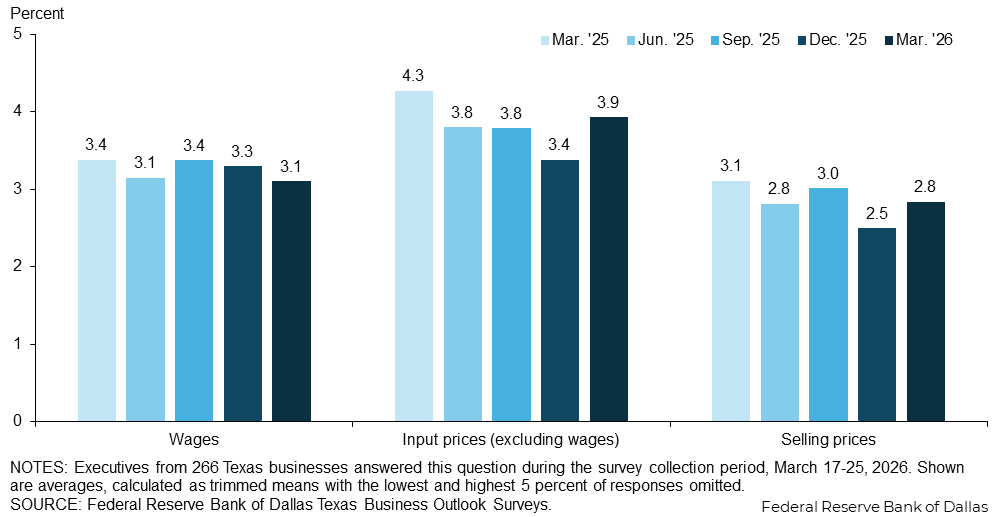
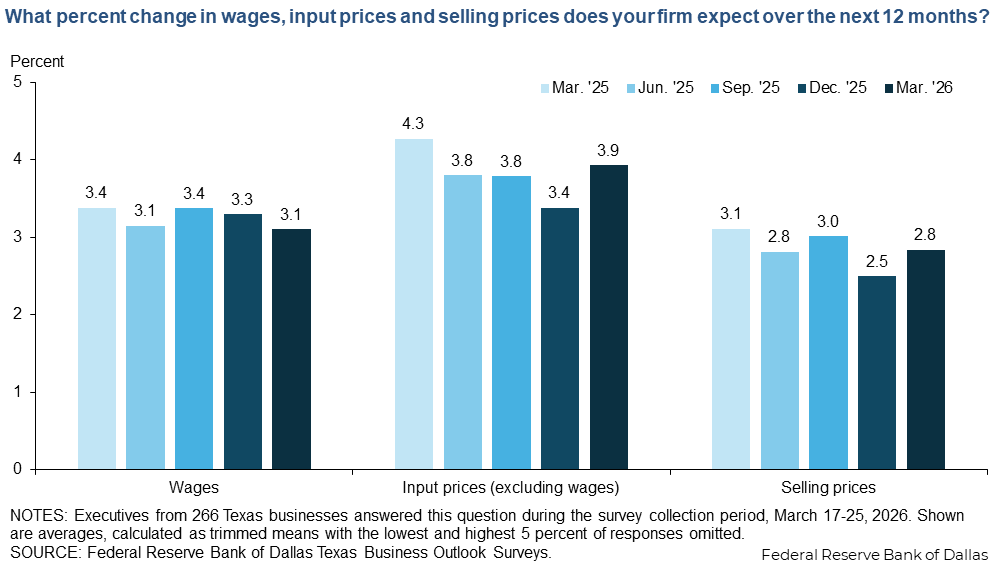
Chart 2
2. What are the primary concerns around your firm's outlook over the next six months, if any? Please select up to three.

Geopolitical uncertainty became the top outlook concern among Texas firms surveyed, and the share citing it as a top-three concern jumped to 57 percent. Demand and inflation remained high on the list of outlook concerns. The share of firms citing supply-chain disruptions rose notably in March, to 18 percent. Among manufacturers the share was higher, 32 percent.
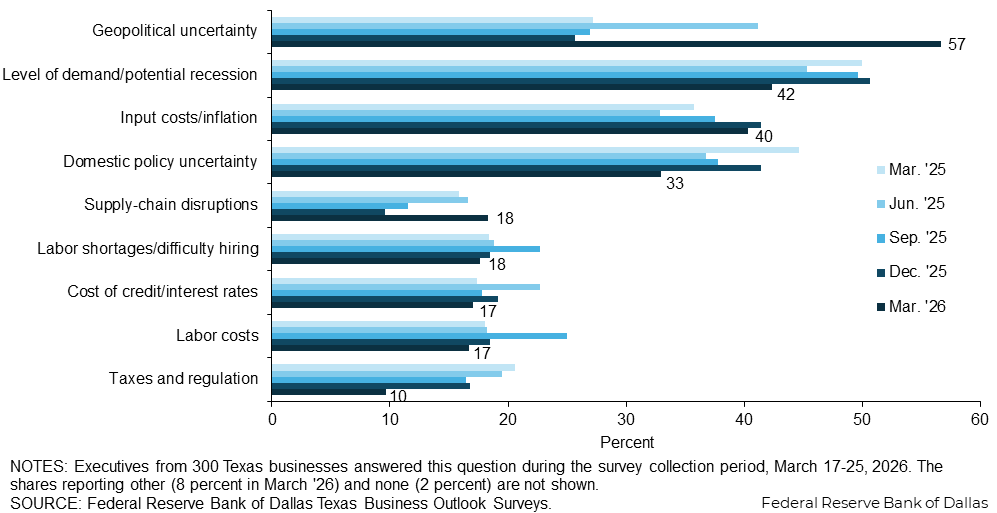
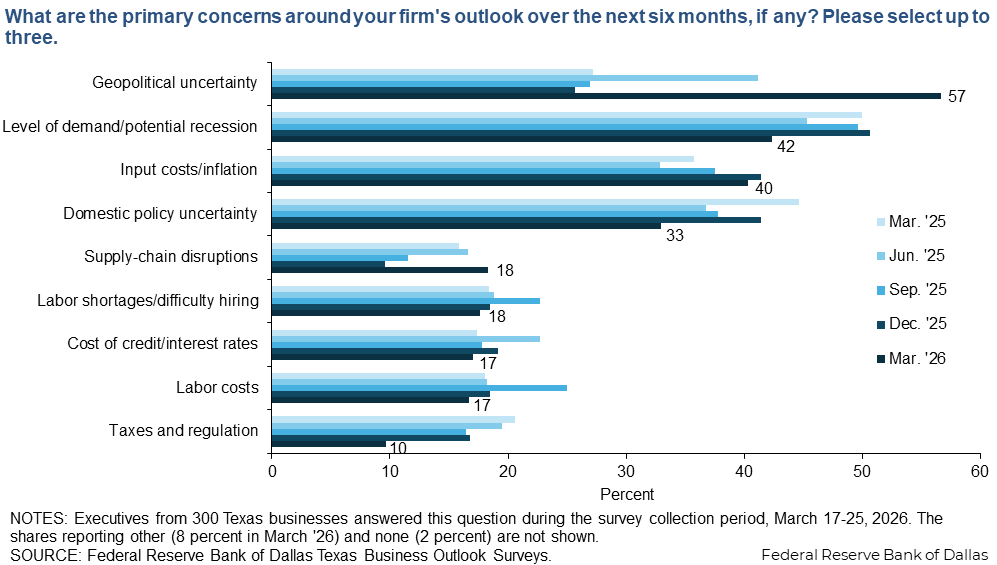
Chart 3

Survey respondents were given the opportunity to also provide comments, which can be found in the Comments tab above.

Texas Manufacturing Outlook Survey

Data were collected March 17–25, and 78 Texas manufacturers responded to the survey.

1. What percent change in wages, input prices and selling prices did your firm experience over the past 12 months, and what do you expect over the next 12 months?
  Jun. '25
(percent)
Sep. '25
(percent)
Dec. '25
(percent)
Mar. '26
(percent)
  Past 12 months Next 12 months Past 12 months Next 12 months Past 12 months Next 12 months Past 12 months Next 12 months
Wages 3.3 3.1 3.8 3.2 3.4 3.3 3.9 3.4
Input prices (excluding wages) 5.5 4.5 5.8 4.2 5.5 4.1 6.0 4.5
Selling prices 3.0 3.7 3.8 3.8 2.7 2.7 3.9 3.7

NOTES: 70 responses. Shown are averages, calculated as trimmed means with the lowest and highest 5 percent of responses omitted.

2. What are the primary concerns around your firm’s outlook over the next six months, if any? Please select up to three.
  Dec. '24
(percent)
Mar. '25
(percent)
Jun. '25
(percent)
Sep. '25
(percent)
Dec. '25
(percent)
Mar. '26
(percent)
Level of demand/potential recession 37.5 50.0 47.9 50.0 53.6 49.3
Geopolitical uncertainty 35.0 30.0 43.8 31.8 30.4 49.3
Input costs/inflation 37.5 43.8 45.2 45.5 46.4 44.0
Supply-chain disruptions 20.0 17.5 30.1 19.7 17.4 32.0
Domestic policy uncertainty 45.0 40.0 27.4 40.9 39.1 29.3
Labor shortages/difficulty hiring 22.5 18.8 17.8 22.7 18.8 21.3
Labor costs 25.0 15.0 13.7 27.3 17.4 16.0
Cost of credit/interest rates 13.8 10.0 13.7 10.6 13.0 13.3
Taxes and regulation 16.3 23.8 23.3 12.1 11.6 9.3
Other 8.8 15.0 11.0 7.6 7.2 4.0
None 2.5 2.5 0.0 1.5 2.9 2.7

NOTES: 75 responses.

Survey respondents were given the opportunity to also provide comments, which can be found in the Comments tab above.

Texas Service Sector Outlook Survey

Data were collected March 17–25, and 237 Texas business executives responded to the survey.

1. What percent change in wages, input prices and selling prices did your firm experience over the past 12 months, and what do you expect over the next 12 months?
  Jun. '25
(percent)
Sep. '25
(percent)
Dec. '25
(percent)
Mar. '26
(percent)
  Past 12 months Next 12 months Past 12 months Next 12 months Past 12 months Next 12 months Past 12 months Next 12 months
Wages 3.8 3.2 3.8 3.4 3.6 3.3 3.4 3.0
Input prices (excluding wages) 3.8 3.6 4.2 3.7 3.7 3.1 3.7 3.7
Selling prices 2.3 2.5 2.4 2.8 2.2 2.4 2.3 2.5

NOTES: 196 responses. Shown are averages, calculated as trimmed means with the lowest and highest 5 percent of responses omitted.

2. What are the primary concerns around your firm’s outlook over the next six months, if any? Please select up to three.
  Dec. '24
(percent)
Mar. '25
(percent)
Jun. '25
(percent)
Sep. '25
(percent)
Dec. '25
(percent)
Mar. '26
(percent)
Geopolitical uncertainty 21.8 26.3 40.4 25.6 24.2 59.1
Level of demand/potential recession 32.5 50.0 44.6 49.6 49.8 40.0
Input costs/inflation 34.5 33.1 29.2 35.3 39.9 39.1
Domestic policy uncertainty 33.3 46.2 39.6 37.0 42.2 34.2
Cost of credit/interest rates 24.6 19.9 25.4 19.7 21.1 18.2
Labor costs 30.2 19.1 19.6 24.4 18.8 16.9
Labor shortages/difficulty hiring 25.0 18.2 19.2 22.7 18.4 16.4
Supply-chain disruptions 9.5 15.3 12.5 9.2 7.2 13.8
Taxes and regulation 25.0 19.5 18.3 17.6 18.4 9.8
Other 6.0 6.8 7.1 7.1 6.7 8.9
None 2.4 1.7 1.7 3.4 2.7 2.2

NOTES: 225 responses.

Survey respondents were given the opportunity to also provide comments, which can be found in the Comments tab above.

Special Questions Comments

Survey participants are given the opportunity to submit comments. Some comments have been edited for grammar and clarity.

Texas Manufacturing Outlook Survey
Beverage and tobacco product manufacturing
  • It is impossible to forecast what is going to happen because of our erratic foreign policy. I am highly concerned about long-lasting energy disruptions or worse. The cost of the war in Iran is also concerning at a time when one of my largest fears is the size of our debt and deficit.
Chemical manufacturing
  • Oil and gas pricing will be a significant impact on raw material inputs.
Computer and electronic product manufacturing
  • We expect to see higher input costs due to the increased cost of diesel fuel. Our bigger concern is an unpredictable supply-chain disruption for raw materials due to events in the Middle East. We don’t expect to see a significant drop in demand, but this could change if high oil prices persist and the economy goes into a recession and companies reduce research and development spending as a way to conserve cash.
Food manufacturing
  • Domestic and international policy are major concerns.
Machinery manufacturing
  • More trade and fewer wars, please.
  • Tariffs and the renegotiation of the USMCA [are issues of concern].
Miscellaneous manufacturing
  • We’re a direct-to-consumer business in private-pay healthcare with a primarily elderly audience. Our customers tend to show economic stress first, and we’re seeing those signs in our purchases.
Printing and related support activities
  • War disruption is causing an unstable situation.
Texas Service Sector Outlook Survey
Accommodation
  • It is difficult to raise prices in a stagnant market, but the increases in costs just keep coming.
Administrative and support services
  • Wages are decreasing due to variable compensation decreasing—jobs are not closing, therefore recruiters are not earning commissions. Compensation plans are tightened for 2026 because of the uncertainty. We are trying not to lay off recruiters. Input prices are going up primarily due to technology costs increasing.
Credit intermediation and related activities
  • The economic environment is somewhat unstable, creating negative sentiment for businesses and consumers.
Food services and drinking places
  • It feels like things are picking up a bit, although the Iran situation put a halt on new activity. It seems that if [interest] rates came down a bit we would see investment start to pick up.
  • Labor and input costs continue to increase, but we have little to no elasticity to increase our selling prices to customers. Customer traffic remains flat. It is hard to raise prices. Weak back-to-office [is a concern] and business travel remains depressed.
Professional, scientific and technical services
  • Labor shortages continue in the architectural field, and wage pressures are increasing rapidly. Wage demands are not based on the local market but on averages of salary postings on a nationwide scale. This presents a real challenge on small market employers’ operating margins.
  • We see early warning signs in this cycle that infrastructure demand is being pulled up to the first half of the year, as we’re seeing more irregular and high value proposal activity than we have ever seen. Even with a robust backlog in the second half of the year, those projects can either get delayed or canceled. We are seeing a few cancellations and a more cautious construction environment by fourth quarter of this year.
  • Inflation for energy processing equipment [is an issue of concern], as demand will go up if the Iran war ends.
  • I feel we will experience short-term uncertainty and supply disruption that will sort itself out before the end of the calendar year. New opportunities will open up following the conflict, and prices will stabilize and then fall slightly, generally. Economic activity will pick up to replenish hardware after the conflict ends, and the U.S. will be calling the shots worldwide.
  • Business will certainly benefit from a more consistent economy and less conflict worldwide.
  • I can't yet predict the next 12 months due to a lack of clear and rational federal government “policy.”
  • It seems like we are seeing some constriction in the market. It is a combination of uncertainty going forward and still working through post-Covid overbuilding. I think a small recession is in the works.
  • Business needs consistent and predictable government policy. We appear to currently have none as a nation, regardless of which party is in power.
Rental and leasing services
  • No one likes uncertainty, and if war is anything it is that. 
Utilities
  • The war has driven uncertainty in our business.
Warehousing and storage
  • Global uncertainty with the war in Iran is a primary concern at the moment, both with crude oil movements, but also potential supply-chain disruptions and heightened security concerns.
Food services and drinking places
  • I expect inflation in input prices to remain a major concern, notwithstanding political pressure to lower rates. In my opinion, the cost of capital is currently at a balanced, reasonable, long-term sustainable level, and lowering interest rates would serve to both fuel inflation and inflate asset prices with the flow of cheaper money.
Merchant wholesalers, nondurable goods
  • Because oil touches so many facets of our economy, it’s inevitable that if oil prices stay high, it will lead to higher raw materials and finished goods prices. I also believe that as we diminish our stockpiles of military hardware (missiles), we are opening the door for China to invade Taiwan. If we think high oil costs are bad, wait until we don’t have any semi-conductor chips to power our technology.
Motor vehicle and parts dealers
  • Tariffs continue to hurt our industry and require our manufacturers to use incentives sparingly.
  • Our business does best when consumers feel good about the economy. The current administration has created so much damage and uncertainty that it will be years before business returns to normal. It is possible it might never return to normal.
Nonstore retailers
  • Hiring qualified candidates continues to be a serious problem for us, especially hiring truck drivers. If the administration pulls foreign truck drivers from the pool of available drivers, that will tighten the market for CDL (commercial driver’s license) drivers.

Questions regarding the Texas Business Outlook Surveys can be addressed to Emily Kerr at emily.kerr@dal.frb.org.

Sign up for our email alert to be automatically notified as soon as the latest surveys are released on the web.