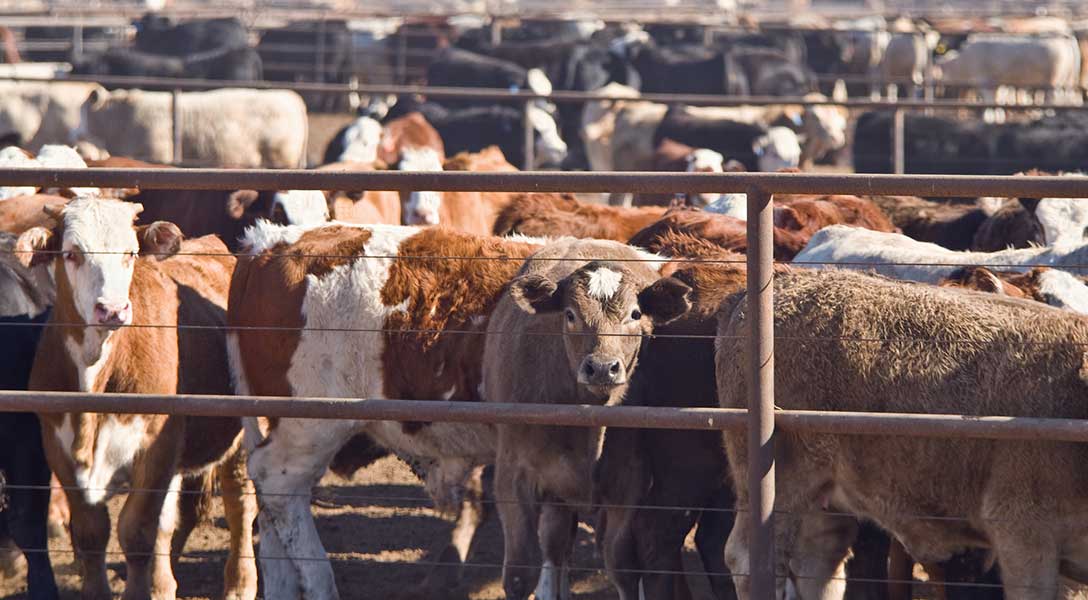
Trader remains bullish on cattle despite economic, contagion threats
Q. How are Texas farmers and ranchers navigating rising fuel and fertilizer costs and tariffs?
The tariff issue has affected the livestock industry, primarily the imports from Brazil and Mexico. Brazil and Australia are our two big import partners that [support] the beef industry within the United States.
And with the very large tariffs that were put in 12, 14 months ago—Brazil's were around 10 percent and went as high as 80 percent [although] some of that has been reduced—it has led to some of the spikes that we've seen predominantly in beef prices.
Now, the petroleum issue and the high cost of diesel has affected every product, not just the beef industry. It has affected me personally. Our company uses about 4,000 trucks a year. Each load just went up by $400 to $600 to transport our live cattle. But that [cost increase] goes for any trucking company, whether it be Walmart or Amazon, any that use a lot of diesel.
Q. How has drought affected the sector?
People want to talk about the immediate drought. The drought has really been going on for four to five years, and we've seen a reduction in herds. We're at the lowest number of cattle that we've had since the 1950s.
You know, we all talk about the rain issue, but it's water in general [and groundwater in particular]. So yes, drought is an issue. We're seeing streams that have run for a long, long time—even during droughts—not running anymore. And a lot of it is the [dwindling] amount of groundwater adding to the drought issue.
Q. Texas dominates the U.S. cattle industry and accounts for a significant portion of the nation's beef production. What long-run challenges does the industry face?
Everybody wants to talk about drought, but gentrification is a huge part of where we are today. People are aging out of our industry, and we're not replacing them with young people. It's not sexy to be in the agriculture industry, and a lot of people don't think that you can make a lot of money.

In most areas, land prices are just pricing out anybody who wants to actually run agriculture. We're taking 10,000-acre ranches and cutting them up to 1,000 acres, and 1,000 acres into 100 acres, and 100 acres into 10 acres.
The golden triangle of the cattle industry in the state of Texas was between San Antonio, Houston and Austin. We used to run more cattle in that area than any place in the United States. Land is bringing $7,000, $10,000, $15,000, $20,000 an acre. You cannot run agriculture on those places. And with that gentrification, people are selling their property because their kids don't want to be involved. That's their cash cow.
Q. On the supply side, are we not producing a sufficient number of animals?
We are producing more beef with a lot less cattle than we've ever done before. You know, we're raising cattle now to 1,500 and 1,600 pounds. We never saw that before. But as we've shrunk the number of cattle, we have increased the genetics of the cattle substantially. And the industry has done a very good job trying to keep up with demand for beef, but [the price of] beef in some places is higher than lobster now. You could call it a premium product. The closure of the southern border [for screwworm control] has probably added 20 percent to the value of our cattle here in the United States because that was 1.2 million cattle [kept from the U.S. market].
Q. What exactly is the screwworm and why is it such a problem?
The New World screwworm is a fly that lays its eggs on any living mammal’s wounds. It is attracted to blood and any open wound. And that includes humans, dogs, cats, hogs, turkeys, birds [and] obviously beef animals. We had it in the ’60s, ’70s and in the early ’50s in the United States, and it was fairly rampant. It was catastrophic for pretty much any animal that got it.
The state of Texas did not have very many deer back in the ’50s, ’60s and ’70s. Now, they're very prolific. [The smaller population] was because of the screwworm. We didn't have a feral hog problem back then because of the screwworm.
Q. What was the thinking behind the decision to close the border?
They [federal officials] shut down the border for cattle crossing into the United States in November of 2024 because they didn't feel the Mexican government was taking the New World screwworm seriously. They were concerned that with the transportation of animals across the border, we would not be able to monitor the screwworm and keep it from coming into Texas.
But the primary reason for shutting the border down was to send a signal to Mexico to say, “Y'all need to get a little more serious about this problem, because it is a major issue.” Finally, it worked. They are working with us on different ways to shut down a perimeter before they [flies carrying the screwworm] get to the Texas border.
Q. How has the screwworm threat affected the cattle market?
There are six or seven ports [of entry] where we used to bring cattle in, from Arizona all the way down through Texas to Laredo. With the screwworm issue, they [federal authorities] shut the border down. It shut down a supply of cattle to not only South Texas, but to all of the South Plains.
We heavily relied on that 1.2 million head of [Mexican] cattle. We kill 550,000 cattle a week in the United States. When you think about that, that's two to two-and-a-half weeks’ worth of production. It is very substantial, especially when you are talking about a commodity.
Those cattle would come through the ports and make their way to the Texas Panhandle, and most of them would be put straight on feed in the feed lots in the South Plains of Texas and then would be raised to 1,200 to 1,400 pounds.
When you talk about a carcass-weight of 500 pounds of meat per animal times 1.2 million cattle, you get an idea of how impactful that was to the beef industry.
Q. Many residents today weren’t around during the last screwworm outbreak, almost 50 years ago in Texas. How prepared is the industry to cope with an outbreak?
We don't have enough labor in the cattle industry anymore to treat the calves. So, we would have to use a preventative that hopefully is oral, that we can feed our cattle on a regular basis.
But the biggest issue is the calves when they hit the ground [and are born]. And one of the things that I've heard several people talk about is that instead of a spring calving program, going to a winter calving program because the screwworm, normally during winter, gets pushed back [south of the border] because it doesn't like the temperatures under 40 degrees.
As far as being able to deal with it, if it gets here, no, we're not prepared. If it escalates very rapidly, which I don't think it will, the amount of wildlife will be the biggest issue. One thing I will say is, technology wise, there are a lot of people working on this, and we have technology that we did not have 50 years ago.
Q. Assuming that we can stop the screwworm and can reopen the southern border, will things go back to how they were before?
In my opinion, and in the opinion of several of my colleagues, no.
A guy gave me a good example of why. If you turn your water off long enough and you have a water break, you just don't turn the spigot back on and expect the water to come back.
Let's say they announced tomorrow that they're going to open one of these ports [of entry], you've lost all of your employees that worked in those areas 24 months ago. They went on and found new jobs.
Everything has been just sitting there, not being used. Stuff starts to disappear. I think Mexico has started to develop its own industry over there [rather than ship livestock to Texas feedlots].
They have cheaper labor. They have fewer restrictions. They're building another packing plant in Mexico. They're building feed yards in Mexico. I don't ever think we'll get back to the million to 1.2 million cattle coming across here into the United States ever again. They're selling their meat to China. They're selling their meat to other areas in the United States. They are working to develop their own industry now.
Q. Are you bullish or bearish about the future of the cattle industry in Texas?
Anytime you're in a commodity industry, there are shocks that you get on a daily basis. We have to deal with it. The commodity industry works on such slim margins.
Most people do not realize how slim margins are. Last year, we did $750 million in sales in my little company, and we work off a 0.5 percent to 1 percent gross. And you know, when you have a hiccup—regardless if it's an Iran war or it's the screwworm—it gets very cumbersome. We have a lot of money at risk.
I'm bearish that if any of these challenges continue, it will hurt our market. And what I'm also very fearful of is some of these shocks that we've had will go away [and prices will fall]. And now these high prices for cattle, not for the beef, but for cattle, get a lot of people holding the bag with a very large and high-priced inventory, and a lot of people don't know how to manage that risk.
I just don't think we're growing this herd. I really don't. How much longer can the consumer pay these prices? I just don't think we can grow the herd large enough to make these prices go much lower.
I sold calves for 26 cents a pound in my lifetime, and I've sold them for $6 per pound. Animals for $200 a head are now going for $3,000 a head.
This is an edited and abridged version of a conversation available on the Southwest Economy Podcast.