Texas Employment Forecast

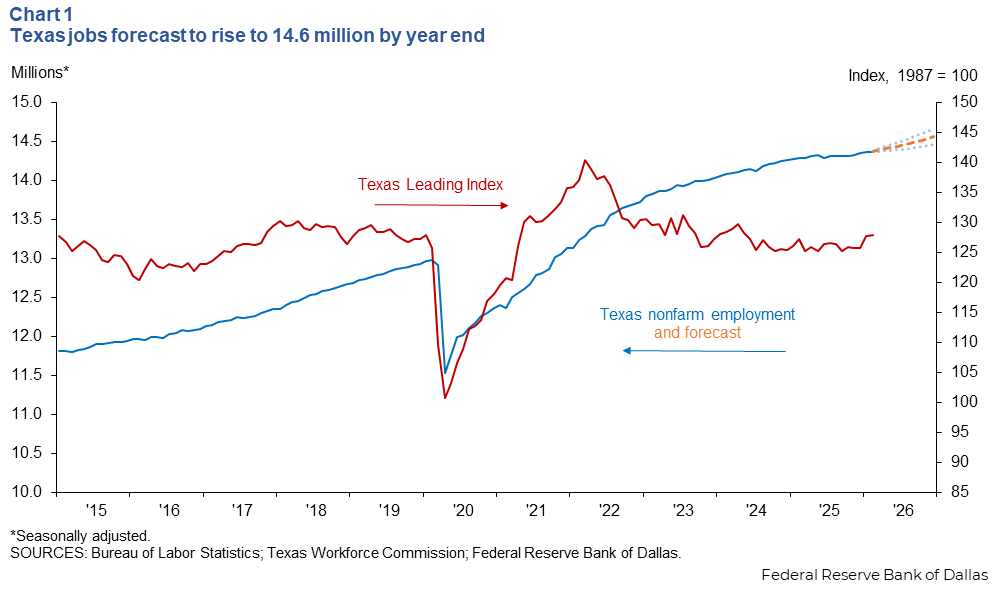
The Texas Employment Forecast indicates jobs will increase 1.4 percent in 2026, with an 80 percent confidence band of 0.7 to 2.1 percent. The forecast is based on an average of four models that includes projected U.S. gross domestic product, oil futures prices and the Texas and U.S. leading indexes. The forecast implies 205,500 jobs will be added in the state this year, and employment in December 2026 will be 14.6 million (Chart 1).
Texas employment grew an annualized 0.3 percent in February, adding 3,800 jobs. Meanwhile, January employment growth was revised down to 1.1 percent.
“Texas employment growth slowed sharply in February, and year-to-date growth is now more aligned with earlier forecasts for 2026. Given several headwinds, our expectations are for this year’s growth to come in at the lower end of the forecast’s confidence band, at around 1.0 percent. Declining immigration is constraining labor supply, and higher productivity is suppressing labor demand. Business activity captured by our Texas Business Outlook Surveys has recently moderated, and geopolitical uncertainty remains elevated. Meanwhile, high oil prices are expected to boost state economic activity only if they are sustained,” said Luis Torres, Dallas Fed senior business economist.
“In February, job gains were led by information, professional and business services and manufacturing. Meanwhile, employment losses were led by trade and transportation, other services and oil and gas. Employment in construction and education and health services, which had been growing at a solid pace, reversed course and fell in February. The remaining sectors recorded job gains. Among major Texas metros, Austin posted the biggest employment decline at 3.3 percent, followed by El Paso at 1.6 percent, Fort Worth at 1.4 percent, San Antonio at 1.0 percent and Houston at 0.8 percent, while Dallas registered nearly flat employment growth at 0.1 percent,” he added.
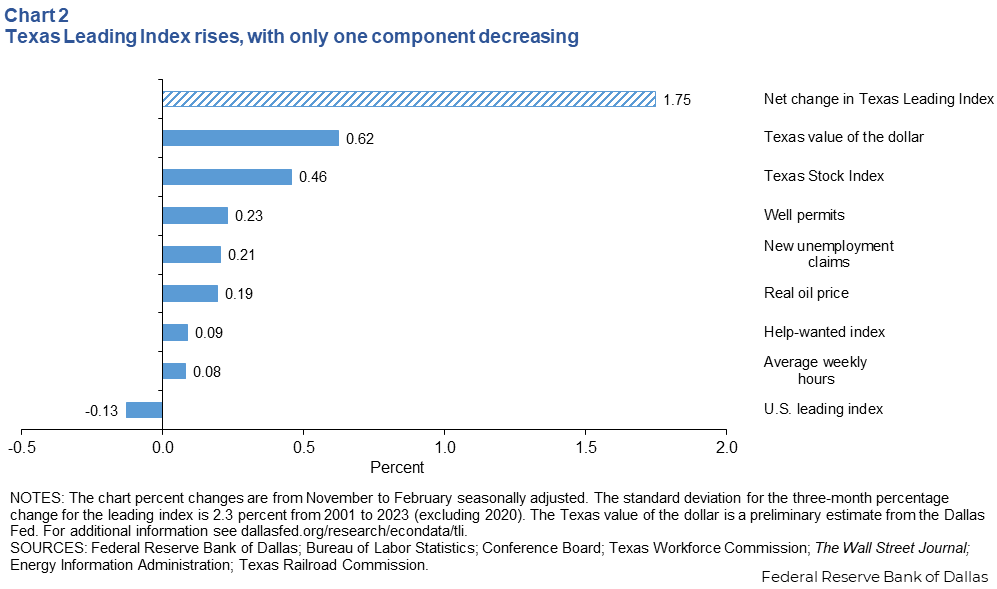
The Texas Leading Index rose over the three months ending in February (Chart 2), with positive contributions across all components except one. The index was boosted by declines in both the Texas value of the dollar and new unemployment claims, as well as increases in the Texas stock index, well permits, the real oil price, the help wanted index and average weekly hours. Meanwhile, the decline in the U.S. leading index contributed negatively to the overall index.
Next release: May 1
Methodology
The Dallas Fed’s Texas Employment Forecast projects job growth for the calendar year and is estimated as the 12-month change in payroll employment from December to December.
The forecast is based on the average of four models. Three models are vector autoregressions for which Texas payroll employment is regressed on the lags of West Texas Intermediate (WTI) oil prices, the U.S. leading index and the Texas Leading Index. The fourth model is an autoregressive distributed lag model with regression of payroll employment on lags of payroll employment, current and lagged values of U.S. GDP growth and WTI oil prices, and Texas COVID-19 hospitalizations through March 2023. Forecasts of Texas payroll employment from this model also use forecasts of U.S. GDP growth from Blue Chip Economic Indicators and WTI oil price futures as inputs. All models include four COVID-19 dummy variables (March–June 2020).
Learn more about the Texas Employment Forecast.
Contact Information
For more information about the Texas Employment Forecast, contact Luis Torres at luis.torres@dal.frb.org.