Fort Worth Economic Indicators

| Fort Worth economy dashboard (May 2026) | |||
Job growth (annualized)
Feb.–May '26 |
Unemployment rate |
Avg. hourly earnings |
Avg. hourly earnings growth y/y |
3.4% |
4.0% | $37.23 | 3.4% |
The Fort Worth–Arlington economy expanded in May. Payroll employment continued to grow, while the unemployment rate was unchanged. Hourly earnings increased year over year and were higher than the state. Housing demand softened in May. Alongside employment and wage growth, population has increased rapidly. Fort Worth has a higher proportion of residents with some college, associate’s degrees or bachelor’s degrees than the state and the nation.
Labor market
Employment increases
Employment in Fort Worth rose an annualized 1.6 percent in May, after rising 2.6 percent in April. Employment in Texas rose 1.2 percent in May. Fort Worth job growth in the three months ending in May was a solid 3.4 percent, faster than the state’s 2.3 percent increase (Chart 1). Job gains from February to May were broad-based across sectors, including solid growth in professional and business services, trade, transportation and utilities, leisure and hospitality, construction and mining, and financial activities. Meanwhile, employment declined in information, other services and manufacturing.
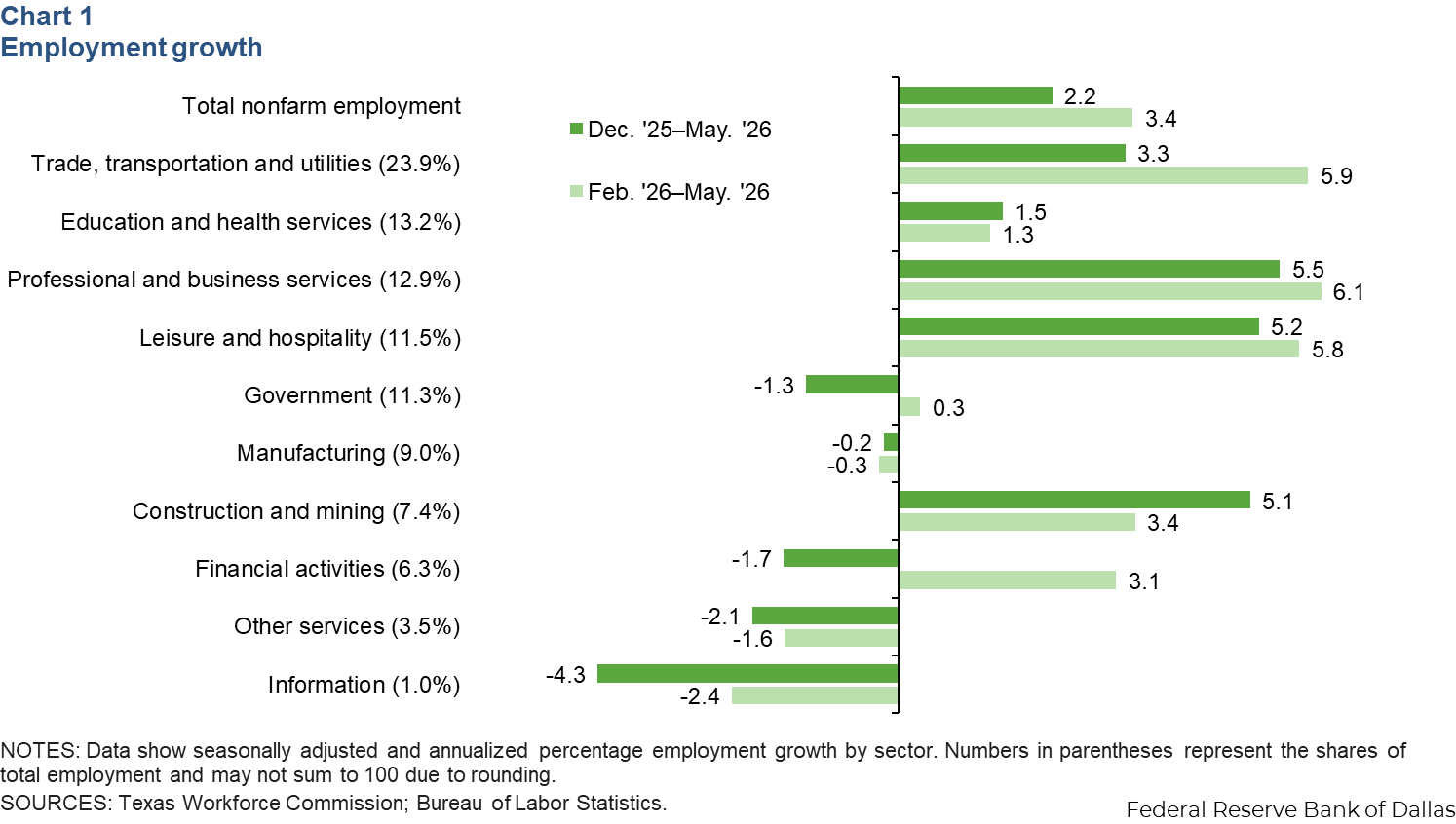
Fort Worth has a notably higher share of jobs in trade, transportation and utilities (23.9 percent) compared to Dallas (19.5 percent) and Texas (19.4 percent). The metro division serves as a multimodal logistics hub, where the combination of AllianceTexas, extensive rail networks, interstate highways and DFW Airport provides companies with exceptional connectivity to U.S. markets and international destinations. It also exceeds Dallas (6.5 percent) and the state (6.8 percent) in its share of manufacturing employment at 9.0 percent, which is attributable to its strong aerospace and defense industry presence as well as more affordable industrial land that attracts manufacturing operations. On the other hand, Fort Worth trails Dallas (20.5 percent) and Texas (15.0 percent) in professional and business services employment, with only 12.9 percent of jobs in that sector. Employment in finance (6.3 percent) is close to the state average (6.5 percent), but significantly lower than Dallas’s 10.0 percent.
Unemployment flat
Fort Worth’s unemployment rate was unchanged at 4.0 percent in May, on par with the average rate in the past twelve months (Chart 2). The May jobless rate was 4.3 percent in Texas, higher than Fort Worth’s unemployment rate. The civilian labor force continued to expand in the Fort Worth metro division, increasing an annualized 6.1 percent in May.

Earnings up year over year
The average nominal hourly wage in Fort Worth was $37.23 in May, up from $35.99 a year ago (Chart 3). Hourly wages in Fort Worth are above the state figure ($35.32). Year over year, hourly earnings were up 3.4 percent in Fort Worth, greater than the state’s increase of 3.0 percent. The national average hourly wage rose to $37.64 in June, up 3.5 percent from year-earlier levels.

Population
Fort Worth’s population has grown rapidly over the past 15 years, increasing an average of 2.2 percent each year and outpacing both the Fort Worth–Arlington metropolitan division and the Dallas–Fort Worth metro area (Chart 4). Over the same period, the population in the U.S. has risen 0.7 percent, on average, annually and 1.5 percent in Texas. In 2024, the city of Fort Worth’s population grew 2.4 percent, eclipsing one million residents. The broader Fort Worth–Arlington metro division is home to 2.7 million people.

Education
Fort Worth's educational attainment and earnings patterns reveal a city that excels in mid-level education but lags behind in advanced degrees. Compared to state and national averages, Fort Worth has a higher percentage of residents with some level of college education or an associate’s degree, but a lower percentage holding graduate or professional degrees (Chart 5).

These educational differences correspond with variations in earnings. Median annual earnings of those with a high school diploma in Fort Worth are on par with the U.S. but higher than Texas. Bachelor’s degree holders earn slightly more in Fort Worth than their counterparts in the state. The largest earnings gaps are for individuals with some college or those with a graduate or professional degree. Median annual earnings for those with some college or an associate's degree were $50,100 in Fort Worth, 4.5 percent higher than the U.S. and 6.0 percent higher than Texas. Meanwhile, for graduate and professional degree holders, median annual earnings in Fort Worth ($85,200) were 3.3 percent lower than the state and 5.5 percent lower than the nation. These patterns likely reflect Fort Worth's industrial makeup, with its higher concentration in trade, transportation, logistics and manufacturing—sectors that typically offer strong compensation for mid-level educational credentials.
Housing
Housing demand softened in May. Existing-home sales in Fort Worth–Arlington decreased 1.7 percent in May after rising 3.4 percent in April. The median sales price was $355,000, down 0.6 percent from a year ago (Chart 6). Supply of inventory was 3.8 months in May, down from 4.0 months in April. Statewide, sales fell 0.7 percent in May, while they rose 3.2 percent nationally.

NOTE: Data may not match previously published numbers due to revisions.
About Fort Worth Economic Indicators
Questions or suggestions can be addressed to Jackie Balanovsky. Fort Worth Economic Indicators publishes bimonthly after state and metro employment data are released.