San Antonio Economic Indicators

| San Antonio economy dashboard (December 2025) | |||
| Job growth (annualized) Sept.–Dec. '25 |
Unemployment rate |
Avg. hourly earnings |
Avg. hourly earnings growth y/y |
| -0.4% | 4.1% | $31.84 | 4.1% |
San Antonio payrolls rose, while the unemployment rate ticked down in December. Wages registered a strong annual increase. Home inventories were flat, while the median sales price declined. Apartment rents declined from a year prior and remained lower than the state and nation.
Business-cycle index
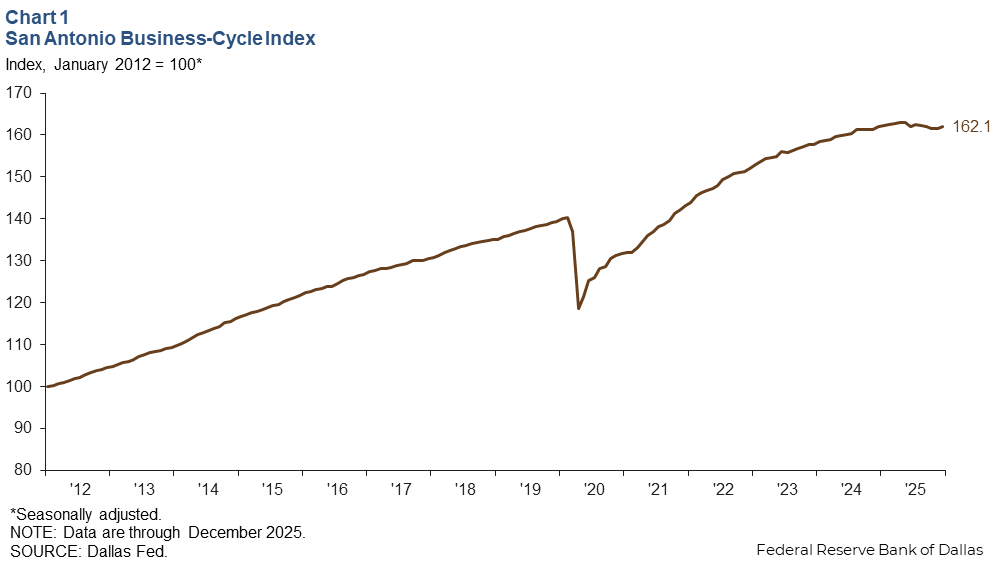
The San Antonio Business-Cycle Index, a gauge of economic conditions in the metro area, rose an annualized 4.1 percent in December from November (Chart 1).
Labor market
Employment declines
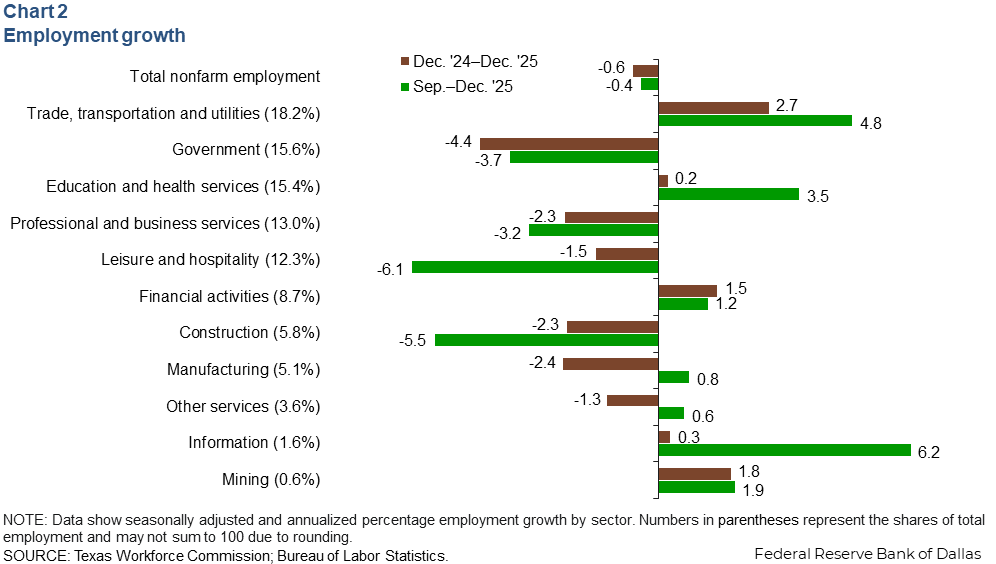
Although San Antonio payrolls grew an annualized 2.2 percent in December from November, payrolls declined 0.6 percent in 2025 (Chart 2). Payrolls declined 0.4 percent (1,300 jobs) from September through December, with the greatest declines in leisure and hospitality (down 6.1 percent, or 2,300 jobs lost) construction (down 5.5 percent, or 1,600 jobs lost), and government (down 3.7 percent, or 1,700 jobs lost). Declines in employment were especially pronounced in the federal government, down 21.9 percent. Over the same period employment in information had the strongest growth (6.2 percent, or 300 jobs) followed by trade, transportation and utilities (4.8 percent, adding 2,500 jobs). The state and nation both registered a higher payroll growth rate of 0.1 percent in 2025.
Unemployment rate declines
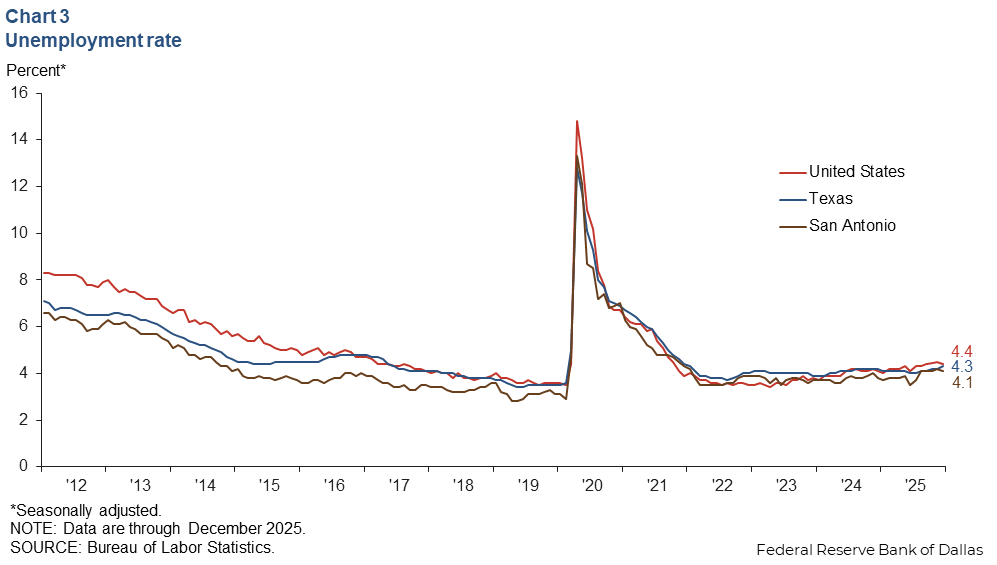
The San Antonio unemployment rate ticked down to 4.1 percent in December (Chart 3). The jobless rate is higher in Texas (4.3 percent) and the U.S. (4.4 percent).
Wages record strong annual increase
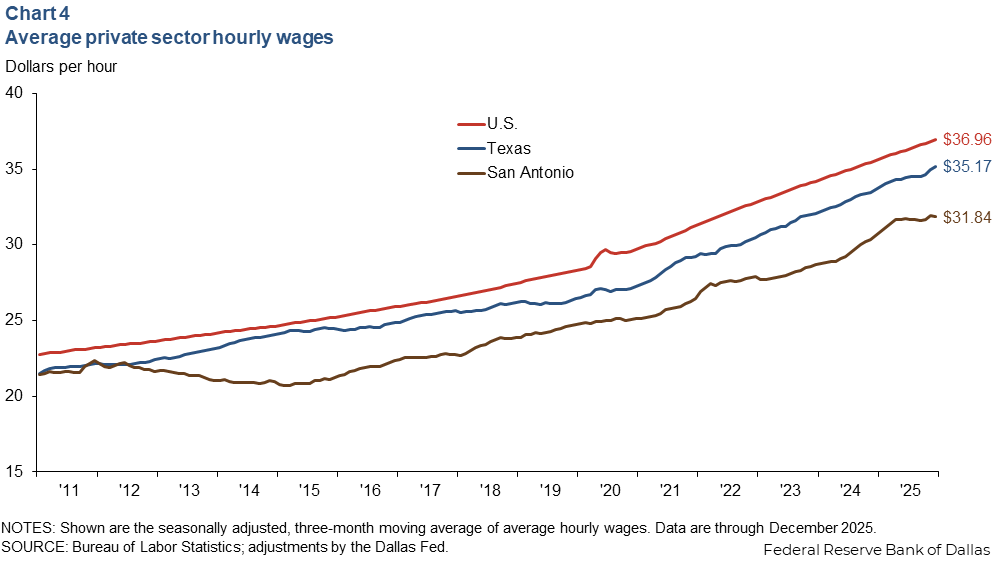
The average nominal hourly wage in San Antonio decreased to $31.84 in December (Chart 4). Wages are seasonally adjusted and smoothed with a three-month moving average. Year over year, wages grew a strong 4.1 percent in December, while wages in Texas rose 4.4 percent and U.S. wages grew 3.9 percent. Earnings in San Antonio continue to be lower than the state ($35.17) and nation ($36.96).
Housing market
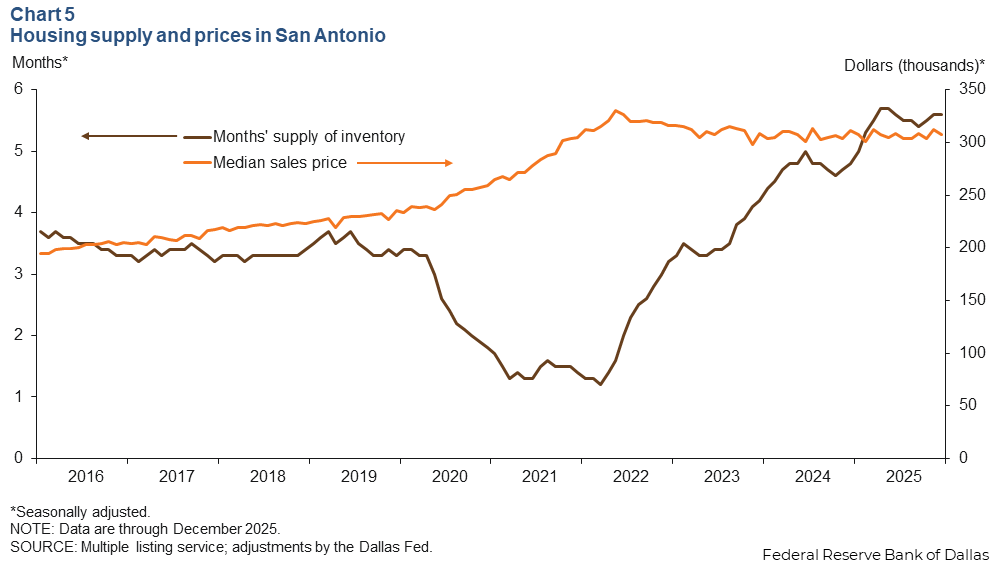
The supply of existing homes for sale in San Antonio was unchanged at 5.6 months in December (Chart 5). San Antonio’s housing supply is greater than Texas’s 5.1 months. The median sales price in San Antonio declined an annualized 1.7 percent in December from November and was 1.2 percent lower than a year ago.
Apartment market
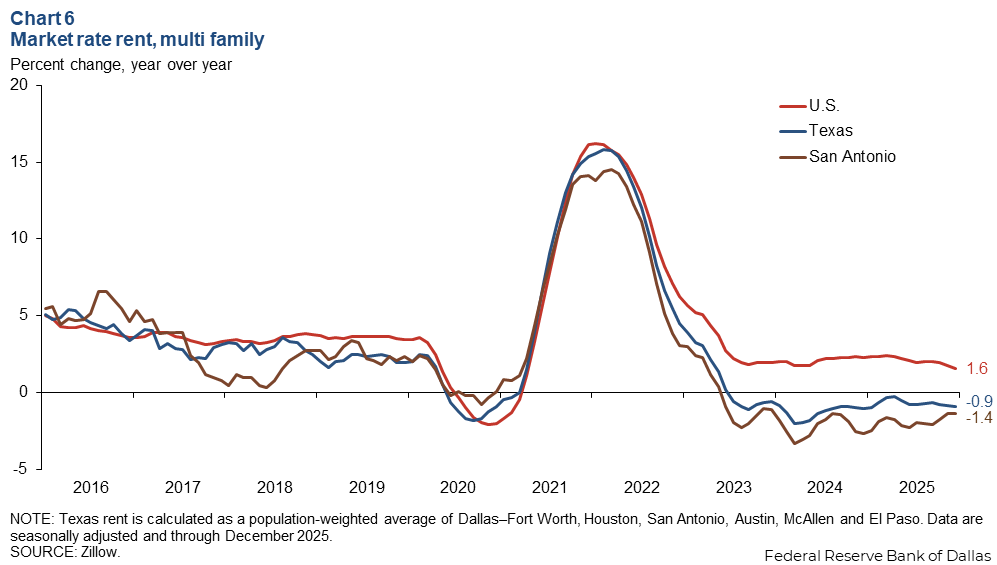
Year-over-year apartment rent declined 1.4 percent in San Antonio in December while declining 0.9 percent in Texas and increasing 1.6 percent in the U.S. (Chart 6). San Antonio rents were $1,230 in December, lower than the state ($1,390) and nation ($1,740). Rents declined 0.2 percent from November in both San Antonio and Texas but were unchanged nationally.
Note
Data may not match previously published numbers due to revisions.
NOTE: Data may not match previously published numbers due to revisions.
About San Antonio Economic Indicators
Questions or suggestions can be addressed to Luis Torres. San Antonio Economic Indicators publishes bimonthly after state and metro employment data are released.