
Surveys

Special Questions

Texas Business Outlook Surveys
February 23, 2026

Special Questions

For this month’s survey, Texas business executives were asked supplemental questions on demand, regulation and hiring. Results below include responses from participants from both the Texas Manufacturing Outlook Survey and Texas Service Sector Outlook Survey.

Texas Business Outlook Surveys

Data were collected February 10-18, and 315 Texas business executives responded to the surveys.

1. How do you expect demand for your firm’s goods and/or services over the next six months to compare with the past six months, aside from seasonal variation?

Demand expectations among Texas businesses are now slightly more bullish than what was reported last November. Of responding firms, 52 percent expect increases in demand over the next six months, exceeding the 15 percent share expecting decreases. Manufacturers in particular report optimism regarding future demand.
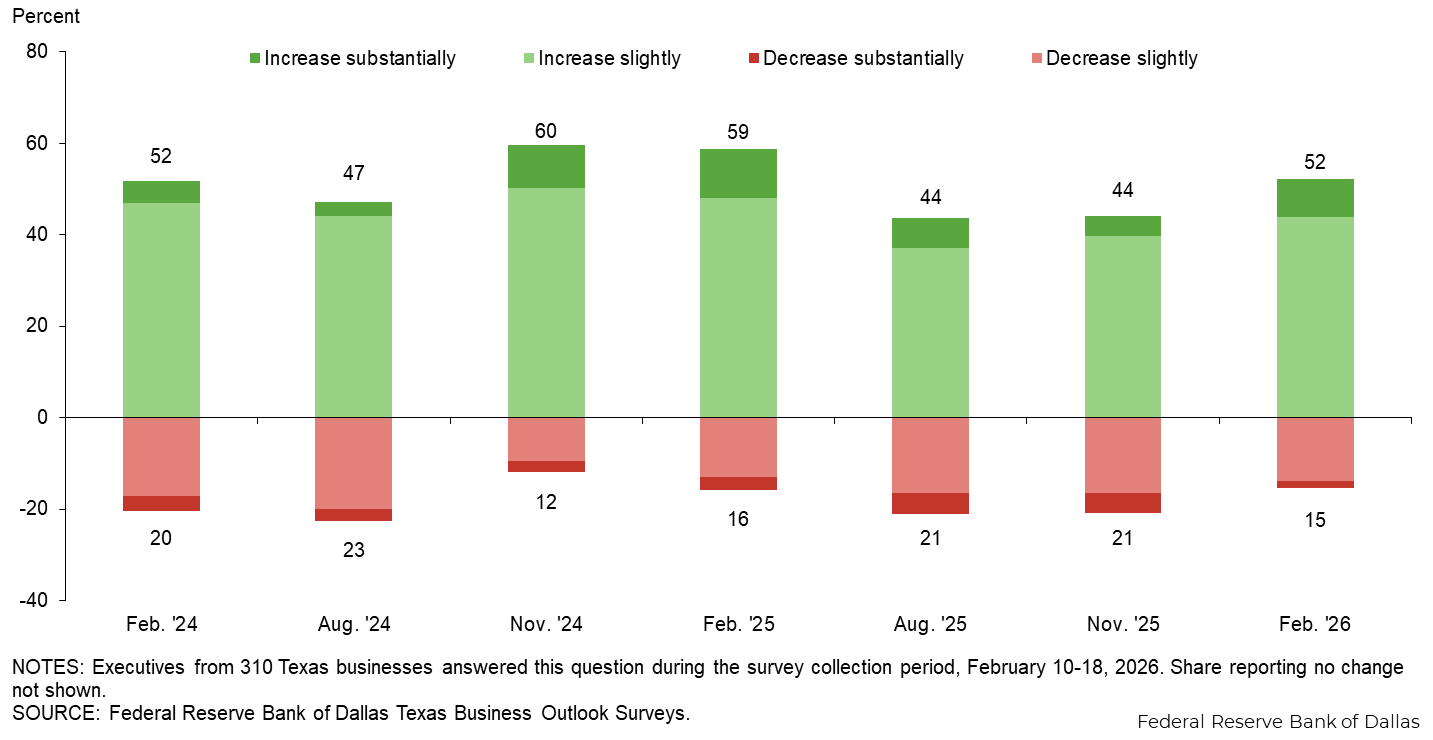
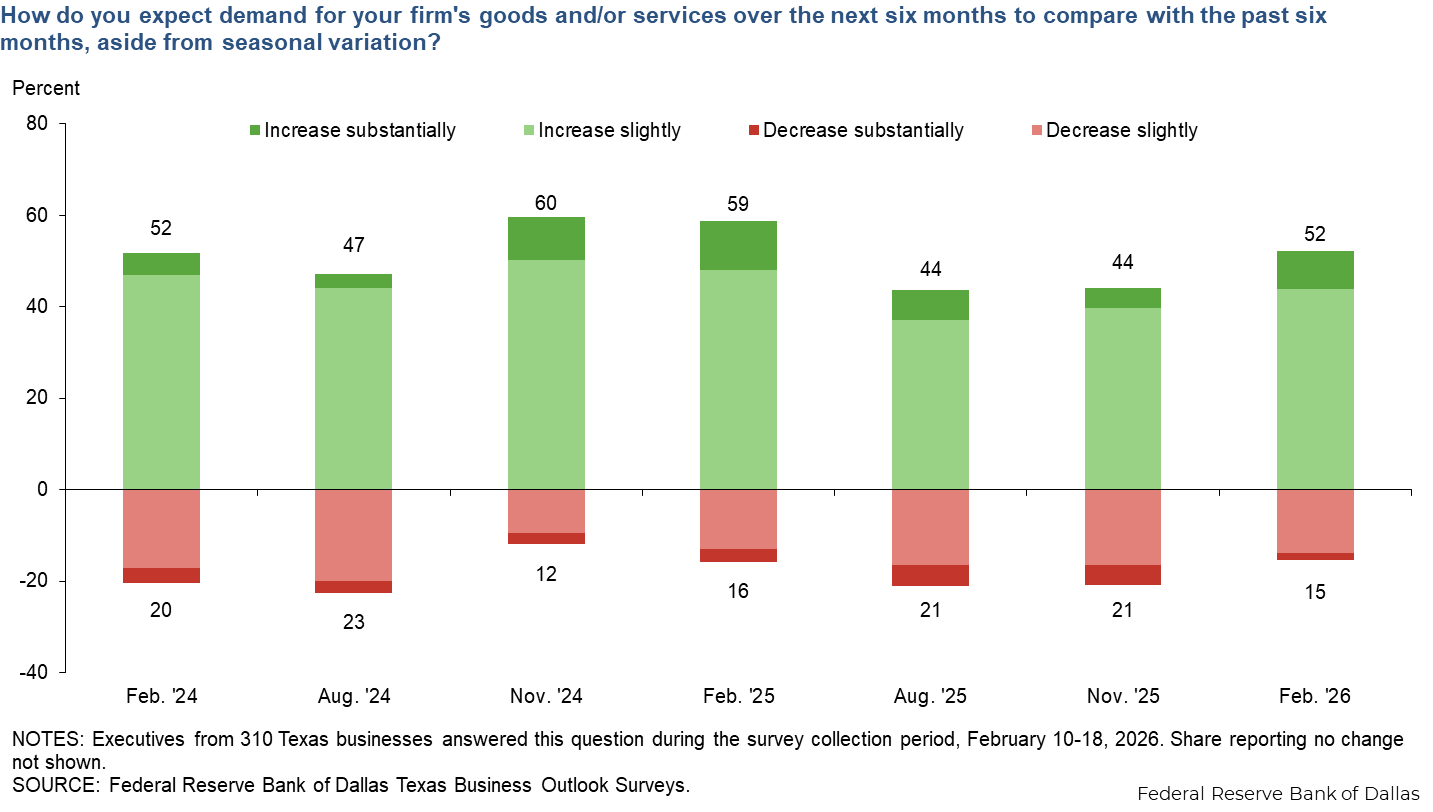
Chart 1
2. Have changes in the regulatory environment over the past year affected your firm? Please consider changes in government regulations and compliance requirements and exclude changes in tariff and tax policy.

Most Texas businesses say they have not been impacted by recent regulatory changes. Thirteen percent say they’ve seen a positive impact, with the share higher among services firms (15 percent) and lower among manufacturers (6 percent). Nearly a quarter say they’ve been negatively impacted, though the adverse impact was largely from tariffs, according to respondent commentary.


Feb. '26
(percent)
Yes, positively on net 12.8
Yes, negatively on net 23.7
No 54.5
Don’t know 9.0

NOTES: 312 responses. While respondents were asked to exclude changes in tariff and tax policy, many who responded ‘Yes, negatively on net’ cited tariffs when explaining the changes affecting their firm.

2a. Which types of regulatory changes have positively impacted your firm? Please select all that apply.

Among firms positively affected by recent regulatory changes, the majority cite changes in financial regulations as a driver, followed by changes in regulatory compliance/reporting requirements and enforcement.


Feb. '26
(percent)
Financial regulations 64.1
Regulatory compliance/reporting requirements and enforcement 43.6
Permitting and licensing process 25.6
Environmental and/or land use regulations 25.6
Mergers and acquisitions review process 17.9
Technology and data regulations 17.9
Labor regulations 7.7
Other 12.8

NOTES: 39 responses. This question was only posed to those who responded ‘Yes, positively on net’ to question 2.

2b. Is your firm taking any action as a result of recent changes in the regulatory environment? Please select all that apply.

Among firms positively affected by recent regulatory changes, nearly a quarter say they are entering new markets/geographical regions or implementing efficiency improvements as a result. More than 40 percent of responding firms are not taking any action in response.


Feb. '26
(percent)
Entering new markets or geographic regions 23.1
Implementing efficiency improvements  23.1
Increasing capital expenditures 20.5
Increasing innovation and/or research and development 20.5
Pursuing mergers or acquisitions 15.4
Launching new products or services 12.8
Other 5.1
None 43.6

NOTES: 39 responses. This question was only posed to those who responded ‘Yes, positively on net’ to question 2.

Texas has typically been able to grow its economy significantly faster than the nation due in part to migration from other states and countries.
3. Over the past year, to what extent has your firm relied on hiring workers who moved to Texas from either a different U.S. state or a different country?

A smaller share of Texas firms relied on hiring workers from other states or countries than what was seen a year ago.

Workers from a different U.S. state Workers from a different country
Feb. '24 Feb. '25 Feb. '26 Feb. '24 Feb. '25 Feb. '26
Significant reliance 5.1 4.6 3.3 2.4 6.6 4.0
Some reliance 24.7 27.8 21.3 12.9 17.7 16.4
No reliance 59.9 54.3 58.5 64.7 56.3 58.2
Not applicable; did not hire 10.2 13.2 16.9 19.9 19.4 21.5

NOTE: 301 responses.

3a. Over the past year, how has your reliance on workers from a different U.S. state changed?

Among firms hiring workers from different states, reliance on these domestic migrants continues to increase on net.
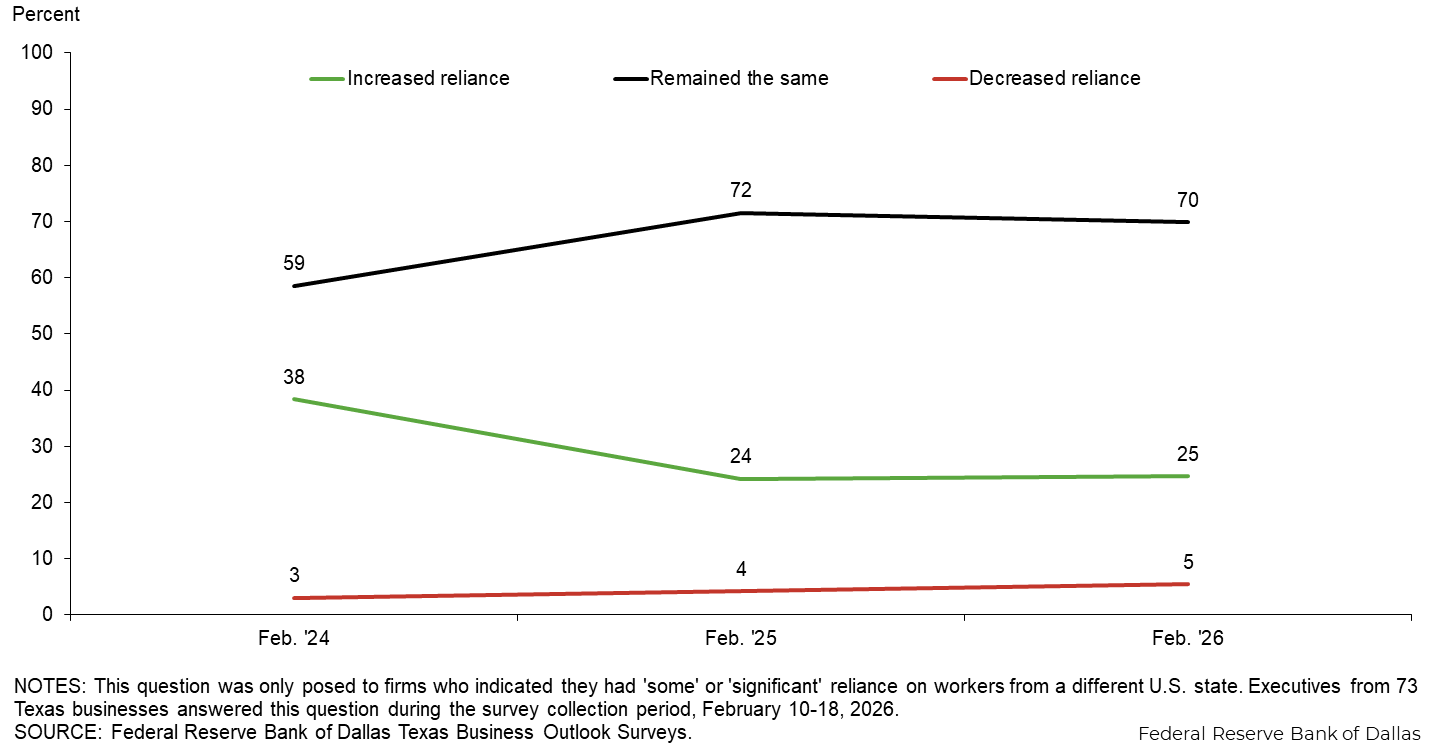
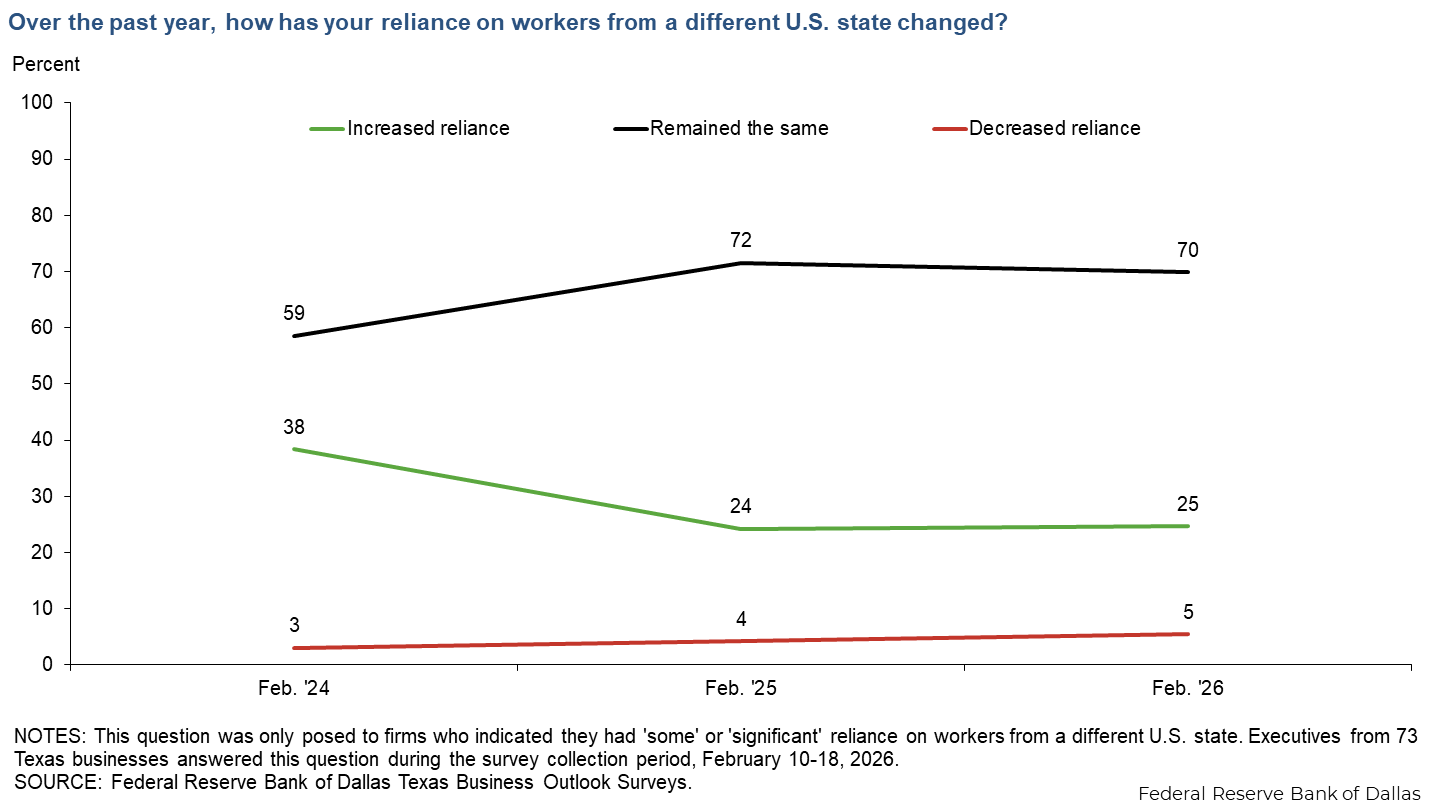
Chart 3a
3b. Over the past year, how has your reliance on workers from a different country changed?

Among firms hiring workers from different countries, reliance on these immigrants declined on net over the past year, which is a reversal from what was reported the prior two years.
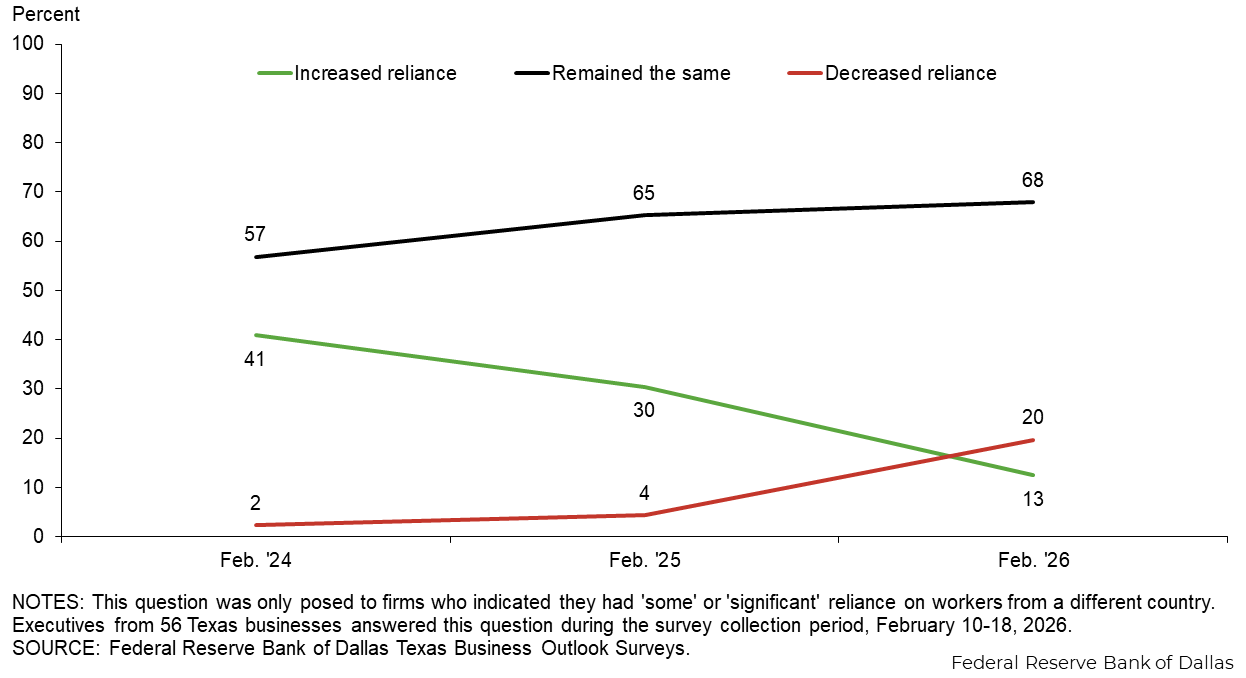
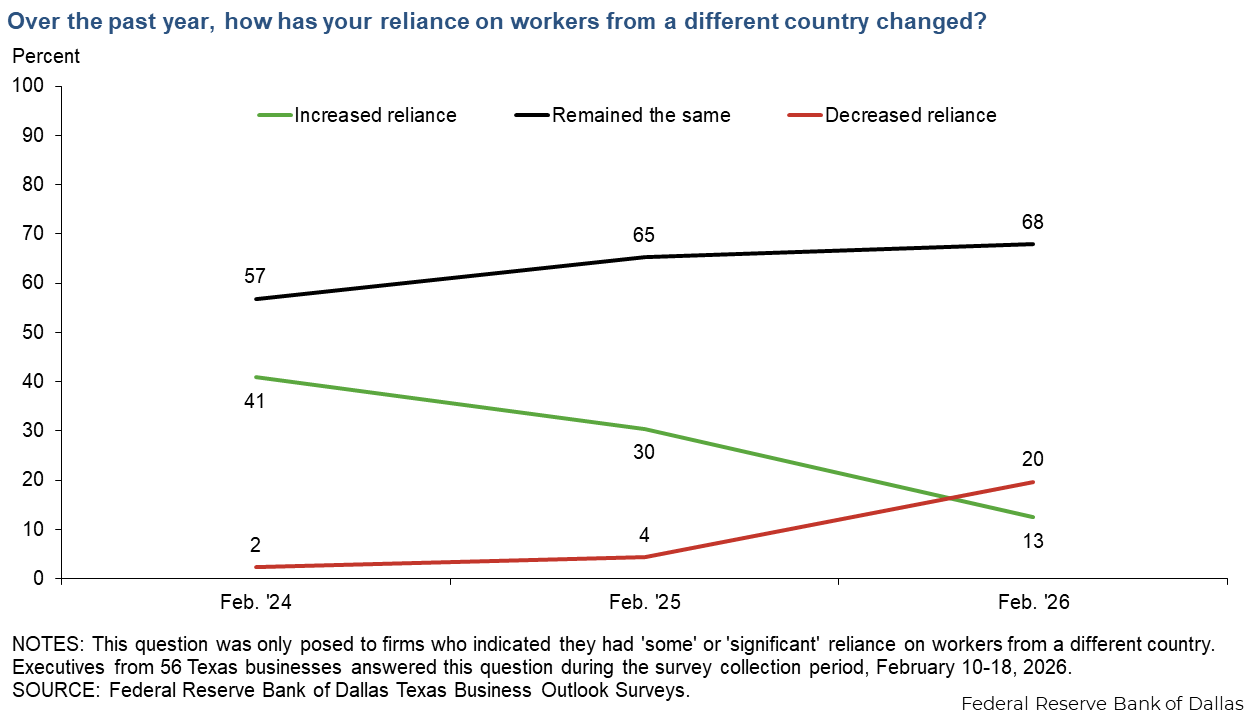
Chart 3b

Survey respondents were given the opportunity to also provide comments, which can be found in the Comments tab above.

Texas Manufacturing Outlook Survey

Data were collected February 10-18, and 78 Texas manufacturers responded to the survey.

1. How do you expect demand for your firm’s goods and/or services over the next six months to compare with the past six months, aside from seasonal variation?

Feb. '24
(percent)
Aug. '24
(percent)
Nov. '24
(percent)
Feb. '25
(percent)
Aug. '25
(percent)
Nov. '25
(percent)
Feb. '26
(percent)
Increase substantially 5.5 1.3 14.3 19.8 12.3 7.5 14.3
Increase slightly 46.2 53.8 58.3 43.0 37.0 41.8 42.9
Remain the same 23.1 20.0 17.9 15.1 29.6 32.8 26.0
Decrease slightly 17.6 22.5 8.3 18.6 16.0 13.4 14.3
Decrease substantially 7.7 2.5 1.2 3.5 4.9 4.5 2.6

NOTE: 77 responses.

2. Have changes in the regulatory environment over the past year affected your firm? Please consider changes in government regulations and compliance requirements and exclude changes in tariff and tax policy.

Feb. '26
(percent)
Yes, positively on net 6.4
Yes, negatively on net 30.8
No 57.7
Don’t know 5.1

NOTES: 78 responses. While respondents were asked to exclude changes in tariff and tax policy, many who responded ‘Yes, negatively on net’ cited tariffs when explaining the changes affecting their firm.

Texas has typically been able to grow its economy significantly faster than the nation due in part to migration from other states and countries.
3. Over the past year, to what extent has your firm relied on hiring workers who moved to Texas from either a different U.S. state or a different country?
Workers from a different U.S. state Workers from a different country
Feb. '24 Feb. '25 Feb. '26 Feb. '24 Feb. '25 Feb. '26
Significant reliance 6.0 0.0 0.0 3.9 8.2 4.2
Some reliance 20.2 33.3 13.3 19.5 24.7 16.7
No reliance 65.5 55.1 66.7 62.3 50.7 51.4
Not applicable; did not hire 8.3 11.5 20.0 14.3 16.4 27.8

NOTE: 75 responses.

3a. Over the past year, how has your reliance on these workers changed?
Workers from a different U.S. state Workers from a different country
Feb. '24 Feb. '25 Feb. '26 Feb. '24 Feb. '25 Feb. '26
Increased reliance 59.1 30.4 10.0 61.1 43.5 6.7
Remained the same 36.4 69.6 70.0 33.3 52.2 73.3
Decreased reliance 4.5 0.0 20.0 5.6 4.3 20.0

NOTES: 15 responses. This question was only posed to those answering ‘Significant reliance’ or ‘Some reliance’ to question 3.

Survey respondents were given the opportunity to also provide comments, which can be found in the Comments tab above.

Texas Service Sector Outlook Survey

Data were collected February 10-18, and 237 Texas business executives responded to the survey.

1. How do you expect demand for your firm’s goods and/or services over the next six months to compare with the past six months, aside from seasonal variation?

Feb. '24
(percent)
Aug. '24
(percent)
Nov. '24
(percent)
Feb. '25
(percent)
Aug. '25
(percent)
Nov. '25
(percent)
Feb. '26
(percent)
Increase substantially 4.5 3.5 7.9 7.2 4.5 3.4 6.4
Increase slightly 47.4 41.2 47.4 50.0 37.2 39.1 44.2
Remain the same 29.3 33.3 32.0 29.2 37.2 35.7 34.3
Decrease slightly 16.9 19.2 9.9 11.0 16.6 17.4 13.7
Decrease substantially 1.9 2.7 2.8 2.5 4.5 4.3 1.3

NOTE: 233 responses.

2. Have changes in the regulatory environment over the past year affected your firm? Please consider changes in government regulations and compliance requirements and exclude changes in tariff and tax policy.

Feb. '26
(percent)
Yes, positively on net 15.0
Yes, negatively on net 21.4
No 53.4
Don’t know 10.3

NOTES: 234 responses. While respondents were asked to exclude changes in tariff and tax policy, many who responded ‘Yes, negatively on net’ cited tariffs when explaining the changes affecting their firm.

Texas has typically been able to grow its economy significantly faster than the nation due in part to migration from other states and countries.
3. Over the past year, to what extent has your firm relied on hiring workers who moved to Texas from either a different U.S. state or a different country?
Workers from a different U.S. state Workers from a different country
Feb. '24 Feb. '25 Feb. '26 Feb. '24 Feb. '25 Feb. '26
Significant reliance 4.8 6.3 4.4 1.9 6.0 3.9
Some reliance 26.2 25.9 23.9 10.5 15.3 16.3
No reliance 58.1 54.0 55.8 65.6 58.1 60.6
Not applicable; did not hire 10.9 13.8 15.9 22.0 20.5 19.2

NOTE: 226 responses.

3a. Over the past year, how has your reliance on these workers changed?
Workers from a different U.S. state Workers from a different country
Feb. '24 Feb. '25 Feb. '26 Feb. '24 Feb. '25 Feb. '26
Increased reliance 32.5 22.2 27.0 26.9 23.9 14.6
Remained the same 64.9 72.2 69.8 73.1 71.7 65.9
Decreased reliance 2.6 5.6 3.2 0.0 4.3 19.5

NOTES: 63 responses. This question was only posed to those answering ‘Significant reliance’ or ‘Some reliance’ to question 3.

Survey respondents were given the opportunity to also provide comments, which can be found in the Comments tab above.

Special Questions Comments

Survey participants are given the opportunity to submit comments. Some comments have been edited for grammar and clarity.

Texas Manufacturing Outlook Survey
Computer and electronic product manufacturing
  • About 20 percent of our employees immigrated legally from another country. We don’t see any negative impact from increased immigration enforcement. I hope to see the U.S. immigration system reformed to a sane and transparent points-based system similar to those in Australia and New Zealand. I’m not optimistic, based on the political objectives of both sides of the aisle.
Machinery manufacturing
  • Tariffs on Chinese electric vehicles and semiconductors have prompted China to restrict tungsten exports. This resulted in 3x increase in tungsten prices. This is an example of the unintended consequences of bad policy.
Plastics and rubber products manufacturing
  • This year has been somewhat odd compared to initial market expectations. The general outlook suggested that the oil market would remain relatively flat compared to 2025, with the possibility of a slight decline. To date, that forecast has not fully materialized for us, although overall performance has been mixed. Certain product segments are experiencing notable growth, while others remain generally consistent with the expected market forecast. From a pricing perspective, we are beginning to see the effects of tariffs reflected in material costs. The impact on our high-volume materials has been manageable due to volume-based pricing advantages. However, we are observing more cost increases on lower-volume items or components with relatively low base costs, where even small increases have a considerable impact.
Printing and related support activities
  • The debt load of the largest companies in our industry is a danger to the economy and our industry (commercial printing). Companies can’t sell anything without labels and packaging.
Texas Service Sector Outlook Survey
Administrative and support services
  • Our employees work from home, and they are located in five different states.
  • Texas’ status as a preferred destination, especially for younger college graduates and skilled workers, has diminished. The low-tax environment in Texas is becoming less of an attraction.
Ambulatory health care services
  • Immigration policy is impacting many sectors and increasing competition for labor. [It results in] smaller [labor] supplies and companies closing lines of business. Immigration policy overall is a net negative for all.
Educational services
  • While we continue to rely on international employees, we are less able to hire them. There is not a sufficient supply of qualified U.S. citizens to replace them.
Food services and drinking places
  • In my 40 years owning and managing restaurants, we have never been able to hire enough employees born in this country. That is just a fact. We comply with the laws as best we are able, but the laws are futile. George W. Bush had a good plan many years ago: Get a simple guest worker plan implemented. For those that came illegally, if they have no criminal record and have worked and supported themselves, also give them a guest worker permit but never citizenship. It’s not the Fed’s role, but why not support something that will support our business and many others? It can’t help but increase GDP, and as a nation we would finally be able to talk about something else.
Merchant wholesalers, nondurable goods
  • As a lifelong resident (born in Dallas), the last 10 years are unprecedented in the rise of cost of living as people move to Texas and Dallas-Fort Worth.
Motor vehicle and parts dealers
  • Texas continues to be a desirable state for people to come to work and live.
Professional, scientific, and technical services
  • We have strengthened our cybersecurity safeguards and reporting of FinCEN (Financial Crimes Enforcement Network) by partnering with third-party vendors. This aids in avoiding fines and losses, which has come at a significant expense. This expense will be passed along to the consumer via a direct charge payable to the third party and/or an increase in our escrow fee.
  • For our consulting engineering services, we recruit nationally and relocate engineers as needed. As a result, we are not dependent on migration of workers into Texas.
  • Our company has hired engineers under H-1B visas. The increased cost and tightening requirements for these visas will make it more challenging to retain engineering talent.
  • Small companies are having a much harder time hiring qualified people. Large companies are taking in many potential employees. In-migration from other states is also putting pressure on wages and upsetting the existing balance.
  • We mostly recruit from the El Paso and Southern New Mexico markets. The salary ranges in these areas are lower than our Dallas-Fort Worth market. It seems to work well having employees in the El Paso and Southern New Mexico area but paying them based on the Dallas-Fort Worth markets.
  • Tax changes like cancelling the capitalization of research and development expenses have helped us and lowered our tax burden. We expect demand for the products we sell to increase but supply to be severely constrained, and we don’t know how long this will last.
  • Trump Administration policies are excellent and timely for small businesses and U.S.- based companies. Texas’ business-friendly state government, laws and abundant land and energy are excellent for any companies to locate here.
  • Texas has an excellent workforce from which to draw.
Real estate
  • We employ many contractors and tradespeople. The vast majority in our service areas hail from Latin America. As roofers, electricians and plumbers disappear, there is no one to take their place. So far, this has been more of an annoyance than a crisis, but it is impacting productivity and costs.
Religious, grantmaking, civic, professional and similar organizations
  • To be clear, we hire workers from a non-U.S. company only if we are in full compliance with all laws. The current ICE behaviors and the even worse rationales coming from the executive branch are bad for business.
Rental and leasing services
  • We have not seen any drop in government regulations to this point. Government regulations continue to be widely unjustified, unprofitable, inefficient and unproductive.
Support activities for transportation
  • Our firm has relied exclusively on U.S.-domiciled drivers based in Texas, with a strong emphasis on verified experience, safety history and regulatory compliance.
Truck transportation
  • Global and international businesses need more flexibility in hiring.
  • Thank God we have been able to attract mechanics from California! Amarillo has 2.8 percent unemployment, which makes it difficult to hire local talent.
Warehousing and storage
  • No real change noted at this point from the restricted immigration pipeline.

Questions regarding the Texas Business Outlook Surveys can be addressed to Emily Kerr at emily.kerr@dal.frb.org.

Sign up for our email alert to be automatically notified as soon as the latest surveys are released on the web.