Special Questions

Special Questions
For this month’s survey, Texas business executives were asked supplemental questions on the Iran war. Results below include responses from participants from both the Texas Manufacturing Outlook Survey and Texas Service Sector Outlook Survey.
Texas Business Outlook Surveys
Data were collected April 14–22, and 308 Texas business executives responded to the surveys.
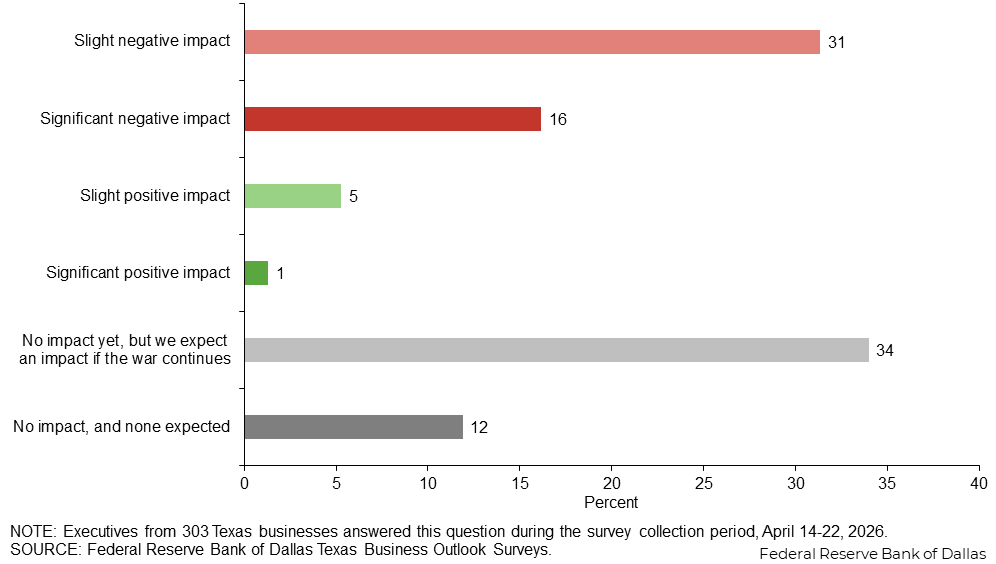
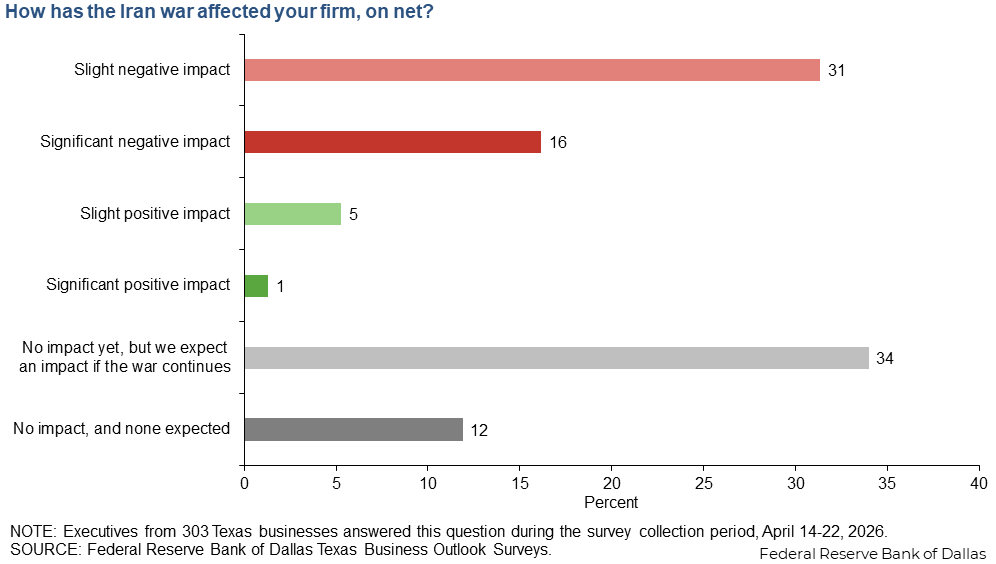
Nearly half of surveyed firms note a negative impact from the Iran war. The negative impact was more widespread in the service sector (51 percent of firms) than in manufacturing (35 percent of firms). Seven percent of firms note a positive impact from the war, partly stemming from increased activity in the oil and gas sector.
The following prompt was given to those positively impacted.
Responses can be found on the individual survey Special Questions results pages, accessible by the Manufacturing and Service Sector tabs above.
The following questions were posed to those negatively impacted.
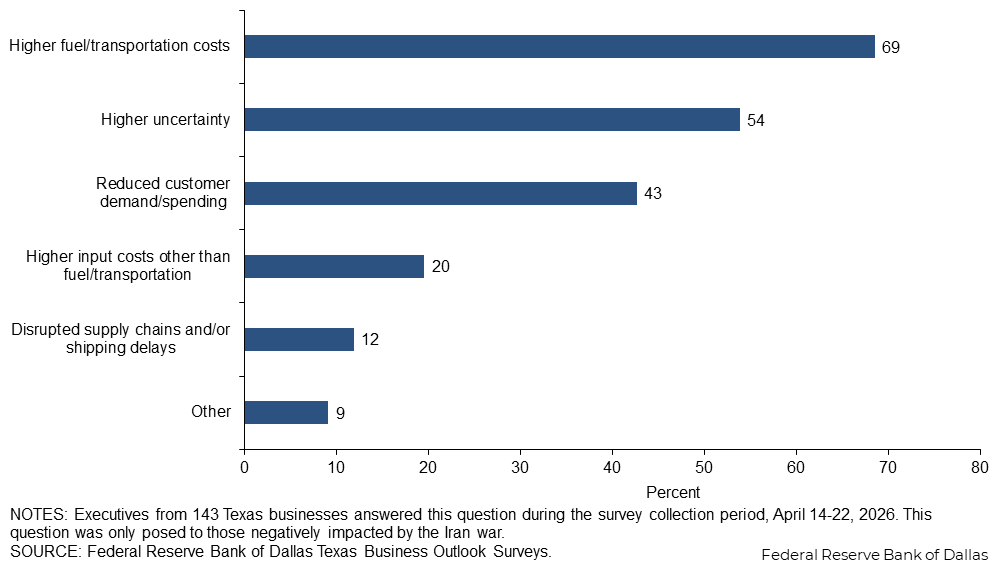
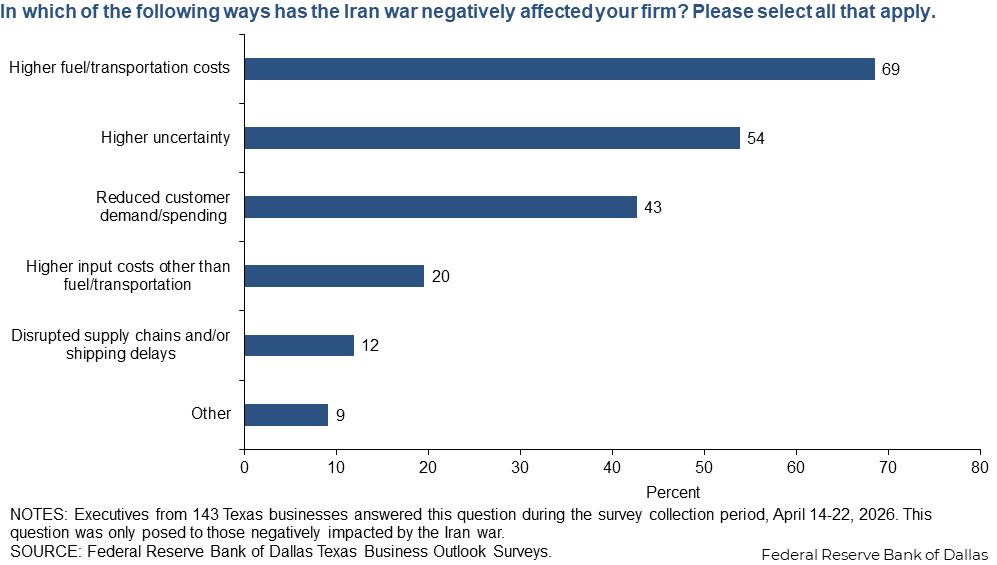
Higher fuel costs are the most commonly cited negative impact, followed by higher uncertainty and reduced customer spending.
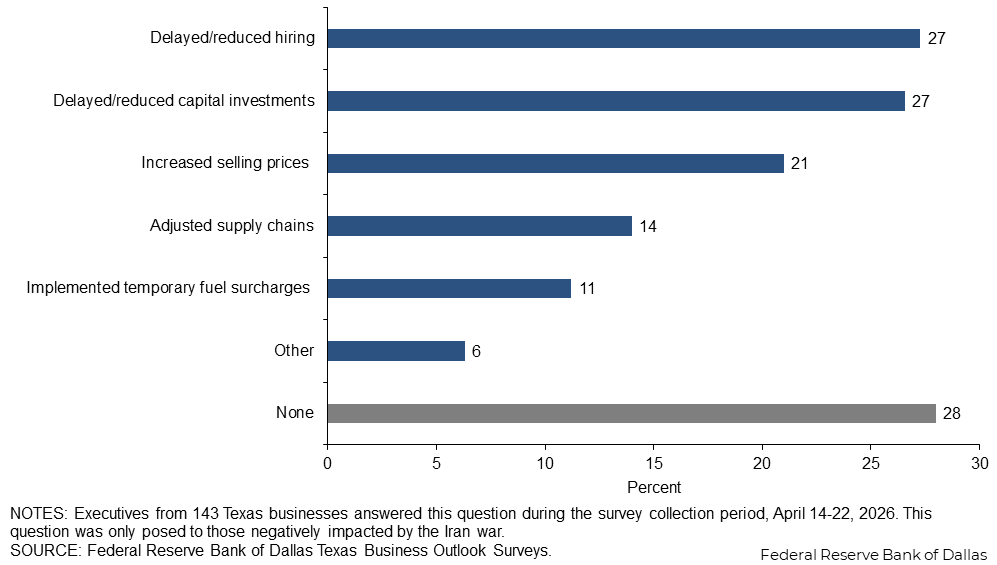
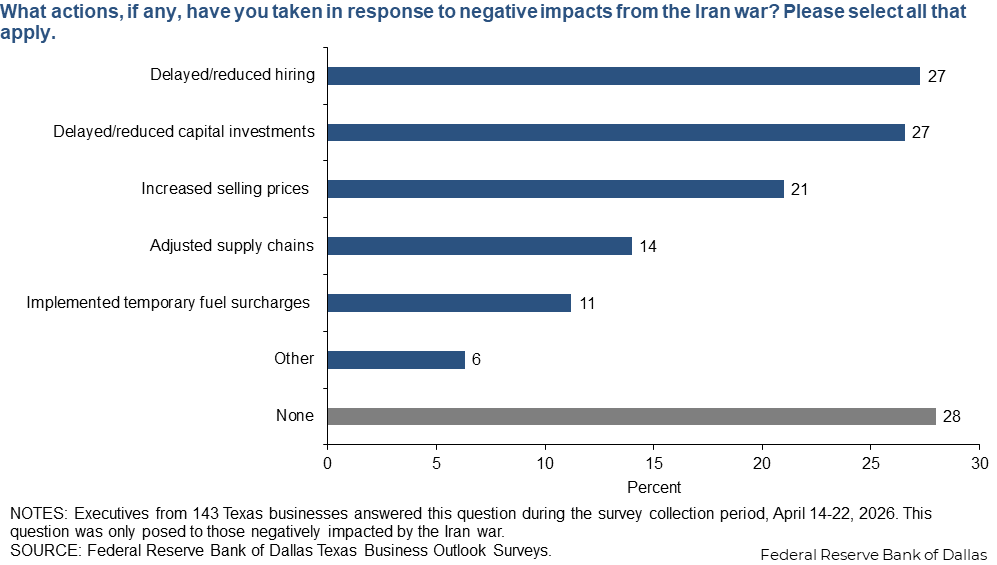
Pullbacks in hiring and capital spending are the most common actions taken by firms surveyed, though increased selling prices was the top response among manufacturers. More than a quarter of firms negatively impacted by the Iran war have not taken action in response.
Survey respondents were given the opportunity to also provide comments, which can be found in the Comments tab above.
Texas Manufacturing Outlook Survey
Data were collected April 14–22, and 67 Texas manufacturers responded to the survey.
| April '26 (percent) |
|
| Slight negative impact | 21.2 |
| Significant negative impact | 13.6 |
| Slight positive impact | 10.6 |
| Significant positive impact | 1.5 |
| No impact yet, but we expect an impact if the war continues | 36.4 |
| No impact, and none expected | 16.7 |
NOTE: 66 responses.
The following prompt was given to those positively impacted.
- Consumers are trying to source more products domestically.
- Raw material prices spiked quickly, but uncertainty on supply has meant some ability to increase pricing.
- Aluminum prices have risen substantially due to approximately 10 percent of the world’s primary aluminum supply coming from the Middle East, traveling via ship though the Strait of Hormuz. Also, two primary reduction smelters of aluminum were bombed by Iran, curtailing a significant portion of the production for that region.
- We maintain and coat tools used downhole [in oil and gas wells].
- Price of oil.
- We are seeing an increase in our domestic manufacturing for oilfield services/oil and gas as a result of the international conflict and uncertainty around delivery of natural resources. We believe some of this increase will remain after the Strait of Hormuz [reopens] and conflict is resolved; however, some will be shifted back to international sources.
The following questions were posed to those negatively impacted.
| April '26 (percent) |
|
| Higher fuel/transportation costs | 87.0 |
| Higher uncertainty | 43.5 |
| Higher input costs other than fuel/transportation | 39.1 |
| Reduced customer demand/spending | 30.4 |
| Disrupted supply chains and/or shipping delays | 17.4 |
| Other | 8.7 |
NOTES: 23 responses. This question was only posed to those negatively impacted by the Iran war.
| April '26 (percent) |
|
| Increased selling prices | 34.8 |
| Adjusted supply chains | 26.1 |
| Delayed/reduced hiring | 21.7 |
| Implemented temporary fuel surcharges | 21.7 |
| Delayed/reduced capital investments | 17.4 |
| Other | 8.7 |
| None | 21.7 |
NOTES: 23 responses. This question was only posed to those negatively impacted by the Iran war.
Survey respondents were given the opportunity to also provide comments, which can be found in the Comments tab above.
Texas Service Sector Outlook Survey
Data were collected April 14–22, and 241 Texas business executives responded to the survey.
| April '26 (percent) |
|
| Slight negative impact | 34.2 |
| Significant negative impact | 16.9 |
| Slight positive impact | 3.8 |
| Significant positive impact | 1.3 |
| No impact yet, but we expect an impact if the war continues | 33.3 |
| No impact, and none expected | 10.5 |
NOTE: 237 responses.
The following prompt was given to those positively impacted.
- More producer interest in additional connections to pipelines.
- More companies are looking to move to the U.S., Texas and the region.
- The Middle East looks like an unreliable source of liquid energy at the moment, and our customers have stepped in to overproduce as partial replacement for Middle East losses.
- The decisiveness of the administration to rid the world of a terror threat is causing positive expectations of the economy for later in the year.
- Increased interest from clients to protect their plants from attacks.
- I think in general the energy industry in Texas sees higher prices as a good thing.
- Hydrocarbon and related products show entanglement with effects in China. As others seek to understand or counter threats from China, our business grows.
- Opportunities for significant economic opportunities.
- We added new defense industry customers. Our infrastructure software is a core commercial need, not open source, and is immune from AI creating new versions. Further, we expect to get more sales as the defense industry uses more drones and unmanned craft and as AI data centers and giant new semiconductor factories need infrastructure software like ours to run daily operations.
The following questions were posed to those negatively impacted.
| April '26 (percent) |
|
| Higher fuel/transportation costs | 65.0 |
| Higher uncertainty | 55.8 |
| Reduced customer demand/spending | 45.0 |
| Higher input costs other than fuel/transportation | 15.8 |
| Disrupted supply chains and/or shipping delays | 10.8 |
| Other | 9.2 |
NOTES: 120 responses. This question was only posed to those negatively impacted by the Iran war.
| April '26 (percent) |
|
| Delayed/reduced capital investments | 28.3 |
| Delayed/reduced hiring | 28.3 |
| Increased selling prices | 18.3 |
| Adjusted supply chains | 11.7 |
| Implemented temporary fuel surcharges | 9.2 |
| Other | 5.8 |
| None | 29.2 |
NOTES: 120 responses. This question was only posed to those negatively impacted by the Iran war.
Survey respondents were given the opportunity to also provide comments, which can be found in the Comments tab above.
Questions regarding the Texas Business Outlook Surveys can be addressed to Emily Kerr at emily.kerr@dal.frb.org.
Sign up for our email alert to be automatically notified as soon as the latest surveys are released on the web.
Special Questions Comments
Survey participants are given the opportunity to submit comments. Some comments have been edited for grammar and clarity.