Texas Service Sector Outlook Survey


Growth in Texas service sector activity stalls
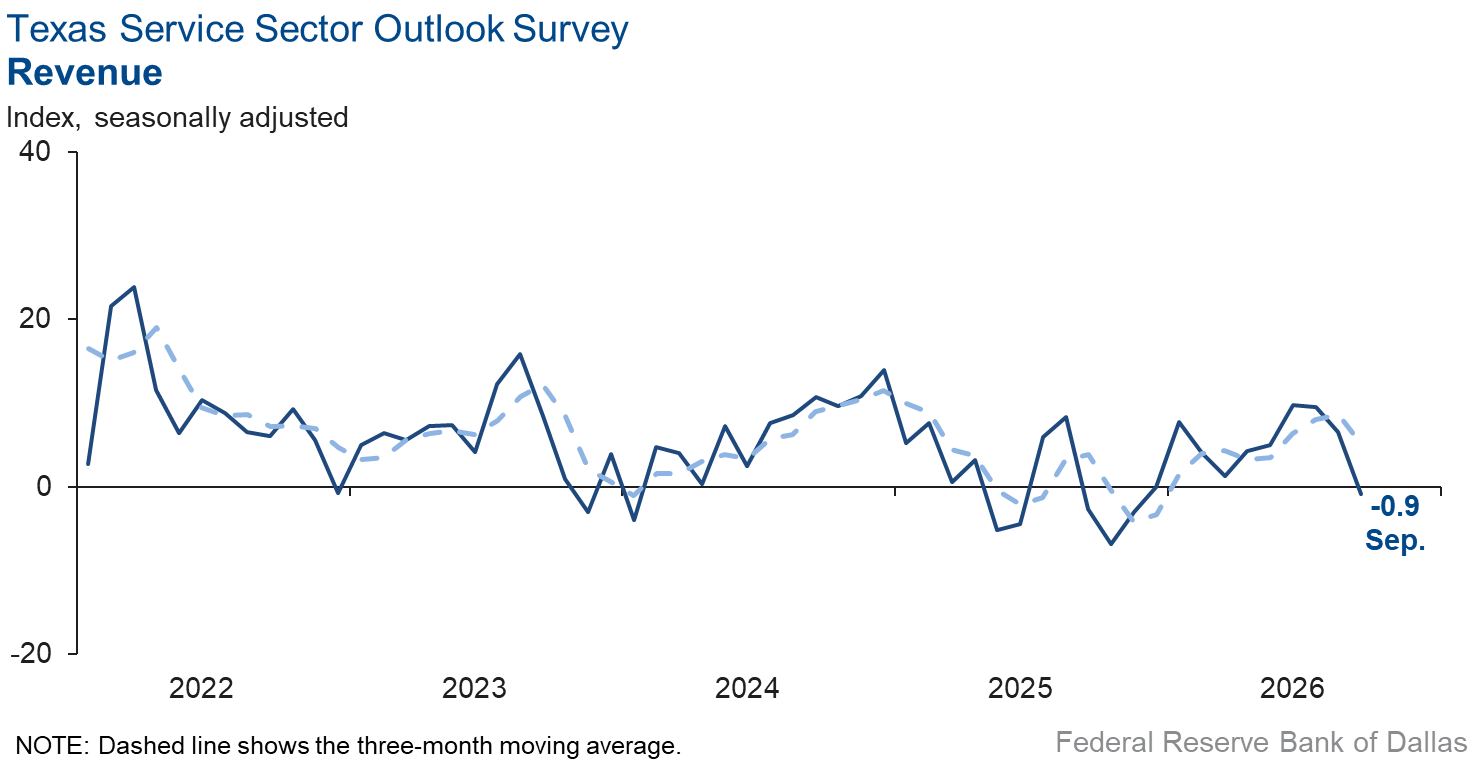
Texas service sector activity held steady in September, according to business executives responding to the Texas Service Sector Outlook Survey. The revenue index, a key measure of state service sector conditions, fell eight points to -0.9, with the near-zero reading indicating no change in activity from the prior month.
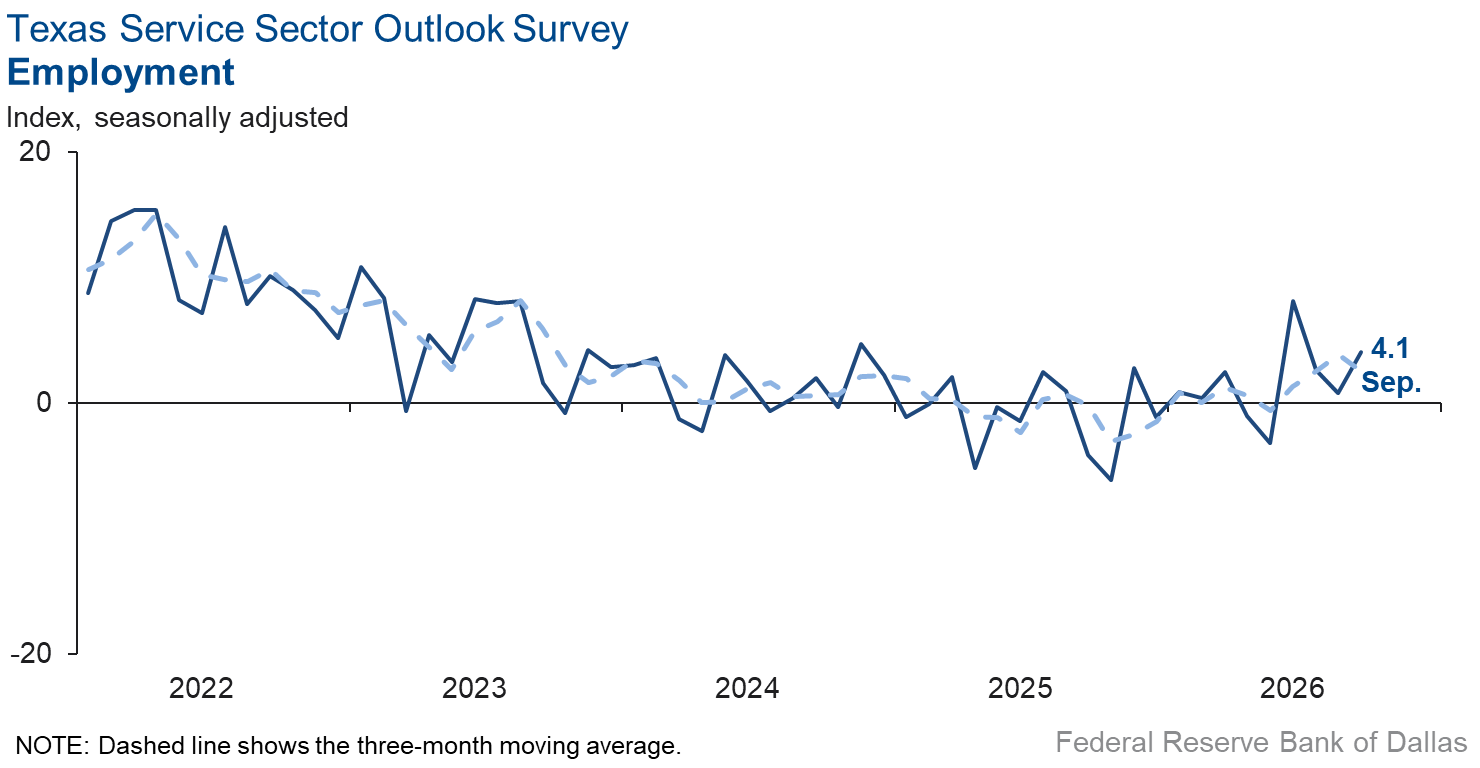
Labor market measures suggested a resumption in employment growth, while workweeks were unchanged. The employment index rose three points to 4.1, while the hours worked index dropped six points to 0.1.
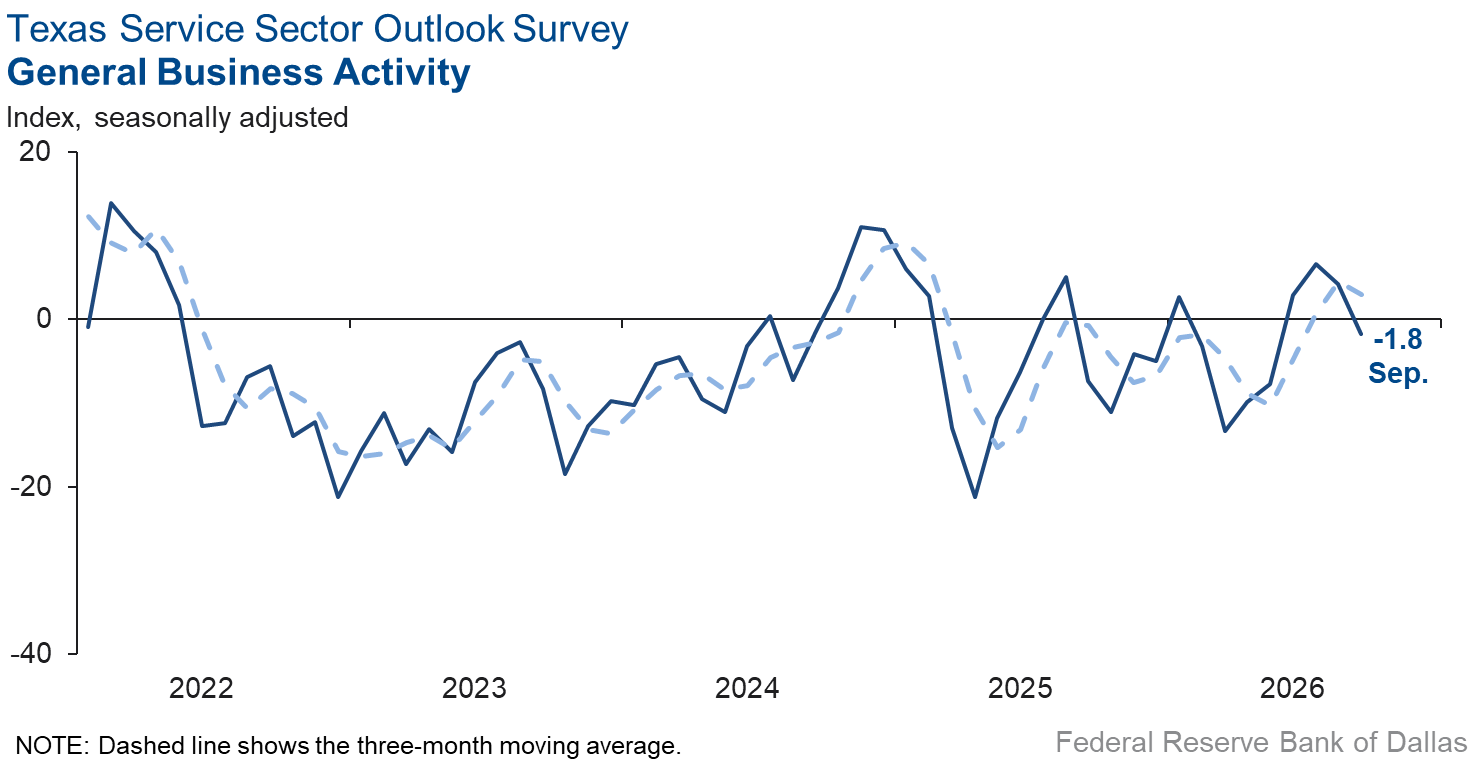
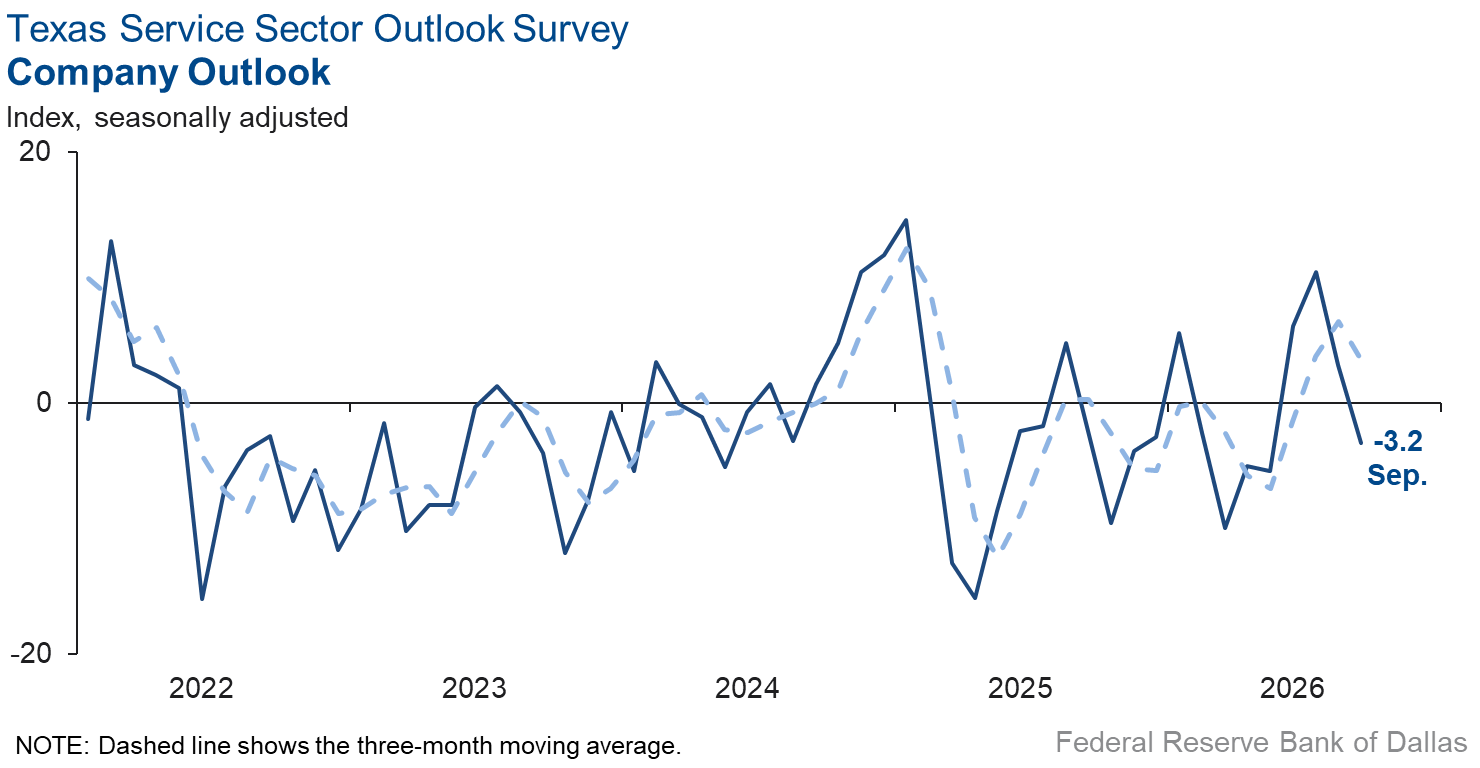
Perceptions of broader business conditions worsened in September. The general business activity index dropped six points to -1.8, slipping into negative territory. The company outlook index fell to -3.2 from 3.0. The outlook uncertainty index increased by nine points to 21.4, well above its series average of 14.1.
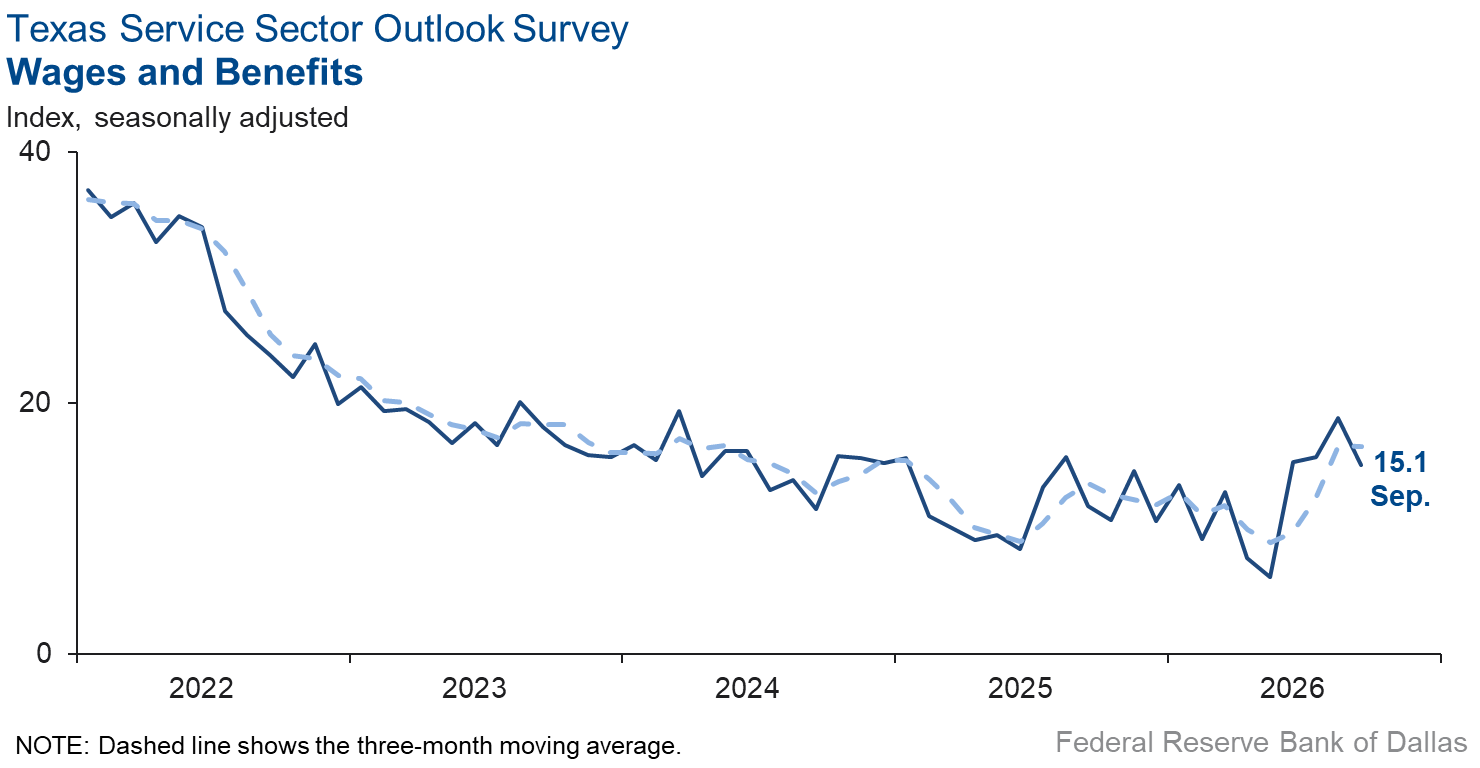
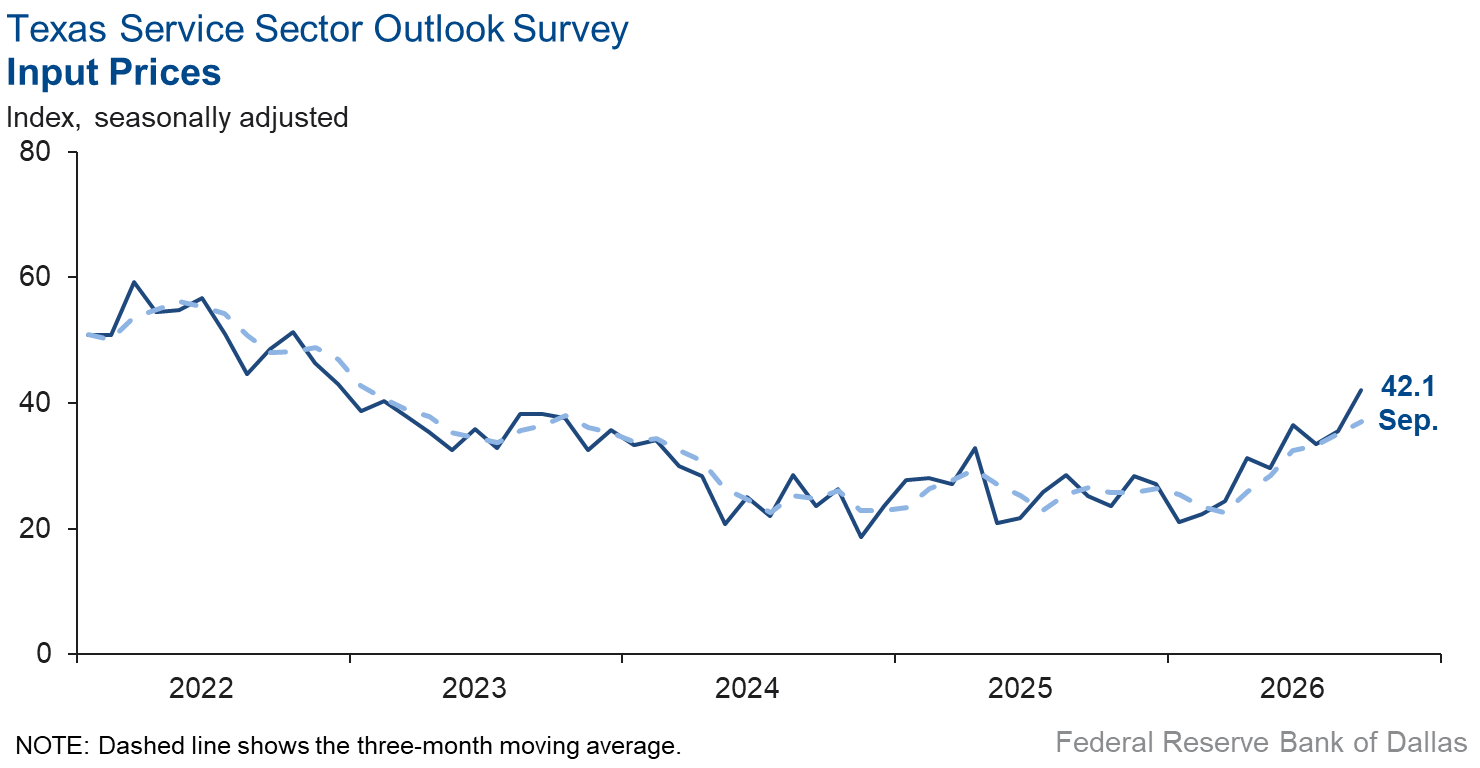
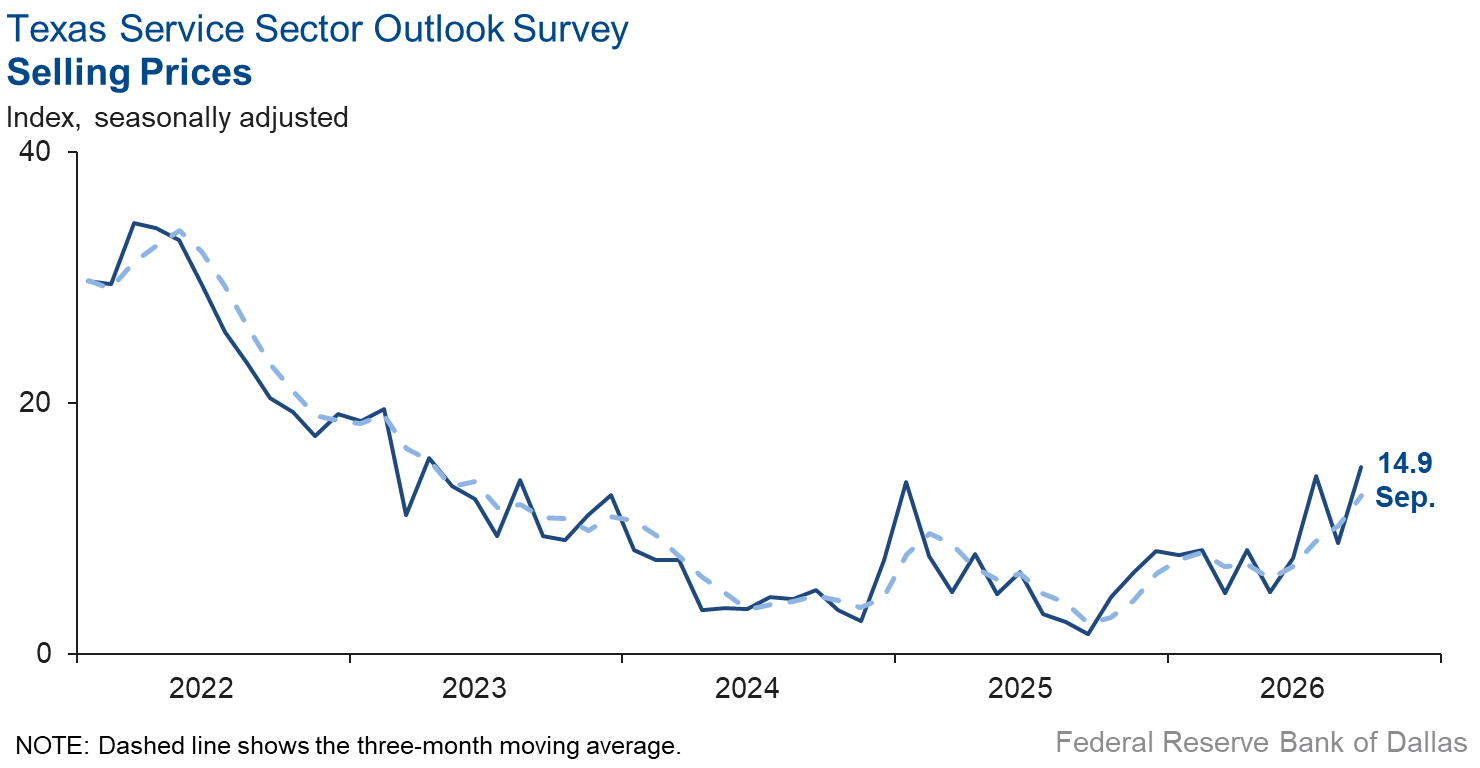
Input and selling price pressures increased, while wage pressures eased. The input prices index rose seven points to 42.1—its highest reading since December 2022. The selling prices index increased six points to 14.9. The wages and benefits index ticked down four points to 15.1, close to the series average of 15.4.
Respondents’ expectations regarding future business activity continued to reflect optimism. The future revenue index rose to 38.2 from 35.9, while the future general business activity index remained positive but declined eight points to 10.7. Other future service sector activity indexes, such as employment and capital expenditures, increased and remained in solidly positive territory.
Next release: October 27, 2026
Data were collected Sept. 15–23, and 234 of the 342 Texas service sector business executives surveyed submitted responses. The Dallas Fed conducts the Texas Service Sector Outlook Survey monthly to obtain a timely assessment of the state’s service sector activity. Firms are asked whether revenue, employment, prices, general business activity and other indicators increased, decreased or remained unchanged over the previous month.
Survey responses are used to calculate an index for each indicator. Each index is calculated by subtracting the percentage of respondents reporting a decrease from the percentage reporting an increase. When the share of firms reporting an increase exceeds the share reporting a decrease, the index will be greater than zero, suggesting the indicator has increased over the prior month. If the share of firms reporting a decrease exceeds the share reporting an increase, the index will be below zero, suggesting the indicator has decreased over the prior month. An index will be zero when the number of firms reporting an increase is equal to the number of firms reporting a decrease.
Data have been seasonally adjusted as necessary.
Historical data are available from January 2007 to the most current release month.
| Business Indicators Relating to Facilities and Products in Texas Current (versus previous month) | ||||||||
| Indicator | Sep Index | Aug Index | Change | Series Average | Trend* | % Reporting Increase | % Reporting No Change | % Reporting Decrease |
Revenue | –0.9 | 6.6 | –7.5 | 9.9 | 1(–) | 20.6 | 57.9 | 21.5 |
Employment | 4.1 | 0.8 | +3.3 | 5.7 | 4(+) | 11.7 | 80.7 | 7.6 |
Part–Time Employment | 4.0 | –1.8 | +5.8 | 1.2 | 1(+) | 6.9 | 90.2 | 2.9 |
Hours Worked | 0.1 | 5.7 | –5.6 | 2.4 | 4(+) | 5.7 | 88.7 | 5.6 |
Wages and Benefits | 15.1 | 18.8 | –3.7 | 15.4 | 76(+) | 17.5 | 80.1 | 2.4 |
Input Prices | 42.1 | 35.6 | +6.5 | 27.9 | 77(+) | 42.8 | 56.5 | 0.7 |
Selling Prices | 14.9 | 8.9 | +6.0 | 7.5 | 74(+) | 21.0 | 72.9 | 6.1 |
Capital Expenditures | 10.5 | 6.0 | +4.5 | 9.7 | 74(+) | 15.5 | 79.5 | 5.0 |
| General Business Conditions Current (versus previous month) | ||||||||
| Indicator | Sep Index | Aug Index | Change | Series Average | Trend** | % Reporting Improved | % Reporting No Change | % Reporting Worsened |
Company Outlook | –3.2 | 3.0 | –6.2 | 3.8 | 1(–) | 13.6 | 69.6 | 16.8 |
General Business Activity | –1.8 | 4.2 | –6.0 | 1.8 | 1(–) | 18.3 | 61.6 | 20.1 |
| Indicator | Sep Index | Aug Index | Change | Series Average | Trend* | % Reporting Increase | % Reporting No Change | % Reporting Decrease |
Outlook Uncertainty | 21.4 | 12.9 | +8.5 | 14.1 | 64(+) | 31.9 | 57.6 | 10.5 |
| Business Indicators Relating to Facilities and Products in Texas Future (six months ahead) | ||||||||
| Indicator | Sep Index | Aug Index | Change | Series Average | Trend* | % Reporting Increase | % Reporting No Change | % Reporting Decrease |
Revenue | 38.2 | 35.9 | +2.3 | 37.1 | 77(+) | 52.6 | 33.0 | 14.4 |
Employment | 27.7 | 19.3 | +8.4 | 22.8 | 77(+) | 35.5 | 56.7 | 7.8 |
Part–Time Employment | 3.4 | 6.5 | –3.1 | 6.4 | 3(+) | 10.8 | 81.8 | 7.4 |
Hours Worked | 6.6 | 5.7 | +0.9 | 5.8 | 15(+) | 11.7 | 83.2 | 5.1 |
Wages and Benefits | 47.1 | 40.6 | +6.5 | 37.6 | 77(+) | 49.4 | 48.2 | 2.3 |
Input Prices | 61.3 | 48.1 | +13.2 | 44.3 | 237(+) | 62.6 | 36.2 | 1.3 |
Selling Prices | 34.3 | 27.6 | +6.7 | 24.5 | 77(+) | 39.7 | 54.9 | 5.4 |
Capital Expenditures | 21.1 | 20.4 | +0.7 | 22.3 | 76(+) | 26.5 | 68.2 | 5.4 |
| General Business Conditions Future (six months ahead) | ||||||||
| Indicator | Sep Index | Aug Index | Change | Series Average | Trend** | % Reporting Improved | % Reporting No Change | % Reporting Worsened |
Company Outlook | 10.5 | 19.1 | –8.6 | 15.3 | 17(+) | 28.5 | 53.5 | 18.0 |
General Business Activity | 10.7 | 18.6 | –7.9 | 11.8 | 4(+) | 30.8 | 49.1 | 20.1 |
*Shown is the number of consecutive months of expansion or contraction in the underlying indicator. Expansion is indicated by a positive index reading and denoted by a (+) in the table. Contraction is indicated by a negative index reading and denoted by a (–) in the table.
**Shown is the number of consecutive months of improvement or worsening in the underlying indicator. Improvement is indicated by a positive index reading and denoted by a (+) in the table. Worsening is indicated by a negative index reading and denoted by a (–) in the table.
Data have been seasonally adjusted as necessary.
Comments from survey respondents
Survey participants are given the opportunity to submit comments on current issues that may be affecting their businesses. Some comments have been edited for grammar and clarity.
- Interest rates are going to be a problem.
- The 25 basis-point increase by the Fed will chill the real estate market. My over-the-fence neighbor who owns two properties that he will be selling said, "With the interest rate increase last Thursday, we are now in a buyer's market." Perception is reality.
- Corporate aircraft inspections have increased as far as hourly timed inspections. Calendar items are still being complied with on a consistent basis. They are flying more often at this point.
- Macro uncertainty around oil supply and price, as well as uncertainty around a workout for the Iran conflict are significant factors.
- Fed funds [rate] up 25 basis points. The economy will survive the rate hike.
- The interest rate environment will create challenges for pricing strategies.
- Customer uncertainty related to future interest rate levels has caused some to move to the sidelines for now.
- Consumers are beginning to feel the pinch of increased cost of goods and services, as well as credit.
- Interest rates are stifling. A $40 trillion national debt that must be financed is stifling. We the people should not have to compete with the government for funds.
- The current economic environment is driving rates up and increasing costs, reducing margins.
- Right now, the consumer is struggling because high oil prices and inflation are making nearly everything more expensive. Gas costs more, groceries cost more, and even basic bills like electricity and transportation are harder to keep up with. The consumer’s paycheck does not stretch as far as it used to, so they have to make tougher choices about what I can afford and what I have to cut back on. As prices keep rising, it feels harder to stay financially stable and manage everyday expenses.
- Food and fuel cost, as well as appliances, continue to increase. Luckily, we are in a necessity business. We are currently down about 50 percent from the same period last year. It is tough going out here.
- People seem to be spending less this month for fast food than over the summer.
- Ongoing Iran situation creating business uncertainty.
- Although we are not borrowers, an increase in interest rates always has a negative effect on what customers can tolerate. Customers tell me that even though they are making more money, it's getting hard to keep up in building a nest egg. My company increased prices in early July. We had some customer pushback, but it was necessary for the health of the company and our employees. This administration continues to drop the ball in understanding we the people are demanding lower gas prices, cheaper food and medicine prices and affordable housing, Unless Congress and the administration begin to tackle these issues, our customers will have less expendable cash, thus slowing down the economy.
- We've seen a slight uptick in revenue for the start of September, likely due primarily to the introduction of our popular fall signature drink line. Fuel prices have slightly impacted input costs. We are in the midst of 2027 planning now. Our view is that price increases are likely off the table or will be very minor and not across the board. Increasing input prices/cost of goods sold will negatively impact margins in 2027, so we plan to pursue lower-cost items and ingredients while placing maximum emphasis on the reintroduction of our loyalty/rewards program after the companywide introduction of a new, interactive customer-facing display at point of sale (POS). While 2026 has been a year of capital expenditure on systems, such as the Oracle/Symphony POS, the build and implementation of NetSuite ERP and various manufacturing and production equipment, none of that is in the budget/business plan for 2027. We will tighten our belts companywide to support margin, and capital expenditures will be primarily focused on new cafe builds in Houston, Dallas and Fort Worth. That said, we are slowing new cafe starts a bit [due to] the overall macroeconomic and geopolitical climate, as well as rising rates. We are still moving ahead to grow the business, but in a very measured, conservative manner.
- Threats of tariffs on some of the drug ingredients we procure.
- I am a little concerned about rising interest rates.
- Diesel costs heavily impact my business, and customers don't want to move forward with so much uncertainty in the world. Instead of making decisions, everyone is at a standstill.
- Increased interest rates and increased fuel prices are affecting customer activity as it relates to vehicle sales and service. While the market has been robust, we see some hesitation on consumer decisions.
- Fuel prices and interest rates impacting negatively.
- We are seeing an increase in delinquencies. This always leads to a tightening up of lending standards, which is always detrimental to our business. It definitely feels like a recession is right around the corner.
- No change in uncertainty. I still feel somewhat uncertain because we are in the fuel business. And we haul fuel to homes, so we are necessarily in the transportation business.
- The volatility in public policy and other shocks to the system are impacting consumer willingness to make plans for the future, which impacts our ability to sell events. Increasingly, we are seeing sales cluster in the ten days before the event, which hurts both cash flow and our ability to plan.
- Prolonged financial pressures forcing downsizing implementation.
- We are seeing an uptick in the number of new projects. Our backlog is improving. My main concern is that our most active sector is our government clients. We are not seeing much movement in the private sector.
- Clients are reducing nonessential purchases across all verticals.
- It is becoming increasingly difficult to understand how the commercial real estate market continues to transact at its current pace given the number of economic and geopolitical headwinds we are facing. The crisis in Iran, a 10-year Treasury at or near 5 percent, federal debt exceeding $40 trillion and inflation that remains stubbornly elevated are all putting additional pressure on an already-challenging capital markets environment. At the same time, the residential market is facing renewed pressure as 30-year mortgage rates move back above 7 percent, further straining affordability and transaction volumes. Any one of these issues would create uncertainty. Taken together, they are beginning to look like the ingredients for a perfect storm. The question may no longer be whether these pressures slow the real estate market, but whether they ultimately become enough to push the broader economy into recession.
- The Iran war [is an issue affecting our business].
- Our potential new clients are primarily foreign companies benefiting from a more favorable exchange rate due to the weaker US dollar, but they are becoming increasingly cautious about expanding in the US because the benefits of doing so are less clear.
- The increase in fuel prices and the rise in interest rates are likely to impact the economic activity in the architectural, engineering and construction industry.
- We are anticipating new growth in the next six months, but not necessarily because of improvement in market conditions. We have been working hard to adapt our strategies and tactics in response to the shifting priorities of our clients, mostly driven by federal policy and funding changes.
- Government retraction from protecting the overall business environment causes cascading uncertainty. While rising uncertainty creates opportunities for our company, it raises exposure to more negative potential outcomes for the environment in which we work.
- The U.S. business market has adjusted to the war in the Middle East and to inflation, and many companies are ready to move on.
- AI spending is increasing, both in seeking operational efficiency as well in AI-optimized marketing (versus SEO-based marketing).
- All our customers are in a holding pattern. They are not stopping projects, but they are not starting new ones, either.
- We are a recruiting firm, and demand is strong. Companies in industries with growing activity are relying on us to fill hard-to-find roles, where the right candidates are already employed and not actively looking.
- [We are seeing] military and some U.S. enterprise opportunities for advanced user-interface software versus license or contract partners-. Uses [ranging] from planned augmented reality apps to training are improving.
- Not a lot has changed since the last month, both on the company level and industry level, but I expect that to change over the next six months because inflation, energy costs, the war in Iran and overall election results/fallout are massive unknowns.
- Investors hate uncertainty, regardless of the direction. The current chaos in government policy causes our investors a great deal of heartburn over current investments as well as any potential new considerations.
- Interest rates remain far too high. We are approaching stabilization in the real estate markets. When that happens, the high interest rates will drive higher real estate inflation
- Our back-to-basics strategy and focus on money in the bank is working. The apartment business is brutal right now, but our old-school style and approach are winning new and better management clients. AI is helping us and promises to revolutionize how the back end of our industry runs.
- The continuing chaos with Iran, and the midterm elections being so soon are making predictability difficult. We are trying to just focus on our business and our local issues, hoping things will improve after the elections. Business is decent, but the noise is impacting small businesses’ willingness to make long-term commitments.
- Higher interest rates will negatively impact commercial real estate values and transactions.
- Interest rates and fuel prices are hurting us.
- Mistaken non-market policies are being implemented by policy makers.
- Data centers [offering high wages] are driving labor costs through the roof. What local construction company can compete with that? I may sell the company and go work for them.
- Small and medium-sized business mergers and acquisitions activity has picked up to normal seasonal levels. Uncertainty has faded somewhat, with no new surprises from the macro environment.
- Firms are seemingly hunkering down and slowing capital spending, especially in expansion.
- Heavy focus on data centers, little or no capital expenditures on the federal/state level.
- The influx of unqualified driver capacity into the trucking market over the past several years contributed to unsustainably low freight rates and the failure of many U.S.-owned trucking companies. As excess capacity has [gone away], supply and demand have begun to rebalance, resulting in improved freight volumes and rates that are moving toward more sustainable levels for carriers.
- The issue is the Iran war. Businesses are in some limbo over the direction our country and the deficit are headed.
- Public sentiment around data centers and political winds cause some level of uncertainty [regarding] our ability to contract data-center business.
- Everything is stable at the moment, even with the backdrop of the Iran war. Potential talk of a ban on exporting some energy products is troubling. But [we expect] no impact unless it's actually done, in which case we would expect an overall negative impact to our operations through higher diesel costs and also a reduction of overall supply [of affected products] in the U.S. as part of the demand signal (exports) is eliminated. For next year, we expect continued expansion of our business and intend to add workforce.
Special questions
For this month’s survey, Texas business executives were asked supplemental questions on wages, prices and outlook concerns. Results below include responses from participants from both the Texas Manufacturing Outlook Survey and Texas Service Sector Outlook Survey. View individual survey results.
Historical Data
Historical data can be downloaded dating back to January 2007.
Indexes
Download indexes for all indicators. For the definitions of all variables, see data definitions.
| Unadjusted |
| Seasonally adjusted |
All Data
Download indexes and components of the indexes (percentage of respondents reporting increase, decrease, or no change). For the definitions of all variables, see data definitions.
| Unadjusted |
| Seasonally adjusted |
Questions regarding the Texas Service Sector Outlook Survey can be addressed to Isabel Brizuela.
Sign up for our email alert to be automatically notified as soon as the latest Texas Service Sector Outlook Survey is released on the web.