
Texas community college enrollment slips while four-year rates stay stable
In recent years, surveys have suggested that young Americans are increasingly skeptical about the value of a college education. Perceptions that a college education doesn’t offer the gateway that it once did raise an important question for lawmakers and educators: Are these changing attitudes translating into fewer students enrolling in college or completing degrees?
Administrative data from Texas provide a detailed view of how college enrollment patterns have evolved over the past three decades. The results suggest a greater number of Texas students are enrolling in four-year colleges. Enrollment rates among high school graduates have remained stable as their number has increased.
Additionally, the data show that students enrolling in four-year colleges are completing bachelor’s degrees at higher rates, especially among those from underserved backgrounds. The surprising finding, meanwhile, is that the two-year college enrollment rate, or the percentage of high school graduates enrolling in two-year colleges immediately following graduation, is in a long-run decline.
Understanding these patterns is important for economic growth and the labor market, as generative artificial intelligence’s impacts are growing, especially among young workers. Moreover, Texas has a deficit of high-skilled workers, and typically fills the gap with domestic and international in-migration, both of which are waning. At the same time, there are looming shortfalls nationwide and regionally in the skilled trades, occupations where community colleges fill a critical role.
Texas education data provide unique insights
Our analysis primarily relies on detailed administrative student-level data from the Texas Education Agency (TEA) and the Texas Higher Education Coordinating Board. The TEA data include student demographics and performance for anyone attending a K–12 public school in Texas. Coordinating board data include student-level information and institution characteristics, such as whether a college is a four-year (public or private) school or a two-year one.
These data enable calculation of the on-time enrollment rate, or the percentage of high school graduates who matriculate in a Texas college in the fall immediately following graduation. Data from the National Student Clearinghouse supplies information on Texas students who attend college out of state, providing a more complete picture of high school graduates’ enrollment decisions. Employee-level wage data from the Texas Workforce Commission are used to compute the college wage premium for two- and four-year schools.
These administrative datasets are beneficial for a handful of reasons, with some caveats. Using unique individual identifiers that are common across datasets allows observation of long-term outcomes. Detailed demographic information allows analysis of differences between subgroups.
However, the data only provide insight on students and wages for Texas. Additional datasets allow a comparison of trends in Texas and nationally. The National Center for Education Statistics hosts the Integrated Postsecondary Education Data System and publishes high school graduation statistics for each state. These datasets enable cross-state and state-nation comparisons and are used to verify the representativeness of our administrative data samples.
There are limitations. Looking at on-time enrollment excludes non-traditional students, such as those who enroll later in life and are more likely to enroll in a community college. These data also exclude students who attended private high schools, out-of-state students who may end up attending college in Texas or high school students enrolling in community college courses for dual credit.
On-time enrollment in community colleges declines
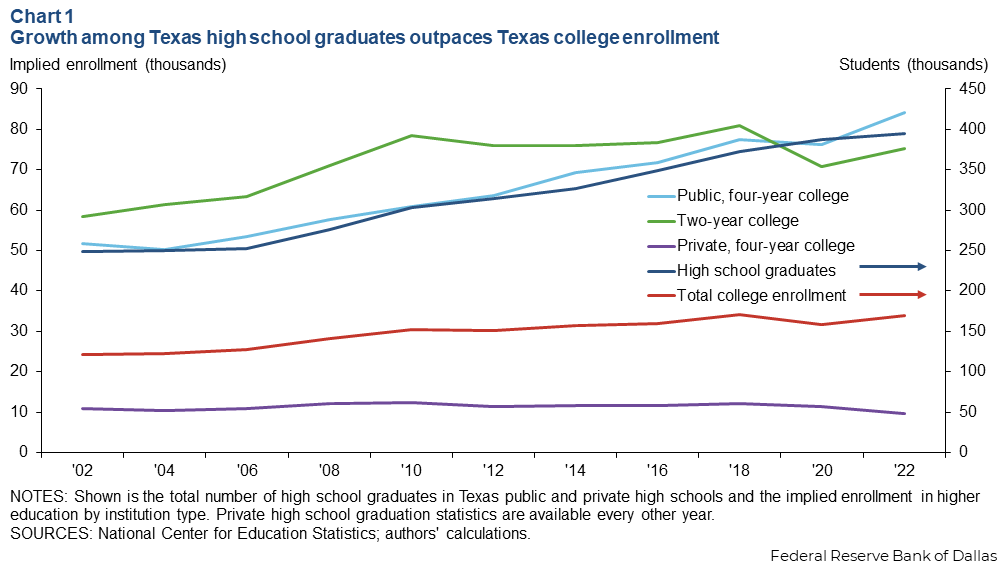
The number of Texas high school graduates increased 58.6 percent, from 249,000 to 394,000 during the 2002 to 2022 period (Chart 1). While college enrollment grew, it has not kept pace. Over the same period, college enrollment increased from 121,000 to 169,000, a 39.6 percent increase.
A sharp decline in two-year college attendance rates since 2009 is the most striking change in Texas college enrollment patterns (Chart 2). An average of 24.7 percent of students who graduated high school from the mid-1990s to late 2000s then enrolled in community college following graduation. Beginning around 2010, however, that share began steadily falling to an average of 18.7 percent over the past five years, including a sharp postpandemic decline. Notably, this decline has not been offset with a rise in enrollment in technical programs.
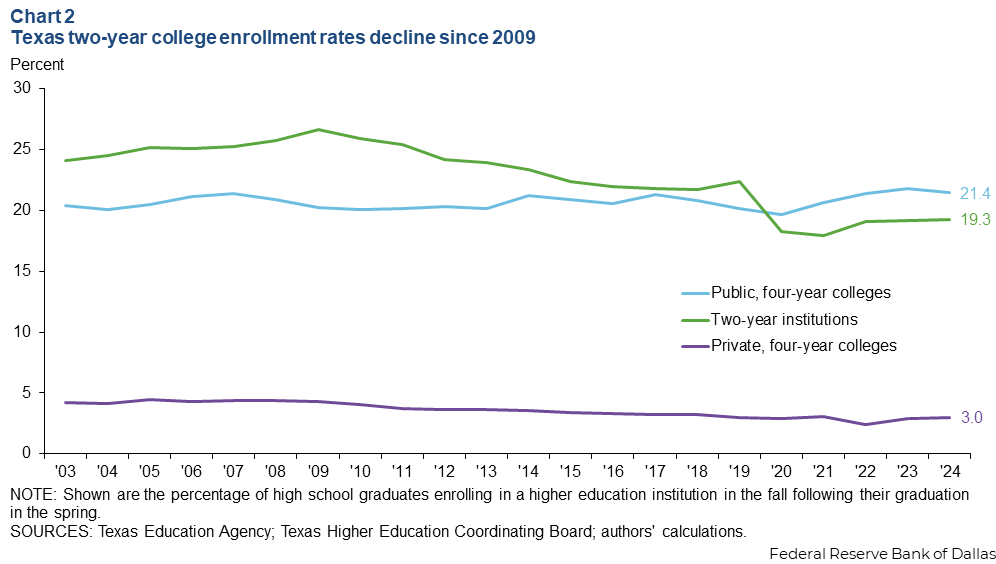
By contrast, enrollment in public four-year universities has been remarkably stable across groups graduating high school between the mid-1990s and early 2020s. Private college enrollment is relatively small and has gradually slipped since the early 2000s.
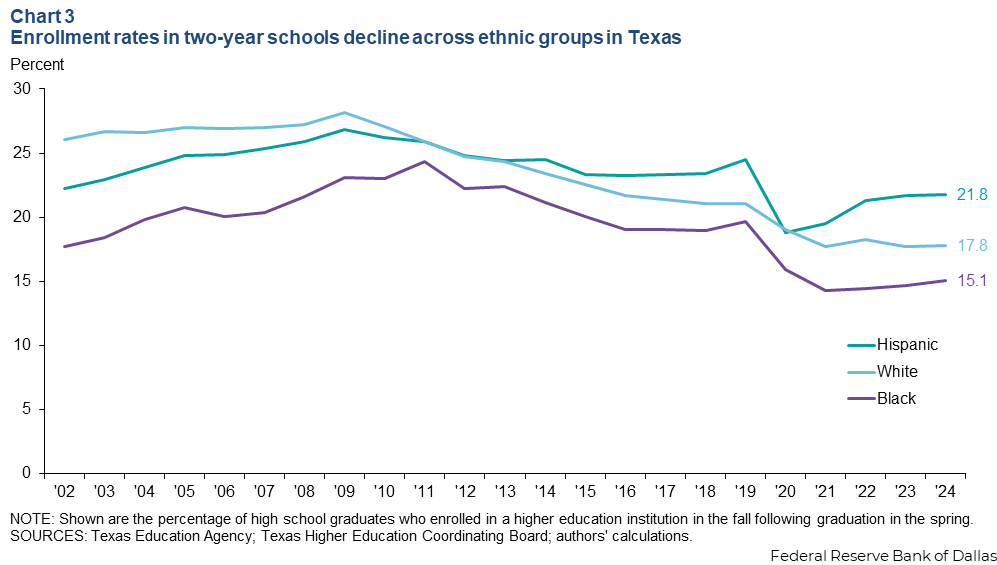
The decline in the two-year college enrollment rate occurs across demographic groups (Chart 3). White non-Hispanic students experienced the largest percentage point decline in on-time, two-year college enrollment, falling from 27.1 percent in 2010 to 17.8 percent in 2024. Hispanic students’ rate fell from 26.2 percent to 21.8 percent, while Black students’ rate fell from 23.0 percent to 15.1 percent.
Since 2009, women have increasingly enrolled in public four-year institutions and less frequently in two-year schools. Meanwhile, men’s enrollment has remained steady in public four-year institutions and declined in two-year schools (Chart 4).
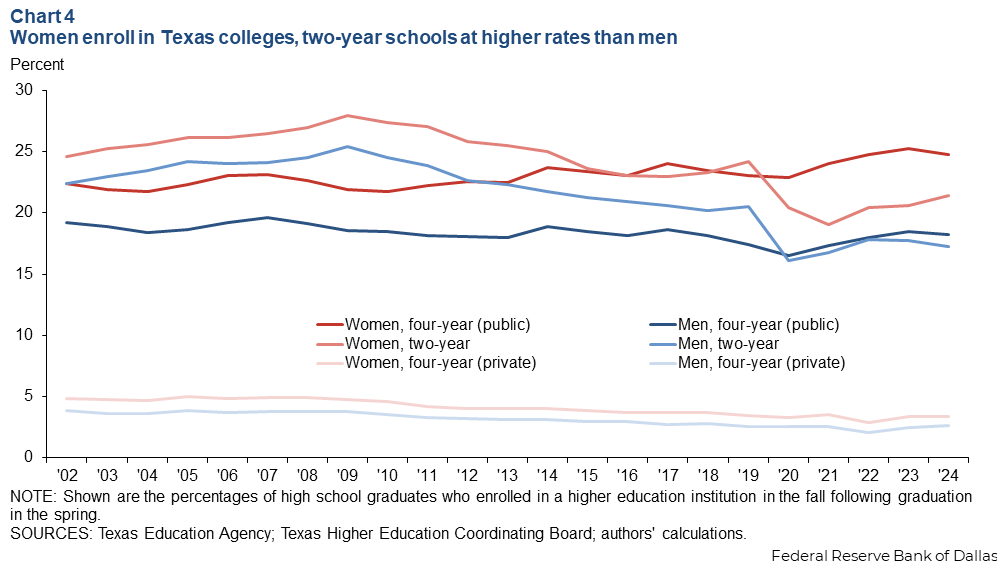
In 2010, 21.7 percent of women graduating from high school enrolled in a public four-year college. The share grew to 24.7 percent in 2024. Women’s two-year enrollment fell from 27.4 percent to 21.4 percent from 2010 to 2024. Men’s two-year enrollment similarly declined, from 24.5 percent to 17.2 percent. Four-year enrollment was little changed, hovering near 18.0 percent throughout the 2010s.
Top Texas students drawn to out-of-state study
TEA and the Texas Higher Education Coordinating Board data paint a detailed picture of trends within Texas. However, additional data is needed to understand if students are leaving the state. National Student Clearinghouse data shows out-of-state enrollment is a small and increasing component of overall college enrollment since 2015. Among high school graduates in 2015, 7.8 percent left Texas for higher education. This proportion rose to 9.4 percent in 2022.
While the growing share was similar across race and gender categories, it was not uniform for different levels of student achievement. The highest achieving students attend out-of-state colleges at higher rates than their peers. The share of students in the highest quartile of test scores attending college out of state grew from 6.8 percent in 2015 to 12.6 percent in 2022. This was the greatest change of any quartile. Students in the lowest quartile of test scores left the state for college at a rate of 3.3 percent in 2015 and 5.3 percent in 2022.
Additionally, students attending college out of state are less likely to work in Texas six years after high school graduation than those attending college in-state. This suggests that the decision to attend college out of state is a form of brain drain.
Although students are leaving the state at higher rates, this is not unique to Texas. Across the nation, more students choose to attend college out of state, suggesting Texas may be gaining students from other states, which could offset the outflow. However, most of the nation’s top colleges are not in Texas, which may pull the best students out of the state. Growing out-of-state enrollment may be the sign of an increasingly interconnected economy rather than a cause for concern.
Out-of-state enrollment doesn’t likely explain the enrollment drop-off in two-year institutions. Students enrolling in two-year institutions are significantly less likely to do so out of state.
College completion rates rise
Some decline in two-year enrollment rates can be attributed to students entering four-year public institutions instead. Many students after 2009 who were previously most likely to attend two-year institutions opted instead for four-year schools, based on detailed demographic and educational data.
Students who attend college in-state and on-time in Texas are also more likely to obtain bachelor's degrees within six years of initial enrollment compared with students a decade prior. This holds true for students in four-year and two-year institutions. The share of students who enrolled in public colleges and graduated with a bachelor's degree within six years grew from 62.6 percent to 67.3 percent, from 2010 to 2017. For those who initially enrolled in two-year colleges the number increased from 17.1 percent to 19.7 percent.
This improvement is especially pronounced for students from underserved backgrounds. While the rate of bachelor’s attainment for white non-Hispanic students who enrolled in public universities increased from 71.2 percent to 74.9 percent over this period, it grew from 54.4 percent to 61.6 percent for Hispanic students, and from 45.2 percent to 50.1 percent for Black students (Chart 5).
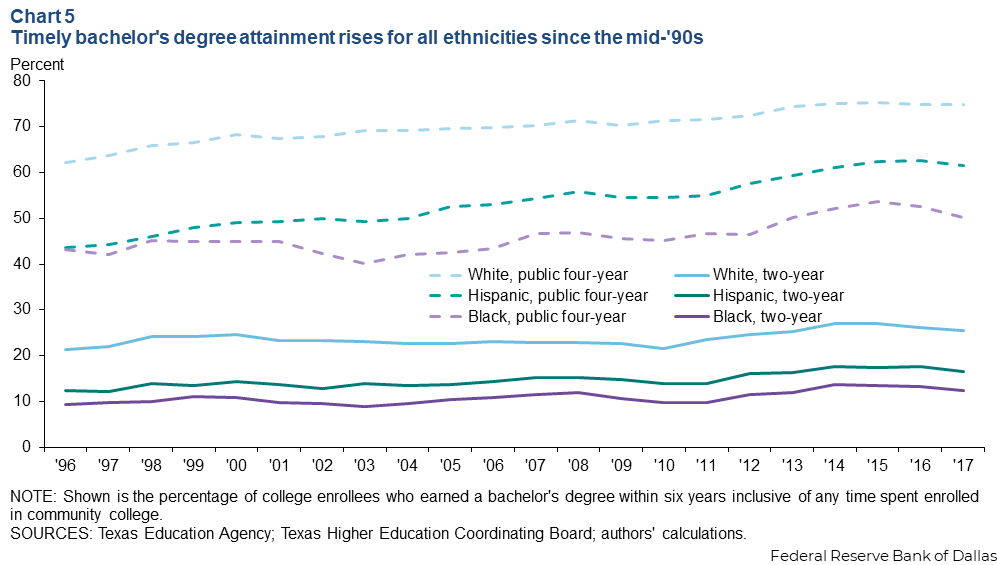
In two-year institutions, eventual bachelor’s completion grew notably. More students who initially enrolled in two-year institutions continued their higher education to get a bachelor’s degree. Black students’ bachelor completion rate increased 2.6 percentage points to 12.4 percent, Hispanic students’ rate rose a similar amount to 16.4 percent, and the white non-Hispanic students’ rate increased from 21.6 percent to 25.5 percent.
Declining enrollment rates and improving bachelor’s degree attainment implies a selection effect, with students who would perform worse in two-year institutions electing to not enroll and those who continue to enroll, performing better on average.
Another important outcome is the wages those who enroll in college earn. The wage premium, or the ratio of average wages for one level of education to another, is a driver of education decisions. And changes in aggregate enrollment shares have the potential to shift wages.
Thus, long-run wages for those who enroll in four-year and two-year colleges can provide clarity on employment outcomes for these two groups. The wage premium for high school graduates who enroll in two- or four-year institutions was compared with the wage premium of those who do not. Although this underestimates the wage premium for degreed graduates, it is a useful measure of the returns to education.
For 2013 high school graduates who subsequently enrolled in a four-year public college in Texas and were employed 10 years later (in 2023) in Texas, earnings were nearly 1.5 times those who did not attend any college, or an average wage of $53,820 for public college graduates compared with $36,170 for high school graduates (Chart 6).
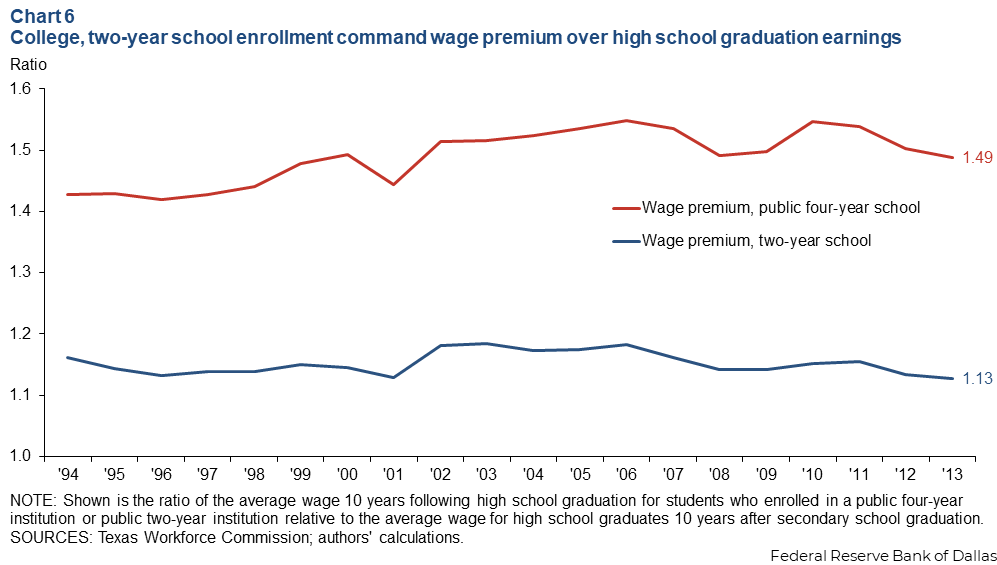
Students who enrolled in a two-year college earned wages 1.13 times of those without any additional education, or an average annual wage of $40,770. A flat wage premium means that there remains an economic advantage to attending college, but no deterioration of relative wages for those who do not attend despite a greater supply of such workers.
Explaining the lower community college enrollment
High school graduates may choose to forego two-year college enrollment for a variety of reasons. If the opportunity cost of attending college increases, meaning alternatives to higher education such as working are relatively more attractive, more students will opt out. This mechanism would be apparent if, as labor market conditions improve, graduates choose work over education.
Research analyzing oilfield fracking occupations and high school completion shows graduates opting for energy sector jobs during oil booms rather than pursuing additional education. Other studies find declining two-year college enrollment nationwide, partly because of local unemployment rates falling. Still others suggest that the economic recovery following the Great Recession and growing wages in jobs not requiring additional education could explain the decline in two-year institution enrollment.
Comparing the difference in enrollment trends over time in shale counties—those where fracking is economically significant—relative to all other counties provides clues about the potential economic motivations for falling enrollment.
Shale counties experienced greater declines in two-year college enrollment than other counties following the Great Recession. The period coincides with the shale oil and gas boom, a period of strength in the Texas oil and gas industry, in which oilfield-related alternative job prospects were stronger relative to other periods.
Although the decline was greater in these counties, two-year-school enrollment in non-shale counties also fell. Combined with findings on the wage premium suggests additional non-economic reasons for the enrollment decline.
Two-year schools expand accessibility
The overall higher-education landscape is evolving at a time when community colleges face serious challenges. Community colleges have responded by expanding non-degree credentials and certifications to build workers’ skills as well as some offering their own version of bachelor’s degrees in many common fields such as nursing and education.
Some are integrating non-degree credentials into degree programs, keeping the door open for students to return to complete a degree program. Additionally, community colleges are expanding offerings targeted at non-traditional students, specifically high school students in dual credit courses and midcareer learners.
About the authors

Christa Deneault is a senior research economist in the Research Department at the Federal Reserve Bank of Dallas.

Isabel Dhillon is a former research analyst in the Research Department at the Federal Reserve Bank of Dallas.

Dylan Council is a research analyst in the Research Department at the Federal Reserve Bank of Dallas.

