Dallas−Fort Worth Economic Indicators

| DFW economy dashboard (December 2025) | |||
Job growth (annualized)
Sep.–Dec. '25 |
Unemployment rate |
Avg. hourly earnings |
Avg. hourly earnings growth y/y |
-0.3% |
4.0% | $37.16 | 3.1% |
Growth in the Dallas–Fort Worth economy was mixed in recent months. Employment increased in December while unemployment declined. Hourly earnings declined but remained higher than the state and nation as well as year-ago levels. Existing-home sales and multifamily rental rates declined in January.
Labor market
Employment increases
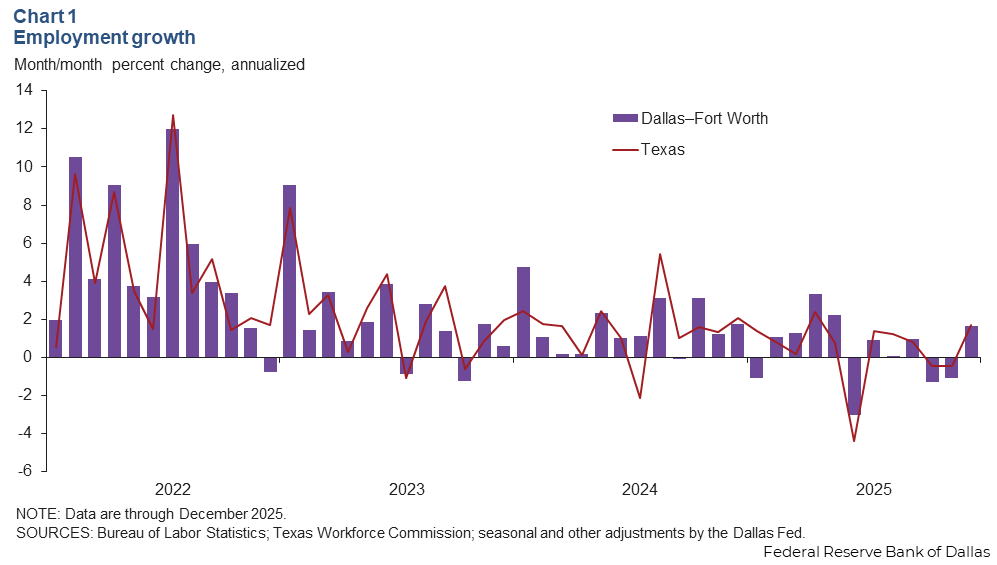
Employment in Dallas−Fort Worth rose an annualized 1.6 percent in December after falling 1.1 percent in November (Chart 1). Employment in Texas rose 1.7 percent in December. Dallas−Fort Worth job growth in the three months ending in December dipped. Job gains were seen in information, trade, transportation and utilities, and education and health services. Meanwhile, employment declined in professional and business services, leisure and hospitality, manufacturing, and construction.
Unemployment dips
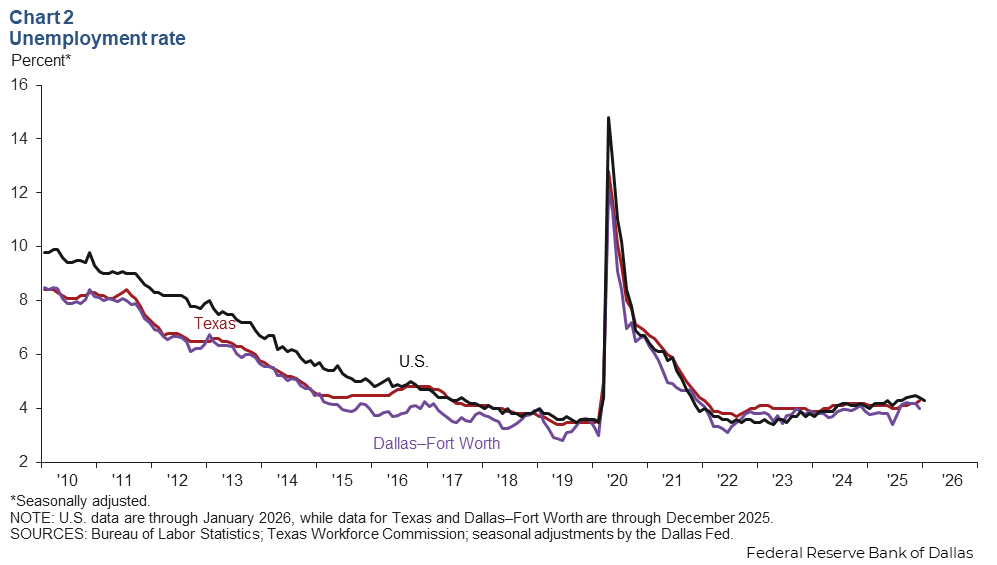
Alongside growth in payroll employment, the Dallas−Fort Worth unemployment declined to 4.0 percent in December (Chart 2). The December jobless rate was 4.1 percent in Dallas and 4.0 percent in Fort Worth, lower than Texas’ jobless rate of 4.3 percent. The U.S. unemployment rate was 4.3 percent in January.
Earnings decline in December
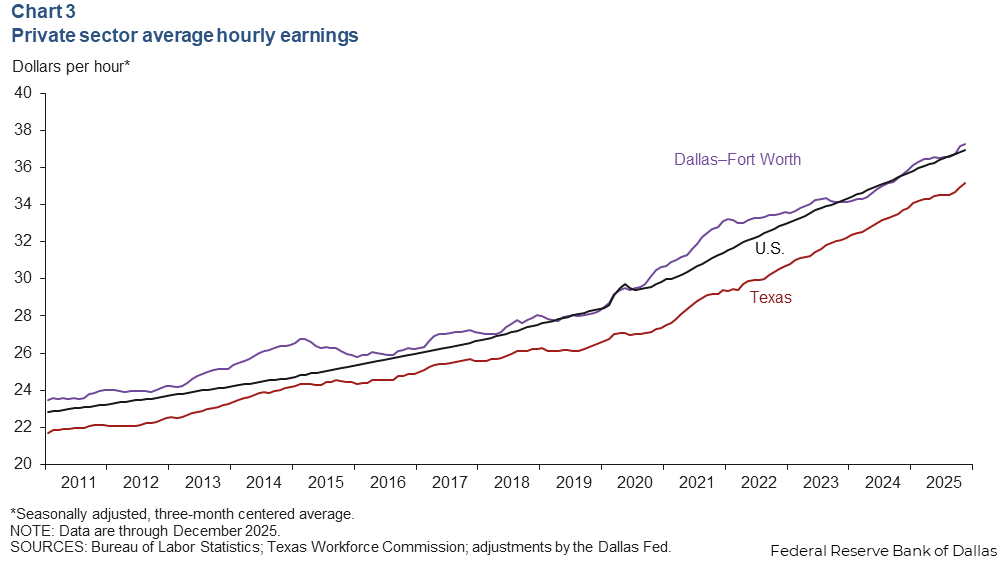
The average nominal hourly wage in Dallas−Fort Worth declined to $37.16 in December, down from $37.73 in November. Hourly wages in the region were above the state figure ($35.40) (Chart 3). The national average hourly wage ticked up to $37.02 in December, 3.7 percent above year-earlier levels. Year over year, hourly earnings were up 3.1 percent in the metro area, lagging the state (3.9 percent) increase.
Housing
Existing-home sales decrease
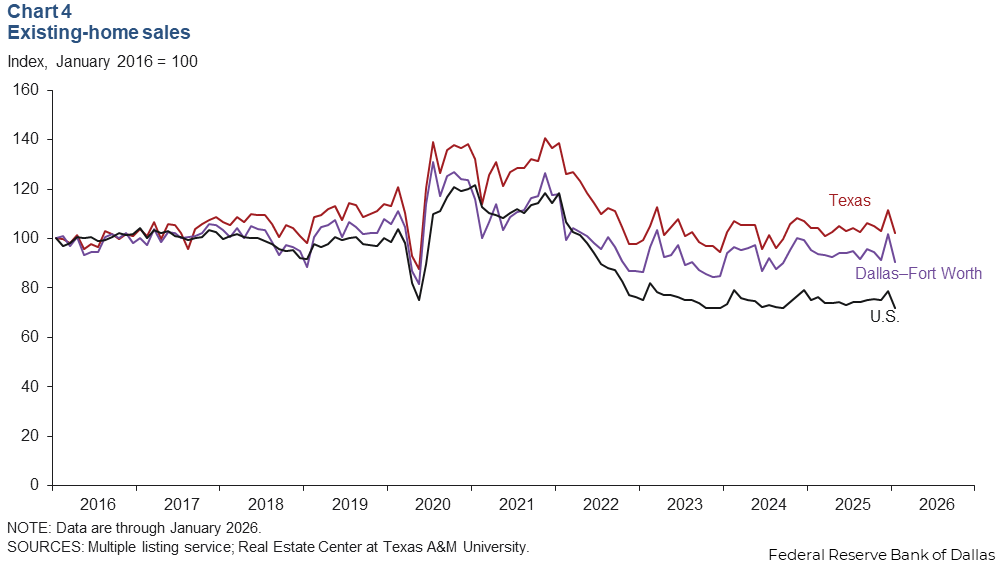
Housing demand declined in January. DFW existing-home sales decreased 11.0 percent in January after growing 11.3 percent in December (Chart 4). Statewide, sales decreased 8.3 percent in January, while they declined 8.4 percent nationally. Year over year, existing-home sales were down 5.0 percent in DFW, 1.9 percent statewide and 4.4 percent nationally.
Apartment rents continue to decline
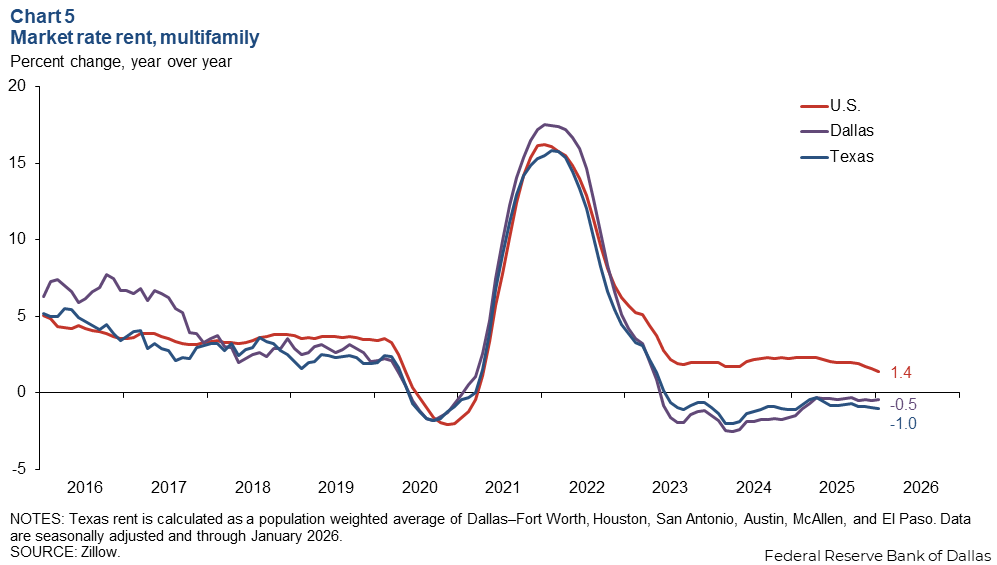
Apartment rents in Dallas declined 0.5 percent in January from year earlier levels and were down 1.0 percent in Texas but rose 1.4 percent in the U.S. (Chart 5). At $1,490 in January, Dallas rental rates remained below the U.S. average of $1,740 but above the Texas average of $1,400. In January, rents dipped 0.1 percent in Dallas, 0.2 percent in Texas and were flat nationally.
NOTE: Data may not match previously published numbers due to revisions.
About Dallas–Fort Worth Economic Indicators
Questions or suggestions can be addressed to Dylan Council. Dallas–Fort Worth Economic Indicators is published every month after state and metro employment data are released.