Texas Service Sector Outlook Survey


Growth resumes in Texas service sector activity
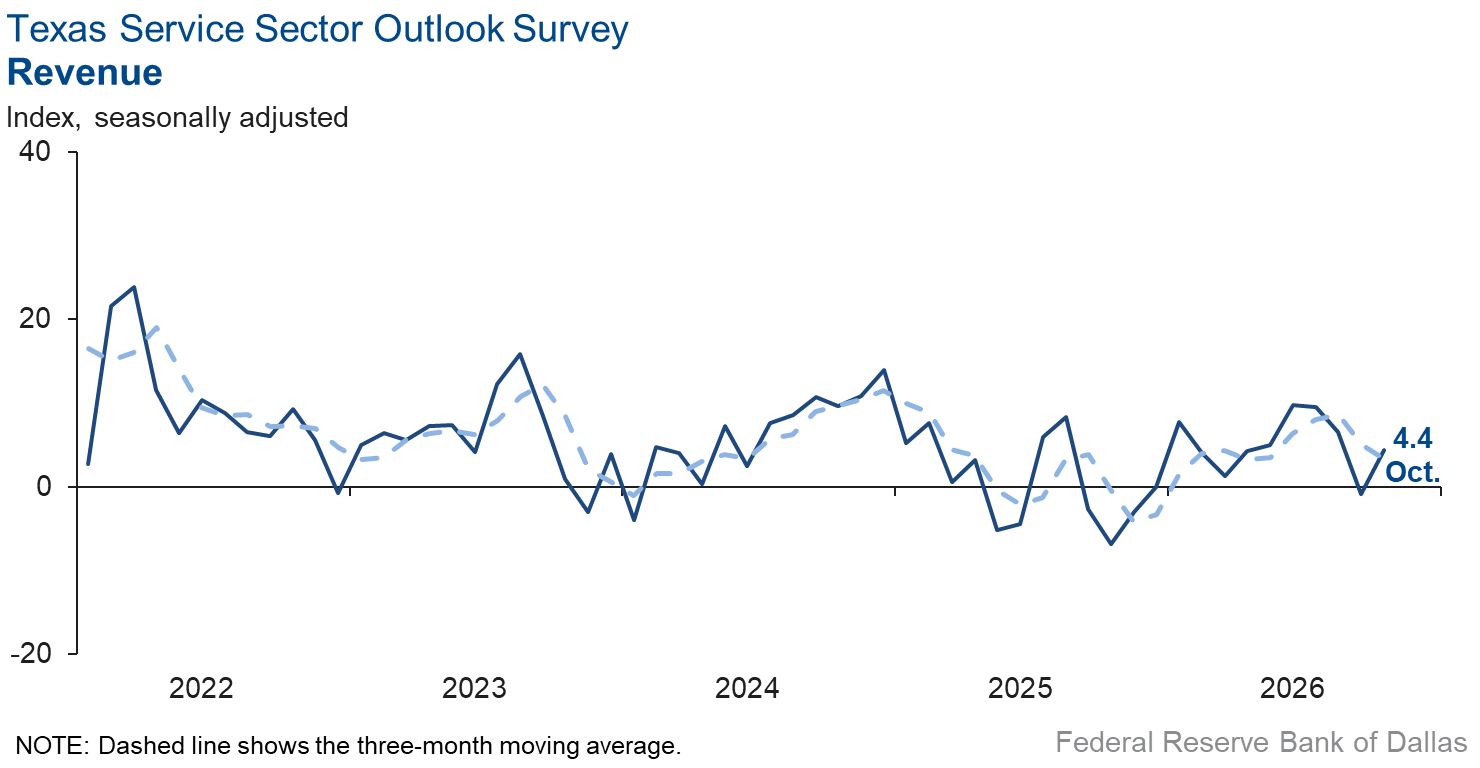
Texas service sector activity grew in October after stalling the prior month, according to business executives responding to the Texas Service Sector Outlook Survey. The revenue index, a key measure of state service sector conditions, rose five points to 4.4.
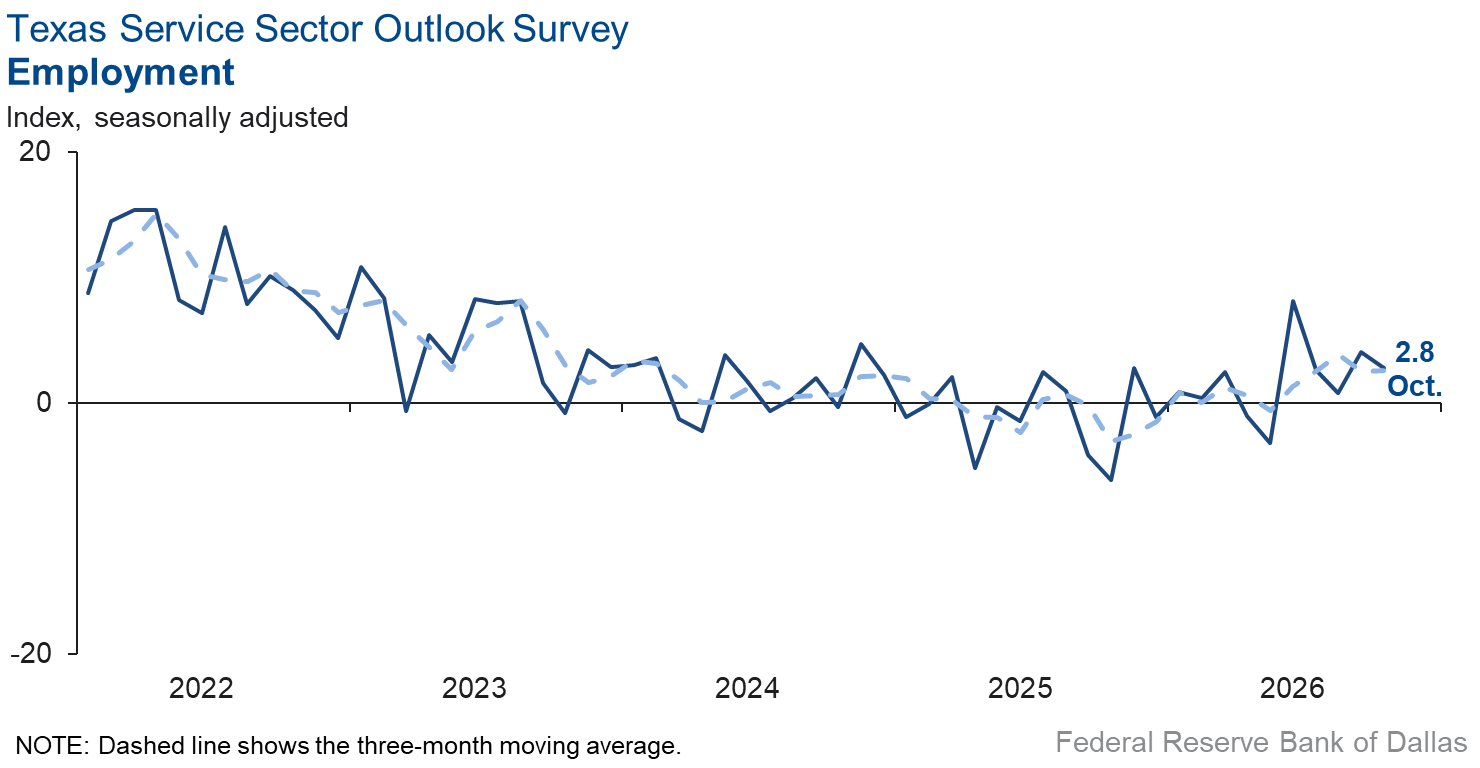
Labor market measures suggested continued growth in employment and expansion in workweeks. The employment and part-time employment indexes were little changed, registering 2.8 and 2.6, respectively. The hours worked index edged up to 2.2 from 0.1.
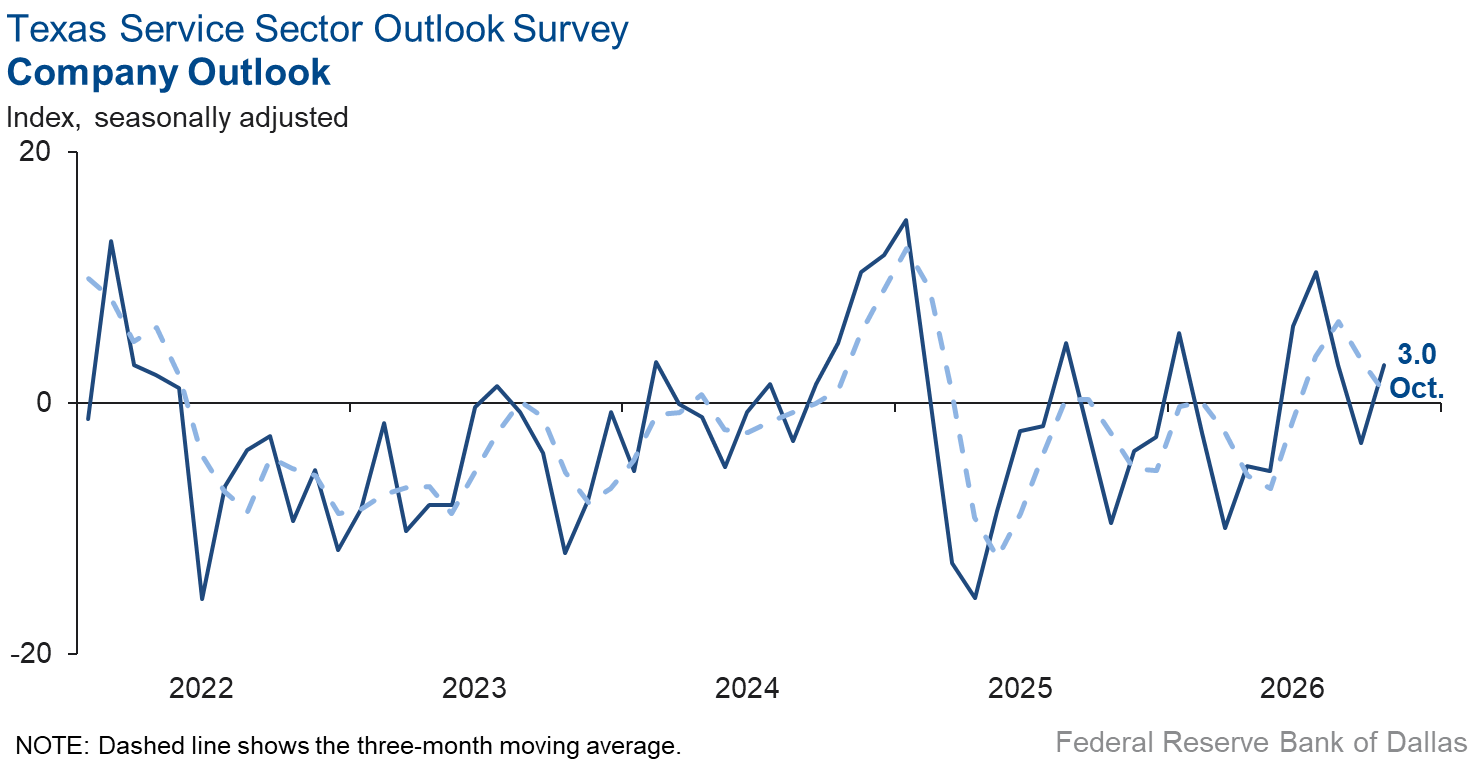
Perceptions of broader business conditions improved in October, with the two key indexes turning positive. The general business activity index rose to 4.0 from -1.8, and the company outlook index rose to 3.0 from -3.2. Meanwhile, the outlook uncertainty index fell five points to 16.3.
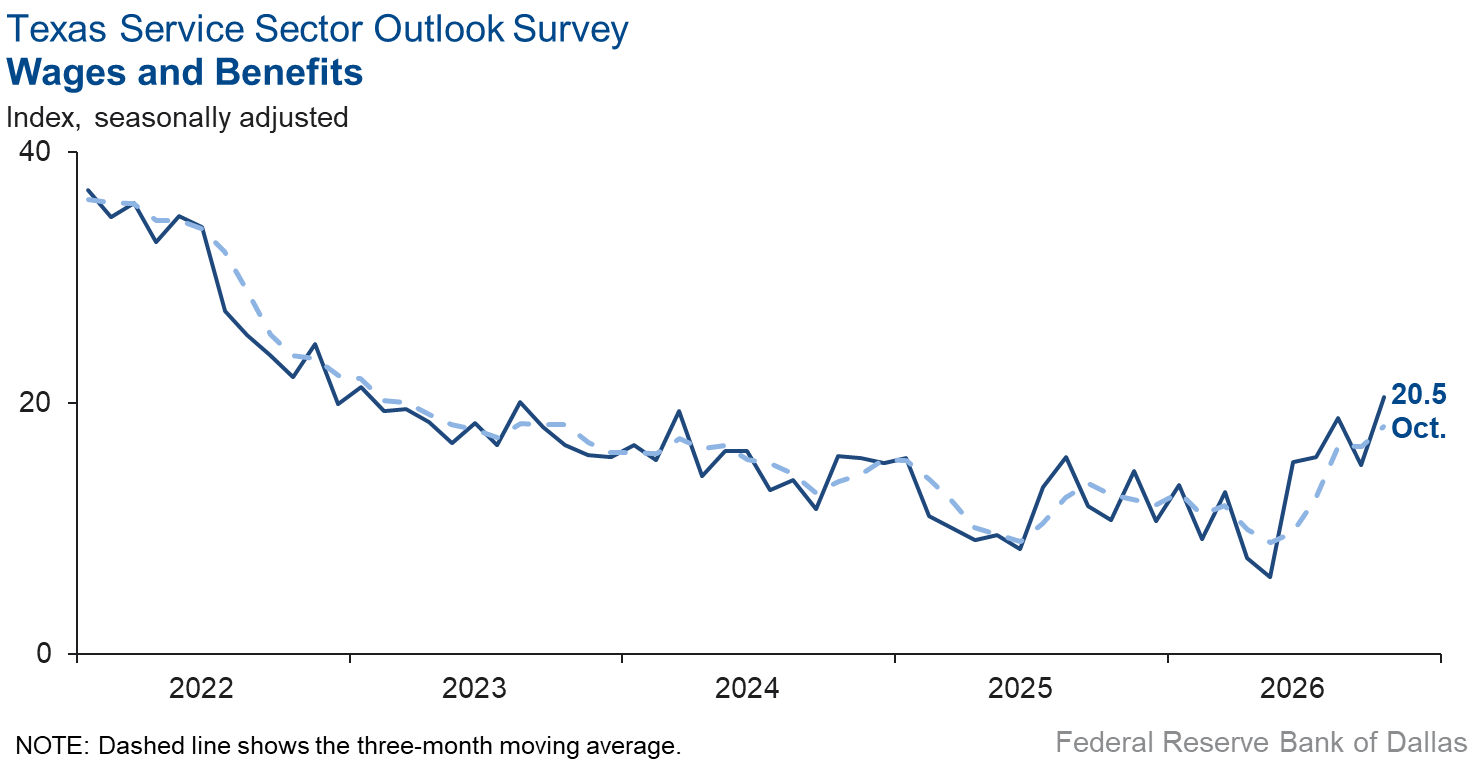
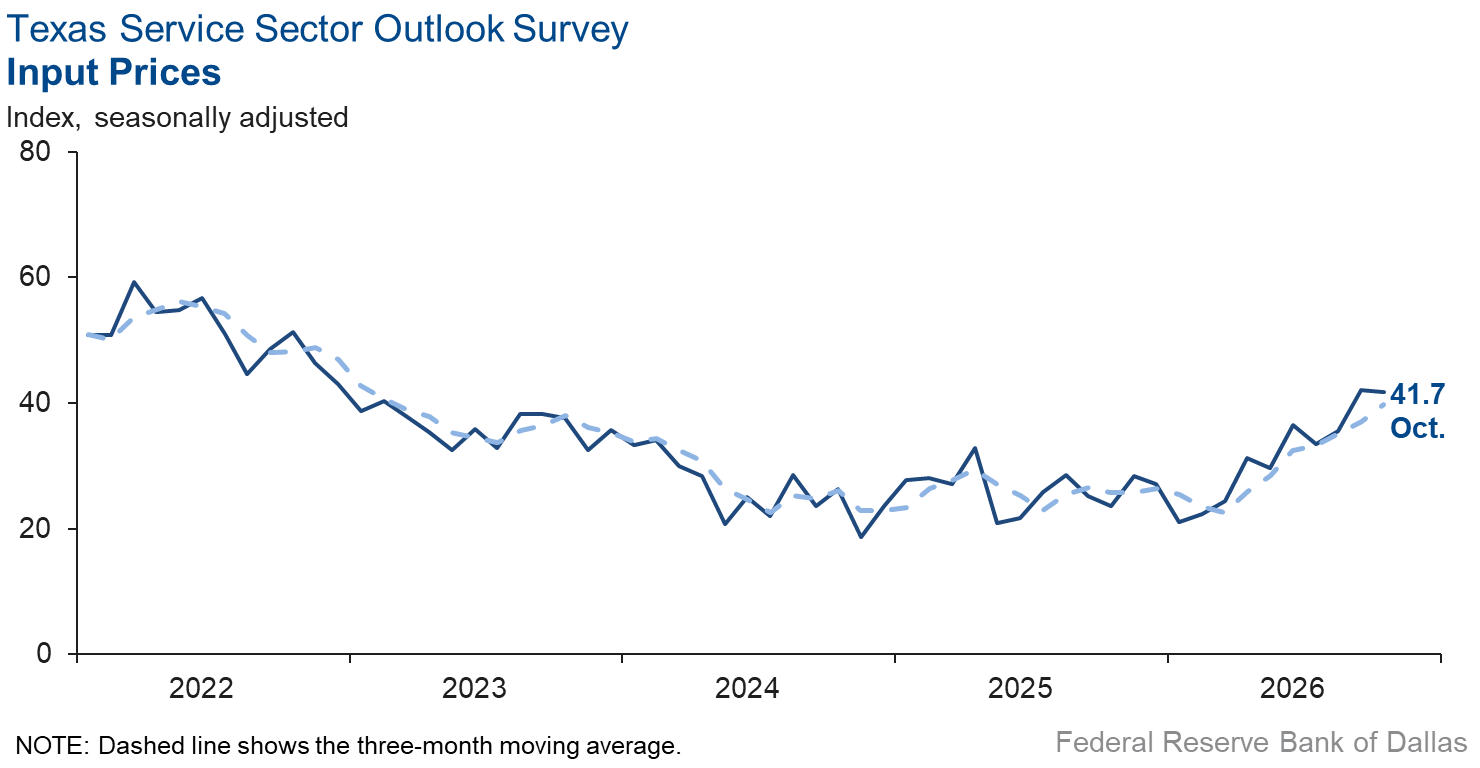
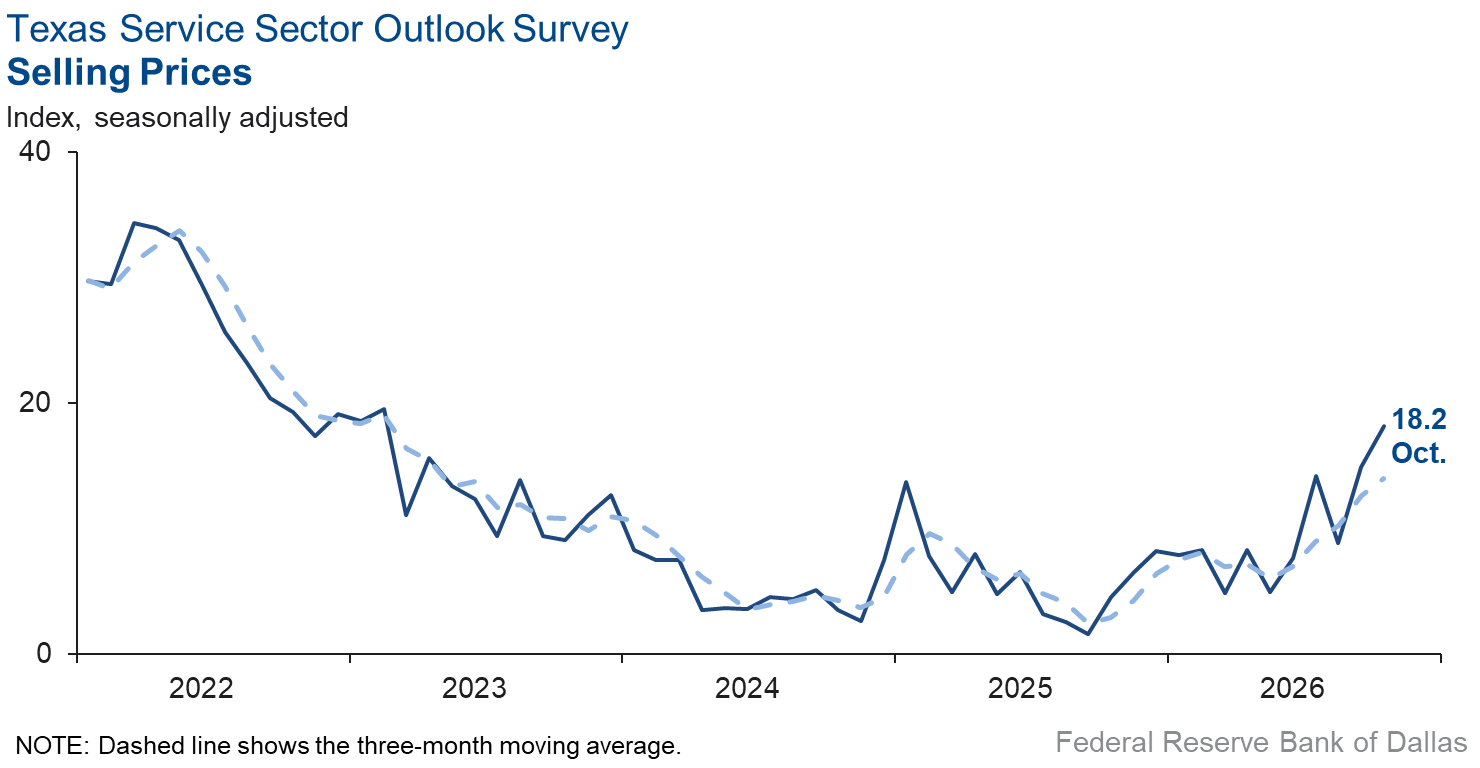
Price and wage pressures remained elevated. The input prices index was little changed at 41.7, remaining far above the series average of 28.0. The selling prices index edged up three points to 18.2, also well above its series average of 7.5. The wages and benefits index rose five points to 20.5, its highest reading since January 2023.
Respondents' expectations regarding future business activity improved. The future revenue index rose five points to 43.6, while the future general business activity index advanced to 19.6 from 10.7. Other future service sector activity indexes, such as employment and capital expenditures, remained in solidly positive territory.
Next release: December 1, 2026
Data were collected Oct. 13-21, and 224 of the 342 Texas service sector business executives surveyed submitted responses. The Dallas Fed conducts the Texas Service Sector Outlook Survey monthly to obtain a timely assessment of the state's service sector activity. Firms are asked whether revenue, employment, prices, general business activity and other indicators increased, decreased or remained unchanged over the previous month.
Survey responses are used to calculate an index for each indicator. Each index is calculated by subtracting the percentage of respondents reporting a decrease from the percentage reporting an increase. When the share of firms reporting an increase exceeds the share reporting a decrease, the index will be greater than zero, suggesting the indicator has increased over the prior month. If the share of firms reporting a decrease exceeds the share reporting an increase, the index will be below zero, suggesting the indicator has decreased over the prior month. An index will be zero when the number of firms reporting an increase is equal to the number of firms reporting a decrease.
Data have been seasonally adjusted as necessary.
Historical data are available from January 2007 to the most current release month.
| Business Indicators Relating to Facilities and Products in Texas Current (versus previous month) | ||||||||
| Indicator | Oct Index | Sep Index | Change | Series Average | Trend* | % Reporting Increase | % Reporting No Change | % Reporting Decrease |
Revenue | 4.4 | –0.9 | +5.3 | 9.9 | 1(+) | 22.3 | 59.8 | 17.9 |
Employment | 2.8 | 4.1 | –1.3 | 5.6 | 5(+) | 11.9 | 79.0 | 9.1 |
Part–Time Employment | 2.6 | 4.0 | –1.4 | 1.2 | 2(+) | 5.0 | 92.6 | 2.4 |
Hours Worked | 2.2 | 0.1 | +2.1 | 2.4 | 5(+) | 6.5 | 89.2 | 4.3 |
Wages and Benefits | 20.5 | 15.1 | +5.4 | 15.4 | 77(+) | 21.2 | 78.1 | 0.7 |
Input Prices | 41.7 | 42.1 | –0.4 | 28.0 | 78(+) | 42.5 | 56.7 | 0.8 |
Selling Prices | 18.2 | 14.9 | +3.3 | 7.5 | 75(+) | 23.1 | 72.0 | 4.9 |
Capital Expenditures | 13.1 | 10.5 | +2.6 | 9.7 | 75(+) | 15.7 | 81.7 | 2.6 |
| General Business Conditions Current (versus previous month) | ||||||||
| Indicator | Oct Index | Sep Index | Change | Series Average | Trend** | % Reporting Improved | % Reporting No Change | % Reporting Worsened |
Company Outlook | 3.0 | –3.2 | +6.2 | 3.8 | 1(+) | 16.2 | 70.6 | 13.2 |
General Business Activity | 4.0 | –1.8 | +5.8 | 1.8 | 1(+) | 19.1 | 65.8 | 15.1 |
| Indicator | Oct Index | Sep Index | Change | Series Average | Trend* | % Reporting Increase | % Reporting No Change | % Reporting Decrease |
Outlook Uncertainty | 16.3 | 21.4 | –5.1 | 14.1 | 65(+) | 24.2 | 67.8 | 7.9 |
| Business Indicators Relating to Facilities and Products in Texas Future (six months ahead) | ||||||||
| Indicator | Oct Index | Sep Index | Change | Series Average | Trend* | % Reporting Increase | % Reporting No Change | % Reporting Decrease |
Revenue | 43.6 | 38.2 | +5.4 | 37.1 | 78(+) | 52.8 | 38.0 | 9.2 |
Employment | 26.5 | 27.7 | –1.2 | 22.8 | 78(+) | 34.7 | 57.1 | 8.2 |
Part–Time Employment | 9.2 | 3.4 | +5.8 | 6.4 | 4(+) | 12.3 | 84.6 | 3.1 |
Hours Worked | 9.5 | 6.6 | +2.9 | 5.9 | 16(+) | 11.7 | 86.1 | 2.2 |
Wages and Benefits | 49.4 | 47.1 | +2.3 | 37.6 | 78(+) | 50.6 | 48.2 | 1.2 |
Input Prices | 51.6 | 61.3 | –9.7 | 44.4 | 238(+) | 54.4 | 42.7 | 2.8 |
Selling Prices | 36.3 | 34.3 | +2.0 | 24.6 | 78(+) | 39.8 | 56.7 | 3.5 |
Capital Expenditures | 27.3 | 21.1 | +6.2 | 22.4 | 77(+) | 30.8 | 65.7 | 3.5 |
| General Business Conditions Future (six months ahead) | ||||||||
| Indicator | Oct Index | Sep Index | Change | Series Average | Trend** | % Reporting Improved | % Reporting No Change | % Reporting Worsened |
Company Outlook | 21.7 | 10.5 | +11.2 | 15.3 | 18(+) | 32.2 | 57.3 | 10.5 |
General Business Activity | 19.6 | 10.7 | +8.9 | 11.9 | 5(+) | 32.4 | 54.8 | 12.8 |
*Shown is the number of consecutive months of expansion or contraction in the underlying indicator. Expansion is indicated by a positive index reading and denoted by a (+) in the table. Contraction is indicated by a negative index reading and denoted by a (–) in the table.
**Shown is the number of consecutive months of improvement or worsening in the underlying indicator. Improvement is indicated by a positive index reading and denoted by a (+) in the table. Worsening is indicated by a negative index reading and denoted by a (–) in the table.
Data have been seasonally adjusted as necessary.

Comments from survey respondents
Survey participants are given the opportunity to submit comments on current issues that may be affecting their businesses. Some comments have been edited for grammar and clarity.
- Revenue is down in October compared to September and August. Professional-level hiring seems to have cooled slightly. There is still strong demand for our mid-to lower-level hourly positions, particularly with manufacturing clients. The increase in the number of employees I'm adding to this update is due to actively looking for a new recruiter to either add to the team or replace a team member. I’m also looking to add a business development employee if I can find a good one. It continues to be challenging to find quality hires, both for our clients and for ourselves. Strong quality candidates receive multiple offers, and the majority of offers are now above requested salaries. Wages are not going down; in fact, we see them going up.
- Increases in interest rates chill the real estate lending market, which decreases real estate valuation assignments, especially for financial services institutions as defined by the Financial Institutions Reform, Recovery, and Enforcement Act (FIRREA).
- Higher relative and absolute interest rates, uncertain political and geopolitical environment, and supply chain concerns and higher energy prices [are issues impacting our business]. The U.S. economy has benefited from a stable, reliable, cost-effective supply of energy products for the past 175 years.
- We are starting a new contract at the end of this month.
- It has not been usual in the past for us to see a slowdown every four years with the presidential election timing; we are now starting to see a pattern of the same slowdown during the midterm elections as well.
- Inflation, interest rates, political uncertainty and apprehension about AI, collectively, seem to be freezing all but the most essential business decisions, transactions foremost among them.
- The economy continues to be influenced by several factors, including geopolitical [issues] and fluctuations impacting inflation.
- Best we can hope for is no change. "Uncertainty", indeed.
- The increases in long-term commercial real estate mortgage rates has resulted in a definite cooling in marketplace activity for permanent financing. The deal that will underwrite at 7 percent is not close to what expectations were when the mortgage rate was 6 percent or even lower 12 to 24 months ago. General activity seems to be slowing in the investment sale sector. Once it becomes clear that mortgage rates will be higher for longer, then activity will gradually pick up. At the same time, I think we will see an increase in maturity defaults relative to loans originated 5 to 7 years ago and where there was little to no amortization of the outstanding loan amount. This will be more of an issue in the banking and commercial mortgage-backed securities [CMBS] sectors, where there has been more volume in interest-only lending over the past few years.
- The outcome of the midterms is anticipated to impact taxes, regulations and the business environment for growth.
- After poor sales the first two weeks of September, October seems to have started much better.
- Supply chain constraints related to drivers and product availability [are issues impacting our business].
- I feel it's the uncertainty of policies plus inflation that is driving confidence down.
- Tariffs on China are excessive and are ultimately a tax on our customers as we are forced to pass on higher costs for medication to them.
- Higher interest rates are causing a slowdown in the purchase of homes, causing a reduction in the need for our services.
- Because of the timing of the midterm elections, it's very hard to discern if there will be any meaningful change to the business outlook in the coming months. If the Republicans lose control of either the Senate or House, I think there will be a mad push to ram any last-minute issues through Congress. I do think that without a meaningful agreement with Iran, the oil prices (particularly diesel prices) will remain high. Beef prices aren't going to come down until 2028 at the earliest, so food input costs will remain elevated, but the higher costs are already baked into the supply chain.
- High prices are slowing sales of new vehicles.
- We sell propane, gasoline and diesel. We also run delivery trucks. Changes in fuel prices and supply issues because of the problems in Russia and Iran are causing us uncertainty and higher costs. I think that it causes our customers more uncertainty, too. And we are feeling the financial impact of the housing slowdown. We had some property under contract to sell for a housing development, and the buyer backed out.
- We believe the U.S. midterm elections and the Iran war have created an atmosphere of uncertainty that should pass by 2nd quarter of next year.
- We are focused on minimizing any extremes by staying small and focusing on what we can accomplish with our four people without adding staff. That works for now, but at some point, we'll have to take a leap of faith and add personnel to grow. That's a difficult place to be right now, though, because we don't feel the economy is stable enough to support that. Our nonprofit partners are feeling the pinch.
- High interest rates, political turmoil, local tax increases and two international conflicts are significant headwinds.
- Our business is predictably cyclical. We offer companywide raises on a calendar year that match increases in our contracted fees, which typically increase with the start of the calendar year. Our increase in employees from September to October is due to being slightly understaffed and to make sure we are appropriately staffed for the coming year.
- Gas prices are still high.
- Uncertainty is still very much alive; I have just become used to it.
- Hiring engineers and technicians is very challenging. The federal government’s immigration policy is making it increasingly difficult to hire legal immigrants. The outlook is worrisome.
- Current earnings and volatility from the top 10 largest companies in the U.S. [are issues impacting our business].
- The real estate market continues to slow.
- We saw a sizable increase in new contracts getting awarded last month. Our fourth quarter [this year] and first quarter of next year are looking a lot better.
- Economic and market uncertainty [are issues impacting our business].
- It feels as if turbulence is the "new normal," and our clients and we are getting better at managing it.
- High energy prices, especially diesel, high interest rates and ongoing randomness and inconsistencies in domestic and foreign policies are increasing commercial real estate uncertainty, which tends to stall or cancel projects.
- The real estate market is heading in the wrong direction due to high interest rates and geopolitical concerns. Until principals feel like they have an understanding of where this market is headed, we are facing a standstill. Commercial is still transacting business, but residential transactions have all but stopped.
- The increase in interest rates affected our business in September, creating some uncertainty throughout the real estate community. There was a noticeable sense of unease, with buyers, sellers and industry professionals taking a more cautious approach. In October, we have seen a slight increase in activity, and our business has picked up compared to the prior month. While some uncertainty remains, the recent improvement in transaction volume is encouraging.
- Definite concerns with a high probability of Fed rate increase given current inflation forecast. Although federal contracting has increased, medium and small businesses are not capturing a proportional increase unless [they] are in certain defense research and development sectors where there is true growth (space, AI integration, low resource computing, etc.) The government procurement landscape is evolving; the expectation is fairly stable budgets with an increase of awards to established contract vehicles and a reduction in the number of separate opportunities for smaller contractors.
- The labor shortage is a big problem and causes uncertainty about increasing capacity to meet demand.
- No significant changes from last month. The general outlook for next year for enabling advanced user interface software in the military is still strong. Enterprise markets will be a greater focus going forward due to advances in company show-and-tell. The problems of uncertainty of decisions and budgets in the military continue, unfortunately.
- The 100+ basis-point rise in long-term treasury yields since February is going to depress commercial real estate activity.
- It is status quo for our company. It will be interesting to see how foreclosures will affect our sales.
- Interest rates are killing us, and diesel and fuel prices are also making business difficult.
- Those who thought the multifamily industry would get bailed out with lower interest rates have been firmly put in their place. Between rising consumer inflation, stagnant wage growth and disappearing immigrants, rent is harder to collect, and occupancy is dwindling while rents continue to fall. At least in workforce housing, a high percentage of properties are currently not worth the debt they are carrying. We see money owners increasingly coming to grips with the inevitability of write-offs instead of dreaming about a turnaround. The mood among our staff is rather grim, and the paycheck-to-paycheck residents they serve are feeling significant pain. All of us are worried.
- The uncertainty of two wars currently is affecting energy prices, and that could affect supply chains, which is causing insecurity in making commitments in investments and hiring. AI spending by big tech companies show signs of creating a bubble much like the dot-com debacle of 25 years ago. We are not bullish on this economy.
- Data centers are actively recruiting local companies’ employees and inflating wages.
- Increased competition for talent is leading to upward pressure on wages and benefits. Also, higher interest rates are leading to an increase in input prices.
- Inflation, concerns about higher costs coming, budget cutbacks [are issues impacting our business].
- Our focus is efficiency with existing labor. Net expanse in labor is very selective to very clear new priorities and/or skills that we do not have in inventory.
- Throw in midterm elections on top of everything else, and we have an increase in uncertainty.
- Political and social pressures against data centers are causing uncertainty in our ability to contract data centers as customers.
- We are worried about inflation and the U.S. deficit.
- There are relatively stable operating conditions at the moment. We expect continued increasing input costs as inflation remains high. We are currently working on budget for 2027 and expect continued increases in input costs but also expect to adjust pricing to compensate for those higher costs. We also expect to continue our hiring push and to continue to increase capital spending to support growth in our South Texas business.
Special questions
For this month’s survey, Texas business executives were asked supplemental questions on credit conditions. Results below include responses from participants from both the Texas Manufacturing Outlook Survey and Texas Service Sector Outlook Survey. View individual survey results.
Historical Data
Historical data can be downloaded dating back to January 2007.
Indexes
Download indexes for all indicators. For the definitions of all variables, see data definitions.
| Unadjusted |
| Seasonally adjusted |
All Data
Download indexes and components of the indexes (percentage of respondents reporting increase, decrease, or no change). For the definitions of all variables, see data definitions.
| Unadjusted |
| Seasonally adjusted |
Questions regarding the Texas Service Sector Outlook Survey can be addressed to Isabel Brizuela.
Sign up for our email alert to be automatically notified as soon as the latest Texas Service Sector Outlook Survey is released on the web.