
Tokenized deposits could affect bank liquidity, maturity transformation
Development of faster payment infrastructure has accelerated in recent years. Real-time payment options for individuals and businesses have grown substantially, including the Federal Reserve’s FedNow platform allowing instant payment processing for eligible banks and credit unions.
Increasing adoption of distributed ledger technology—blockchain is the best known—has opened up digital payment infrastructure, allowing real-time settlement. Growth in stablecoins (a payment instrument often backed by liquid assets such as cash or Treasuries) has garnered attention, supported by efforts to construct regulatory regimes in the U.S. and overseas. Meanwhile, tokenized deposits have received comparatively little focus.
Stablecoins and tokenized deposits differ in important ways that could pose meaningful consequences for the banking sector. We explore potential impacts of large-scale tokenized deposit adoption, such as blurring of deposit categories and increased bank demand for high-quality liquid assets, without passing judgment on the likelihood of such adoption occurring.
Despite recent legal and oversight changes, stablecoin usage requires a willingness to step outside mature regulatory structures. In contrast, tokenized deposits exist within the prevailing bank regulatory structures and also pay interest to holders. However, tokenized deposits are not necessarily easy to move between issuers, making them less flexible means of payment than stablecoins.
For adoption to meaningfully grow, deposit tokens would need to circulate beyond the original issuer’s walls. Banking institutions are exploring various implementation models, including consortiums and associations, that would allow wider use.
Tokenization could change deposit composition
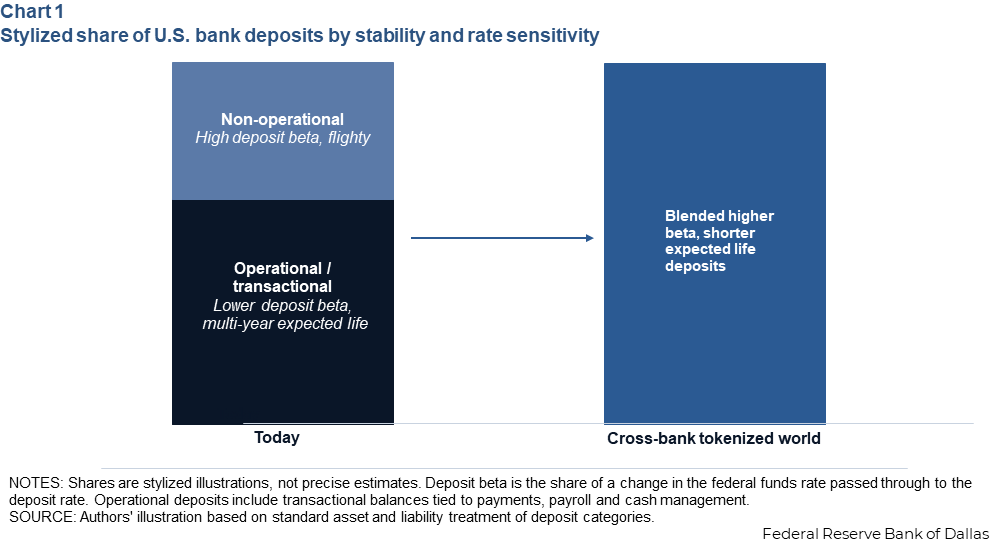
Banks utilize various features and analyses of historical behavior to classify deposits. Wholesale deposits are characterized as either operational or nonoperational. Operational deposits are core funds in wholesale accounts that are required for business operations, such as clearing, custody or cash management. Nonoperational deposits are any surplus wholesale account balances beyond what is needed for operational purposes.
Operational deposits are considered stickier for liquidity management purposes. The pre-existing relationship, usually with a client who is obtaining a portfolio of services from the bank, suggests that depositors are less likely (or less able) to rapidly withdraw their balance. Stickier deposits tend to have lower deposit rate betas (indicating less price sensitivity) and a longer expected life.[1]
Sticky deposits rely in part on the existence of frictions preventing rapid reallocation from one bank to another. Instant settlement would allow deposit holders who prioritize yield to switch banks almost instantaneously. Development of agentic artificial intelligence, along with programmable features of deposit tokens (smart contracts), could theoretically allow this switching to occur without requiring direct action from the deposit holder.
Tokenized money market mutual funds could also emerge as direct competition to deposits as frictions dissipate. This could pressure deposit rate betas higher. Although frictions may persist to a greater extent between corporate deposit holders and their banks, more instant payments could also reduce the magnitude of operational deposits, as firms manage their intraday liquidity more precisely through improved payment sequencing (Chart 1).
Deposit composition alters affect maturity transformation
Banking is often described as borrowing short to lend long, but this is a misleading oversimplification. While demand deposits are not subject to a contractual term and are therefore redeemable at any time, they are typically characterized by a weighted average life (WAL) that is considerably longer than overnight. The combination of a longer WAL and a deposit beta below 1 means that deposits behave like a long-duration liability.
Effectively, deposits can be thought of as a blend of beta units of floating-rate liabilities and (1 minus beta) units of a fixed-rate liability. As such, a given homogenous pool of deposits may be thought of as having an effective duration equal to the product of WAL and 1 minus the deposit beta. Long WALs and low betas enable banks to make longer maturity fixed-rate loans (buying duration on the asset side of the balance sheet), allowing the banking system’s core function of maturity transformation—using short-term liabilities (deposits) to fund assets (comparatively long-term loans).
Tokenization of deposits risks moving both these characteristics in adverse ways. Tokenization could lower the average life of deposits while making them more rate sensitive (biasing the beta higher).
To be sure, there are offsetting factors. Banks could respond with pricing changes that mitigate some of these risks, for instance. The magnitude of these effects is therefore uncertain, but we can evaluate the impact of such shifts on the banking system’s duration capacity. Table 1 illustrates how changes in deposit beta and expected life affect effective duration.
Table 1: Effective duration of deposits for various assumed betas and WALs
| Deposit Beta | |||
| WAL | B=30% | B=50% | B=70% |
| 1 | 0.7 | 0.5 | 0.3 |
| 2 | 1.4 | 1.0 | 0.6 |
| 3 | 2.1 | 1.5 | 0.9 |
| 4 | 2.8 | 2.0 | 1.2 |
| 5 | 3.5 | 2.5 | 1.5 |
| 6 | 4.2 | 3.0 | 1.8 |
| 7 | 4.9 | 3.5 | 2.1 |
| 8 | 5.6 | 4.0 | 2.4 |
| 9 | 6.3 | 4.5 | 2.7 |
| 10 | 7.0 | 5.0 | 3.0 |
|
NOTES: Weighted average life (WAL) measures how long deposit balances are expected to remain on a bank’s balance sheet. Effective duration is approximated as WAL * (1 minus beta). SOURCE: Authors’ calculations. | |||
To estimate potential shifts in duration capacity from tokenized deposits, assessing the banking sector’s current capacity is helpful. It is difficult to know precisely what WAL and beta assumptions individual banks use. However, Federal Reserve H.8 data of banks’ assets and liabilities allow calculation of an implied duration of deposits, by assuming that banks are duration-matched in the aggregate. Table 2 shows a breakdown of total assets on commercial bank balance sheets, in notional terms, as well as duration-weighted terms.[2]
Table 2: Breakdown of total assets on commercial bank balance sheets
| Asset | Current Amount ($bn) | Assumed Avg. Dur. (years) | Dur. Adj. Amt. (est.) $bn 10-year eq. |
| Treasury and agency securities | 4,833.1 | 5.0 | 3,020.7 |
| Other securities | 1,007.9 | 1.0 | 126.0 |
| Commercial and industrial loans | 2,886.1 | 2.5 | 901.9 |
| Real estate loans | 5,810.7 | 2.7 | 1,929.0 |
| Consumer loans | 1,907.4 | 2.7 | 640.0 |
| All other loans and leases | 3,295.8 | 1.0 | 412.0 |
| LESS: Allowance for credit losses on loans and leases | ($201.7) | 0.0 | 0.0 |
| Cash assets | 3,124.4 | 0.0 | 0.0 |
| Total federal funds sold and reverse repurchase agreements | 804.9 | 0.0 | 0.0 |
| Loans to commercial banks | 8.9 | 0.0 | 0.0 |
| Other assets including trading assets | 2,222.5 | 0.0 | 0.0 |
| Total assets | 25,700 | 2.2 | 7,029.6 |
| NOTES: Best-guess duration assumptions were made at a granular level and then aggregated for duration adjusted amount. Current values are as of July 15, 2026. SOURCES: Federal Reserve H.8 statement; authors' calculations. | |||
If we assume that the approximately $7 trillion, 10-year equivalents of asset-side duration exposure is offset by liabilities, we can then solve for the likely duration of the aggregate deposit base needed to support existing assets. In Table 3, we estimate aggregate deposit duration at about 2.8 years. If we assume a somewhat typical WAL of five years, this equates to an aggregate deposit beta of around 0.44.
Table 3: Aggregate deposit base needed to support existing assets
| Liability | Current Amount ($bn) | Avg. Dur. (years) | Dur. Adj. Amt. (est.) $bn 10-year eq. |
| Large time deposits | 2,538.3 | 1.0 | 317.3 |
| Other deposits | 16,928.2 | 2.8 | 5,841.3 |
| Borrowings | 2,322.7 | 3.0 | 871.0 |
| Net due to related foreign offices | 3,62.3 | 0.0 | 0.0 |
| Other liabilities including trading liabilities | 1,026.3 | 0.0 | 0.0 |
| Total liabilities | 23,177.8 | 2.2 | 7,029.6 |
| NOTES: Duration for time deposits and borrowings reflect best-guess assumptions. Duration for "other deposits" reflects a solved value that equalizes asset side interest rate risk exposure. SOURCES: Federal Reserve H.8 statement; authors' calculations. Current values as of July 15, 2026. | |||
A back-of-the-envelope analysis such as this still makes several important points. First, about 80 percent of the duration risk taken by banks ($5.8 trillion 10-year equivalents out of $7 trillion total) in the aggregate is supported by the duration characteristics of deposits. Second, a 10 percent reduction in the WAL of deposits would shrink maturity transformation capacity in the aggregate by about $580 billion 10-year equivalents. Third, a 10 percent increase in the price sensitivity of deposits (deposit rate beta) would result in a reduction of $700 billion 10-year equivalents of duration risk appetite from banks (assuming a deposit WAL of four years).
Alternatively, banks could strive to leave the composition of lending close to unchanged by altering their liabilities in other ways. This would likely include greater reliance on term debt issuance; on the margin, the economics of such lending activity funded by wholesale debt would resemble those of non-bank financial firms and would thus likely adversely impact the cost of credit for consumers and businesses.
Banks may prioritize highly liquid assets
Banks hold portfolios of high-quality liquid assets for liquidity management purposes, both for regulatory requirements, such as the liquidity coverage ratio and internal liquidity stress tests, and for day-to-day management of outflows.
Given the real-time, instant nature of tokenized deposit transfers, meaningful adoption would likely increase both the volatility of deposit balances and uncertainty around potential outflows during the normal course of business. For meeting the liquidity coverage ratio requirements and stress-testing purposes, deposits are assigned stressed outflow probability assumptions based on their classification. For example, operational deposits receive lower outflow assumptions, reflecting their stickier nature.
If tokenization drives a shift in deposit composition, as we have suggested, presumed deposit outflows under stress would also rise, even if the aggregate deposit book size remains unchanged. Absent any changes in willingness to use intraday credit or the Federal Reserve’s discount window, banks would need to hold larger high-quality liquid asset portfolios to remain certain of their ability to meet unexpectedly high deposit outflows. Within these portfolios, banks may prioritize assets that provide instant or almost-instant liquidity, namely reserves and Treasuries.
Lessons from global instant payment systems
Tokenized deposit development and adoption remain at an early stage, with limited real-world comparisons that could inform expectations for banking sector impacts. However, instant payments more broadly have rapidly gained traction in other regions around the world. Although these platforms are not a perfect comparison to tokenized deposits, some key similarities, like real-time, instant outflows from one bank to another, may make comparisons instructive.
In Brazil, the Pix instant payment system enables 24/7, real-time interbank transfers at zero cost for individuals. Pix was launched in 2020 and adoption grew rapidly. By first quarter 2026, the platform had around 200 million active users and monthly transactions totaled around $650 billion, equivalent to roughly one-quarter of Brazil’s annual GDP.
Using regulatory data covering the initial years of implementation, a 2025 paper showed that heavier Pix customer usage increases banks’ demand for liquid assets, particularly government bonds, and reduces credit intermediation. Within the remaining loan book, banks increase their share of subprime loans, seeking to maximize returns and increase capital efficiency (Chart 2).
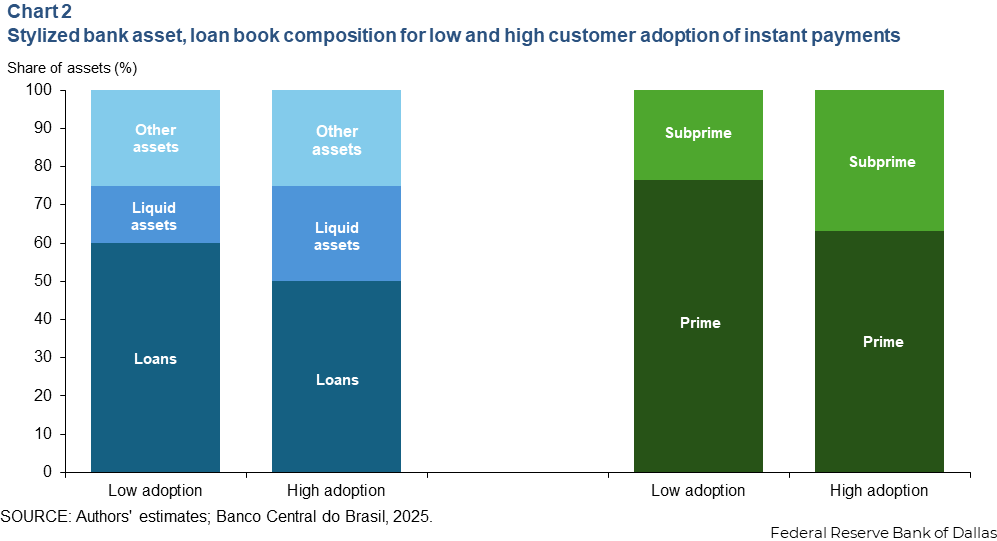
These results are consistent with the potential consequences of tokenized deposit adoption and may also be instructive when considering the impact of broader real-time payments adoption in the U.S., across both public and private mechanisms.
The outlook is uncertain, but development is accelerating
Tokenized deposits are in the early stages of development in the U.S., and how design and implementation proceed now may well bear on their end state. Project Agorá, a joint initiative by the Bank for International Settlements and Institute of International Finance, explored the potential for a unified ledger merging tokenized central bank money and commercial bank deposits as a mechanism for cross-currency transactions.
Developments in the broader digital asset ecosystem could support tokenization of deposits, such as progress on tokenized securities and collateral, while tokenized money market funds and stablecoins could be potential competitors.
Widespread adoption of tokenized deposits could have meaningful consequences for banks, but there may be broader implications too. Market participants and policymakers should consider the potential implications for current payment systems, monetary policy transmission and implementation, potential asymmetric effects across bank sizes and types, and the role of the central bank as the lender of last resort in a heavily tokenized world.
Notes
- A deposit beta measures the sensitivity of deposit rates to changes in short-term market interest rates (the federal funds rate). Standard retail checking accounts typically have a beta close to zero.
- The duration weighted amount of an asset is calculated as the notional amount of the asset multiplied by the ratio of its modified duration to the modified duration Iof a 10-year Treasury. Modified duration is a measure of the interest rate sensitivity of an asset and is used for asset-liability management.
About the authors

Rosie Levy is a senior financial economist in the Research Department at the Federal Reserve Bank of Dallas.

Srini Ramaswamy is a senior financial economist in the Research Department at the Federal Reserve Bank of Dallas.