Contract design, higher yields make basis trade alternatives attractive
Few Treasury market trading strategies have drawn as much attention from policymakers as the cash-futures basis trade, which seeks to arbitrage the difference between the price of Treasuries and the price implied by futures contracts.
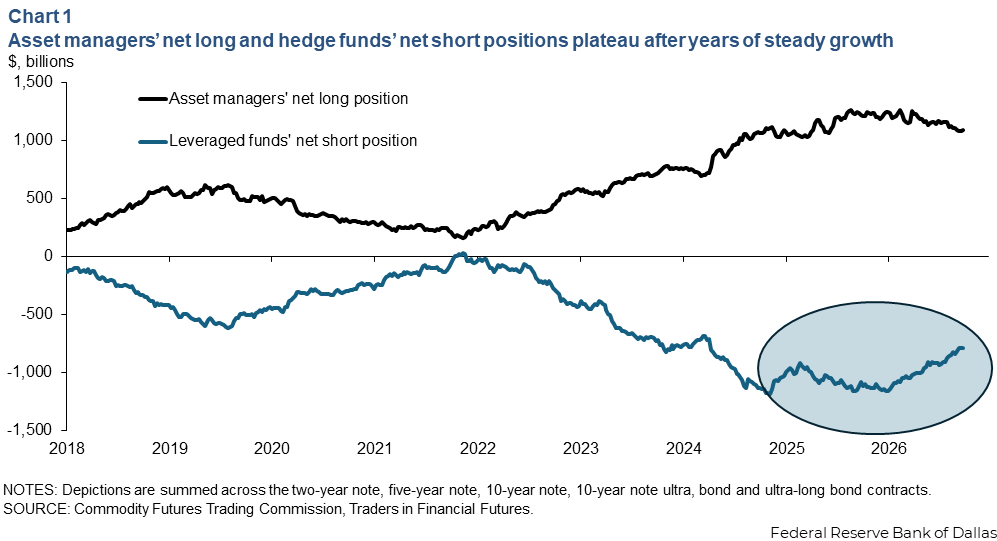
Leveraged funds’ net short positioning in Treasury futures has grown steadily since 2021, reaching historically elevated levels after an episode of forced unwinding in March 2020 caused the basis trade to become a financial-stability concern. This short positioning is a mirror image of the long futures exposure that asset managers acquired.
Over the past year, however, this positioning has plateaued and even reversed slightly (Chart 1). It is important to understand the drivers of these shifts, because they have implications for how leverage in the Treasury market is evolving, whether risk is moving to other trading strategies or markets, and the extent to which a deleveraging of Treasury holdings may be affecting demand for short-term funding.
We find evidence that asset managers have increasingly found futures-based synthetic duration less attractive relative to alternatives, including swaps linked to new debt issuance tied to data center construction in support of artificial intelligence (AI).
Research relying on Securities and Exchange Commission Form PF data detected signs of a plateau in basis positioning beginning in 2025. (Fund managers with a minimum of $150 million in assets under management must file Form PF, a requirement that arose following the Global Financial Crisis in 2008.)
The plateau’s effects show up in repo and interest-rate derivatives markets. Sponsored delivery-versus-payment (DVP) repo volumes, a rough proxy for the cash leg financing of a basis trade, have eased from their peaks. Open interest in short-dated Secured Overnight Financing Rate (SOFR) futures is noisier but also consistent with stabilization in basis trade activity (Chart 2).
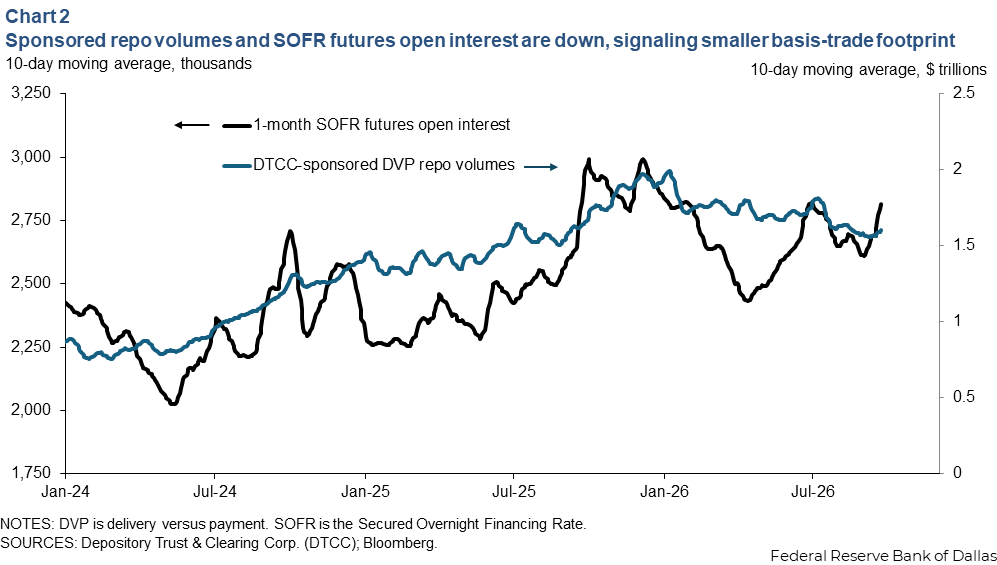
Basis traders use interest rate futures to hedge the financing-rate exposure that a basis position carries to delivery, though this series also reflects hedges motivated by uncertainty in the near-term path of rates. Neither series is definitive on its own, but both are consistent with a genuine—if modest—retrenchment of the trade.
Two explanations for the plateau are commonly offered. The first is that the trade has simply become too crowded. As more leveraged funds entered, competition compressed the returns available and prompted some participants to scale back. This explanation may describe compositional shifts regarding which leveraged funds engage in the basis trade but falls short as an explanation of aggregate positioning.
The second points to regulatory relief—most importantly a less stringent supplementary leverage ratio requirement for banks—making it easier for banks to warehouse Treasuries and, in so doing, to displace leveraged funds.[1] Indeed, there’s some evidence for this channel affecting leveraged funds, as dealer net short Treasury futures positioning has increased since the revisions were proposed in April 2025. This reflects increased Treasury inventories that dealers hedge via short futures positions. However, this increase in short futures positions among dealers does little to explain the plateauing of net long positions held by asset managers.
We argue that an overlooked reason for the retrenchment of the basis trade is a narrowing of the basis in long-maturity futures contracts for reasons tied to the mechanics of the futures contract and the level of yields—reasons that have little to do with crowding or supplementary leverage ratio relief.
We present three lines of evidence for that view and raise a fourth possibility: that asset managers are meeting some of their duration demand by absorbing swap flow from the financing of AI-related capital expenditures. Taken together, the four channels paint a picture of a trade whose attractiveness to asset managers has quietly eroded rather than a crowding out of leveraged funds by less sophisticated new entrants.
Basis trades are levered bets on the delivery option
Asset managers often prefer to obtain part of their Treasury exposure synthetically, through futures, rather than by owning the underlying bonds outright. That preference leaves someone to take the other side in the futures market, and leveraged funds—typically hedge funds—step in.
To hedge the interest-rate risk of their resulting long futures position, these funds buy the underlying Treasury (ideally the cheapest-to-deliver bond, or CTD) and finance it in the repurchase (repo) market.[2] The result is a levered position in the difference between the cash bond price and the futures-implied price of that bond—the basis. The leveraged fund’s long basis position is exposed to financing conditions and to the risk that a different bond becomes cheapest to deliver.
Most of the gross basis is simply carry—the net of coupon income and financing cost that the cash-bond holder earns while waiting for delivery—and carry is largely a wash over the life of a basis trade.[3] This is because the futures price reflects the carry lost by holding the contract in place of the bond.
The economically interesting piece is what remains after carry is stripped out: the basis net of carry, or BNOC.[4] The BNOC is best understood as an option premium. Because the party short a futures contract decides which bond to deliver, a long basis position embeds a valuable right. If the cheapest-to-deliver bond switches before delivery, the position pays off.
In effect, buying the basis means buying an option on a cheapest-to-deliver switch, and the BNOC is the price paid for it. Absent a switch, the BNOC converges to zero by delivery—so the buyer bleeds the premium—while a switch delivers an option-like gain. The economic value of that option depends on the dispersion of deliverable bonds’ factor-scaled prices.[5] In addition to determining the magnitude of potential payoffs, the option value also reflects the probability of collecting it (which rises with the volatility of yields).
For an asset manager, selling that optionality through futures is a yield-enhancement strategy that works most of the time, because cheapest-to-deliver switches have historically been rare. For a hedge fund, simply owning the option would mean small, steady losses punctuated by occasional gains—the opposite of the smooth returns these investors seek. Hedge funds, therefore, aim to buy the option cheaply in the basis and sell a replicating position in the interest-rate options market at a better price, capturing the gap (known as the option-adjusted BNOC).
The key implication becomes:
- The attractiveness to an asset manager of holding futures in place of cash bonds hinges on the BNOC.
- Meanwhile, the attractiveness to a hedge fund of taking the other side via a long basis trade is proportional to the option-adjusted BNOC. Recent trends in these metrics shed light on the reasons for the decline in basis trade positioning in long-dated futures contracts.
Higher yields compress dispersion across deliverable bonds
Declining rate volatility offers a straightforward reason for BNOC compression from August 2025 to August 2026. Lower volatility reduces the probability of cheapest-to-deliver shifts occurring and, therefore, the value of the delivery option.
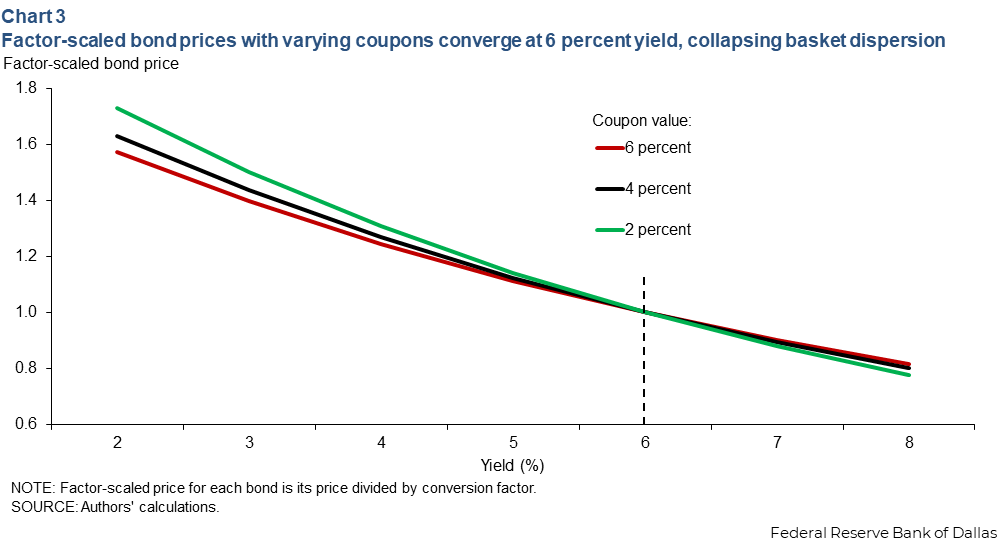
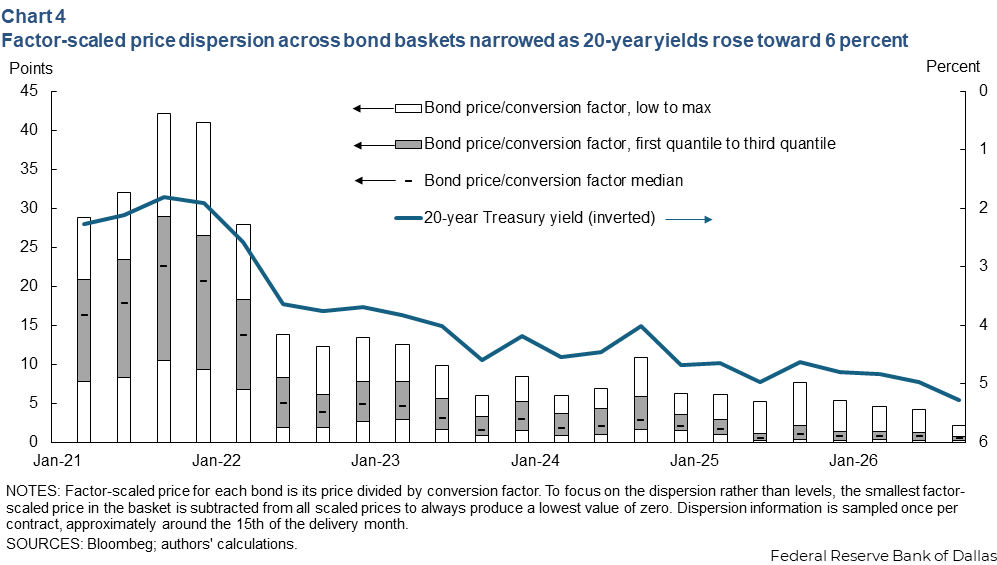
But a more important and nuanced reason for the narrowing in BNOCs involves futures contract specifications. In particular, this involves the conversion factor, the number that scales each deliverable bond’s price so that bonds with different coupons can become somewhat comparable with respect to being deliverable. It is intended to achieve perfect standardization when yields are 6 percent. As the recent rise in yields has brought levels closer to 6 percent at the long end, it has reduced the dispersion of scaled bond prices in deliverable baskets, which—all else equal—lowers option value.
The exchange sets each bond’s conversion factor equal to its price, per dollar of face value, computed at a fixed reference yield of 6 percent.[6] That fixed 6 percent is just a design choice, but is crucial in explaining recent trends. Divide any bond’s market price by its conversion factor and you get its factor-scaled price, which can be compared to the futures price. When the market yield is exactly 6 percent, every bond’s scaled price equals one, regardless of coupon (Chart 3). This achieves perfect standardization. Cheapest-to-deliver shifts, even if they occur, will have little price impact on futures. The further away yields sit from 6 percent, the more scaled prices fan out across the deliverable basket; as yields move toward 6 percent, that dispersion collapses toward zero.
In recent months, as yields have climbed toward the 6 percent reference level, the deliverable basket thus became more homogeneous. The gap between the high- and low-coupon bonds’ scaled prices has shrunk (Chart 4). The payoff from a cheapest-to-deliver switch is precisely the difference between two bonds’ factor-scaled forward prices. A more homogeneous basket means a smaller potential payoff from cheapest-to-deliver shifts. This is true even if cheapest-to-deliver shifts occur more frequently because greater homogeneity mechanically lowers the value of the delivery option and therefore the BNOC.
Incidentally, this construct also helps explain the persistently low BNOCs in shorter durations, such as the 2- and 5-year note contracts. Their lower duration means that much larger deviations in yield from the 6 percent reference level are needed to produce a given level of dispersion in factor-scaled prices. As a result, low duration contracts always tend to have low delivery option value and BNOCs near zero (Chart 5).
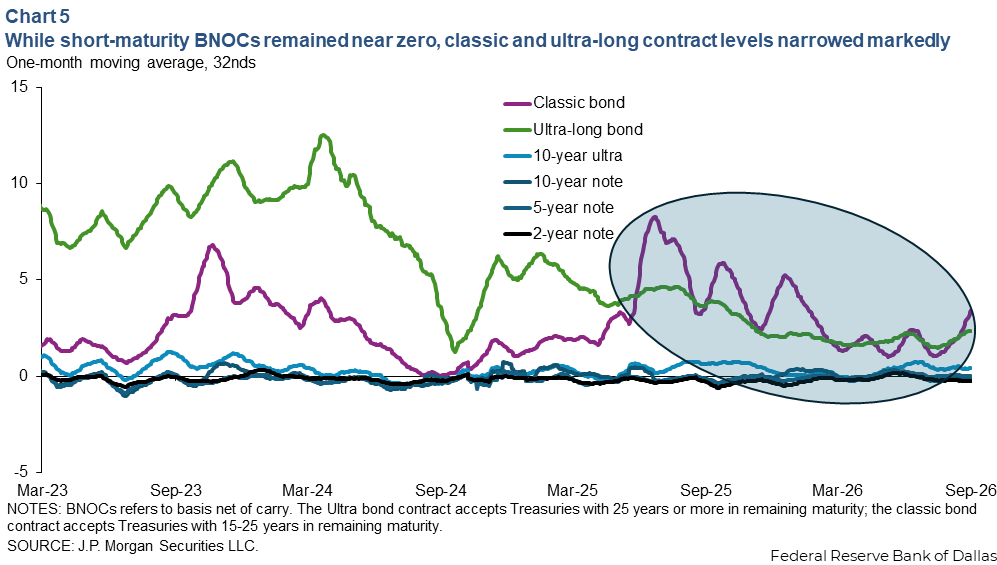
The ultra-long bond contract has an additional twist. As the very low-coupon bonds issued during the pandemic era roll out of the deliverable basket, the coupon and conversion factor of the cheapest-to-deliver bond have risen, eroding the value of the “wildcard option” (exploiting a small difference in the futures and cash markets’ daily availability) that has historically been a primary driver of that contract’s net basis.[7]
For an asset manager, the consequence is direct: Futures have become less cheap relative to other sources of duration, diminishing the yield-enhancement case for using them. This has likely contributed to asset managers scaling back futures-based duration longs.
Notably, declining exposure to the two-year contract has accounted for a large share of the total dollar decline in the basis trade. This is likely unrelated to BNOC compression. But on a duration-weighted basis, much of the decline in the basis trade’s footprint has occurred in longer maturity sectors where BNOC compression has likely played a role affecting the economics of the trade.
Lastly, this discussion is incomplete without addressing the spike in volatility since early September 2026, and the accompanying widening among BNOCs in longer maturity contracts. With yields in the bond basket close to 6 percent, dispersion is already low. With rising volatility relative to a few weeks earlier, the probability of yield shifts large enough to further drive higher dispersion has increased, explaining the recent widening in BNOCs.
There are three consequences for delivery option values and asset manager behavior. First, the delivery option in long-end contracts is now close to being at-the-money. When starting levels of dispersion are low, moves in yields in either direction can cause cheapest-to-delivery shifts to occur. The larger the move, the greater the potential dispersion and payoff from the delivery option.
Second, the delivery option value’s sensitivity to the level of volatility (known as vega) is likely close to its maximum. This means that BNOCs could fall quickly if implied volatility were to decline. Third, the risk-reward profile for asset managers has become unfavorable. Historically, the cheapest-to-deliver bonds were entrenched, as yields were far from 6 percent, making cheapest-to-deliver shifts improbable. With the delivery option far out of the money, selling it meant asset managers would receive yield enhancement most of the time, with only occasional underperformance.
In contrast, selling the delivery option when yields are near 6 percent means a high likelihood of cheapest-to-deliver shifts, with a volatile return profile closer to that of selling an at-the-money option rather than an out-of-the-money option. As a result, wider BNOCs driven by higher volatility may prove insufficient to entice asset managers into increasing their futures positions.
Option-adjusted spreads show an exit from long basis positions
Turning to the long basis positions that leveraged funds hold, option-adjusted BNOCs, which reflect the attractiveness of a long basis position to a leveraged fund, have mostly held stable or narrowed across contracts. Thus, absolute trade returns for leveraged funds have remained stable or increased, despite a slowdown in growth in net long futures positions and increased net short futures supply from dealers (Chart 6).
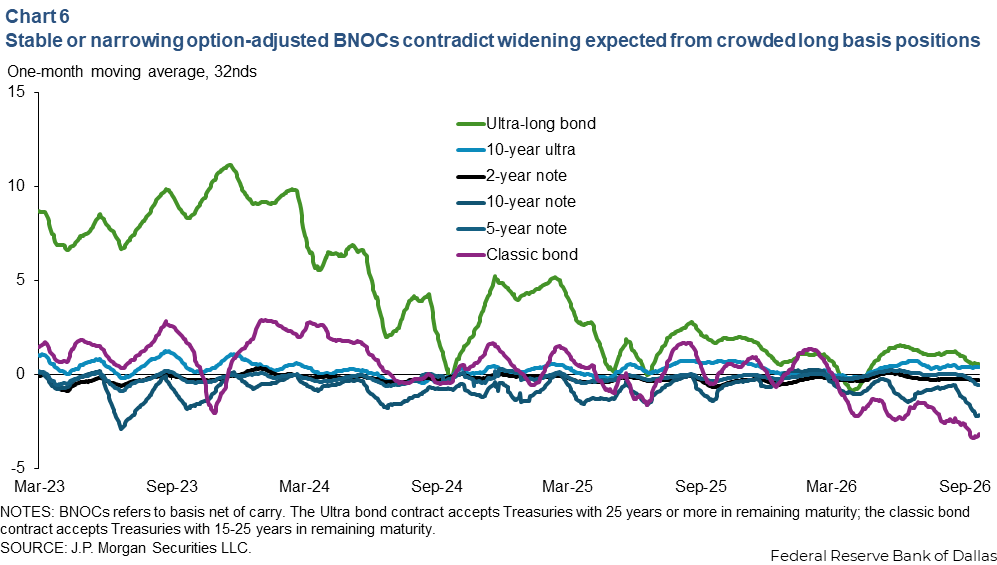
One caveat: Unlike the BNOC, which is computed directly from market prices, the option-adjusted BNOC is model-dependent. It requires an estimate of the delivery option’s value, and different models may produce different estimates. Any single provider’s series should therefore be read with care. Reassuringly, estimates from three dealers move together even though their levels differ, which suggests the pattern reflects the option-adjusted basis itself rather than one model’s quirks.[8]
Swap-spread wideners offer leveraged funds a comparable trade
The narrowing of the option-adjusted BNOC in some contracts while net asset-manager long futures positions have plateaued raises the possibility that leveraged funds are in aggregate allocating away from long basis positions.
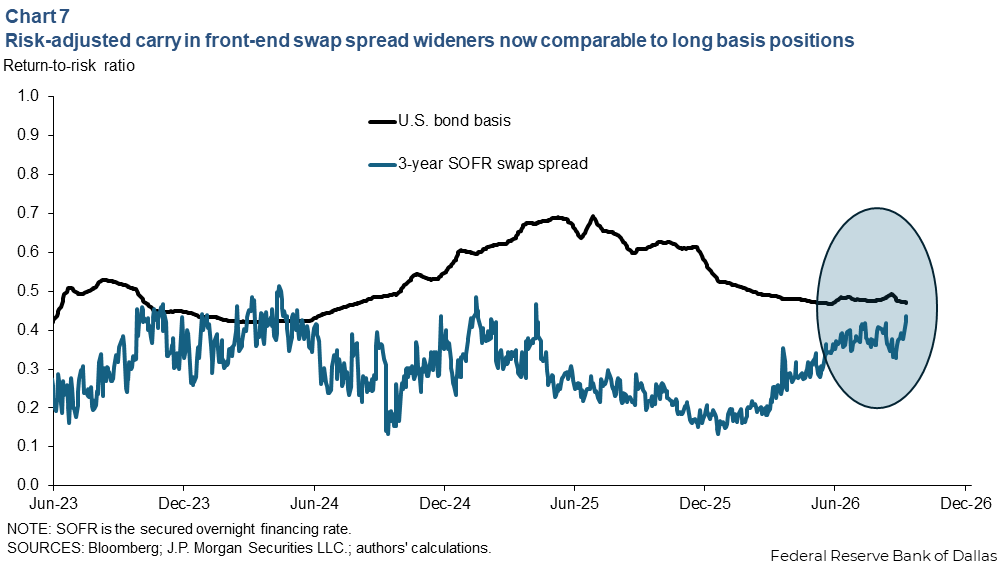
Leveraged funds allocate capital based on return relative to risk, not return alone. Thus, the relevant question is not whether the basis trade is still profitable, but whether it remains attractive against the alternatives. Many alternatives exist across global markets, but one close competitor to the basis is the swap-spread widener—a long Treasury position paired with a pay-fixed interest-rate swap, which profits when swap rates rise relative to Treasury yields.[9]
Front-end swap-spread wideners have become markedly more attractive recently. The risk-adjusted carry in such positions has climbed to levels close to the risk-adjusted return we estimate for a long basis position in the classic bond contract (Chart 7). A leveraged investor now has, at a minimum, a plausible and comparably attractive alternative—a reason to diversify away from the basis trade that is exogenous to the futures market entirely.
At first glance, the replacement of cash-futures long basis positions with swap spread trades might appear to be a mere shift in the derivative leg of the position, leaving the cash Treasury bond position unchanged. However, this is not the case. The substitution matters because of a scale effect.
A swap-spread position carries considerably more dollar risk per unit of notional value than a basis position of the same size. As a result, even modest reallocation of risk capital from basis trades to swap spreads can produce an outsized decline in aggregate Treasury futures notional—and a parallel decline in cash Treasury and repo positions (as well as the short SOFR-futures hedges) that accompany basis positions. That is exactly the pattern visible in the positioning and open-interest data noted at the outset.
Additionally, that this dynamic is independent of the workings of the futures market. It does not require the basis trade to have become unprofitable for hedge funds, only that the basis trade is a relatively less attractive use of a marginal dollar of capital than other trades.
Asset managers may be absorbing swap flow tied to AI financing
The three channels–mechanical BNOC compression, the absence of a crowding signature in option-adjusted spreads and a newly competitive swap-spread alternative—together offer a narrative that explains much of the base trade’s plateauing. This raises the natural question of how asset managers are otherwise obtaining the duration exposure they might have obtained through futures.
There does not appear to have been a broad rotation to asset manager holdings of cash debt instruments, and thus this duration exposure is likely obtained via other types of derivatives. One candidate is receive-fixed swaps—asset managers essentially taking the other side of the pay-fixed swap flow associated with the financing of AI/data center capital expenditure. Such debt issuance is not only large but unusually long in duration.
Two features of that financing generate pay-fixed swap flow. First, a borrower seeking a large amount of long-dated fixed-rate financing may be unable to place it all in the cash bond market at one tenor without widening the credit spread, and so may synthetically extend duration through pay-fixed swaps.
Second, a share of AI-related financing comes from private-credit lenders whose loans are floating-rate by construction; a borrower wanting fixed-rate economics must pay fixed in a swap to convert them. Both mechanisms create a supply of pay-fixed swaps, requiring someone to receive fixed and take on synthetic duration.
Asset managers such as life insurance companies are a natural constituency for this. To the extent they receive fixed in these swaps, they satisfy part of their duration demand without resorting to Treasury futures, providing yet another exogenous reason for a softening of the basis trade. Quantifying the extent of such flows is difficult, as much readily available evidence is anecdotal.
Seeking alternatives to the basis trade
The Treasury cash-futures basis trade grew substantially between 2021 and 2024 before plateauing. The economic literature primarily focuses on structural drivers of the basis trade and the rapid deleveraging that can occur during market stress. As a result, the plateauing of long asset manager futures positions, particularly in the absence of a clear rotation towards cash holdings of longer-duration Treasuries, requires additional explanation. We help close this explanatory gap by presenting a set of cyclical drivers that have eroded the return on long futures positions and presented alternatives both for leveraged funds seeking returns and asset managers seeking duration exposure.
The basis on long-maturity contracts has narrowed for a mechanical reason. As yields have risen toward the 6 percent reference yield used to set conversion factors, the deliverable basket has grown more homogeneous, mechanically shrinking the delivery option embedded in the basis. Stripping that option value out, option-adjusted spreads across contracts have remained stable or narrowed—consistent with leveraged investors allocating towards alternative trades.
Alternatives on both sides of the basis trade can affect the aggregate size of the trade. One such alternative for leveraged funds, swap-spread wideners, has become a comparably attractive use of leveraged capital. Moreover, their higher dollar risk per unit of notional value as compared to the basis means even a modest reallocation can sharply reduce aggregate futures exposure. For asset managers, long futures positions are playing a declining role in providing duration, which instead appears obtained in derivatives other than futures. We note one potential channel, absorbing receive-fixed swap flow tied to AI financing. However, evidence for this channel is not concrete but rather limited to a plausible mechanism and market commentary.
Together these channels expand upon the existing finance literature by painting a more nuanced picture of the cyclical drivers of positioning in the basis and the alternative channels through which trade participants accomplish their goals.
Notes
- The supplementary leverage ratio is an asset-quality-agnostic minimum capital rule for large banks. Because it applies the same charge regardless of risk, it can be punitive at the margin for holding low-risk, low-return assets such as Treasuries; recent relief efforts have centered on it.
- Each Treasury futures contract can be settled by delivering any of several eligible bonds. The short-futures holder chooses which to deliver and will pick the one that is cheapest to deliver, given prevailing prices.
- The gross basis of a bond is defined as its spot price minus the product of the futures price and the bond’s conversion factor.
- Basis net of carry is the gross basis less carry to the futures delivery date. Because carry is roughly a wash, the basis net of carry—not the gross basis—captures the economic return to a basis position.
- The invoice price—or futures-implied price—of a deliverable bond is equal to the futures price multiplied by its conversion factor. Therefore, prices of bonds are not directly comparable to the futures price, but the bond’s forward price at delivery horizon divided by its conversion factor is. The futures price can be loosely thought of as tracking the lowest of these factor-scaled forward prices.
- More precisely, the conversion factor is the clean price of the bond as of the first delivery day priced to a 6 percent yield, subject to certain maturity-rounding conventions. The essential point is that the reference yield is fixed at 6 percent.
- The wildcard option arises because Treasury futures stop trading before the cash market closes, giving the short-futures holder a daily window to decide whether to declare delivery using known futures prices. Its value accrues to the “tail”—the difference between the conversion factor and one—and so shrinks as cheapest-to-deliver coupons rise. See Galen D. Burghardt, Terrence M. Belton, Morton Lane and John Papa, The Treasury Bond Basis (McGraw-Hill Education, 2005).
- A comparison of J.P. Morgan, Barclays and Bank of America estimates finds that levels differ across providers—as expected from different models of the same option—but the series are positively correlated, supporting the common pattern described here.
- We proxy the ex ante attractiveness of each trade by the ratio of expected dollar carry to a dollar risk measure (the rolling one-year standard deviation of monthly changes in the relevant spread, duration-scaled and annualized). For the long basis position, we assume a skilled trader extracts roughly two ticks—about 6.25 basis points—per quarter in the classic bond contract.
About the authors

Matthew McCormick is a principal financial economist in the Research Department at the Federal Reserve Bank of Dallas.

Srini Ramaswamy is a senior financial economist in the Research Department at the Federal Reserve Bank of Dallas.

Hugo De Vere is a research analyst in the Research Department at the Federal Reserve Bank of Dallas.