Special Questions

Special Questions
For this month’s survey, Texas business executives were asked supplemental questions on artificial intelligence (AI). Results below include responses from participants from both the Texas Manufacturing Outlook Survey and Texas Service Sector Outlook Survey.
Texas Business Outlook Surveys
Data were collected May 12–20, and 313 Texas business executives responded to the surveys.
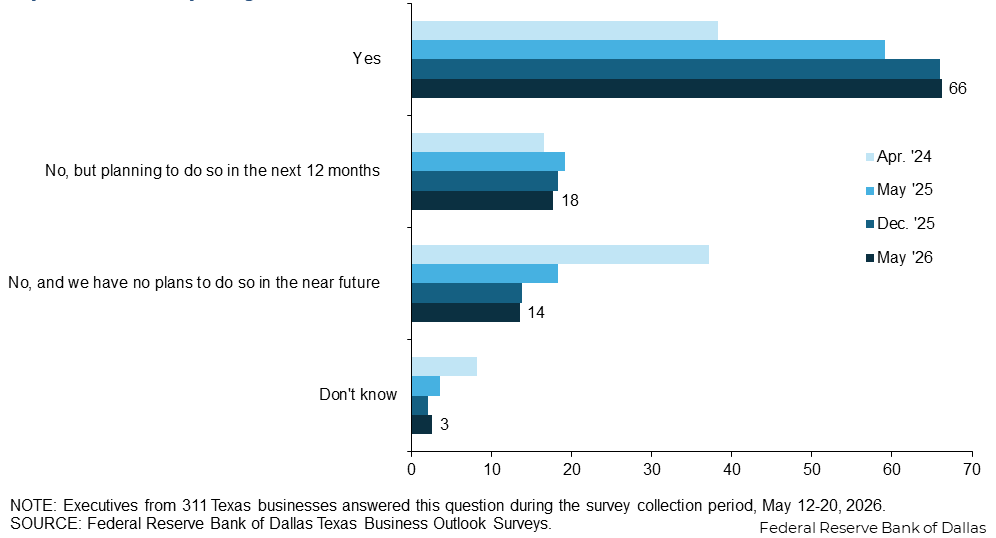
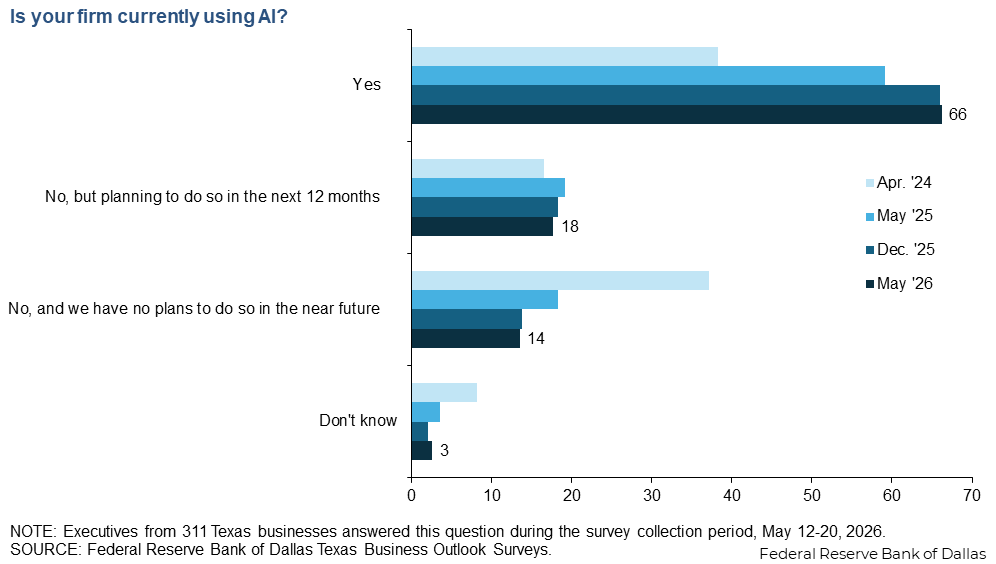
Two-thirds of responding firms report they are currently using artificial intelligence (AI), unchanged from December 2025 but up from 59 percent a year ago. AI use is more common among service sector firms than manufacturing firms.
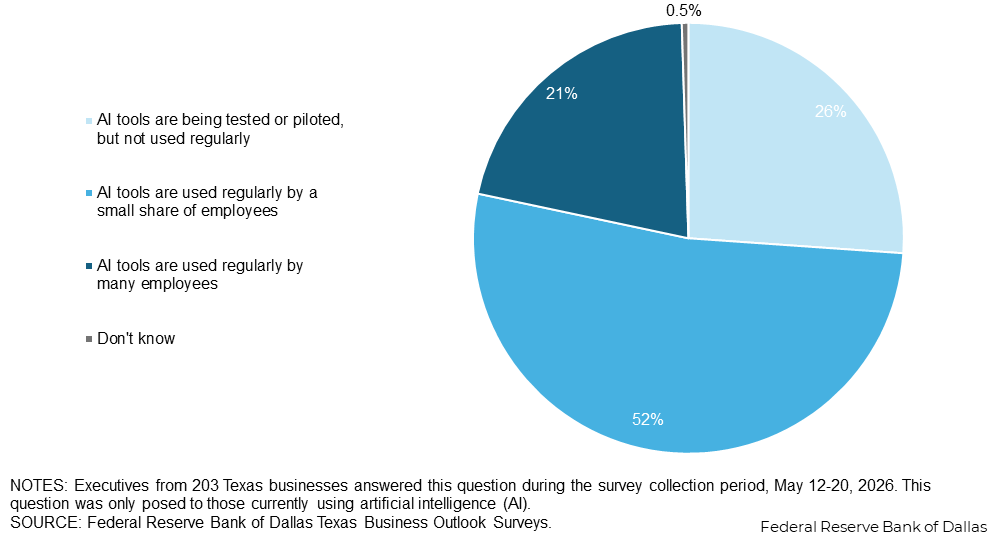
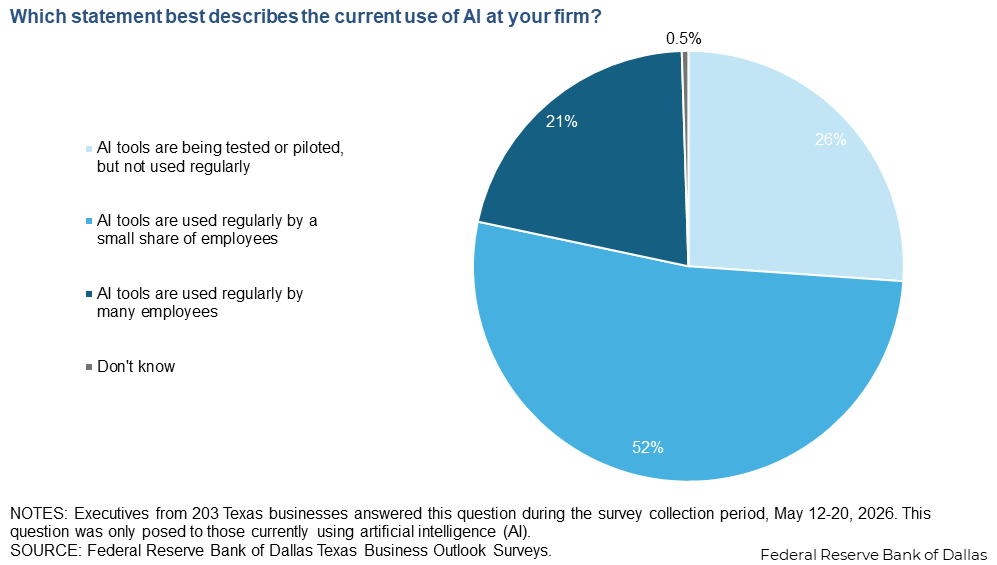
AI use at responding firms is largely happening in either a testing or piloting phase or among a small share of employees.
Among firms where AI tools are used regularly by many employees, it’s largely the case that these tools are integrated into the firm’s core business processes.
| May '26 (percent) |
|
| AI use is primarily happening on an ad hoc basis | 34.9 |
| AI tools are integrated into our core business processes and/or operations | 62.8 |
| Don't know | 2.3 |
NOTES: 43 responses. This question was only posed to those indicating that AI tools are used regularly by many employees.
Among firms using AI, most report it has not impacted their need for workers. Ten percent say it decreased their need for workers.
| May '26 (percent) |
|
| Significantly increased our need for workers | 0.5 |
| Slightly increased our need for workers | 0.5 |
| Changed the type of workers we need but not the number | 4.4 |
| Has not impacted our need for workers | 76.4 |
| Slightly decreased our need for workers | 8.9 |
| Significantly decreased our need for workers | 1.5 |
| Don't know | 7.9 |
NOTES: 203 responses. This question was only posed to those currently using AI. We asked a similar question in Dec. ’25, May ’25, and April ’24.
Among AI-using firms, just under 30 percent expect AI to decrease their need for workers in the medium term, and 20 percent expect AI to change the type of workers they need but not the number. Among firms who have not yet adopted AI but plan to, most expect AI use will not impact their need for workers over the next few years.
| May '26 (percent) |
|||
| Firms already using AI | Firms planning to use AI | Combined | |
| Significantly increase our need for workers | 1.5 | 0.0 | 1.2 |
| Slightly increase our need for workers | 2.5 | 1.8 | 2.3 |
| Change the type of workers we need but not the number | 20.3 | 16.4 | 19.5 |
| Will not impact our need for workers | 38.1 | 65.5 | 44.0 |
| Slightly decrease our need for workers | 24.3 | 12.7 | 21.8 |
| Significantly decrease our need for workers | 5.0 | 0.0 | 3.9 |
| Don't know | 8.4 | 3.6 | 7.4 |
NOTES: 257 responses. This question was only posed to those currently using AI or planning to do so in the next 12 months.
A majority of AI-using firms report that AI has boosted productivity among AI-using employees.
| May '26 (percent) |
|
| Yes | 71.4 |
| No | 10.8 |
| Don't know | 17.7 |
NOTES: 203 responses. This question was only posed to those currently using AI.
Most AI-using firms report that AI has not prompted higher wage growth among AI-using employees.
| May '26 (percent) |
|
| Yes | 7.4 |
| No | 76.5 |
| Don't know | 16.2 |
NOTES: 204 responses. This question was only posed to those currently using AI.
The following prompt was given to those who currently use AI and indicated a decrease in the need for workers or change in the type of workers needed in question 3.
Responses can be found on the individual survey Special Questions results pages, accessible on the Manufacturing and Service Sector tabs above.
The following prompt was given to those who currently use AI and indicated an increase in the need for workers or change in the type of workers needed in question 3.
Responses can be found on the individual survey Special Questions results pages, accessible on the Manufacturing and Service Sector tabs above.
Survey respondents were given the opportunity to also provide comments, which can be found in the Comments tab above.
Texas Manufacturing Outlook Survey
Data were collected May 12–20, and 74 Texas manufacturers responded to the survey.
| Apr. '24 (percent) |
May '25 (percent) |
Dec. '25 (percent) |
May '26 (percent) |
|
| Yes | 28.2 | 49.4 | 55.1 | 56.8 |
| No, but planning to do so in the next 12 months | 15.3 | 20.8 | 18.8 | 18.9 |
| No, and we have no plans to do so in the near future | 47.1 | 24.7 | 23.2 | 20.3 |
| Don't know | 9.4 | 5.2 | 2.9 | 4.1 |
NOTES: 74 responses.
| May '26 (percent) |
|
| AI tools are being tested or piloted, but not used regularly | 30.0 |
| AI tools are used regularly by a small share of employees | 52.5 |
| AI tools are used regularly by many employees | 15.0 |
| Don't know | 2.5 |
NOTES: 40 responses. This question was only posed to those currently using AI.
| May '26 (percent) |
|
| Significantly increased our need for workers | 0.0 |
| Slightly increased our need for workers | 0.0 |
| Changed the type of workers we need but not the number | 7.5 |
| Has not impacted our need for workers | 72.5 |
| Slightly decreased our need for workers | 10.0 |
| Significantly decreased our need for workers | 0.0 |
| Don't know | 10.0 |
NOTES: 40 responses. This question was only posed to those currently using AI. We asked a similar question in Dec. '25, May '25, and April '24.
| May '26 (percent) |
|||
| Firms already using AI | Firms planning to use AI | Combined | |
| Significantly increase our need for workers | 0.0 | 0.0 | 0.0 |
| Slightly increase our need for workers | 5.0 | 0.0 | 3.7 |
| Change the type of workers we need but not the number | 17.5 | 14.3 | 16.7 |
| Will not impact our need for workers | 42.5 | 71.4 | 50.0 |
| Slightly decrease our need for workers | 27.5 | 7.1 | 22.2 |
| Significantly decrease our need for workers | 2.5 | 0.0 | 1.9 |
| Don't know | 5.0 | 7.1 | 5.6 |
NOTES: 54 responses. This question was only posed to those currently using AI or planning to do so in the next 12 months.
| May '26 (percent) |
|
| Yes | 70.0 |
| No | 15.0 |
| Don't know | 15.0 |
NOTES: 40 responses. This question was only posed to those currently using AI.
| May '26 (percent) |
|
| Yes | 2.5 |
| No | 85.0 |
| Don't know | 12.5 |
NOTES: 40 responses. This question was only posed to those currently using AI.
The following prompt was given to those who currently use AI and indicated a decrease in the need for workers or change in the type of workers needed in question 3.
Printing and related support activities
- Some art and some communication work.
Plastics and Rubber Products Manufacturing
- Order processing, accounts payable, engineering.
The following prompt was given to those who currently use AI and indicated an increase in the need for workers or change in the type of workers needed in question 3.
Fabricated metal product manufacturing
- Financial summaries such as MD&A (management discussion and analysis) writeups.
Survey respondents were given the opportunity to also provide comments, which can be found in the Comments tab above.
Texas Service Sector Outlook Survey
Data were collected May 12–20, and 239 Texas business executives responded to the survey.
| Apr. '24 (percent) |
May '25 (percent) |
Dec. '25 (percent) |
May '26 (percent) |
|
| Yes | 41.4 | 62.2 | 69.4 | 69.2 |
| No, but planning to do so in the next 12 months | 16.8 | 18.7 | 18.0 | 17.3 |
| No, and we have no plans to do so in the near future | 34.1 | 16.2 | 10.8 | 11.4 |
| Don't know | 7.7 | 2.9 | 1.8 | 2.1 |
NOTES: 237 responses.
| May '26 (percent) |
|
| AI tools are being tested or piloted, but not used regularly | 25.2 |
| AI tools are used regularly by a small share of employees | 52.1 |
| AI tools are used regularly by many employees | 22.7 |
| Don't know | 0.0 |
NOTES: 163 responses. This question was only posed to those currently using AI.
| May '26 (percent) |
|
| Significantly increased our need for workers | 0.6 |
| Slightly increased our need for workers | 0.6 |
| Changed the type of workers we need but not the number | 3.7 |
| Has not impacted our need for workers | 77.3 |
| Slightly decreased our need for workers | 8.6 |
| Significantly decreased our need for workers | 1.8 |
| Don't know | 7.4 |
NOTES: 163 responses. This question was only posed to those currently using AI. We asked a similar question in Dec. '25, May '25, and April '24.
| May '26 (percent) |
|||
| Firms already using AI | Firms planning to use AI | Combined | |
| Significantly increase our need for workers | 1.9 | 0.0 | 1.5 |
| Slightly increase our need for workers | 1.9 | 2.4 | 2.0 |
| Change the type of workers we need but not the number | 21.0 | 17.1 | 20.2 |
| Will not impact our need for workers | 37.0 | 63.4 | 42.4 |
| Slightly decrease our need for workers | 23.5 | 14.6 | 21.7 |
| Significantly decrease our need for workers | 5.6 | 0.0 | 4.4 |
| Don't know | 9.3 | 2.4 | 7.9 |
NOTES: 203 responses. This question was only posed to those currently using AI or planning to do so in the next 12 months.
| May '26 (percent) |
|
| Yes | 71.8 |
| No | 9.8 |
| Don't know | 18.4 |
NOTES: 163 responses. This question was only posed to those currently using AI.
| May '26 (percent) |
|
| Yes | 8.5 |
| No | 74.4 |
| Don't know | 17.1 |
NOTES: 164 responses. This question was only posed to those currently using AI.
The following prompt was given to those who currently use AI and indicated a decrease in the need for workers or change in the type of workers needed in question 3.
Motor vehicle and parts dealers
- Marketing, planning.
- Automated customer follow-up for sales and service in business development centers.
Publishing industries (except internet)
- Initial coding use and larger plans to use in code and application development and testing.
Securities, commodity Contracts, and other financial investments and related activities
- Graphics designers, coders, mid-level managers. Processes that are redundant or repetitive, reminders, outreach tasks.
Professional, scientific and technical services
- Lower-level contract review, summarizing lengthy but somewhat formulaic documents.
- Coding, contract reviews, prototype design, negotiation, human resources.
- We have developed and deployed an AI agent for customer support and success tasks across our digital platform. AI (Codex and Claude Code) are used to support code generation and code review within our development team. AI tools are also used for legal and due diligence tasks on the commercial side.
- Software development and testing, contract creation and reviews, project documentation, project management, document creation, marketing material development.
- Research, modeling, process execution, analysis of media buys.
- We have used AI to accompany product and program development and are beginning to look at AI to assist with some tech build-out needs. Tech is not replacing any jobs or people in our company; it is assisting with moving projects along as task assistant.
- Database performance tuning, analyzing software code bases (static code analysis), supporting programming tasks, contract and deliverables analysis, requirements analysis and initial generation of marketing content for humans to edit and publish.
Food services and drinking places
- Accounts payable entry.
The following prompt was given to those who currently use AI and indicated an increase in the need for workers or change in the type of workers needed in question 3.
Professional, scientific and technical services
- The need for software support people due to AI use in more software sales and customer satisfaction.
- We use it for research in RFPs (requests for proposals) and bids.
Survey respondents were given the opportunity to also provide comments, which can be found in the Comments tab above.
Questions regarding the Texas Business Outlook Surveys can be addressed to Emily Kerr at emily.kerr@dal.frb.org.
Sign up for our email alert to be automatically notified as soon as the latest surveys are released on the web.
Special Questions Comments
Survey participants are given the opportunity to submit comments. Some comments have been edited for grammar and clarity.