Does it matter who finances the government’s debt?
Government debt and deficits have surged dramatically since the Global Financial Crisis of 2008. At the same time, interest rates fell. In attempting to reconcile huge government borrowing with low interest rates we ask, does it matter who is financing that debt?
We find that debt financed from foreign borrowing affects interest rates more than the same debt financed from domestic savings. Additionally, net international creditors can borrow more cheaply than net international debtors. Thus, who finances government debt significantly affects interest rates.
Government debt, deficits and interest rates
Since the Global Financial Crisis, government debt and deficits have soared. In both 2008 and the 2020 pandemic, the average government budget deficit rose from near zero before the crisis to more than 7 percent of GDP during the event for an average of 19 Organization for Economic Cooperation and Development (OECD) countries (Chart 1).
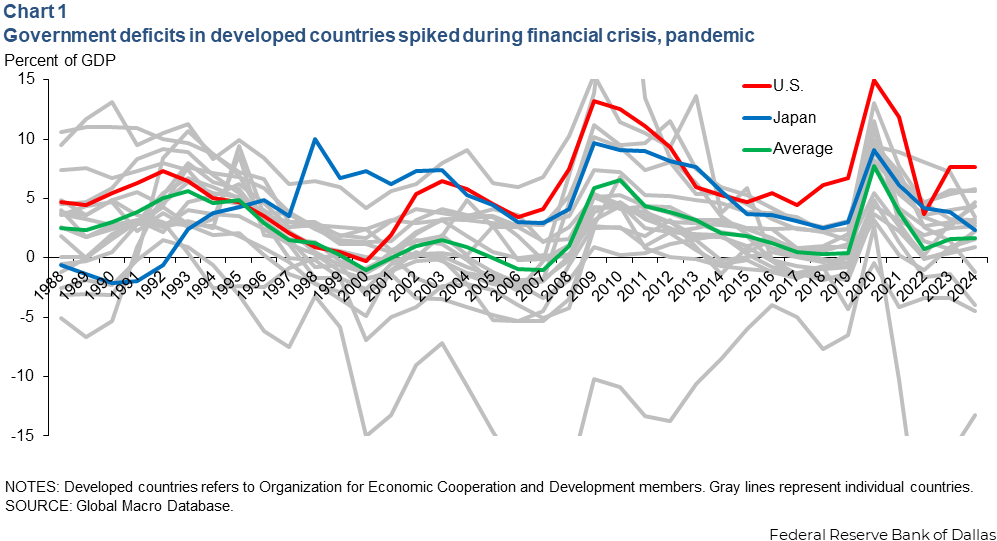
More specifically, the U.S. government budget deficit exceeded 13 percent of GDP in both crises. In Japan, the government deficit was nearly 10 percent of GDP during those events and exceeded 5 percent of GDP most years since the mid-1990s.
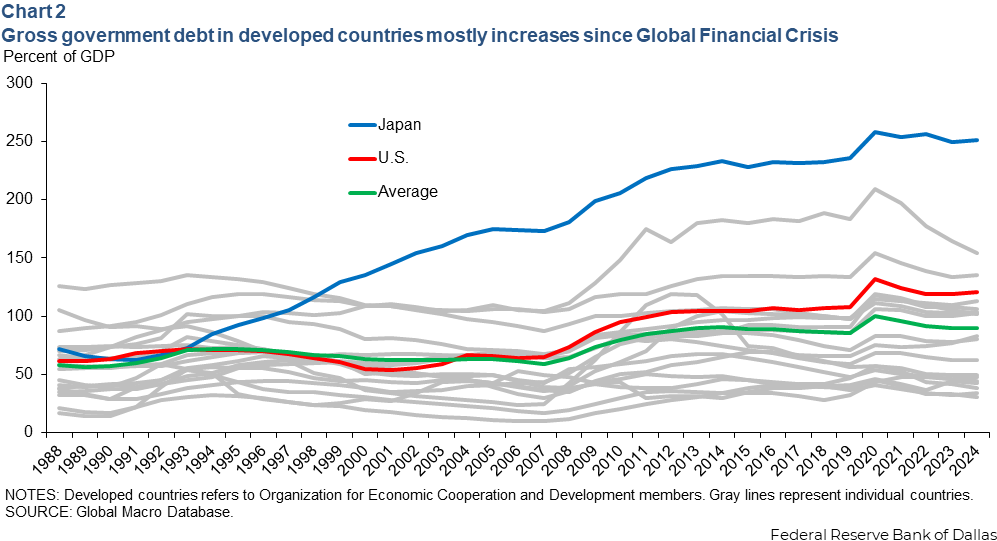
Gross government debt from these deficits has increased (Chart 2). On average, the government gross debt-to-GDP ratio rose from 59 percent in 2007 to 90 percent by 2024. By comparison, in the two decades before 2007 it increased marginally, from 58 to 59 percent. The U.S. gross debt-to-GDP ratio increased from 64 percent of GDP in 2007 to 121 percent in 2024. Japan’s ratio rose from less than 70 percent in the early 1990s to 251 percent in 2024.
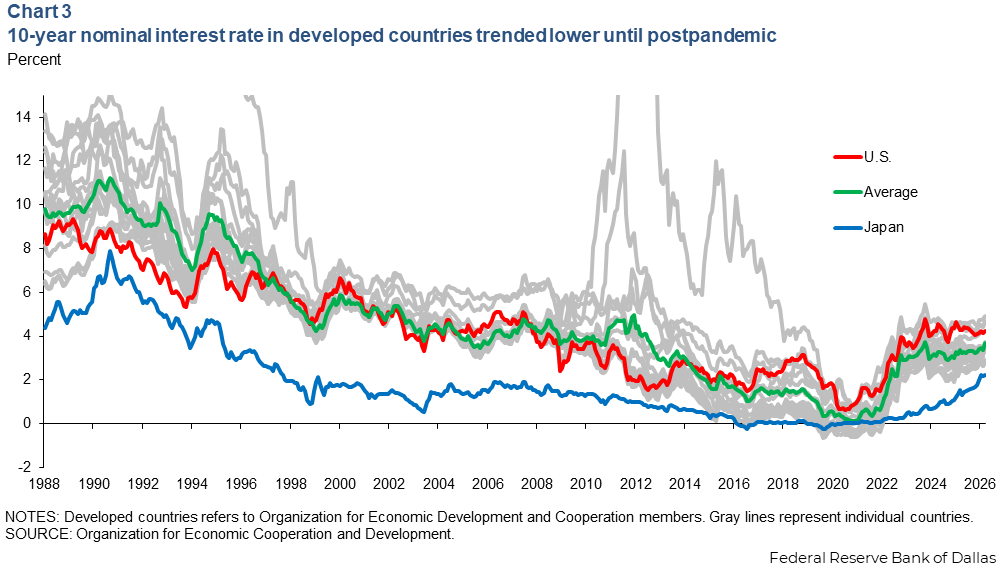
However, this surge in government borrowing did not lead to a sharp increase in interest rates. Apart from a few countries in the eurozone periphery, there was no surge in government bond yields after the 2008 crisis, and bond yields stayed low after the 2020 crisis (Chart 3). Bond yields only began rising with the postpandemic inflation surge in 2022.
Additionally, there is not a positive correlation between government debt levels and interest rates across countries.
The chart of gross government debt levels shows a wide variation in debt levels across countries. However, Chart 4 shows a slight negative correlation between average 10-year government bond yields and average gross government debt (1988–2024) for the 19 OECD countries. Japan is the outlier on the upside in the chart of gross government debt and is the outlier on the downside in the chart of 10-year interest rates as well.
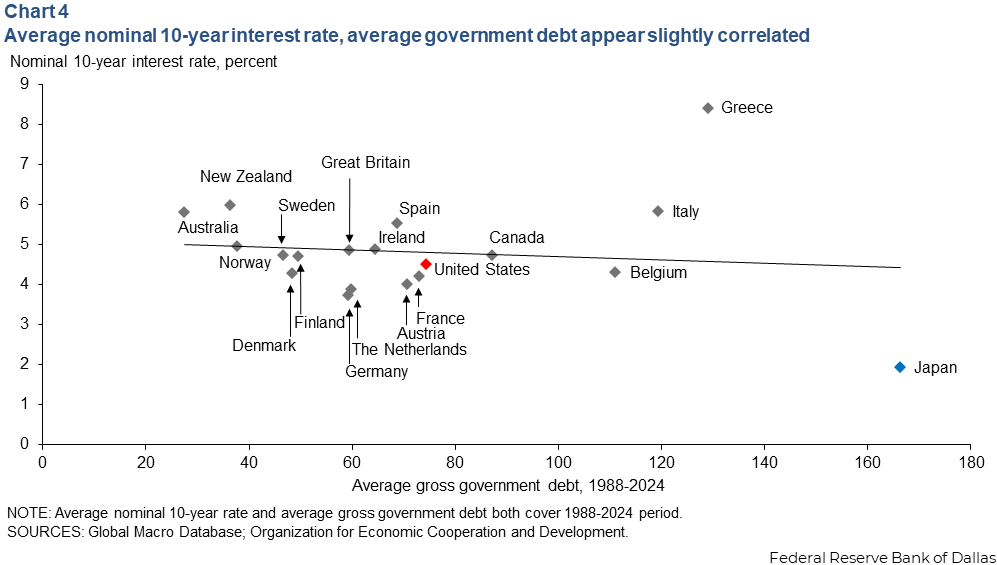
How can we reconcile massive government borrowing since 2008 with persistently low bond yields? As a separate question, how can we explain this lack of a cross-sectional relationship between the level of government debt and the level of interest rates?
In a new working paper, we argue that the answers to these two questions are related. Government debt financed from domestic savings has a smaller effect on interest rates than government debt financed from foreign borrowing.
Private sector savings offsets increased government borrowing
Massive surges in U.S. government borrowing in the 2008 and 2020 crises have been accompanied by an equal increase in private sector saving, we showed in a recent article. Thus, the U.S. current account deficit—a measure of total national borrowing—has been remarkably stable and less than 3 percent of GDP per year from 2008 through the pandemic.
U.S. borrowing from the rest of the world peaked between 2004 and 2006, when government budget deficits combined with a negative private sector net savings to produce an annual U.S. current account deficit of 6 percent of GDP. In the 2008 crisis, government borrowing surged, but so did private sector savings, and by 2009 the U.S. current account deficit fell to 3 percent of GDP.
Similarly in 2020, the U.S. current account fell by less than a percentage point of GDP, despite a decrease in government net savings of 8 percentage points of GDP. Increased savings by U.S. households largely offset growing government borrowing. This offset allowed the total national savings to remain fairly stable.
Among developed countries, a similar pattern emerged. Government debt and deficits surged during the 2008 and 2020 crises, but were offset by increased private sector savings, leaving total national borrowing largely unchanged.
Another recent article looks at the same representation of total national saving in Japan. Despite massive government borrowing since the mid-1990s, private sector saving has more than offset this government borrowing, leading to a current account surplus for the country as a whole. The cumulative sum of all of this government borrowing and national savings means that despite a level of gross government debt equal to 251 percent of GDP, Japan as a whole is a net creditor with a net foreign asset position of 82 percent of GDP.
How interest rates reflect government debt
With government borrowing only part of total national borrowing, we look at the interest rate effects of government debt. Our new working paper follows the empirical literature estimating the effect of government debt and deficits on interest rates.
Since the business cycle affects both government borrowing and interest, simply regressing interest rates on government debt or deficits isn’t useful. Thus, we follow the academic literature and regress interest rates on expected government debt and deficits.
Specifically, we follow a study by economists Joseph Gruber and Steven Kamin and regress long-term interest rates on two-year ahead forecasts of government debt and deficits from the OECD. However, unlike Gruber and Kamin, we also incorporate OECD forecasts of the current account and net foreign asset position, to see not only government borrowing but also total national borrowing.
Using this framework that incorporates total national borrowing, we analyze the effect of an increase in government debt or deficits on interest rates as a function of whether a country is a net creditor or net debtor, and whether new borrowing is financed at home or abroad. This is in contrast to previous studies that just find one number for the effect of government borrowing on interest rates.
Chart 5 plots the estimated effect of a 1 percentage point increase in government gross debt or deficits on 10-year interest rates.
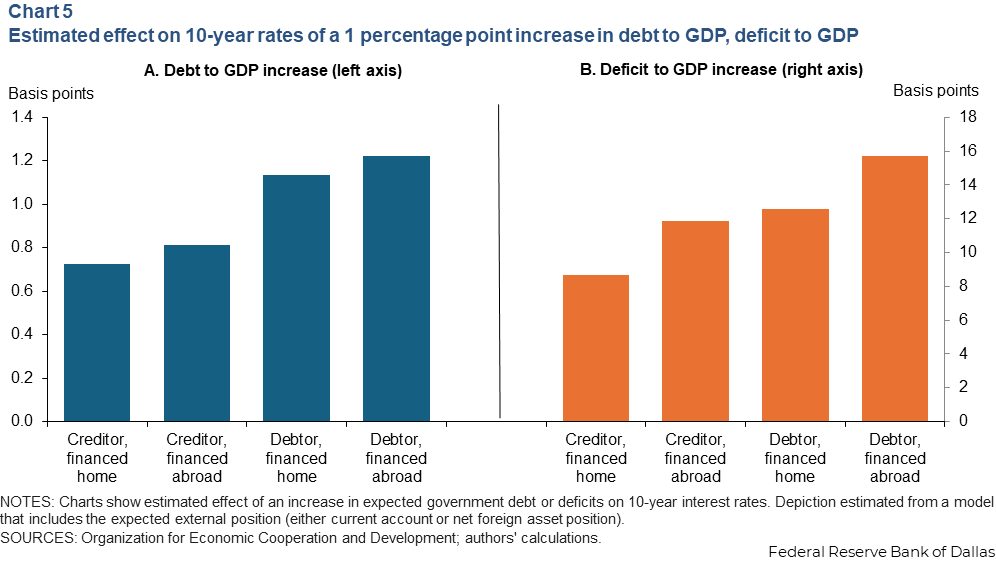
Debt or deficits financed from foreign borrowing have a greater effect on interest rates than the same debt or deficits financed from domestic savings. The government of a country that is a net international creditor is able to borrow more cheaply than the government of a country that is a net international debtor.
The results suggest that when analyzing the effect of government borrowing on interest rates, it is important to think about whether that government debt is financed at home or abroad. Government borrowing has less of an effect on interest rates in a country such as Japan, an international creditor. New government borrowing there is easily financed from domestic savings. Likewise, the surges in government borrowing in the U.S. in 2008 and 2020 have less of an effect on long-term interest rates when they are financed from domestic saving, keeping the current account stable.
U.S. current account deficit to influence debt cost
This takes us back to thinking about the debt situation in the U.S. After remaining stable at less than 3 percent of GDP per year from the 2008 crisis through the pandemic, the U.S. current account deficit began deteriorating.
Government budget deficits are increasing and are around 8 percent per year. At the same time, private sector net savings is well off the levels of 2020–21 and has steadily declined over the past few years. U.S. private sector savings is still positive, unlike the years before the 2008 crisis, but the U.S. current account deficit, which averaged under 2 percent of GDP per year in the years before the pandemic, is near 4 percent of GDP today.
About the authors

Scott Davis is an assistant vice president in the Research Department of the Federal Reserve Bank of Dallas.

Lillian Derr is an outreach advisor in the Community Engagement and Development Department at the Federal Reserve Bank of Dallas.