Refinery outages pumping up fuel prices more than cost of crude oil
Global refinery capacity has declined by as much as 10 percent amid mounting transportation challenges and geopolitical tensions.
They include closure of the Strait of Hormuz, attacks from Houthi rebels in Yemen on Red Sea shipping, damaged Middle East refineries, Ukrainian drone attacks on Russian refineries, and export restrictions in China and Russia. Additionally, a decade of minimal refinery investment has intensified fuel market pressures.
As refined product inventories have declined, the difference between the price of oil and the wholesale prices of diesel, gasoline and jet fuel has increased well beyond normal. These differences, known as crack spreads, have exceeded levels last seen in 2022 following Russia’s invasion of Ukraine and the subsequent market disruption (Chart 1).
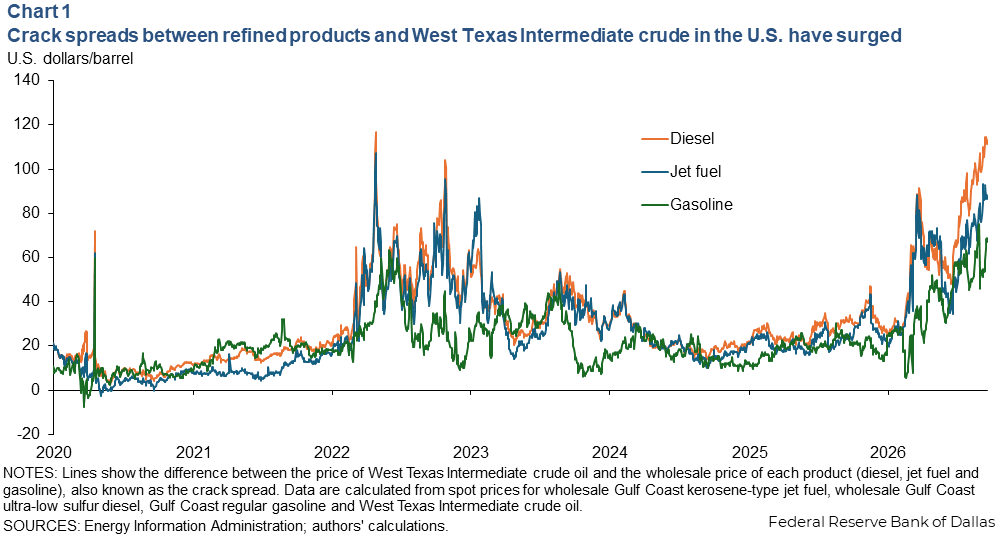
These pricing dynamics reflect acute, multifaceted supply constraints in the global market for refined fuels rather than retailer or distributor markup.
Even after the Iran conflict ends and the flow of crude oil through the Strait of Hormuz normalizes, U.S. fuel prices will likely remain unusually elevated relative to crude prices. As a result, headline inflation measures could remain above where oil price trends would normally indicate for as long as a significant portion of global refining capacity stays offline.
Long-term refining demand had softened
Global refined fuel demand growth has decelerated in recent years following slowing population growth, improved vehicle fuel efficiency and rising electric vehicle market share. Between 2019 and 2025, global liquid fuel consumption grew by 4 million barrels per day (mb/d), while refining capacity increased 2.3 mb/d.
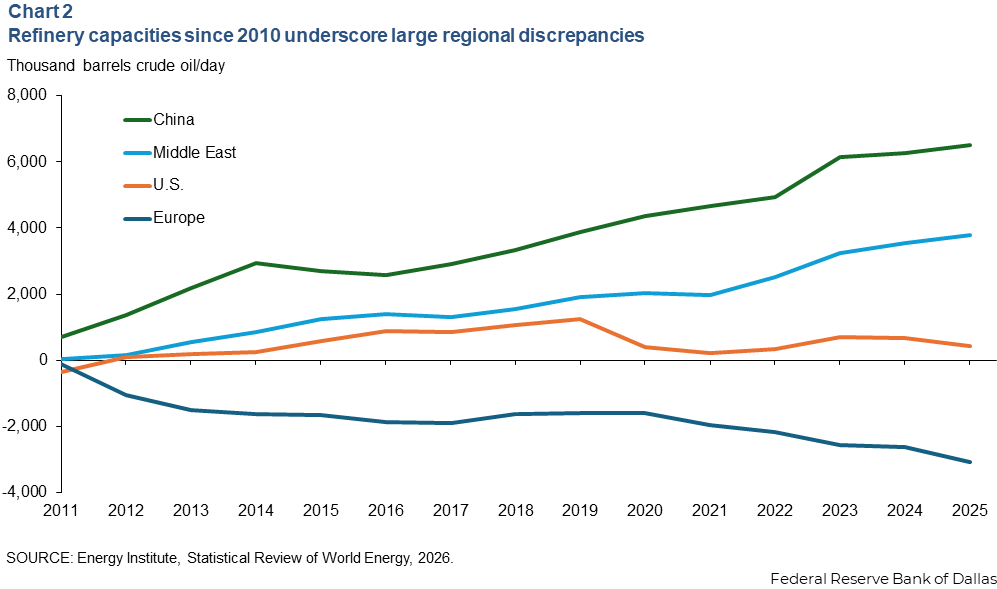
Capacity expansion has been regionally uneven. Since 2019, China and the Middle East have added 4.4 mb/d, while Europe and North America shed 2.1 mb/d. As newer world-scale complexes were built in China and the Middle East, older Western refineries closed due to thin margins, regulatory costs and aging facilities.
In the U.S., about half the decline was offset by renewable diesel conversion—diesel or jet fuel made from biomass (such as soybeans)—and new Gulf Coast hydrocrackers processing light shale oil. In Europe, natural gas prices surged to record sustained highs along with other key refinery inputs, such as Russian crude oil and vacuum gasoil, a feedstock for gasoline, diesel and jet kerosene production. This accelerated the already-certain rationalization of older, high-cost, heavily regulated European refining and chemical processing capacity (Chart 2).
Russia largely redirected exports that had gone to Europe toward other nations despite sanctions that followed its invasion of Ukraine. The cost of such evasion was higher for refined products than for crude oil.
Then came Ukrainian drone attacks on Russian refineries and ports. Ukrainian drones initially successfully struck a Russian refinery in May 2023. Combined with the challenges of navigating sanctions and economic duress, the attacks only marginally diminished Russia's operable capacity by year-end 2025. Operational outages occurred but, in most cases, damage was mostly minor or was offset by increases in refinery utilization elsewhere. Successful hits did not result in major prolonged shutdowns of refinery complexes.
Product markets, particularly for diesel and jet fuel, were tight before the Iran war began in February 2026 and the subsequent closure of the Strait of Hormuz. Simultaneously, Ukrainian drone attacks on Russia’s refineries intensified.
Conflicts combine to curb refinery output
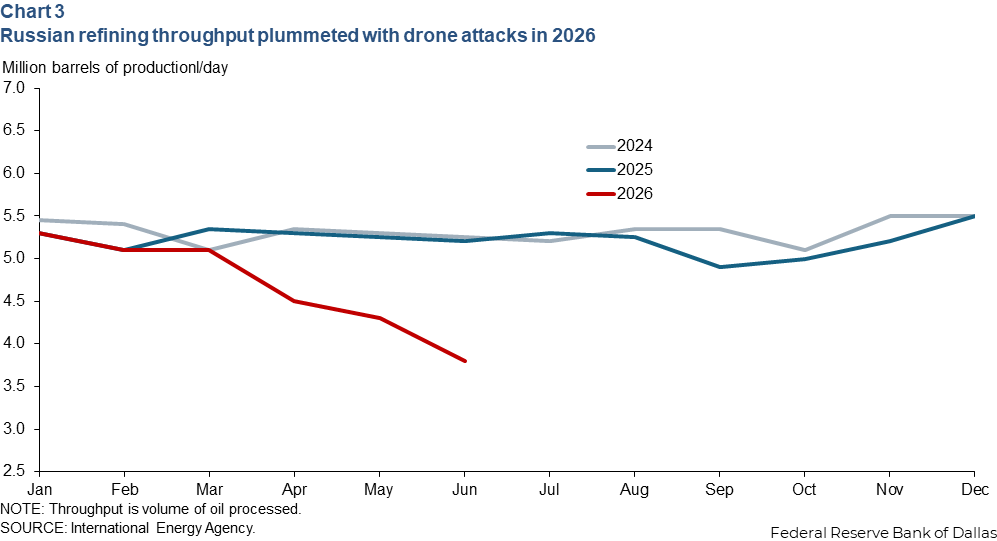
Ukraine’s drone attack effectiveness against Russian refineries accelerated with heavier payloads and longer-range accuracy. These attacks reduced Russia’s refining capacity by as much as 60 percent over summer 2026, though estimates of the impact vary widely month to month. In addition to capacity losses, Russia restricted exports to alleviate domestic supply shortages. In total, Russian crude processing and refined product exports decreased by 1.5 mb/d, according to the International Energy Agency (Chart 3).
The closure of the Strait of Hormuz in March 2026—which immediately but only temporarily prevented about 5 mb/d of Persian Gulf refined product exports—further affected the global fuel market. Iranian drone and ballistic missile strikes, and the blockage of tanker flows reduced the volume of oil processed by Middle East refineries since February by 2.0 mb/d, according to preliminary International Energy Agency data for August.
Markets respond to product shortfalls
Markets have adjusted to the disruption in meaningful ways. For example, China slashed its crude oil imports by more than 5 mb/d. The reduction spanned three areas: at least 1 mb/d less oil to fill its strategic reserves, a roughly 2 mb/d drop in refinery processing and a decline in oil imports for petrochemical manufacturing used to produce plastics and other products.
To extend the life of domestic inventories, China also temporarily reduced its exports of refined products through mid-summer, relaxing those reductions slightly amid a drop in Russian exports that further pressured the supply side and logistics of the global refined product market.
Meanwhile, exports of crude oil from the U.S. ramped up to record highs, surging as much as 1.5 mb/d over previous levels in the immediate aftermath of the Hormuz blockage. Releases of oil from the U.S. Strategic Petroleum Reserve enabled a portion of the exports. However, these are temporary measures and cannot be sustainably maintained if the Strait of Hormuz remains constrained well into the fall.
Shock absorbers wearing thin
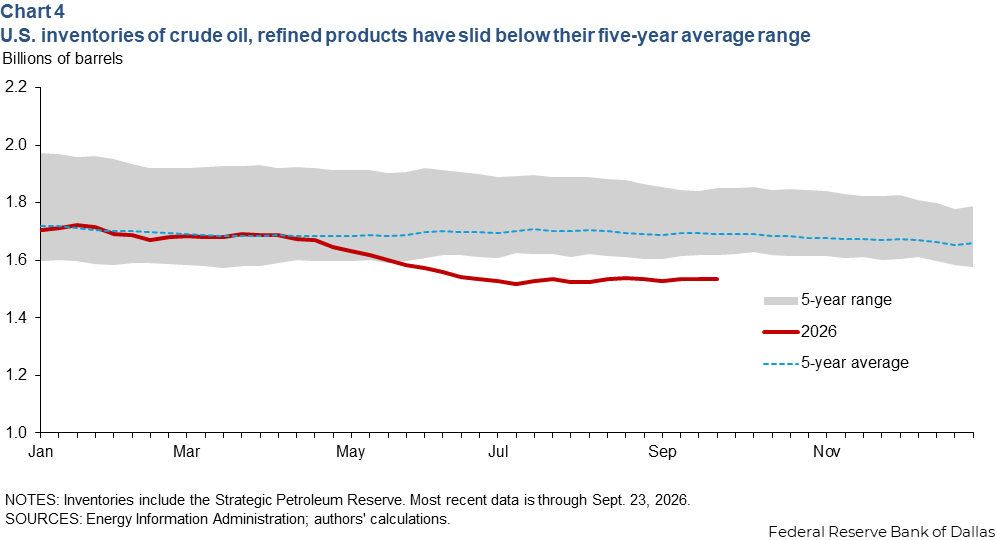
In September, the Strategic Petroleum Reserve held 284 mb of crude oil, its lowest level since 1982. Draining at 1.2 mb/d, the reserve could last less than six months if official estimates are accurate that it requires an 80 mb operational minimum. Some private sector analysts believe the minimum required is much higher, upwards of 200 mb. If true, the viability of drawing from the reserve could have a much shorter timeline.
While U.S. crude exports surged from 4 mb/d in February to 5.2 mb/d on average in May, U.S. crude oil production was essentially flat during that period. Similarly, the amount of crude oil processed by U.S. refineries rose only 0.6 mb/d during that time, while exports of refined product grew by a slightly larger amount.
As a result, U.S. stocks of crude oil and refined products are at multiyear lows (Chart 4). Drawing further on these inventories will not only pressure prices higher but will leave the global oil market in a much tighter fundamental position when—and if—the Strait of Hormuz becomes reliably passable.
When the market bids up the prices of oil or refined products following a supply disruption, those higher prices pull supplies from commercial inventories and can even pull new production online to fulfill demand. Estimates vary widely, but crude oil and petroleum products in floating storage and transit across Organization for Economic Cooperation and Development nations; in Fujairah, United Arab Emirates; and in Singapore, along with estimates of China’s landed oil stocks, added up to about 8 billion barrels in late September, about 450 million barrels below prewar levels.
That implies that consumers have used around 2.5 mb/d pulled from storage since February. Given a few broad assumptions about storage capacity utilization and the minimum volumes needed across systems for oil infrastructure to function, at least 3 billion barrels of crude oil, products, refinery feedstocks and refined products are globally available. That represents several years’ worth of inventory cover if the world continues to draw inventories at 2.5 mb/d, with one major caveat: Everything is not available everywhere all at once.
Inventories of petroleum are only helpful if they are comprised of the specific products, raw materials or blending components that a location or region requires at one time to meet local demand.
Long before global stocks hit functional floors, local inventory shortages and logistical challenges will increasingly contribute to greater price volatility, rising prices, curtailed consumption or some combination of these factors. The impacts will creep further into global markets product by product over the next year, though not necessarily all at once. Such an outcome is unavoidable if global supplies remain constrained.
Consumers face long-lasting effects
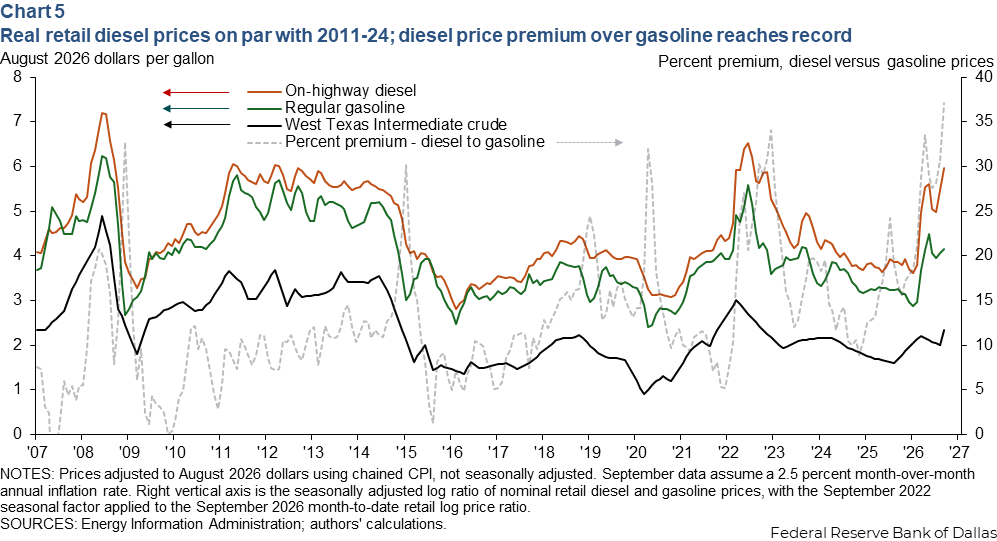
Taken together, refining capacity curtailment and depleted inventories are driving a blowout in fuel prices. The global economy is wrestling with a refining shock in addition to an oil price shock, particularly for diesel. Retail fuel consumers have endured similarly expensive gasoline and diesel prices, after adjusting for inflation, for multiple years in the 2010’s, but retail diesel prices have never exceeded gasoline by as much (Chart 5).
The diesel situation is even worse in Europe, where reduction of Russian and Middle East fuel exports has been more impactful. European importers have increasingly turned to the U.S. for export of distillate, such as diesel, in recent months. Low water-level shipping restrictions on the Rhine River, an important waterway for energy products, have contributed to Europe’s supply challenges.
Between Middle East refinery outages, shipping constraints, damaged Russian refineries and curtailed Chinese refining, the global fuels market has sustained as much as 6 mb/d to 8 mb/d of reduced capacity since late spring, up to 10 percent of global refining.
Given the potential for damaged Middle East refineries to require months to recover and the potential for Russian refinery outages to persist, higher crack spreads for various fuels will likely linger after shipments via the Strait of Hormuz normalize.
In the meantime, as inventory buffers dwindle, consumers will be increasingly forced to balance the market through reduced consumption, greater price volatility and potentially higher prices.
About the authors

Jesse Thompson is a senior business economist at the Houston Branch of the Federal Reserve Bank of Dallas.

Garrett Golding is an assistant vice president for energy programs at the Federal Reserve Bank of Dallas.