
Higher fuel prices seep into core inflation
Fuel prices have been on a wild ride since late February 2026, when military strikes on Iran set off sharp moves in oil and fuel markets. Retail gasoline prices aside, the U.S. retail diesel price reached an all-time high, the jet fuel price is near its previous peak, and the heating oil price has set a new record. The U.S. price of natural gas, meanwhile, has barely budged.
The fuel price surge has been very uneven. Diesel prices in particular moved sharply higher. Diesel is the fuel of the freight economy. Trucks, trains, ships and farm equipment run on it, which means its price may potentially touch the cost of moving nearly everything consumers buy.
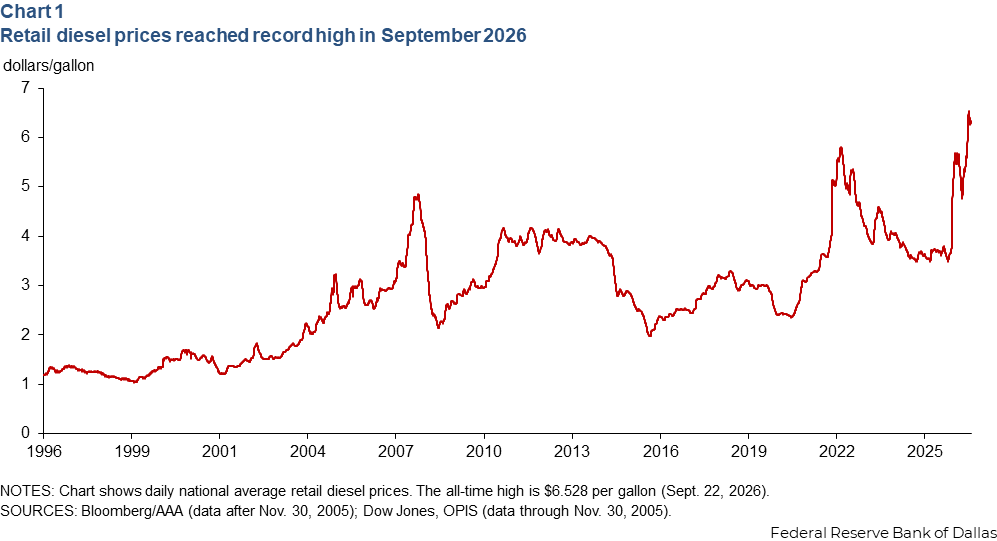
The price gap between diesel and gasoline has widened significantly in recent months. On Sept. 22, 2026, the national average retail price of diesel reached $6.53 per gallon, about 70 percent above its level at the end of February (compared with a 50 percent rise for retail gasoline). The diesel rise surpassed the fuel’s previous record set in 2022 (Chart 1). Prices have eased only modestly, to about $6.31 as of the end of October.
Consumers experience these prices directly at the pump and indirectly on their utility bills. But fuel prices may also work their way into the prices of other goods and services, from airline tickets to paper towels. Economists call these "second-round effects," and they matter for the Federal Reserve because they show up in core inflation, an inflation measure that excludes food and energy. Policymakers watch core inflation closely to gauge underlying price pressures.
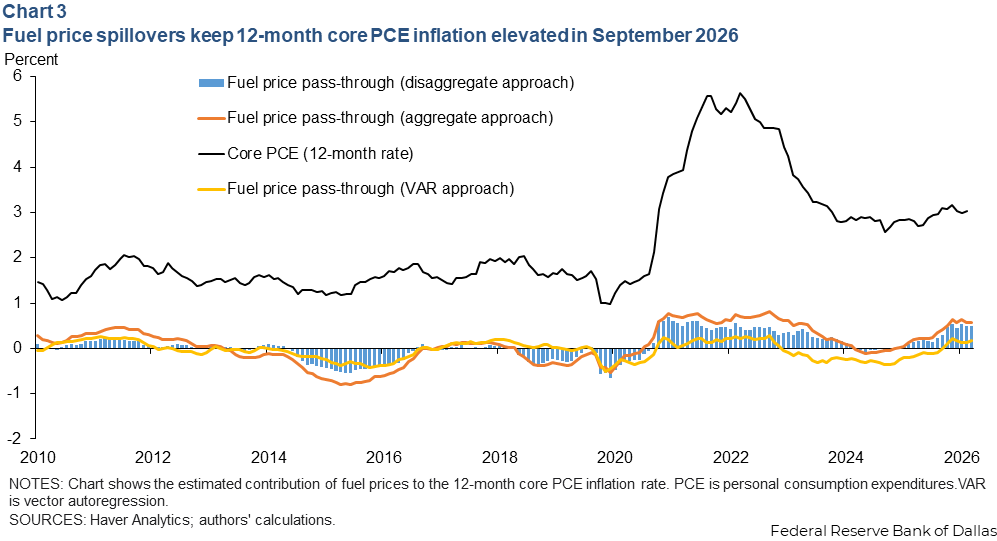
Our estimates suggest that higher fuel prices added between 20 and 60 basis points to 12-month core inflation, as measured by the personal consumption expenditures (PCE) price index, as of September 2026. If fuel prices simply held at their current levels, that contribution would gradually decline by about 30 basis points by the end of 2027.
Not all fuel prices have moved alike
Households and businesses don't face a single energy price. They face many energy prices, including the prices of gasoline, diesel, jet fuel, heating oil and natural gas. Individual fuel prices have behaved very differently this year. The heterogeneity in fuel price increases matters.
Chart 2 plots eight fuel price indexes since Feb. 27, 2026, the day before the Iran conflict began, with each scaled to 100 on that date. The spread across them is striking.
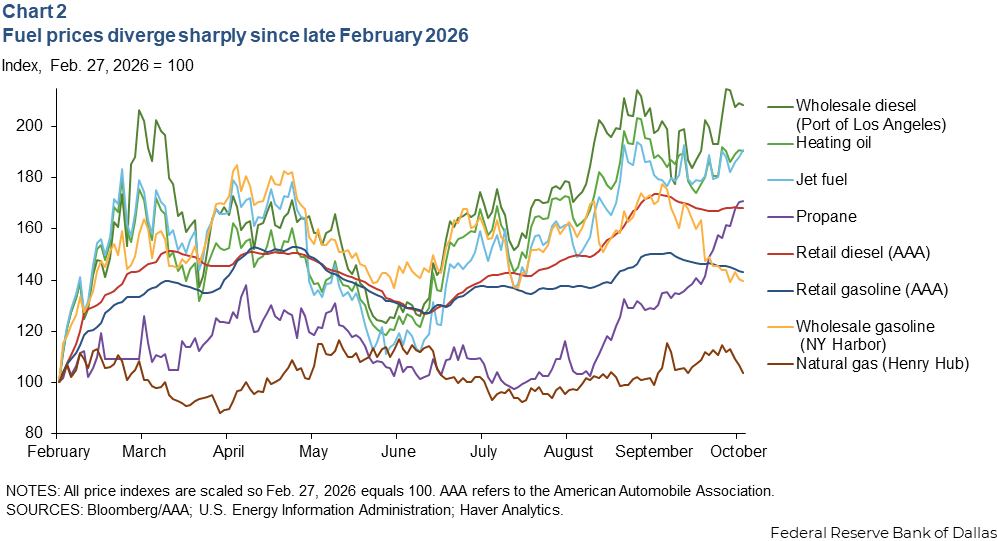
Prices of distillate fuels such as diesel, jet fuel and heating oil rose the most, while the price of gasoline climbed less. This largely reflects the additional disruptions the Iran war caused in the global market for diesel and jet fuel, on top of the disruption of crude oil exports. The price of natural gas is the notable exception, moving little since the end of February. (Most of the natural gas, abundantly produced in the U.S., remains in the country.)
How fuel prices find their way into core inflation
By construction, core PCE inflation excludes energy. But excluding energy prices from the index doesn't insulate it from their effects. When fuel costs rise, airlines tend to charge more for tickets, shippers tend to raise freight rates and manufacturers that rely on energy-intensive inputs seek to pass along higher costs. The size of these second-round effects is not clear a priori because not all producers can pass on fuel price increases. For example, farmers may find it challenging to pass on higher diesel costs when faced with large corporations buying their crops. In practice, these second-round effects historically have been delayed and typically modest, but when fuel price swings are large, they can add up.
To quantify these effects, we use three alternative estimation approaches. The first is a structural vector autoregressive (VAR) model by Lutz Kilian and Xiaoqing Zhou that quantifies the incremental impact of shocks to several fuel prices on headline and core inflation.
The second and third approaches use mixed-frequency estimators recently developed by Alexander Chudik and Lutz Kilian, which relate monthly inflation data to daily movements in fuel prices. We apply these mixed-frequency estimators both to aggregate core PCE inflation (aggregate approach) and to 149 of its individual components, adding up the component-level estimates to obtain an overall contribution to core PCE inflation (disaggregate approach). All three approaches include gasoline, diesel, jet fuel and natural gas prices.
Depending on the modeling approach taken, we find that fuel prices contributed between 20 and 60 basis points to 12-month core PCE inflation in September 2026 (Chart 3). All of our estimates point to the same conclusion: The pass-through of fuel prices to core PCE inflation is generally small and difficult to estimate precisely, but because this year's fuel price swings have been so large, their second-round effects on core inflation are not negligible.
Implications for 2027
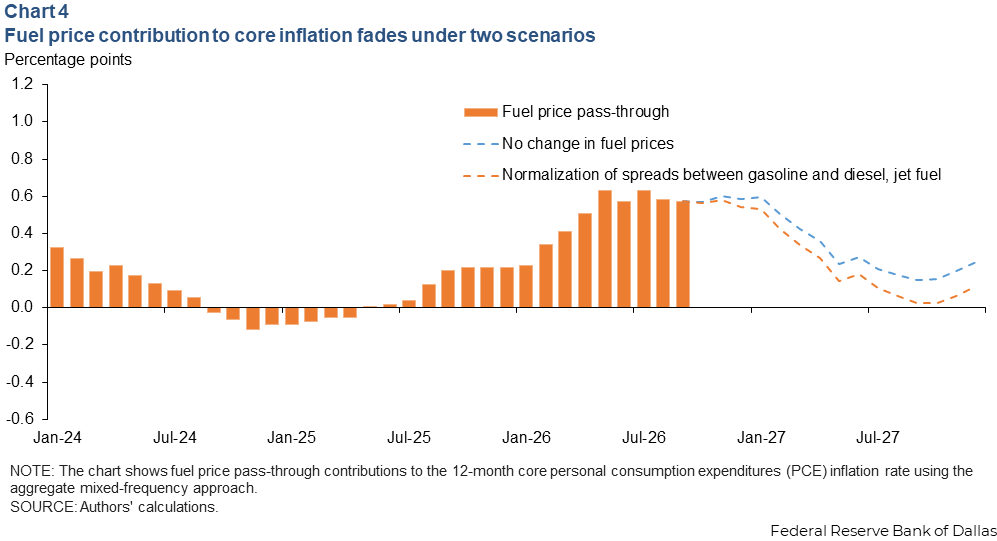
Where fuel prices go next is highly uncertain, and we don't attempt to forecast them. Instead, we consider two scenarios for how the fuel price contribution to core inflation might evolve through the end of 2027, using the aggregate mixed-frequency approach for illustration (Chart 4).
The indicated results are:
- No change: Fuel prices stay at the elevated levels of mid-October. Even so, in that case the contribution of fuel prices to 12-month core PCE inflation would fade as this year's increases drop out of the 12-month comparison, lowering the inflation rate by roughly 30 basis points by December 2027 relative to its September 2026 contribution.
- Normalization of spreads: Gasoline prices hold steady, but the unusually wide gaps between gasoline prices and those of diesel and jet fuel return to their historical averages. In this case, the downward drag on core inflation would be about 12 basis points larger than in the no-change scenario.
As with any empirical exercise, these estimates come with uncertainty. Our approaches allow for a rich set of relationships among consumer prices, but they assume that those relationships have been stable over time. The actual pass-through during an episode as unusual as the current one could be larger or smaller than history suggests.
Still, the broad message is clear: This year's fuel price shocks have added a meaningful, if modest, amount to core inflation, and absent further increases in fuel prices, that boost should gradually unwind.
About the authors

Alexander Chudik is an assistant vice president in the Research Department at the Federal Reserve Bank of Dallas.

Lutz Kilian is a vice president in the Research Department and director of the Center for Energy and the Economy at the Federal Reserve Bank of Dallas.

Xiaoqing Zhou is an assistant vice president in the Research Department at the Federal Reserve Bank of Dallas.