Wildfires and smoke cloud hospital debt costs, investment
The number of wildfires nationwide in 2025 exceeded the 20-year average. The effects are extensive, as wildfire smoke can drift thousands of miles from its origin. In summer 2026, smoke plumes from Canadian wildfires traveled as far south as the U.S. mid-Atlantic region, triggering air quality warnings.
The risk of physical damage from climate-related events is often priced into financial assets, such as municipal bonds. Wildfire smoke can impose financial costs even where no property is damaged. Smoke carries fine particulate matter, known as PM2.5, roughly 30 times smaller than the width of a human hair.
Such airborne material can increase demand for emergency care at hospitals far from fires. In recent research, we find that this demand adversely affects hospitals' borrowing costs, profitability and investment, particularly where hospitals serve many uninsured or publicly insured patients.
Exposure to wildfire smoke is rising
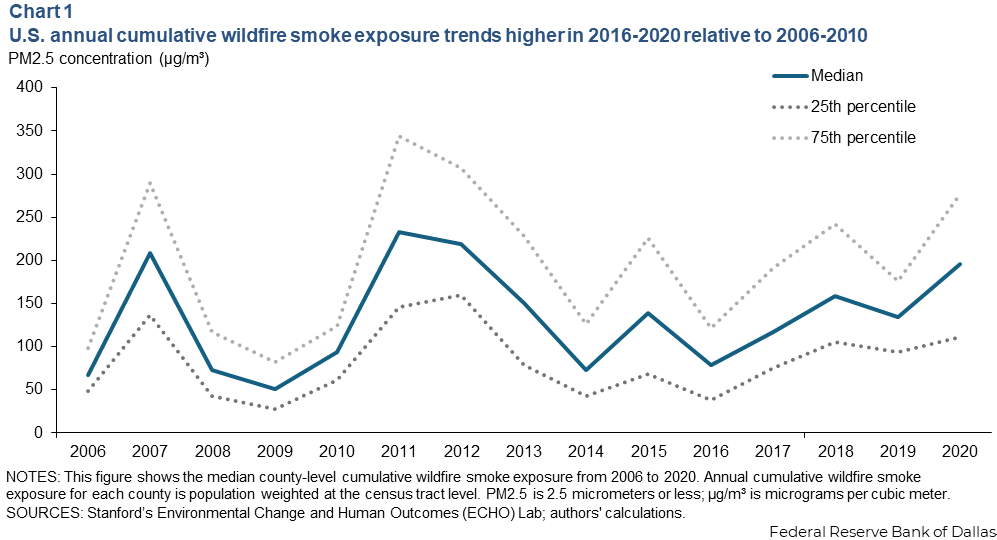
Smoke exposure has trended higher, though it varies widely from year to year. We measure exposure by calculating daily smoke-related PM2.5 concentrations over a year, which captures both how heavy the smoke was and how long it lasted. Average county-level exposure in 2016–20 was about 40 percent higher than in 2006–10 (Chart 1).
Smoke raises hospital borrowing costs
The healthcare municipal bond market is a primary source of financing for nonprofit hospitals. Because bond prices are forward-looking, we decompose smoke exposure into two components: expected exposure, measured as a county's trailing three-year average, and unexpected exposure, measured as the deviation of current exposure from that average.
We compare the gap in yields between healthcare bonds and other municipal bonds issued in the same state and month and then examine how that gap varies with the issuing county’s smoke exposure from 2010 to 2019.
A one-standard-deviation increase in expected smoke exposure is associated with a 12-basis-point increase in healthcare bond offering yield spreads relative to non-healthcare issuance. The increase is equal to about 12.9 percent of the yield gap between Aaa (Moody’s highest rating) and Baa1-rated (the eighth-highest debt rating) municipal bonds.
By contrast, year-to-year deviations from expected smoke exposure have a small, statistically insignificant effect (2 basis points), consistent with investors pricing persistent exposure rather than reacting to each year's smoke exposure.
Applying our estimate to the $28.4 billion healthcare municipal bonds issued in counties with above-average expected smoke exposure implies approximately $327 million in additional interest costs in present value terms, using the sample's average bond duration of 10 years.
If expected exposure keeps rising at its recent pace, reissuing the sample’s $92.6 billion of healthcare bonds a decade from now would cost roughly $1.19 billion more in present-value interest. The effect is specific to healthcare. Yields on non-healthcare bonds in the same counties do not rise with expected smoke. The results also hold when we follow the same bonds as they trade in the secondary market, and they are not unique to California and surrounding areas.
Smoke from other states matters, too
To gauge the role of distant fires, we separate smoke exposure into a part explained by wildfires within a state and the remaining portion largely reflecting smoke blown in from elsewhere. Expected out-of-state smoke raised hospital bond yields by 11.6 basis points per standard deviation, compared with 15.1 basis points for expected in-state smoke. The two effects are not statistically different, suggesting that smoke from other states is an important source of hospital credit risk.
Consider 2020, when more than 4 million acres burned in California. That year, Nevada's out-of-state smoke exposure was well above its average. If repeated California fire seasons raised expected out-of-state smoke exposure in Nevada by one standard deviation, healthcare borrowing costs would rise by 11.6 basis points, or about $732,000 in present value terms for hospital issuance averaging $63.1 million and a duration of about 10 years.
Hospital patient mix can squeeze profits
Smoke drives patients to emergency departments, and hospitals cannot turn these individuals away. Under the Emergency Medical Treatment and Labor Act, they must screen and stabilize anyone seeking emergency care, regardless of ability to pay.
The financial consequences of wildfire smoke exposure ultimately depend on patients' insurance coverage. In our analysis, we group uninsured, Medicaid-insured and Medicare-insured patients under the term “underinsured” because hospital emergency rooms on average lose money on these patients. (Medicaid covers low-income individuals; Medicare mostly covers retirees and some with disabilities.)
Using emergency department data, we find that a one-standard-deviation increase in expected quarterly smoke exposure is associated with a 1.7 percent increase in visits among underinsured patients and a 1.3 percent increase among privately insured patients. Underinsured patients account for roughly three-quarters of emergency department discharges, compared with one-quarter for privately insured patients.
For a hospital that typically discharges 3,000 underinsured and 1,000 privately insured patients per quarter, this implies about 51 additional underinsured discharges versus 13 additional privately insured discharges—roughly four times as many from the underinsured group. A back-of-the-envelope calculation implies that this patient mix yields an average negative margin of roughly 9.5 percent on smoke-related ER demand. For every $100 a hospital collects for these extra patients, it spends about $109.50 treating them.
Across all hospitals, we find no significant change in profit margins when expected smoke or smoke deviations increase. However, the relationship between smoke exposure and hospital profitability is more adverse in counties with a higher ratio of underinsured residents per hospital. In such counties, both expected smoke and smoke deviations are associated with lower profit margins.
Smoke's effect on borrowing costs is also about 45 percent larger in counties where the measure of underinsured residents per hospital is one standard deviation above average. Medicaid expansion under the Affordable Care Act, which moved many uninsured patients into coverage that reimburses hospitals, offers further evidence. After a state expanded insurance coverage, the sensitivity of healthcare bond yields to expected smoke fell significantly in counties with high pre-expansion uninsurance rates, suggesting that better reimbursement makes hospitals more resilient to smoke-driven demand.
Hospitals invest less after smoky years
Financial pressure from smoke exposure may also affect hospital investment decisions. Hospitals' fixed assets include facilities and medical equipment needed to deliver care.
Hospital cost reports filed with the Centers for Medicare and Medicaid Services show that a one-standard-deviation increase in expected smoke exposure is associated with a 2.4-percentage-point reduction in net fixed asset growth over the following year. Deviations from expected exposure have no statistically significant effect, so hospitals, like bond investors, appear to respond to persistent smoke exposure rather than to year-to-year fluctuations.
By comparison, the average one-year growth rate of net fixed assets in our sample is 3.7 percent. Together with the borrowing-cost results, this finding is consistent with financial pressure constraining hospital investment.
Fires create distant impacts
Climate risk can be priced even where no property is damaged. Wildfire smoke imposes financial costs on hospitals far from a burn zone. Our findings link smoke exposure to higher healthcare borrowing costs and slower investment growth. The borrowing cost and profitability effects are strongest where hospitals serve many underinsured patients. These costs cross state borders. Hospitals can face higher financing costs because of smoke from fires elsewhere. These downstream healthcare costs are relevant when evaluating wildfire mitigation and interstate coordination policies. The Medicaid expansion evidence suggests that insurance coverage and reimbursement can influence hospitals' financial resilience to smoke exposure. Conversely, cuts to Medicaid or Medicare funding could amplify smoke’s effects on hospital finances.
About the authors