Ranchers herd it all as fewer cattle pressure beef prices; screwworm lurks
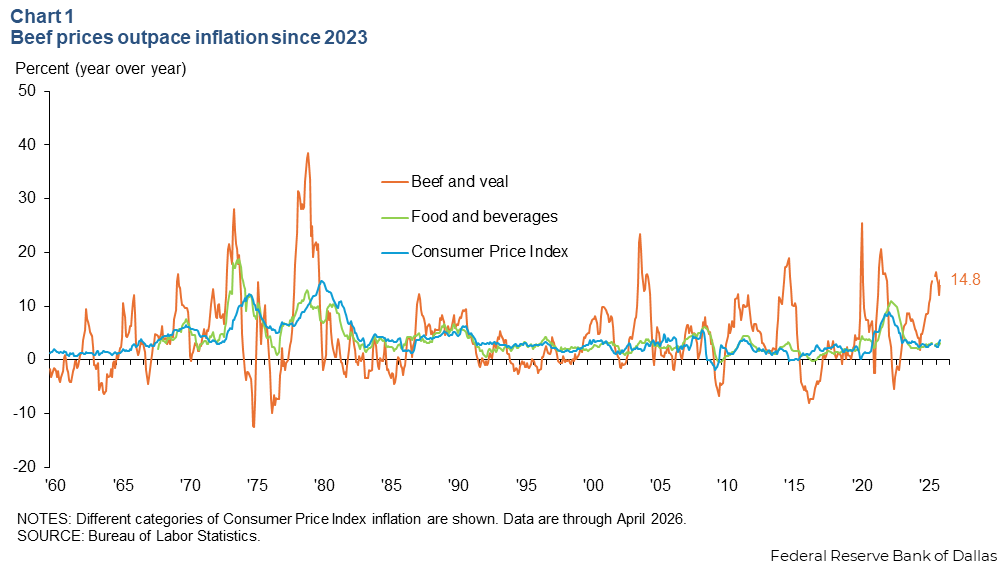
The beef industry reacts slowly to market forces, a reflection of consumers’ demand for beef and the time it takes to breed cattle. Beef prices have increased 57 percent since 2020 and 3 percent during the first four months of 2026 (Chart 1). Cattle ranchers benefit from this increase, especially in Texas, the state that has far and away the largest stock of beef cattle in the U.S.
More recently, the reemergence of the flesh-eating New World screwworm parasite threatens the beef industry. Texas cattle ranchers are on high alert as an outbreak infects animals just across the Rio Grande in the Mexican states of Tamaulipas, Nuevo León and Coahuila. Mexico had more than 1,800 active cases as of mid-May.
Beef endures as American favorite
Beef consumption has fallen significantly from a peak of 94 pounds per capita in 1976 to 59 pounds per capita in 2025, as consumers turned to alternative animal protein sources, notably chicken. Increased chicken consumption led to a rise in Americans’ overall meat consumption.
Long-term trends notwithstanding, per capita beef consumption has remained remarkably stable during the past 15 years, even as prices rose. Beef consumption is relatively price inelastic, meaning beef demand declines by less than the increase in price. A recent estimate from the U.S. Department of Agriculture (USDA) suggests that consumers’ price elasticity of demand for beef is -0.70, meaning that with a 10 percent increase in price, consumers’ demand falls by 7 percent. This compares to an elasticity of -0.8 for chicken.
Slow-moving beef cycle dictates herd growth
The U.S. cattle herd peaked in the 1970s, declining to a recent low in 2025 (Chart 2). The decline was offset by increasingly heavier animals.
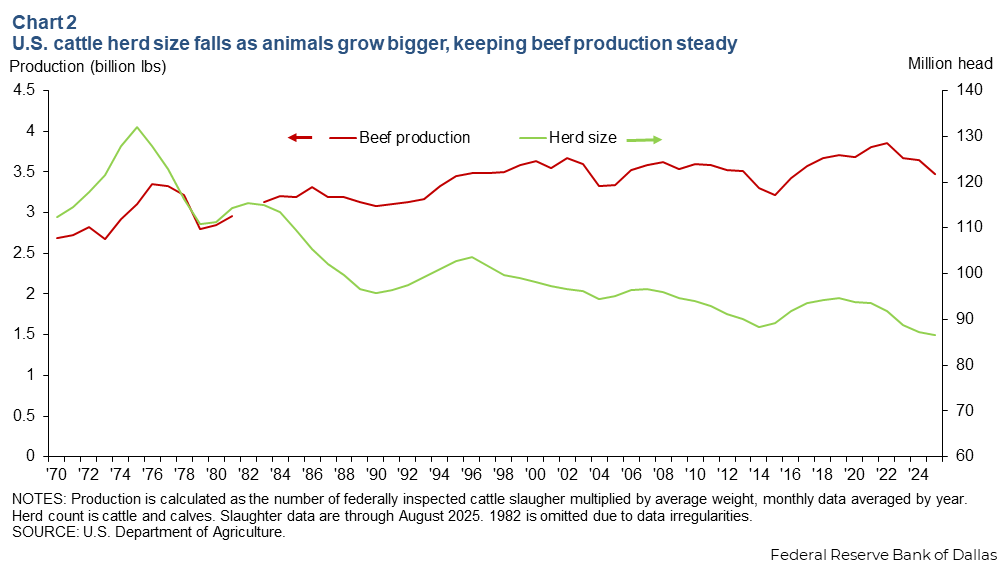
After cattle weight fell during the Great Depression, it subsequently steadily rose, peaking at 1,443 pounds in January 2025. In average pounds produced per month, production has grown a cumulative 12 percent since 1975.
Beef supply has not completely adjusted to higher prices. The beef supply chain runs through a series of hands. Cattle are sent from ranches to feedlots to grow, to meatpackers for slaughter and finally to retailers to sell. While beef supply can change at any level of the chain, supply shifts typically start with ranchers.
Because of physiological factors, the beef industry is usually playing catch-up. If ranchers want to expand their herds, they must first hold back heifers to breed. These heifers calve 10 months later. A calf is weaned nine months after birth and then fed for another 10 or 11 months until it is ready for slaughter. In total, this process requires about 2.5 years. In contrast, hogs and chickens are ready for market in a matter of months.
Because of the cattle production lag, cattle ranchers cannot immediately respond to higher prices, and future prices are no sure thing.
Drought is another factor. In some parts of the state, dry pasture lands for grazing may have deterred herd expansion. Ranchers have also been forced to use more expensive hay and feed to sustain their herds.
The Texas beef industry has historically relied in part on live cattle imports from Mexico. Until U.S. southern border crossings were halted, Mexican cattle were herded across the border to Texas feedlots to continue to grow.
U.S. imports are generally cheaper, leaner meat that producers mix with fattier domestic beef to create hamburger. These cuts complement domestic ground beef production but are not full substitutes and, thus, cannot offset upward price pressures.
Record prices are helping ranchers recoup prior-year losses and offset elevated input costs. But not every participant in the beef supply chain is reaping the rewards. Feedlots and meatpackers have suffered layoffs and closures because of diminished herd counts.
New World screwworm slowly flies north
An emerging threat to the supply of beef is the northward spread of the New World screwworm, a deadly parasite that infects warm-blooded animals, including cattle, other livestock and wildlife. Humans are also susceptible to screwworm infection. The Key deer outbreak in Florida in 2016 was a notable recent U.S. wildlife incident.
The screwworm fly deposits eggs in flesh wounds, cuts or bodily orifices (eyes, nose). Larvae emerge from these eggs and consume the host’s flesh. Wounded animals tend to hide in brushy areas and, if left untreated, will die within weeks. Once satiated, the larvae fall to the ground and bury themselves, later metamorphosizing into more flies.
The spread of the screwworm could have large, complex economic effects on ranchers and the beef supply chain. Beef supply could increase in the short run if ranchers liquidate herds to reduce their exposure to the parasite. Prices may also initially fall if consumers reduce demand for beef perceived as infected. But since it is safe to eat an animal that has been properly treated for screwworm, such fears may not persist.
By sickening or killing cattle, the screwworm could trigger shortages and higher beef prices. This implies that equilibrium prices could fall in the short run, only to then rise in the medium to long run.
The U.S. banned livestock imports from Mexico in July 2025. Texas Gov. Greg Abbott declared a disaster in January 2026. The preemptive response reflects fears of the devastating economic consequences of past outbreaks: cattle and livestock disfigurement and death, costly surveillance and treatment, higher cattle and livestock prices, and damage to the hunting industry from increased wildlife mortality.
Learning from past screwworm outbreaks
The screwworm thrives in warm conditions—temperatures around the 80s—where abundant hosts are present in which to lay eggs. The flies can travel 2.5 to 12.5 miles, typically going only as far as needed to lay their next batch of eggs. Transport of infested animals can spread the flies much further. Despite the concentration in southwestern states, the screwworm spread as far north as the Dakotas during previous incidents.
There have been several major screwworm outbreaks over the past century. The first recorded outbreak occurred from 1933–36. Texas reported 3 million cases in 1935. The screwworm was believed to have claimed 180,000 head of cattle in 92 of Texas’ 254 counties, according to Charles Scruggs’ The Peaceful Atom and the Deadly Fly. By 1936, annual damage totaled $225.7 million in 2024 dollars.
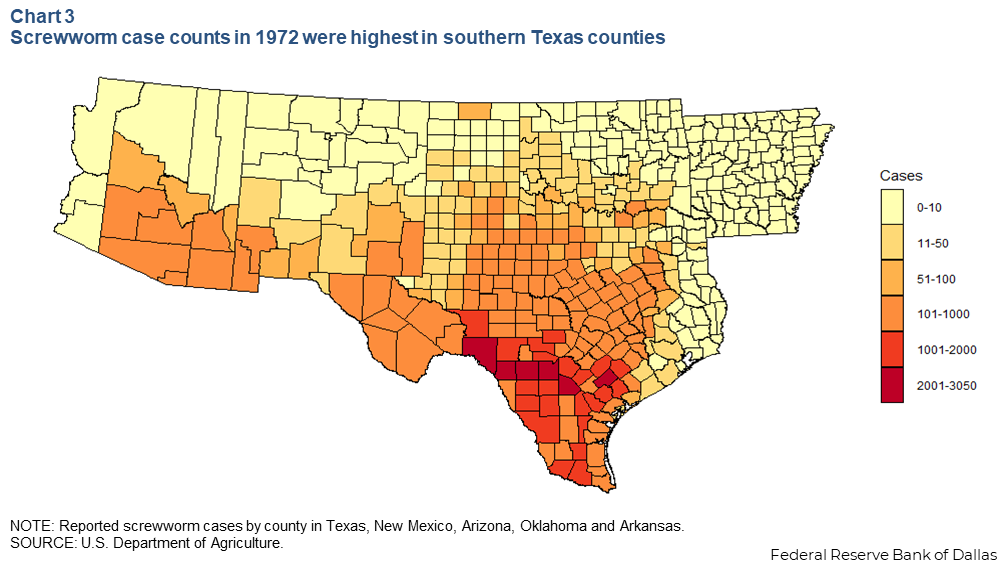
Mortality and infestation rates vary. At the peak of the 1930s outbreak, about 12 percent of animals were infected, with a mortality rate of 12.4–19.4 percent. At the peak of the 1970s outbreak, the infestation rate in surveyed areas of Texas was 20.6 percent in cattle and 9 percent in sheep and goats. Texas is a particularly suitable environment for the parasite, given the state’s seasonal warmth, abundant potential targets and proximity to the southern border across which the screwworm has historically crossed. During the 1970s outbreak, Texas had more cases than any other state in the U.S. (Chart 3).
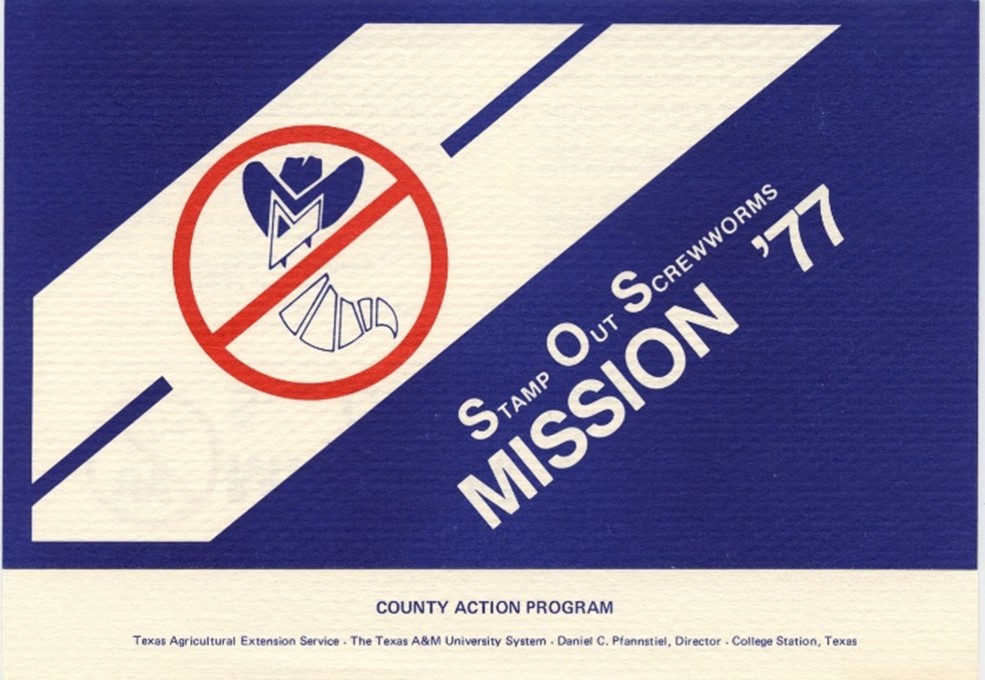
The Texas screwworm awareness campaign included this ad in 1977. SOURCE: U.S. Department of Agriculture archive “STOP Screwworms: Selections from the Screwworm Eradication Collection.”
The now canonical solution to screwworm outbreaks, first proposed by Dr. Edward Knipling in 1935, is the release of sterile male flies. Sterile male flies—lab bred and irradiated—ensure that the female flies lay faulty eggs. This strategy is particularly effective, as males mate with many female flies, while females only mate with one male.
In 1962, the USDA’s southwest screwworm eradication efforts were based in Mission, Texas. If ranchers found a suspected case, they would send a sample to the USDA lab. Once the screwworm was confirmed, the government would drop sterile flies from planes onto the infected area. In total, the U.S. released 62.5 billion sterile flies from 1962 to 1980. After successfully ending the outbreak of the 1970s, the eradication mission shifted south to Chiapas, Mexico, and later to the Darién Gap in Panama.
The sterile fly technique requires constant monitoring, as lab-raised strains can lose their competitiveness. The large 1972 outbreak can be partly attributed to the use of an uncompetitive strain of male flies, along with the movement of infested cattle north from drought-stricken southern Mexico, a steady increase in absentee cattle ownership and favorable winds.
Before the sterile fly method, the government relied on educational programs and fly traps to decrease the rates of infestation and mortality. These outreach efforts continued over the years, and their insights remain relevant. Texas A&M Agrilife Extension recommends that ranchers shift cattle birthing cycles and other elective procedures—which may cause wounds—to winter months when the screwworm is not present. The FDA also recently approved treatments for treating and preventing screwworm infections.
Screwworm outbreaks lead to rancher losses
Screwworm outbreaks impose significant costs on ranchers, apart from increased cattle mortality. Surveillance and treatment costs accounted for 30 percent of producer losses, a USDA study found in 1976. The remaining losses resulted from cattle deaths (41.3 percent) and from weight loss or disfigurement (28.7 percent).
Ranchers must closely monitor and treat screwworm cases. In 1950, cattlemen were advised to check their herd twice weekly. Cattlemen hired personnel to ride the range, finding and treating wormy animals. Treatment involved finding infected animals, removing worms, cleaning wounds and applying insecticide. Ranchers got creative, tying up infested calves to make them easier to find, and creating dark places in which to lure injured animals.
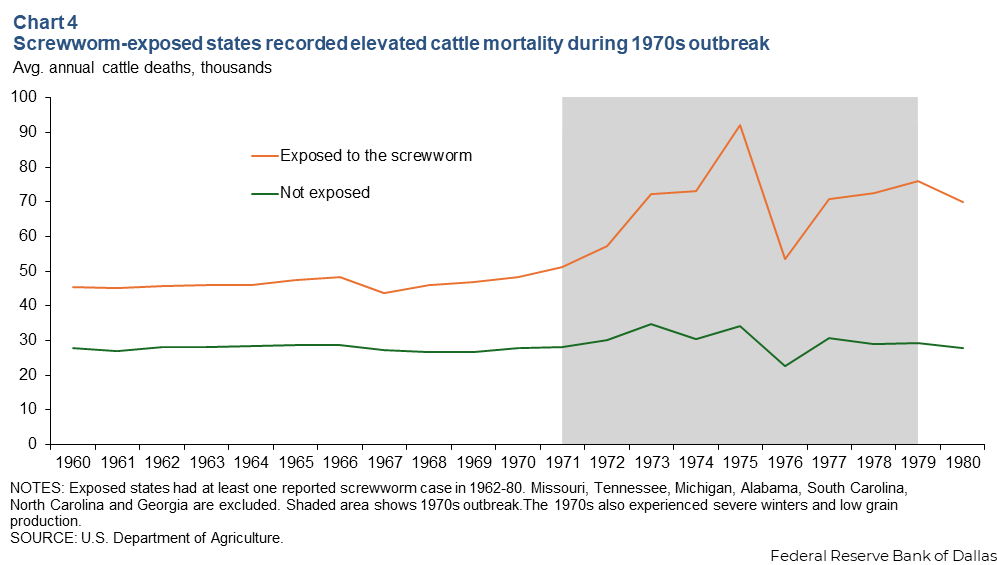
The uptick in cattle mortality during the 1970s outbreak was particularly costly for ranchers (Chart 4).
If an outbreak of the same magnitude as occurred in 1972—the year with the most screwworm cases—was repeated today, damage could total $2.5 billion across the Southwest. If the outbreak was of the duration and size as the 1962–80 episode, damage could exceed $6 billion in the U.S. alone.
These are likely underestimates, as ranchers’ diminished knowledge and recognition of the screwworm and a rising cow-to-ranch hand ratio may increase initial herd mortality. With heavier cattle and smaller herd counts, each head lost would matter more.
U.S. boosts screwworm prevention efforts; beef prices to stay high
The U.S. is significantly ramping up production and dispersion of sterile flies. The USDA began operating a sterile fly dispersal facility in Tampico, Mexico, in November. It aims to release 100 million sterile flies per week. The USDA opened a sterile fly dispersal facility in Edinburg, Texas, in February. However, an accompanying fly production facility will not produce 100 million flies until spring 2027. The USDA is spreading sterile flies in northern Mexico and South Texas.
Even if the screwworm doesn’t enter the U.S., beef prices will remain elevated, at least in the near term. The cessation of live cattle imports from Mexico contributed to the closure of a large Lubbock feedlot, which had sourced cattle mainly from Mexico. One Dallas Fed contact noted that in response to the border closure, Mexico opened feedlots and packing plants, suggesting that animals could be slaughtered there rather than sent to the U.S.
The U.S. increased the quotas for beef imports from Argentina in February 2026 to ease beef prices. However, because these imports are lean trimmings, they may lower ground beef prices but have limited effect on prices of other beef products.
There is some evidence of U.S. herd expansion. The number of beef heifers entering the herd rose from 2,120 in 2023 to 2,301 in 2025, the USDA said. If sustained, this action will take years to reduce prices.
The USDA projects that beef production will slowly increase in 2026, and the price of steers will rise a further 7.7 percent. If the New World screwworm jumps the border, beef prices will rise even more.
|
Updated June 11, 2026. The estimate of the potential damage from a screwworm outbreak of a magnitude similar to the 1962-80 incidence has been recalculated to better reflect inflation effects. |
About the authors

Ethan Dixon is a former research analyst in the Research Department at the Federal Reserve Bank of Dallas.

Mariam Yousuf is a business economist in the Research Department of the Federal Reserve Bank of Dallas.