How USMCA compliance cushioned the 2025 tariff shock
As U.S. tariff rates rose in 2025, the United States–Mexico–Canada Agreement (USMCA) offered a lower-cost alternative for qualifying goods that exporters increasingly relied upon. That shift reduced the effective duties paid at the border on Mexican and Canadian goods and gave North American firms a relative advantage over competitors outside the region facing higher U.S. tariffs.
Compliance with the USMCA, a free-trade accord, nonetheless comes with costs. They include certification, documentation and rules-of-origin requirements. Alternatively, exporters can pay a fallback tariff rate, which many Mexican and Canadian exporters chose to do before 2025 when those rates were still relatively low.
USMCA compliance surges in North America
Two trade accords preceded USMCA: The United States–Canada Free Trade Agreement in 1989 and the North American Free Trade Agreement (NAFTA), which extended that free-trade framework to Mexico in 1994. They eliminated most internal tariffs, while conditioning preferential access on use of inputs sourced within the trade area.
That conditionality became more central under USMCA, which replaced NAFTA in July 2020. It imposed additional costs arising from stricter rules of origin and certification requirements, adding administrative burdens and limiting sourcing flexibility.
Rates of compliance with these trade accords had drifted lower in the late-2000s and again at the start of the pandemic in 2020, when firms transitioned to the USMCA (Chart 1). According to U.S. International Trade Commission data, rates stabilized at historically low levels before accelerating sharply in early 2025. The recent increase occurred as a new round of U.S. tariffs raised the cost of non-USMCA trade while retaining the USMCA exemption for qualifying goods.
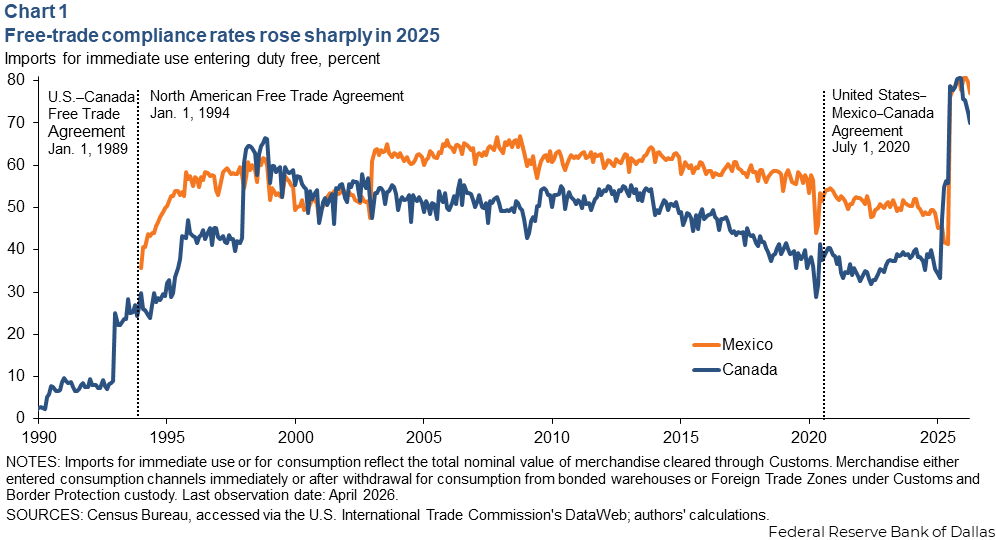
The share of U.S. imports qualifying for duty-free treatment under USMCA rose to record-high levels of about 80 percent by July 2025, from roughly 50 percent for goods from Mexico and below 40 percent for Canada. The increase marked a structural shift in how Mexican and Canadian goods enter the U.S.
Still, "entered under USMCA" does not always mean duty-free. Most qualifying goods face zero duty, but eligibility is assessed product by product, usually at the tariff-line level. A single shipment can therefore include goods that qualify for USMCA treatment and others that do not because they fall short of origin rules, lack documentation or are subject to product-specific provisions such as quotas.
Tariff mitigation lowers paid tariffs, but comes with costs
Banco de México economists José Ramón Morán and Alfonso Cebreros show that stricter rules of origin shape sourcing decisions by tying preferential access to regional content thresholds. Compliance burdens can limit efficient sourcing, while higher non-preferential tariffs encourage firms to comply, promoting regionalization but increasing administrative and production costs.
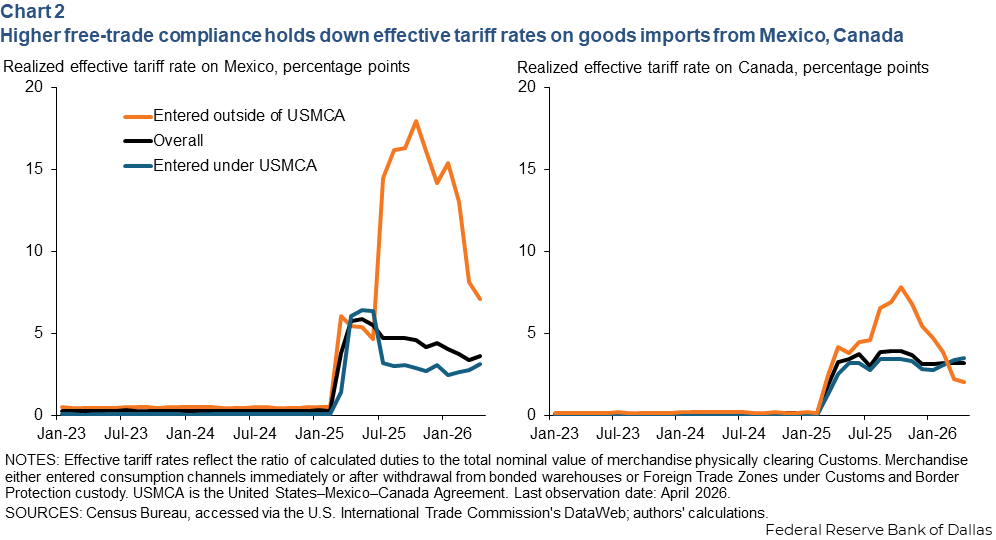
Recent U.S. International Trade Commission data are consistent with this interpretation. As USMCA compliance surged, effective tariffs paid on imports from Mexico and Canada entering the U.S. under the agreement remained well below those applied to goods entering from the outside (Chart 2). The cost is a reconfiguration of supply chains toward North American suppliers that may be less efficient or more expensive than global alternatives, plus administrative expenditures including origin certification, audits and recordkeeping.
Tariff exposure is also uneven. Product-level exemptions have partly shielded artificial intelligence (AI)-related goods, leaving effective tariff rates lower than for other goods. In those more-shielded sectors, trade dynamics are driven less by tariff avoidance than by demand associated with the AI investment boom.
When tariffs increase, compliance rises
A sizable share of imports that may once have entered duty-free outside USMCA are now routed through duty-free USMCA channels (Chart 3). At the same time, non-USMCA imports subject to duties—especially from Canada—have declined, indicating a narrowing of trade outside the preferential regime.
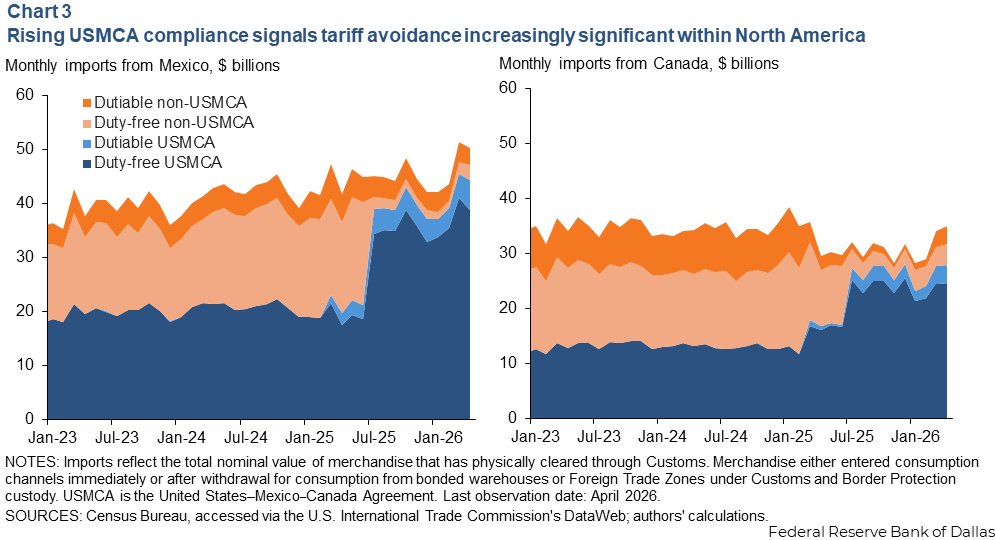
Mexico data illustrate how compliance and import growth can coexist. Between December 2024-February 2025 and December 2025-February 2026, growth of nominal U.S. imports from Mexico slowed to 4.1 percent, from 7.9 percent in the preceding period, even as a larger share entered duty-free under USMCA.
Sectoral data show that computers and related electronic equipment accounted for much of the increase, consistent with AI-related trade becoming a key driver of U.S. import growth since 2024 (Chart 4).
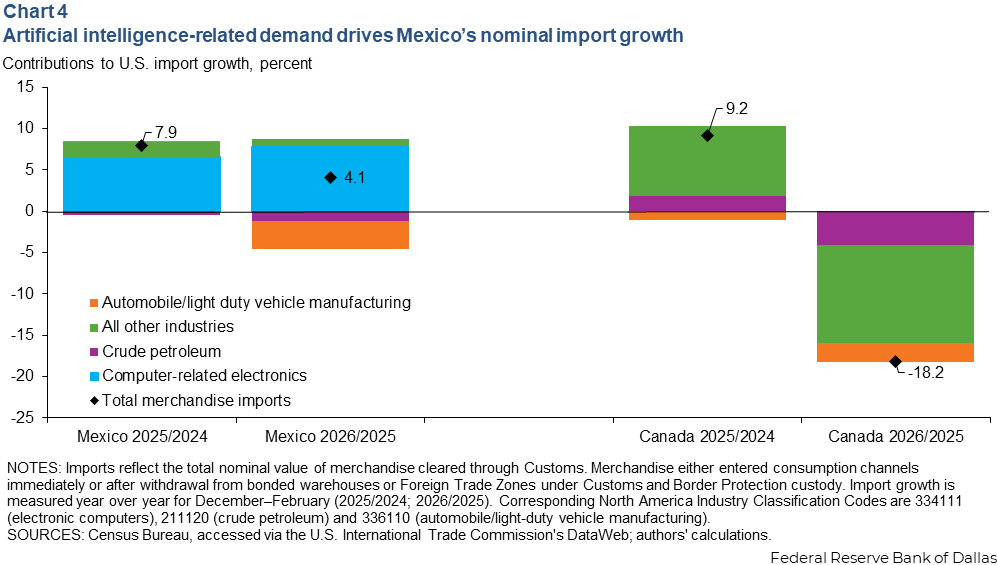
Canada looks different. U.S. imports from Canada declined from roughly $36.3 billion monthly to $29.7 billion over the period, even as duty-free USMCA use rose sharply. In Canada’s case, tariff avoidance did not prevent a broad contraction in nominal trade.
Our data focus on 2025, before the Supreme Court’s February 2026 ruling invalidating tariffs imposed under the International Emergency Economic Powers Act. Those tariffs raised the cost of entering goods outside USMCA, strengthening compliance incentives.
Going forward, how U.S. trade policy adapts to the loss of that authority—and any replacement tariffs for those disallowed—could again reshape the trade-off between paying duties outside the USMCA and operating within its tighter sourcing constraints.
From trade liberalization to regionalization
Higher tariffs outside the USMCA, combined with preserved preferential access inside it, have pulled more North American trade under the agreement. Despite the costs of regional sourcing and compliance, USMCA-based firms enjoy an edge over competitors outside North America facing higher U.S. tariffs.
As the 2026 USMCA review unfolds, consultations in the United States, Mexico and Canada are setting the stage for a broad reassessment of the agreement’s terms—and of its underlying purpose. What began as a liberalization project has moved increasingly toward conditionality and greater regional integration, where preferential access depends more heavily on meeting regional sourcing and compliance rules.
The policy challenge is to preserve the resilience gains from deeper North American integration while limiting the efficiency costs of overly restrictive compliance rules. Recent experience suggests that USMCA can cushion tariff shocks, but that cushion is not free.
About the authors

Enrique Martínez García is an assistant vice president in the Research Department and co-director of the Global Institute at the Federal Reserve Bank of Dallas.

Ron Mau is a senior business economist at the Federal Reserve Bank of Dallas.