
What Big Macs tell us about the disconnect between prices and exchange rates
The Big Mac is sold nearly everywhere, and The Economist magazine has used the Big Mac Index as a way to infer real exchange rates and relative currency strength.
Fluctuations in nominal exchange rates are highly correlated with those in the Big Mac Index even at very long intervals when prices should have time to adjust. This result corroborates the findings from modern theories of exchange rate determination that argue financial shocks, not monetary shocks, primarily drive exchange rates.
Burger-based real exchange rates
The real exchange rate measures the relative price of a basket of goods and services in two different locations. The Economist’s Big Mac Index is a measure of the real exchange rate, but instead of measuring the price of a basket of goods and services, it measures the price of one good, the McDonald’s Big Mac.
The “burger-based real exchange rate” simply shows the value of the U.S. Big Mac relative to the value of foreign Big Macs. In other words, the number of foreign Big Macs you would have to exchange for one U.S. Big Mac.
Of course, no one buys Big Macs in a foreign country and brings them to the U.S. to trade, so we can instead calculate this burger-based real exchange rate using local prices and nominal exchange rates. To find the burger-based real exchange rate, we divide the U.S. Big Mac price by the foreign country’s Big Mac price converted into dollars.
If local currency prices don’t change, a nominal depreciation in the foreign currency leads to a declining dollar price of the burger in the foreign country, and thus depreciation in the burger-based real exchange rate. In contrast, if local currency prices did change, then the foreign burger price could rise following the nominal exchange rate depreciation, leaving the real exchange rate unchanged.
Since the Big Mac is relatively similar across countries, one could argue that this burger-based real exchange rate compares prices of the same good. However, while some of the ingredients are traded (like two all-beef patties, special sauce, lettuce, cheese, pickles, onions on a sesame-seed bun), others are not (like local labor and rent). This mix of traded and non-traded inputs can lead to differences in burger-based real exchange rates not only across countries, but even across locations within a country or a city.
Fluctuations in relative burger prices
In addition to looking at the relative price of the Big Mac across locations, we can look at changes in these relative prices over time. We can observe how much the burger-based real exchange rate changes following a change in the nominal exchange rate.
At first glance, this conversion between the U.S. and foreign Big Macs ought to depend on such factors as personal taste and technology, which in turn should drive relative prices. The nominal exchange rate should not affect the underlying real exchange rate.
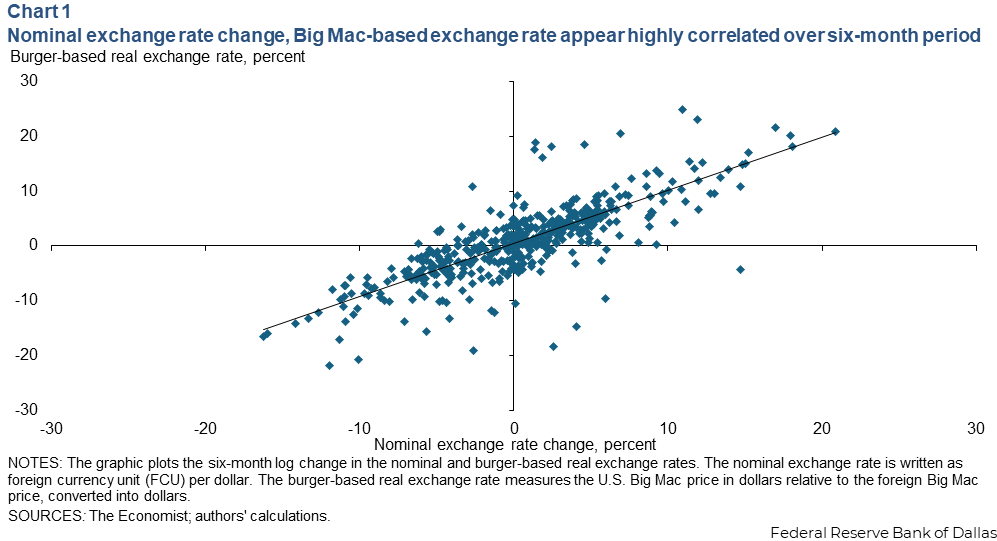
Chart 1 presents a simple scatterplot of the six-month percent changes in the nominal exchange rate and the burger-based real exchange rate in 14 advanced foreign countries. The scatterplot trend line has a slope of 0.97, and the correlation between the two variables is 0.79. This indicates that at the six-month frequency, relative Big Mac prices adjust nearly one-for-one with nominal exchange rate changes. To put it another way, local prices adjust very little to nominal exchange rate changes.
This pattern is not surprising. If prices are sticky—meaning they don’t frequently change—then at a six-month frequency, it’s unlikely that local prices would immediately respond to exchange rate changes. However, when looking at the same scatterplot, using the four-year change in exchange rates (instead of the six-month change), the trendline has a slope of 0.78 and the correlation between the two exchange rates is still sizeable at 0.78 (Chart 2).
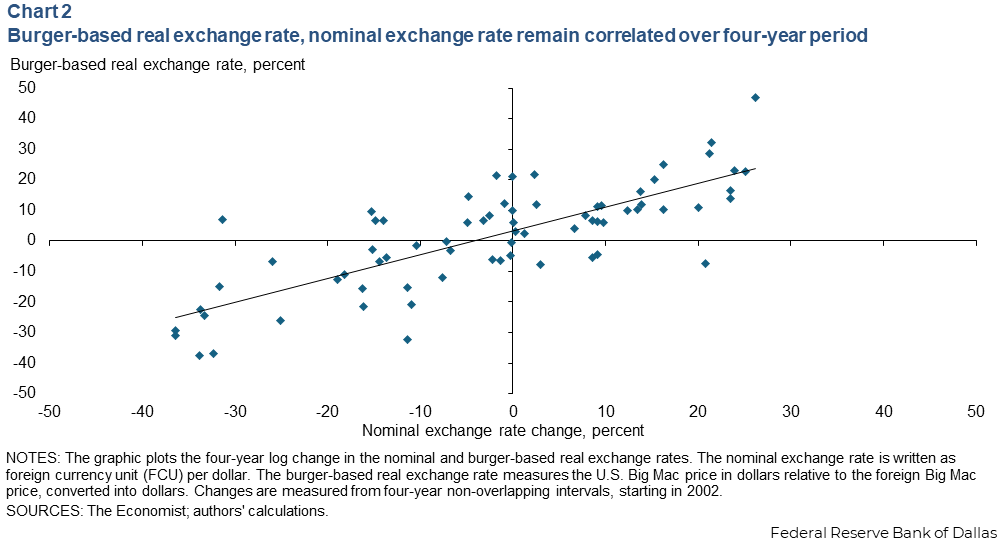
The pattern indicates that a 10 percent exchange rate appreciation over a four-year period is associated with a 7.8 percent burger-based real exchange rate appreciation. This magnitude is slightly less than the one-for-one adjustment at the six-month frequency, but not by much. Four years is more than enough time for prices to adjust, so one would have expected a slope closer to zero at this frequency.
Real and nominal exchange rates in broader context
While Big Mac prices are a light-hearted and digestible introduction to the topic of real exchange rates, serious research and policy considers more than burgers when calculating real exchange rates. The concept is exactly the same to calculate a Consumer Price Index (CPI)-based real exchange rate instead of a burger-based real exchange rate. The Big Mac price is replaced by the CPI. Divide the level of the U.S. CPI by the level of the foreign CPI, with the latter converted to U.S. dollars, to get the real exchange rate.
The Federal Reserve Board produces broad real and nominal exchange rate indexes for the U.S. dollar. These measures reflect the trade-weighted average value of nominal and real exchange rates for the U.S. dollar against a basket of foreign currencies.
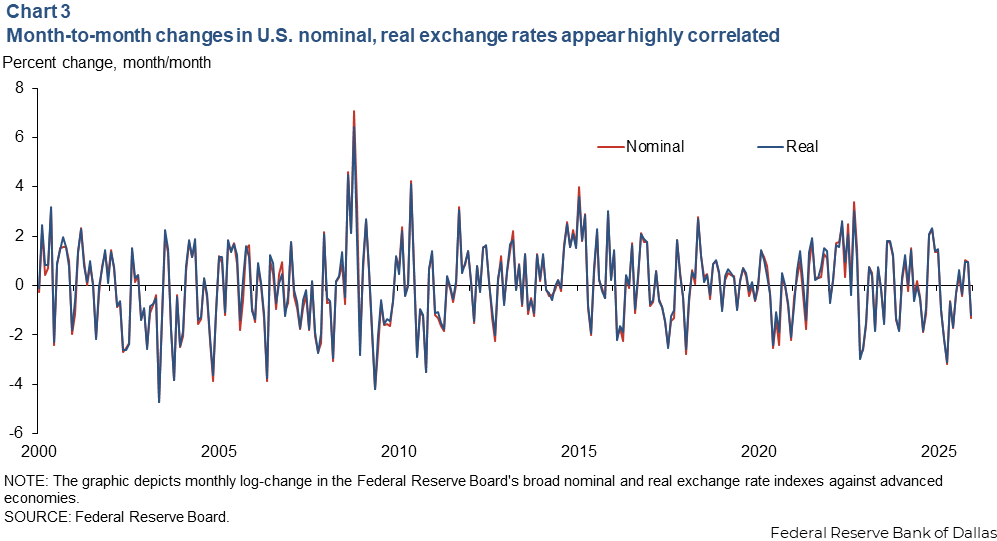
Chart 3 plots the monthly percentage change in the real and nominal exchange rates indexes for the U.S. dollar against advanced foreign economies. Unsurprisingly, the two series lie nearly on top of one another. The monthly frequency gives foreign and U.S. prices little time to adjust, so nominal exchange rate changes are passed into real exchange rates one-for-one.
Looking at these changes over longer time intervals provides a similar result (Chart 4). The two series plotted on an annual basis remain highly correlated.
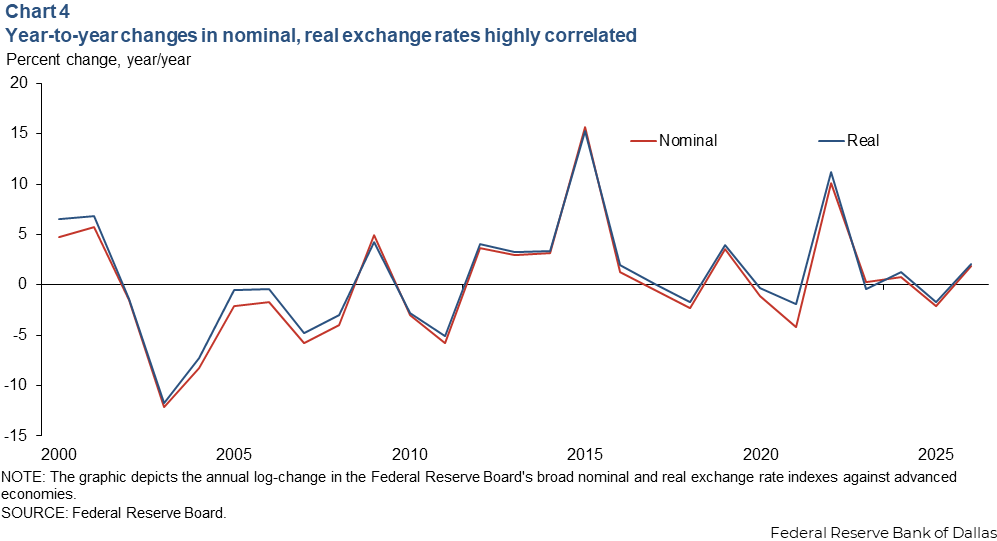
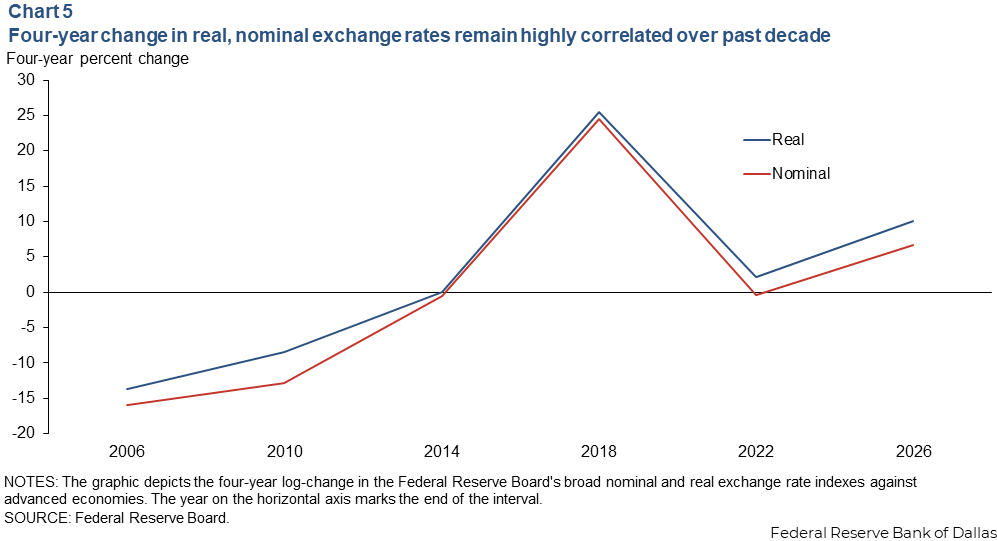
Any remaining gap between the two series can be explained by differences in inflation between the U.S. and advanced foreign economies. U.S. inflation has slightly exceeded advanced foreign economy inflation nearly every year in the sample, causing the real exchange rate to exceed the change in the nominal exchange rate. Notably, that positive difference holds, regardless of the change in the nominal exchange rate.
The same pattern exists when plotting four-year changes in exchange rates (Chart 5). Even at a four-year frequency, when prices have plenty of time to adjust, nominal and real exchange rates remain nearly perfectly correlated.
Purchasing power parity puzzle revealed
The patterns illustrated are known to economists as the purchasing power parity puzzle. Instead of being relatively smooth, the real exchange rate closely tracks the nominal exchange rate, implying that local price levels (or Big Mac prices) move little in response to changes in the nominal exchange rate. Due to price stickiness, comovement—when two variables move in the same direction—is understandable for short-term changes. But the fact that the correlation remains high even for four-year periods represents a puzzle.
This puzzle arises when one thinks of exchange rates as driven by monetary factors. Both the nominal and real exchange rates may respond in the short run to monetary shocks. However, in the long run, prices should also adjust following a monetary disturbance such as a central bank changing its policy rate, offsetting the nominal exchange rate change and resulting in zero change in the real exchange rate.
A 2021 paper proposed an explanation for the purchasing power parity puzzle. Economists Oleg Itskhoki and Dmitry Mukhin suggested that exchange rates are driven primarily by financial shocks, not monetary shocks. In a 2025 paper, they build on an earlier paper by economist Robert Kollmann to show that this view can explain the famous Mussa puzzle, (named for economist Michael Mussa) of high volatility and comovement in both real and nominal exchange rates. The comovement became notable after the breakdown of the Bretton Woods System of fixed exchange rates and the adoption of floating exchange rates in the early 1970s.
Itskhoki and Mukhin argue that when there is low pass-through from nominal exchange rates to prices and the nominal exchange rate changes are driven by financial shocks, highly correlated fluctuations in nominal and real exchange rates occur regardless of price stickiness. Financial shocks in the foreign exchange market move nominal exchange rates, but are disconnected from consumer prices, leading to a mechanical relationship between real and nominal exchange rates.
In recent empirical work, we have measured the response of nominal and real exchange rates to fluctuations in the global financial cycle, which are generally independent of local conditions. The analysis covered a broad range of advanced, emerging and developing countries.
At an annual frequency, when prices should have time to adjust, we found fluctuations in the global financial cycle have identical effects on nominal and real exchange rates, indicating little effect on prices. The results confirm that when nominal exchange rates fluctuate due to financial disturbances, these exchange rate changes are largely disconnected from local prices.
One last bite
The Big Mac Index, a bite-sized take on the topic of real exchange rates, provides an interesting laboratory for testing modern theories of what drives exchange rates. The very high correlation between nominal exchange rates and the Big Mac-based real exchange rate at low frequencies indicates that nominal exchange rate fluctuations are largely driven by financial factors, not monetary factors, and that exchange rate fluctuations are largely disconnected from other prices in the economy.
About the authors

Scott Davis is an assistant vice president in the Research Department of the Federal Reserve Bank of Dallas.

Ben Kim is a research analyst in the Research Department at the Federal Reserve Bank of Dallas.

Andrei Zlate is a group manager at the Board of Governors of the Federal Reserve System.