Region’s commercial space exploration industry has lofty goals for growth, discovery
Space exploration and its commercialization are deeply rooted in Texas. Apollo 11 astronaut Neil Armstrong’s call to Houston’s Johnson Space Center upon landing on the moon in 1969 included the unforgettable reference to the state’s largest city—“Houston, Tranquility Base here. The Eagle has landed.”
The Johnson Space Center has been the command center for every NASA manned spaceflight since 1965, directing space shuttle and International Space Station operations and training the astronaut corps.
Private enterprise in the Texas space industry began relatively humbly. A cattle ranch on Texas’ Matagorda Island was the site in 1982 of the first commercial rocket launch, the Conestoga I. The company behind the endeavor was founded by Dallas entrepreneur and oilman Toddie Lee Wynne, who, besides owning the ranch, was a founder of the Six Flags Over Texas amusement park in Arlington.
Over the years, the state has worked to expand the space industry. The Legislature created the Texas Space Commission in 1987 to encourage the economic development and integration of aerospace industries. More recently, after the space commission went on hiatus in 2003, it restarted operations in 2023 with $150 million in grant funding for space exploration and research along with $200 million to build the Texas A&M University Space Institute in Houston.
Texas figures prominently in several established private-sector space companies, notably SpaceX, Blue Origin, Firefly Aerospace, Axiom Space and Intuitive Machines.
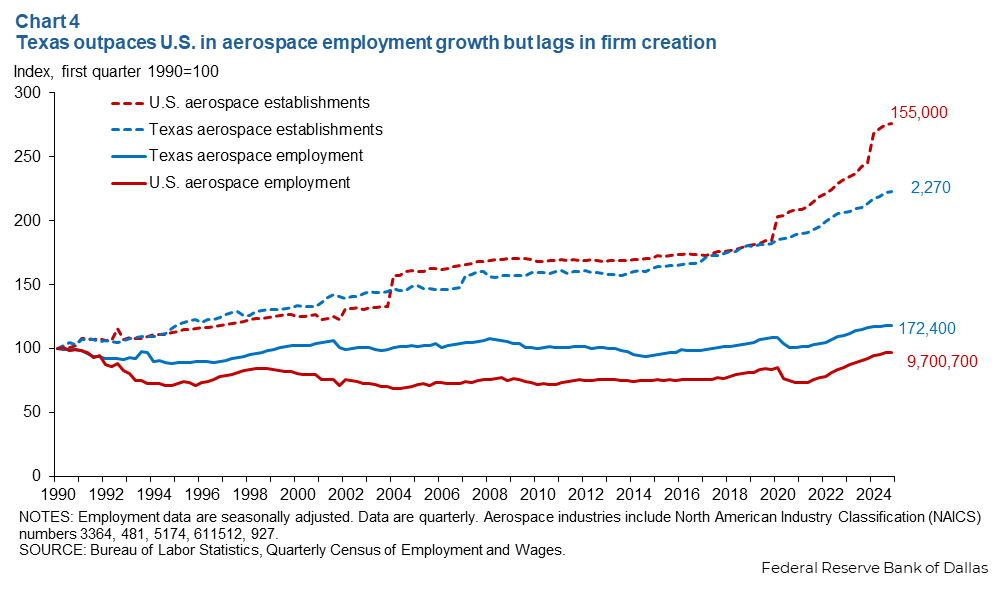
The space industry appears poised for more growth. Broadly speaking, the aerospace and defense industry employs about 170,000 workers in Texas, 1.8 percent of the industry’s U.S. total. Its employment has grown 18 percent in Texas since 1990. By comparison, the U.S. aerospace and defense industry lost 2.5 percent of its jobs over the same period.
Space industry has Cold War roots
The federal government has historically accounted for most space endeavors. The Cold War produced the space race with the Soviet Union beginning in the mid-1950s. As a result, the U.S. military developed rockets capable of launching surveillance satellites and long-range missiles. A surge of space launches occurred in the 1950s and 1960s (Chart 1).
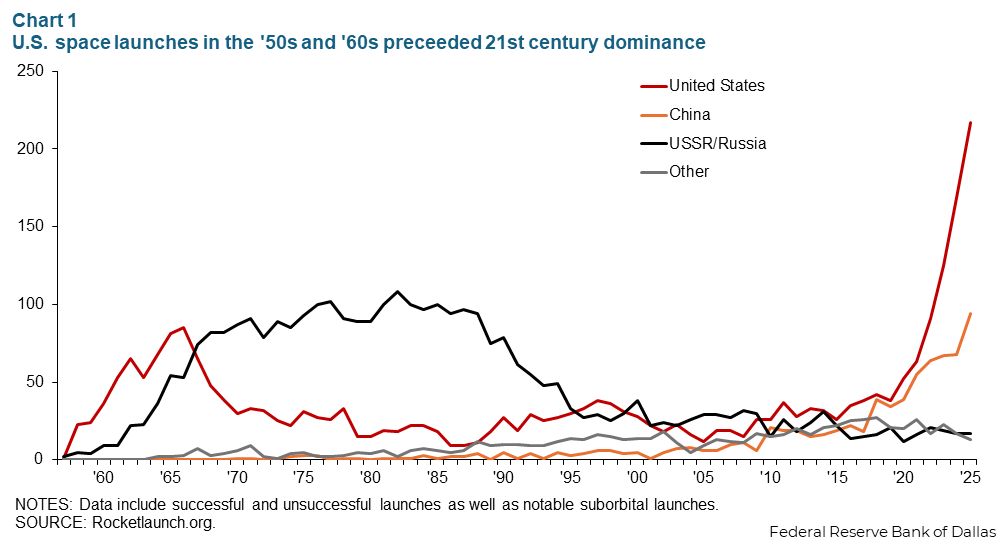
After the Soviets successfully launched the first satellite (Sputnik 1) into space in 1957, the U.S. created NASA (the National Aeronautics and Space Administration) and shifted its focus to landing a man on the moon, achieved in 1969. Launches subsequently tapered off in the 1970s and 1980s as the U.S. focused on the space shuttle program.
Over the past several decades, a combination of rapid innovations in space technology, shrinking government resources, easing regulations and rising commercial opportunities opened the door to private companies. American space companies are responsible for much of the increased launch activity since the mid-2010s.
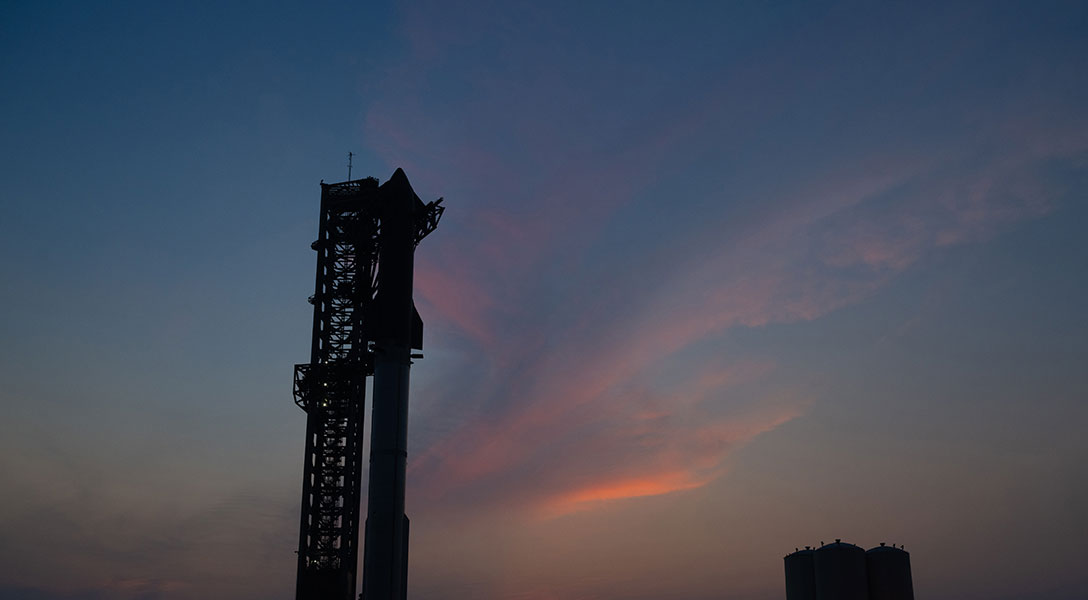
SpaceX relocated its headquarters from California to Texas in 2024 and operates its Starbase launch facility near the South Texas community of Boca Chica. SpaceX accounted for more than half of the world’s space launches and 83 percent of those in the U.S. in 2024.
Space commercialization follows government monopoly
The federal government maintained a de facto monopoly on U.S. space launches well past Apollo 11’s successful lunar mission, a concluding chapter in the space race. Private companies were not allowed to launch vehicles, including satellites, into space without NASA contracts until 1982. Diminished government funding and increasing demand for military, civil and commercial launches forced a change.
Multiple executive orders and legislative actions laid the foundation in the early 1980s for commercialization of the U.S. space industry. Congress conferred regulatory powers over commercial space ventures to the Department of Transportation, with the goal of removing barriers to entry and stimulating private investment.
Technological gains led to the eventual growth of private space launches. New, ultra-light materials, such as carbon composite and aluminum-lithium alloys, 3D printing, new welding and machining techniques, and advancements in propulsion efficiency enhanced private space sector financial viability.
These advances are behind some Texas companies’ major projects. For example, Firefly Aerospace—headquartered in Cedar Park, north of Austin—became the first company to land on the moon, in March 2025.
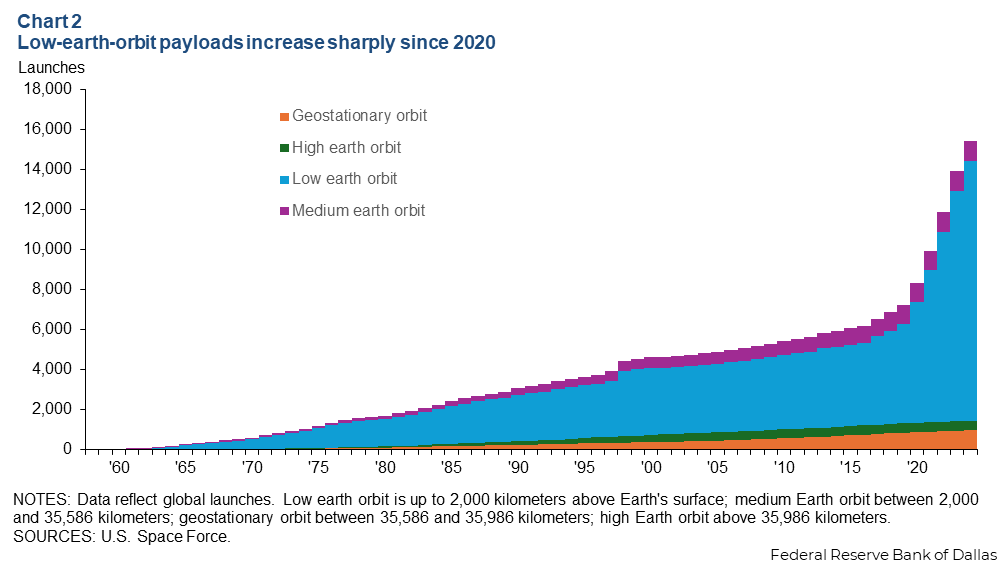
The private sector has also developed miniature satellites that can be used in low-earth-orbit constellations (multiple satellites working together) to provide communications and internet services. The small satellites can operate communications systems at much faster speeds than traditional satellites. SpaceX and its Starlink internet service use thousands of such satellites.
Starlink began expanding its constellation in 2020 with Amazon’s Project Kuiper (now known as Amazon Leo) following in 2021 and Paris-based Eutelsat’s OneWeb entering in 2022 (Chart 2).
Reusable rockets have helped contain the cost of private space launches. The most prolific reusable rocket is SpaceX’s Falcon 9 heavy launch vehicle. The company is also working on a larger reusable rocket, Starship, at its South Texas base. Blue Origin, with a launch site near Van Horn, Texas, similarly has developed reusable rocket systems as it seeks to develop space tourism with its New Shepard and newer, larger New Glenn launch vehicles.
Technological change and improving economies of scale have driven down the cost per launch 5.5 percent annually from 2000 to 2020, according to research published in Economics Bulletin. Part of the decline is attributable to the shift to low-earth-orbit payloads.
SpaceX’s cost structure offers an example. The company’s reusable rockets and vertical integration—most development and building are done within the company—provide a cost advantage relative to its competitors and operate at a fraction of the cost of similar government programs.
Non-commercial launches for military and government and civilian use have not realized the same cost decline as the private sector. The cost to launch a non-commercial satellite was 2.5 times that of a commercial satellite in 2020. Indeed, from 1996 to 2024, NASA’s launch cost rose 2.8 percent per year. NASA faces higher costs as human spaceflight requires more complex systems, a lower tolerance for failure and more government reviews than a commercial payload.
SpaceX has been among NASA contractors, with 20 manned missions as of the launch to the International Space Station of a Falcon 9-powered spacecraft in mid-February 2026. Three astronauts and a cosmonaut were aboard.
Texas offers favorable attributes
Houston was chosen as the location of the Manned Spacecraft Center (later renamed the Johnson Space Center) because of its temperate location and nearby bodies of water. The selection also reflected the political influence of then-Vice President Lyndon Johnson of Texas. The oil and gas industry provided a rich source of engineers and investment capital over the years.
Major aerospace and defense companies have maintained large operations in Texas for decades, including Lockheed Martin, Bell Textron (formerly Bell Helicopter), Boeing and Raytheon. This industry ecosystem and Texas’ relatively light regulatory environment have supported the private space industry.
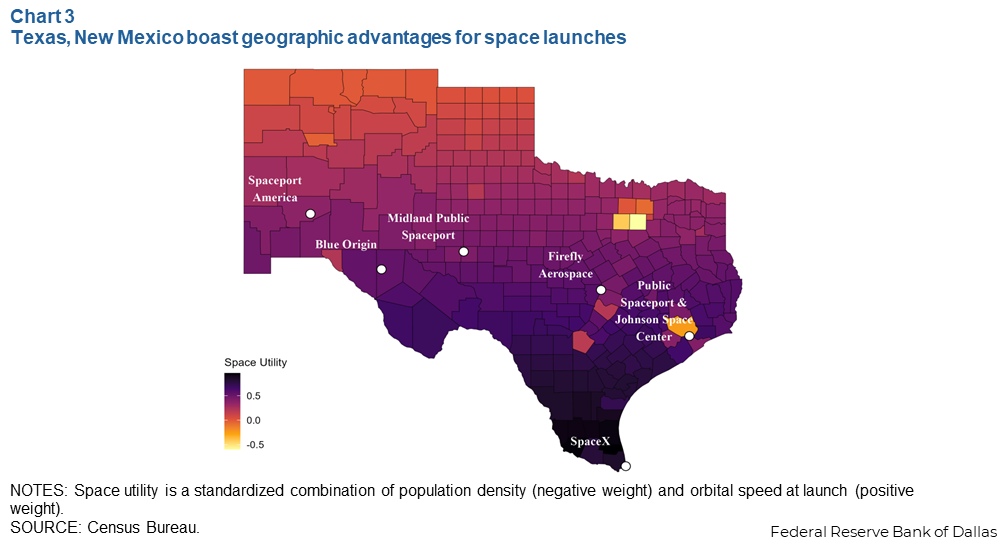
Geography also favors much of the Southwest, including Texas, as launch sites (also known as space ports). The physics of rocket launches favor locations relatively close to the equator and capable of supporting launches in an easterly direction, reducing the fuel required to reach orbital speed. Additionally, companies launch rockets over unpopulated areas or bodies of water to limit property damage from falling debris. The Texas Gulf coast and vast interior lands offer some of the best places to launch within the continental U.S.
Space utility, a metric based on population density and orbital speed at launch, measures the relative ease of launching rockets from different counties (Chart 3). Among others, Spaceport America, 45 miles north of Las Cruces, N.M.; Blue Origin’s Corn Ranch site in Van Horn; and SpaceX’s Starbase in Boca Chica, take advantage of these features.
Although Texas hosts many leading space companies, most U.S. space launches still occur at Cape Canaveral in Florida or Vandenberg Space Force Base in California. Of all space launches from 2015 to 2024, only 5.6 percent were from Texas. Firefly Aerospace ships its rockets to California to launch, and SpaceX lifts off more often from Florida than from Texas.
While Texas has five licensed spaceports, only two are public, and both facilitate aircraft-assisted launches rather than vertical orbit launches. (More than 90 percent of launches are vertical.)
By comparison, New Mexico’s space-related companies depend heavily on its public spaceport, Spaceport America. This facility offers in-house manufacturing as well as horizontal and vertical launching. Virgin Galactic, a space tourism company, launches from this spaceport. Public spaceports reduce launch costs and may encourage entry into the industry.
Similarly, the Houston Spaceport at Ellington Airport, near the Johnson Space Center, includes Axiom Space, which is developing next-generation spacesuits and a private space station, and Intuitive Machines, a lunar exploration firm.
Space industry employment remains small
The space industry forms only a small part of an aerospace and defense industry, with overlapping infrastructure, workforce, research and supply chains. The pure space industry represents about 7,000 jobs in Texas. Employment in this sub-industry has grown 65 percent in Texas since 1990 while shrinking in the U.S. Notwithstanding, Texas only accounts for 2.5 percent of employment in the national space industry.
Another measure of industry dynamism is the number of companies. There are 2,270 aerospace and defense establishments in Texas, about 1.5 percent of the U.S. total (Chart 4). The number of aerospace establishments in the U.S. grew strongly after 2020, outpacing growth in Texas.
NASA accounts for about 40 percent of the 7,000 Texas jobs in the space industry and 2 percent of jobs in the larger Texas-based aerospace and defense industry. NASA has a larger presence in Texas than in the U.S., where the space agency represents 18 percent of jobs in the space industry and 0.6 percent of jobs in the aerospace and defense industry.
Technical, environmental constraints remain
The rapid increase in the number of low-earth-orbit satellites and plans for many more have raised concerns. The risk of satellite collisions and subsequent chain reaction pileups leaving large amounts of space debris in the atmosphere is a worry. Additionally, light pollution from the sun reflecting off satellites distorts telescope images and could potentially cause ecological harm on Earth, though there are efforts to mitigate such risks.
Environmental groups have focused on SpaceX’s launch site development in Boca Chica. SpaceX built its facility on coastal marshland, and Gulf of Mexico water is used to cool the rockets during launches. The area also is home to migratory birds, marine plants and other wildlife that may be susceptible to noise and pollution from launches.
Despite these challenges, space exploration, moon landing missions and satellite launches continue to draw on Texas expertise. NASA’s public-private partnership Artemis missions, which anticipate launching to the moon in second-quarter 2026, employ several Texas space contractors. SpaceX has ambitions to launch crewed missions to Mars as soon as 2030, powered by the Starship rocket developed at Starbase.
About the authors

Isabel Dhillon is a former research analyst in the Research Department at the Federal Reserve Bank of Dallas.

Ethan Dixon is a former research analyst in the Research Department at the Federal Reserve Bank of Dallas.

Isaiah Spellman is a former research analyst in the Research Department at the Federal Reserve Bank of Dallas.

Pia Orrenius is a vice president in the Research Department at the Federal Reserve Bank of Dallas.