Texas electricity providers draw on variety of sources
Q. What is the size and scope of Vistra’s operations?
We've got about 60 generating plants across the country. About half of our output, though, is for Texas. We produce about a quarter of Texas’ electricity needs, and we serve 5 million homes and businesses across the country. And again, about half of those are in Texas. We don't have a really large workforce. It's only about 7,000 people across the country.
Part of growing outside of Texas really came about because of the acquisition in 2018 of Dynegy, which was headquartered in Houston. That gave us a national footprint. Most recently, we added three nuclear plants to our portfolio as part of the acquisition of [Akron, Ohio-based] Energy Harbor, which has two plants in Ohio and one in Pennsylvania to go along with the one we have in Glen Rose, Texas [75 miles southwest of Dallas].
It's been a great expansion for us. Our people are excited, and it puts us all the way from California to Maine. But our footprint is anchored here in Texas. We can only operate where competitive markets exist, which is in about half the country.
Q. How does the Texas electricity market differ from others?
Texas went further toward competition than any other state. It's the 10th-largest power market in the world just on its own. In fact, Texas is about 10 percent of the U.S. electric grid.
What's really driven Texas more than any other state is that you have open access. If you want to build a power plant in Texas, you can build a gas plant, a solar farm, a wind turbine, put a battery on the grid and the Public Utility Commission (PUC) does not need to approve that.
Of course, you need to get your permits and make sure you have the authority from the counties to do it. We've attracted over $100 billion of capital to Texas just in generation since 2000. And none of that is in rate base. None of that is anything that the customer is required to pay for.
Those are all investors hoping to make money in the power sector, but with no guarantee. That is very different from a lot of states. In other states, that happens through the regulated utility. Texas went further, and I think it's seen the benefits of it because this is one of the only states that has seen consistent growth in the electricity sector for the past 25 years.
Q. How has the Texas grid changed since the February 2021 statewide freeze?
I should start by acknowledging that the event was devastating for Texans. We can't go through that again. As a state, the loss of life is unacceptable. The disruption for the state was also very costly. The Legislature went to work very quickly to look at what happened. It passed Senate Bill 3 during the legislative session in 2021 to make sure that winterization activities were top of mind. [Senate Bill 3 requires utilities to develop emergency preparedness plans.]
The Public Utility Commission of Texas has jurisdiction over the electric grid, and it also oversees ERCOT [the Electric Reliability Council of Texas, which manages the market]. Activities regarding winterization and inspections and communications have all improved.
The Railroad Commission of Texas oversees the oil and natural gas industries. A critical part of the value chain for powering the electric grid is natural-gas-fired generation, [accounting for] about 50 percent of the electric grid. They've been working on winterization activities as well. And it's critical that they continue to do so.
I'm confident we're in a better place as a state if a similar storm were to occur. But I will tell you, no two storms are alike. We've got to remain vigilant.
The mix on the grid has changed. There are a lot more batteries on the grid right now. There's a lot more solar on the grid right now, which actually can help in the winter during the day if it's not cloudy. But we've got to be prepared for an electric grid that can handle three to five days of cold and cloud cover and with little wind.
I still think we need to pay some attention to that because the ERCOT system does not have a reserve, and it doesn't have a capacity market like other states. [Providers in a capacity market are paid for reserve generating capacity that can be tapped when needed.]
Q. How likely is the state to achieve grid redundancy?
Texas has always had a history of charting its own path. I think it can still do so on the electric grid. There are many large customers, in particular, who operate all across the country who prefer Texas' electric market. I think that's why you've seen industry and businesses continue to come to Texas.
We're not advocating that a capacity market is the only way to solve this. The question still to be answered is whether you're valuing energy, which is paying for energy when it's produced and only when it's produced. Or do you also pay for certain resources to be on the sidelines and available to respond?

They may not be producing at that moment, but if you needed them, there's no mechanism in Texas today to pay for that. Investors aren't going to put resources on the grid to sit on the sidelines with no compensation. What Texas is trying to figure out is, “How do I have the best of the energy market, where you only get paid if you're producing, but also give the peace of mind of something being in reserve, which may only be needed 1 percent of the hours in the year?” But that's when people need it most.
I think it can be solved without going to a full blown capacity market. I think our customers expect it. I will tell you that we have older assets on the grid that could have been retired, but we keep them around for these moments, and there isn't necessarily a compensation model for that. If we don't have the generation to do it, we have to go into the wholesale market and buy it at [what would likely be expensive] spot prices.
Q. How has the proliferation of data centers and bitcoin mining operations changed the business of providing electricity?
Texas has been growing at 5 to 6 percent in the last two to three years on an energy basis, that's the kilowatt hours or megawatt hours on an annual basis. Peak demand in the ERCOT service area has actually not grown over the last couple years.
The weather has not been quite as hot for the last couple of summers, and we're starting to see more flexible load come into the system. Large industrial customers and even the crypto companies are learning that when the prices get higher on the electric grid, which means the grid is getting tighter, they're using less energy.
That's a good thing because it provides an opportunity for energy to serve other customers, including residential. The last two to three years have not been about AI [artificial intelligence]. There has been cloud computing, so that's not new. But there has been electrification and home heating. There has been electric vehicle demand, there has been chip manufacturing, there has been onshoring of manufacturing.
Even in West Texas, there's the electrification of the oil and gas fields. In fact, we announced that we're going to be spending about $1 billion in West Texas to expand our Permian Basin gas plant. We're going to triple the output of that facility because customers need the power.
I think what’s captured people's imagination is all of the announced load. Is that going to turn into real megawatts that we have to serve? And where's that power going to come from?
What that means for the country is that we could see the data center consumption of power on the grid go from 3 or 4 percent of total consumption to maybe 9 or 10 percent of total consumption.
Everything is big when you scale it to the size of the electric sector, but it's doable. What gives me comfort is this country has a lot of untapped generation already on the grid. In Texas there are power plants called combined cycle gas turbines, which are basically highly efficient gas turbines that are able to run at baseload [to meet continuous, 24-hour demand], but they're running at only 40 to 45 percent of their capability.
There's a lot of wind and solar on the grid. We're now the nation's leader in both of those categories and are becoming the nation's leader in energy storage. When those are producing, the gas plants will back down. If load comes on to the system, the gas plants can actually ramp back up with the invested capital that's already on the system.
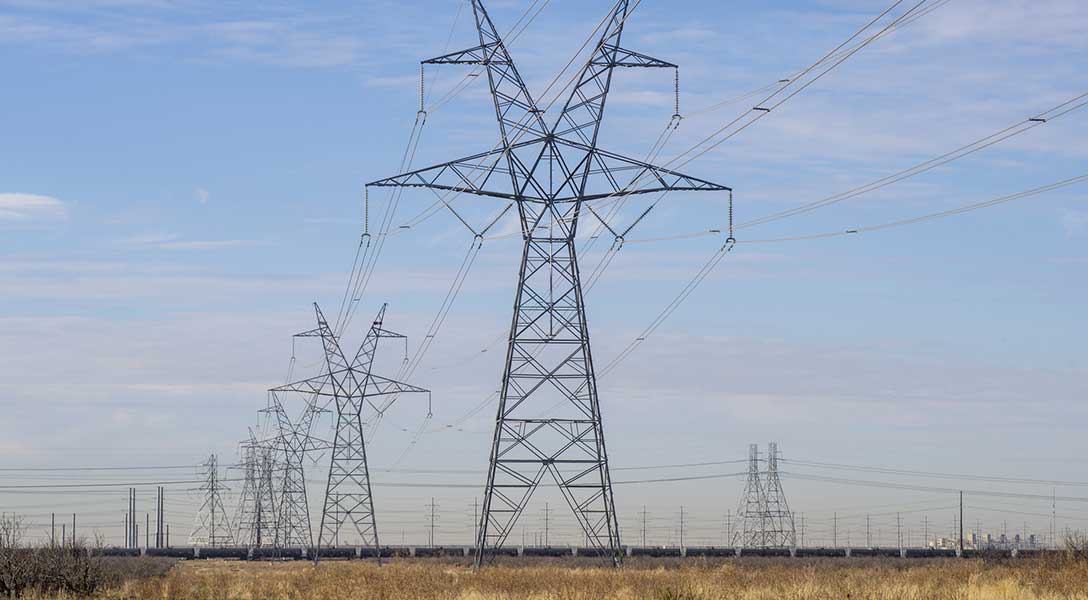
You have got to have the transmission to connect all this, and the PUC just approved the beginnings of what we'd call the transmission superhighway, these are 765-kilovolt lines, which can carry a lot more electricity.
Q. Given the overall rising demand for electricity, is there a place for nuclear power?
We're fortunate that Texas has two nuclear plants. We own one of them, the one in Glen Rose, called Comanche Peak. [The other is the South Texas Project near Bay City.] Those projects were started and then interrupted with the Three Mile Island incident [a partial nuclear meltdown near Harrisburg, Pennsylvania, in March 1979]. Additional engineering was required, and additional safety measures were put in place.
It ended up being very expensive, and the country lost its will to build new nuclear. But these plants have run extremely well. We're fortunate that last year we were successful in relicensing Comanche Peak, so that it has a license to run into the 2050s.
These are highly valuable resources from a grid reliability standpoint because they run 24/7. You take them offline for refueling, and then they come back online in 30 days or less.
It has not been cost-effective to build new nuclear. Now, nuclear is being announced with small modular reactors as well as building large-scale nuclear such as what Georgia just completed [the Vogtle Units 3 and 4 reactors in Waynesboro]. Georgia did that in a rate-regulated market, meaning they [Georgia Power] have cost recovery on building new nuclear.
That project went about three times over the original expected budget, and it ended up costing more than $30 billion more to build those two new units. A comparable amount of natural gas capacity in today's dollars, would probably be on the order of $4 billion to $5 billion, to put in perspective the capital cost difference. The operating costs are not that different.
If the hyperscalers [such as data centers] and the large technology companies are looking for carbon-free generation, there is a hope that they would be willing to sign contracts for new nuclear, whether that's a small modular reactor or a large unit.
It really comes down to customer preference, who's going to pay for that carbon-free attribute.
Q. Why have electricity prices around the country been rising?
We are seeing electricity prices rise across most of the country, but that’s recent. And it's worse in some parts of the country than it is in others. We haven't really borne the brunt of it in Texas per se. But it's definitely an issue in New York, New Jersey and a handful of other places.
Lawrence Berkeley Labs and the Brattle Group, a consulting firm that follows this industry closely, put out a report recently. Electric rates rose slower than the rate of inflation from 2010 to 2024. They've gone up and down because they are a bit cyclical. But over time, they've actually not even kept pace with inflation. But in the most recent years, they've been catching up and actually growing at a rate faster than inflation.
That's just the nature of the category. They [the public] recognize it when it starts to outpace inflation. And that's logical. It's the same thing as gasoline.
There are a couple drivers on what's happening outside of Texas. A lot of the other states have over a number of years been more difficult to build new assets in, and there's been more retirement of coal.
As the load started to grow, even at a 2 to 3 percent level—which was up from zero—the grid started to lose its excess capacity. Old stuff was retiring; new stuff wasn't coming onto the grid. They [other states] do not have some of the renewable footprint that Texas has. So, the question was, what were you going to build to replace it?
I think price signals represent where supply and demand meet. That's true, whether it's in New Jersey, whether it's in Ohio, or whether it's in Texas.
Where you're seeing the price pressure, you're seeing it in two places. It's where supply and demand for wholesale electricity are getting tighter. It's also the portion of the electric bill that is the wires-and-poles portion of the bill. The bill is almost equally made up of those two parts. What's happening with the wires-and-poles build-out affects prices. And that's played out differently in different parts of the country.
Q. With all the new solar and wind generation in Texas, what’s the future of natural gas-powered electric generation in the state?
The state of Texas passed the Texas Energy Fund with the idea that if there are lower-interest loans that could help incentivize gas plants, that might help bridge some of the revenue requirements that are not showing up in the market price for power.
The cost of building gas plants has more than doubled in the past five years. However, there has been more renewables penetration on the electric grid, which means you have many more hours when the price of electricity at the wholesale level can approach zero or even be negative. As an asset owner, you're looking at your prospects for revenue and you're saying, “Unless I can get a contract—an offtake agreement—I'm actually just having to sell into the wholesale market, which is highly volatile.”
So far, the corporate entities that buy power through offtake agreements have shown a preference for wind and solar to meet their sustainability objectives. They have not shown a preference for an offtake coming from gas plants. The question is, if gas is valued because it's flexible, and it can be the backup resource, and it can be reliable, how should it be valued in a wholesale market?
We talk about reliability, affordability and sustainability—and we say in that order. Texas has historically had a little bit more of a leaning toward the affordability angle. And now they're starting to pay more attention to the reliability angle.
This is an edited and abridged version of a conversation available on the Southwest Economy Podcast.