
Job postings show early signs of AI automation impact
Texas firms are increasingly integrating generative artificial intelligence (GenAI) into their business processes. Two-thirds of firms surveyed in the May 2026 Texas Business Outlook Survey reported using AI, up from 40 percent two years prior.
The rapid adoption of GenAI tools, which iteratively refine their capabilities based on tasks assigned, raises concerns of labor market disruption as the new technology automates work humans previously performed. While it increases worker productivity, it may also reduce the demand for certain types of labor.
A new analysis, using data from millions of online job postings, shows GenAI is reshaping labor demand in Texas. We measure the exposure of individual occupations to automation based on observed capabilities of GenAI tools to perform particular tasks.
After the release of ChatGPT in late 2022, job openings fell for occupations whose tasks are automatable by GenAI. The decline was not confined to new firms or driven by a reduction in the number of surviving firms. Surviving incumbent firms posted fewer openings and shifted the composition of their job posts away from more AI-exposed occupations.
These results characterize the early effects of the AI transition on labor demand. Follow-up analyses suggest this shift in demand has negatively affected the labor market outcomes of recent college graduates from Texas universities and prompted current students to change their educational decisions.
Measuring occupational AI exposure
Economists view jobs as bundles of tasks or activities regularly performed by workers. For example, a medical records technician’s job consists of several related actions. They include compiling and maintaining patients' medical records; documenting conditions and treatment; identifying, compiling, abstracting and coding patient data using standard classification systems; and reviewing records for completeness, accuracy and compliance with regulations.
GenAI’s immense capabilities include many tasks traditionally done by human workers, raising the question of whether firms will hire fewer workers for roles specializing in tasks that can now be fully or partially automated, including, for example, the tasks medical records technicians perform.
We use a task-based metric developed by Anthropic, a company that builds AI systems, to determine a given occupation’s exposure to GenAI automation. The measure maps job tasks in the O*NET database—a comprehensive list of approximately 1,000 common occupations in the U.S. economy and the tasks they perform—to tasks performed using Anthropic’s Claude platform, a leading AI assistant and family of large language models.
Because this measure is based on actual Claude usage, it captures not only what AI could theoretically do, but what it actually does cost-effectively and efficiently enough to be adopted by consumers and firms. The resulting occupation-level measure of exposure to AI automation can be interpreted as the share of an occupation’s tasks that GenAI can automate.
For a medical records technician, nearly 5 percent of the occupation’s tasks are automatable, according to actual Claude usage in the index. In the data, the most exposed occupations are generally in software development, web design and other computer-heavy occupations. Managers, clerical workers, editors and other white-collar occupations are also subject to some of the highest levels of AI task exposure.
We link occupational exposure to quarterly job postings in Lightcast (formerly Burning Glass) job posting data, which can serve as a measure of occupation-specific labor demand over time. Lightcast collects and standardizes the text of job postings across more than 220,000 online job boards and company sites. Lightcast then categorizes and codes the job ads by company, industry, occupation and skills.
The dataset allows tracking nearly in real time of how labor demand for different occupations and industries evolves. This approach comes with the caveat that Lightcast postings represent the types of jobs typically posted online—coverage of some occupations is limited. For example, farming, construction, building maintenance and personal service job openings are underrepresented in the Lightcast data.
GenAI reduces demand in automatable occupations in Texas
First, we examine whether Texas firms are posting fewer openings for occupations with more tasks that AI can automate relative to before the release of ChatGPT in November 2022. The release of ChatGPT represented a watershed moment in the development of GenAI technology that launched a wave of adoption, development and investment.
Because industry composition is a partial determinant of occupational labor demand, our model compares posting counts for more- versus less-exposed occupations within the same industry.
The findings suggest job postings fell 5 percent for more-exposed positions relative to less-exposed ones by the end of 2023 and by approximately 8 percent by first quarter 2025 (Chart 1).
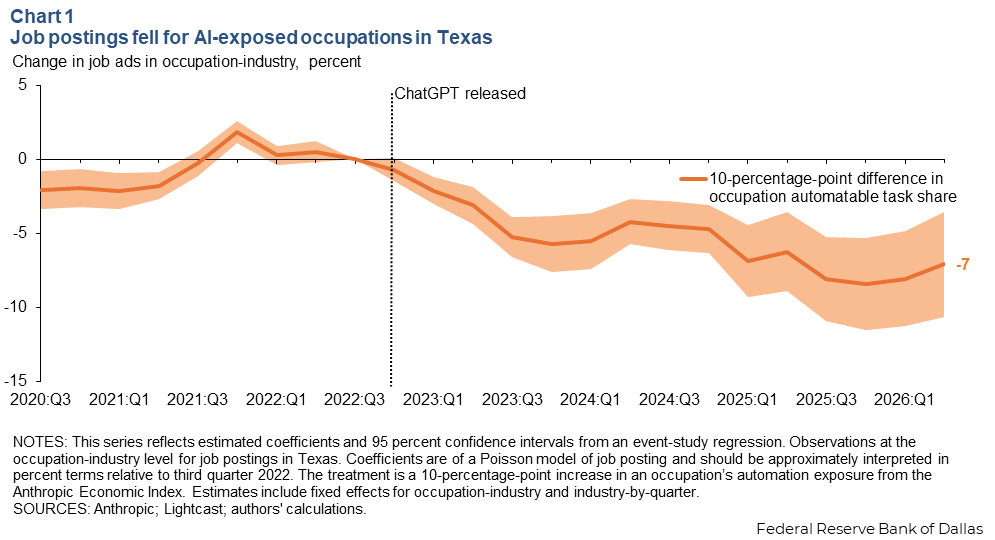
The results are based on the relationship between occupational AI exposure and job postings over time, scaled to represent the difference in postings associated with a 10-percentage-point difference in the share of automatable tasks. Because the estimation limits comparisons to posting counts across firms in the same industry, the findings do not conflate a true decline in demand for automatable skills with a general slowdown in hiring in a particular industry (technology, for example). Results from estimating the same model using job postings for each occupation-industry cell across the entire U.S. are quantitatively and qualitatively similar.
Existing firms pull back demand for automatable positions
One natural question is whether restructuring existing firms’ workforces, the emergence of new firms that require fewer human workers or a reduction in the number of surviving firms is driving demand declines for AI-exposed occupations.
To examine this, we measure firm-level job postings in Texas using a balanced panel of firms present in the jobs data during the entire analysis period. Exposure is based on the occupations posted before the release of ChatGPT. Evidence of smaller declines of postings by existing firms relative to the overall declines in openings for more-exposed occupations would suggest that new firms requiring fewer human workers or a reduction in the number of surviving firms explain a large share of the decline.
Existing firms that were more exposed to AI reduced their demand by similar amounts to the aggregate effects found across occupations, decreasing their job postings by approximately 5–6 percent by the middle of 2024 and by 8–9 percent by early 2026 (Chart 2).
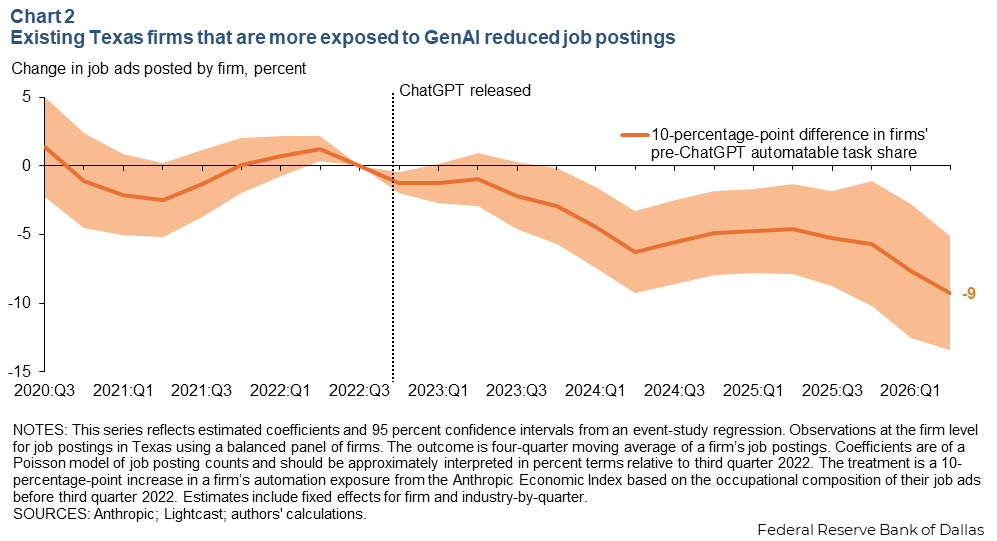
Neither of these estimates are statistically distinguishable from the occupation-industry level results. While JPMorgan Chase research finds that “newer business cohorts were more likely to incorporate AI from the onset,” such AI-native firms do not appear disproportionately responsible for the slower rate of hiring among AI-exposed occupations.
If AI automation acts as a substitute for certain jobs—as firms incorporate GenAI into their production and service processes—the composition of job ads would be expected to shift away from more automatable occupations. Indeed, more-exposed firms posted fewer automatable positions relative to their total ads after the release of ChatGPT (Chart 3).
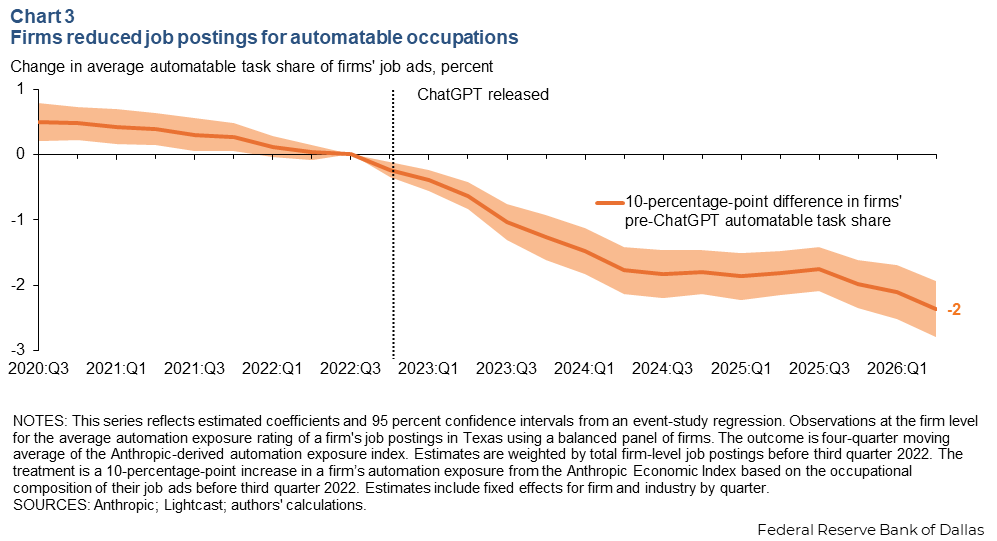
Firms whose listed jobs prior to the release of ChatGPT were destined to become 10 percent more automatable by GenAI posted jobs with 2 percentage points fewer automatable tasks after the release—a nearly 50 percent reduction relative to the mean in the data.
Who loses in a world of shifting demand from AI?
Based on our calculations, we can estimate the effect of AI automation exposure on total Lightcast job posting behavior in Texas. Given AI usage rates and automation scores across occupations and Texas’ industry composition, the estimates imply that automation exposure to generative AI reduced total Lightcast job postings in Texas by approximately 1.8 percent in 2024 and by 2.6 percent in 2025.
There is strong evidence that GenAI has decreased labor demand for occupations consisting of tasks that can be performed by these new tools. Though the overall effect on aggregate online job posting behavior thus far has been modest, demand reductions have been significant and meaningful for specific types of workers. Even in the absence of layoffs, a hiring pullback in these jobs would negatively impact individuals entering the labor market for the first time or those attempting a job transition.
In the Lightcast data, fewer than half of firms’ typical job ads explicitly require more than two years of experience and very few firms require more than five (Chart 4). Because the types of jobs posted online typically require little prior work experience, a decline in job postings is likely to disproportionately affect new labor market entrants.
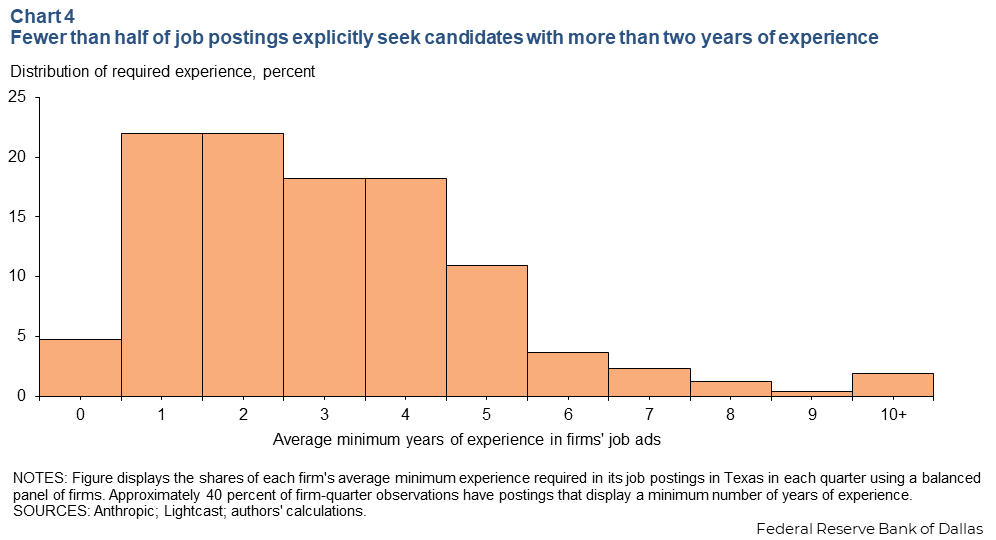
These dynamics suggest that recent college graduates, whose unemployment rate rose to unusually high levels during this period of rapid GenAI adoption, are where effects of GenAI on employment and earnings are likely to first appear.
Data from online job ads may not capture the full scope of labor demand or worker outcomes, so consulting alternative, high-quality sources of data on employment and wages is valuable. Administrative data from the state of Texas suggest that AI automation has affected labor market outcomes such as employment and earnings for recent college graduates and prompted some current college students to adjust their studies to this shift.
About the authors

Samuel Dodini is a senior research economist in the Research Department of the Federal Reserve Bank of Dallas.

Tucker Smith is a research economist in the Research Department of the Federal Reserve Bank of Dallas.