AI plays a role in weak labor market for college graduates
Recent college graduates are having an unusually difficult time finding jobs. Is AI to blame? Evidence suggests that generative AI (GenAI) has reduced demand for positions in which the new technology can more efficiently complete tasks than humans.
Such hiring slowdowns would disproportionately affect new labor market entrants, including recent college graduates. Thus, both recent graduates and current students likely benefit from developing skills that complement GenAI.
Drawing on administrative education and earnings records for students and graduates of Texas public universities, we examine the outcomes of students and graduates from majors that typically feed into occupations that the new technology can more readily automate and compare those results to majors that feed into less automatable occupations.
After the 2022 release of ChatGPT—an AI application that can answer questions and assist with written prose and code—recent graduates from more-exposed majors at Texas universities experienced a 1.7-percentage-point decline in the probability of finding employment in Texas within a year of graduating relative to graduates from less-exposed majors. Moreover, students from more-exposed majors who found jobs after 2022 earned 5 percent lower wages relative to earnings changes for less-exposed majors.
Recent college graduates and current students are adjusting to the GenAI-prompted shift in demand across skills. To avoid a soft labor market, 2024 graduates from more-exposed fields were more likely to return to school to pursue graduate degrees. However, for the most part, they continued studying the same field in which they earned their undergraduate degree. The earnings records of recent master’s degree recipients suggest there may be limited returns to formal upskilling in AI-exposed fields. In the aggregate, entering undergraduate students have begun to pivot away from AI-exposed fields.
The evidence indicates that the AI transition has negatively affected many recent college graduates. As firms continue to adopt and integrate AI into their production processes, layoffs and wage growth for prime-age (ages 25–54) workers in occupations at greater automation risk will be key indicators to monitor.
College-major exposure to AI
Evidence suggests that GenAI has reduced hiring for occupations consisting of tasks that can be performed by these new tools. Even in the absence of layoffs, a pullback in hiring in these disproportionately white-collar jobs would harm individuals entering the labor market for the first time. This suggests that new college graduates are likely to have been particularly affected by the initial stages of the AI transition.
We define an occupation’s exposure to GenAI automation using a task-based metric developed by Anthropic, a U.S. AI development firm. The measure maps job tasks in the O*NET database— a comprehensive list of approximately 1,000 common occupations in the U.S. economy and the tasks they perform—to records of the tasks that Anthropic’s Claude platform has performed. (Claude is Anthropic’s AI assistant and family of large-language models.) The exposure measure can be interpreted as the share of an occupation’s tasks that GenAI can automate.
To examine the effects of GenAI on outcomes for recent college graduates and current students, we define an analogous exposure measure for college majors using information from online job postings. Lightcast (formerly Burning Glass) job posting data capture job ads from more than 220,000 online job boards and are systematically categorized by occupation, industry, company, and, importantly, the field(s) of study demanded in the job ads.
We consider a college major’s exposure as the average of the occupation-level exposure across all of the jobs that mention that field of study in their job ads. In other words, a major is more exposed if the jobs that traditionally demanded graduates from that major are susceptible to AI automation. We map majors to occupations based on job openings posted from first quarter 2018 to third quarter 2022—before the release of ChatGPT—because contemporaneous demand factors and GenAI itself might change this mapping, which would confound estimates of GenAI’s effects.
This procedure yields an intuitive ordering of majors. The most-exposed majors to GenAI automation include computer science, computer engineering and languages, while nursing, education and psychology are among the least-exposed fields.
AI exposure leads to worse labor market outcomes
Did the observed decline in demand for AI-exposed occupations reduce employment and earnings for new college graduates? We link major-level AI exposure to education and earnings records of enrolled students and graduates from Texas four-year universities, using administrative data from the Texas Higher Education Coordinating Board and Texas Workforce Commission.
For a given four-year graduate, the dataset includes their major, course history, college entrance exam scores and demographic information, along with quarterly earnings and employment records for jobs held in Texas. First-year employment rates and annual nominal earnings are defined across a graduate’s first four quarters after graduation (for example, third quarter 2024 through second quarter 2025 for a May 2024 graduate).
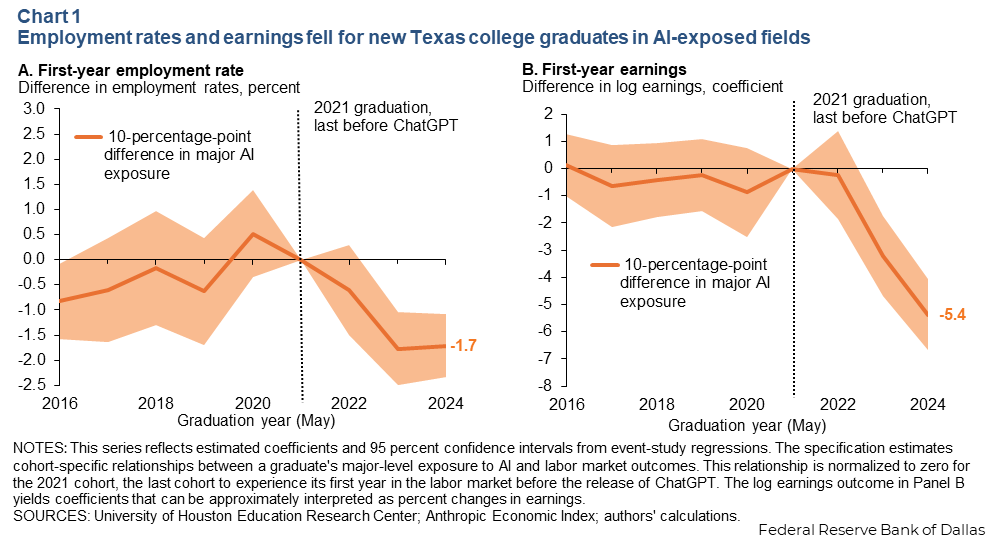
We estimate how the share of new graduates who found employment in Texas within a year of graduating evolved across cohorts that graduated before and after the release of ChatGPT. We do this comparison for more- and less-exposed majors (Chart 1, panel A). The event-study estimates trace out how employment rates evolved for more- and less-exposed majors relative to the difference among the last cohort to experience their first year in the labor market before release of ChatGPT (May 2021 graduates).
The difference in employment rates between more- and less-exposed majors was stable before the release of the new technology in late 2022. Since then, a 10-percentage-point higher share of automatable tasks is associated with a 1.7-percentage-point relative decline in employment rates. Among graduates who found work in Texas, first-year earnings for more-exposed majors also fell by approximately 5 percent from 2021 to 2024 relative to less-exposed majors (Chart 1, panel B).
AI exposure is pushing students toward grad school
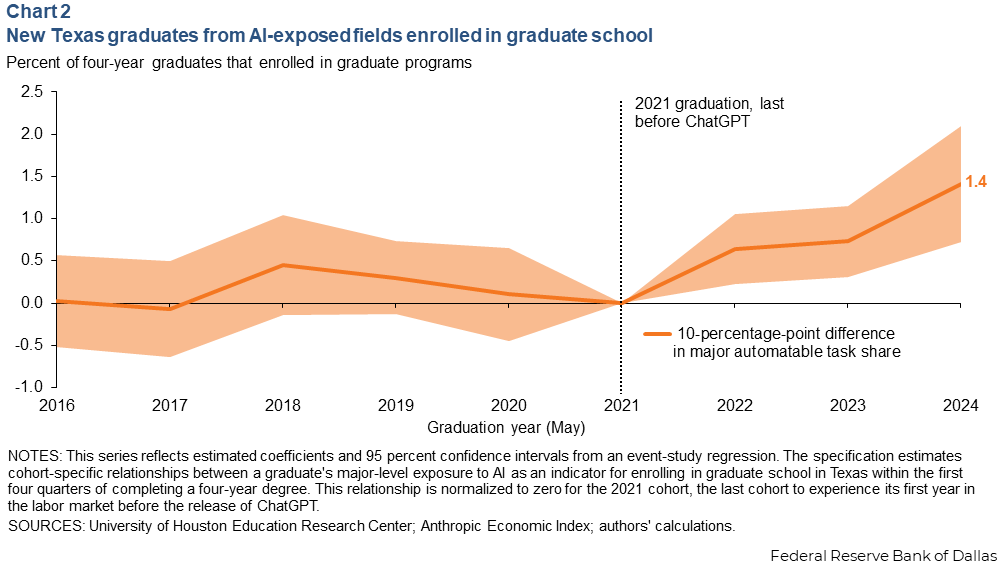
Pursuing more education is one way to react to deteriorated labor market prospects. The reduction in employment opportunities made additional education less costly, on average, for four-year graduates from exposed majors, because the wages foregone when attending school are relatively less than before the rapid deployment of GenAI. We use our panel dataset to define re-enrollment in graduate studies at Texas four-year universities within a year of graduation.
Consistent with a decline in opportunity costs, May 2024 four-year graduates from majors with 10-percentage-points higher GenAI automation exposure were 1.4 percentage points more likely to enroll in graduate school (Chart 2).
Rather than diversify their skill development away from fields exposed to AI, returning students largely continued studies in the same field as their undergraduate major. For example, two-thirds of 2024 computer science graduates returning to school the following fall semester chose a computer science graduate program.
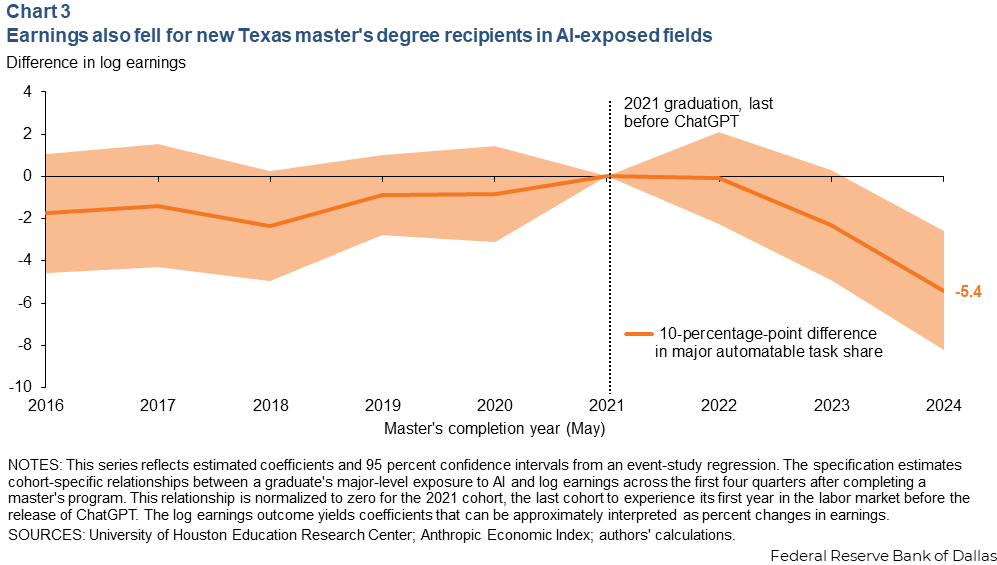
Investments in education beyond a four-year degree could yield sizable returns if the additional expertise is more complementary to AI than the knowledge gained from undergraduate studies. This may not be the case for students pursuing graduate degrees in computer science and other AI-exposed fields: New labor market entrants holding master’s degrees in more-exposed fields experienced similar relative declines in earnings as four-year graduates (Chart 3). This suggests that the returns to formal upskilling within AI-exposed fields may be limited.
Undergraduates shift from AI-exposed fields
Individuals entering or currently attending college will likely need to pivot to avoid similar labor market harm as recent graduates from AI-exposed majors. Research shows that shifts in major enrollment trail changes in demand.
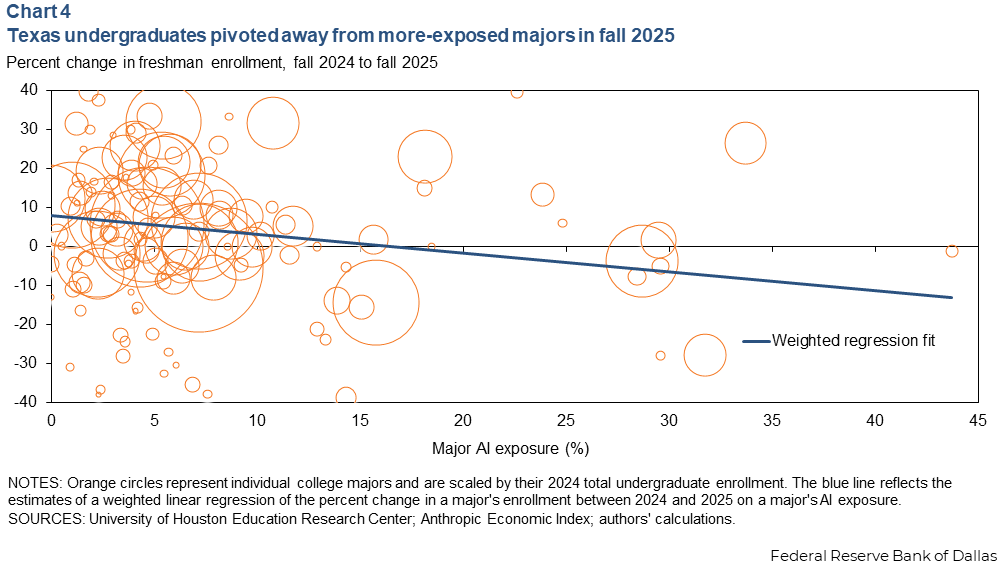
We use Texas undergraduate enrollment counts by major to assess whether fall 2025 marked a turning point for enrollment in computer science and other AI-exposed majors. For a 10-percentage-point difference in major automatable task shares across majors, undergraduate enrollment in Texas four-year institutions declined by 4.8 percent between fall 2024 and fall 2025 (Chart 4). Current students appear to be learning from the rough labor market experiences of their predecessors.
Transition and adaptation
This research suggests that GenAI caused declines in employment and earnings for new college graduates possessing automatable skill sets, consistent with the decline in labor demand observed in other studies. As the AI transition progresses, both students and educational institutions will need to pivot toward developing skills that complement the new technology.
Texas students can now enroll in courses designed to cultivate AI literacy that train students in AI model design and deployment. Given the pace of technological change, entirely new fields of study that do not currently exist may emerge in the coming years as labor demand changes and educational institutions adapt. Whether such courses and programs better prepare students for the transformed labor market remains an open question.
About the authors

Samuel Dodini is a senior research economist in the Research Department of the Federal Reserve Bank of Dallas.

Tucker Smith is a research economist in the Research Department of the Federal Reserve Bank of Dallas.