Global Institute builds bridges to understand economic change
Many forces shaping the U.S. economy originate beyond its borders. Global supply chains, international capital flows, migration, technological diffusion, cross-border payments and financial linkages interact in ways not fully visible in domestic data alone. Looking outward to understand the U.S. economy is therefore consistent with the Federal Reserve’s core objective of achieving price stability and maximum employment.
The Federal Reserve Bank of Dallas is uniquely positioned to study how global forces transmit to the U.S. economy. The Eleventh District anchors the world’s largest land-based trade corridor by value—the nearly 2,000-mile U.S.–Mexico border—supporting more than $870 billion in two-way goods trade in 2025. Texas exported about $450 billion in goods, approximately one-fifth of all U.S. exports, with roughly 28 percent going to Mexico, the U.S.’s largest trading partner. Texas is a critical node in national and global trade networks. These flows reflect dense production networks of goods that routinely cross the border multiple times during manufacturing.
This integration also makes the U.S.–Mexico corridor one of the most active cross-border payments channels globally. Industry estimates identify it as the world’s largest bilateral payments corridor, with flows on the order of trillions of dollars per year driven by trade settlement, supply-chain finance, intercompany transfers, and remittances—about $60 billion in 2025—tied to deep labor-market integration.
These linkages with the world are supported by a highly developed logistics ecosystem (border crossings, ports, rail, highways and global air-cargo hubs), reinforced by Texas’ role as a global energy node. All of this allows global developments to surface quickly in regional conditions and through them in national inflation, growth, and policy trade-offs.
Recognizing this unique vantage point, the Dallas Fed relaunched the Global Institute in November 2024 to strengthen and integrate its work on global economic issues. Work in the first year builds on expertise in international economics on a broad variety of topics and is designed to inform academic research and the public.
- Researchers offered fresh findings on tariffs and trade costs, the renewed centrality of tariff policy and the inflation and monetary policy trade-offs posed by sectoral cost-push shocks.
- Work on tariff Laffer curves shows how retaliation, revenue use and general-equilibrium effects shape real and distributional outcomes.
- Other research examines macro-financial vulnerabilities, including external dollar funding fragility among non-U.S. global banks, distortionary capital controls, and global financial cycles—clarifying how shocks propagate across borders and influence financial stability and the transmission of monetary policy. A strand of the institute’s research speaks directly to monetary policy. Work on flexible average inflation targeting shows how make-up strategies shaped post-pandemic inflation outcomes, highlighting key differences between the U.S. and other advanced inflation-targeting economies.
- Research on the global pandemic inflation episode underscores the importance of distinguishing between supply- and demand-driven shocks and the role of nonlinearities in inflation dynamics.
- In 2025, institute-related authors contributed 18 Dallas Fed Economics articles, including widely read work on AI and productivity, the macroeconomic effects of immigration, and trade deficits viewed through a macroeconomic lens.
- Core data initiatives include the International House Price Database, built through close collaboration with scholars worldwide, and the expanding Database of Global Economic Indicators, supporting data-driven frontier international economics research and real-time policy analysis.
- Collaboration with Banco de México and Centro de Estudios Monetarios Latinoamericanos (CEMLA) featured prominently in 2025, including the 4th CEMLA–Dallas Fed Financial Stability Workshop and the 10th Annual Banco de México–University of Houston–Dallas Fed Conference on International Economics.
- The institute co-organized policy events with partners such as the Peterson Institute and reputed scholars including Steven B. Kamin.
- Institute researchers provided background materials for the Federal Reserve’s 2025 framework review and presented at the Reserve Bank of New Zealand conference marking 35 years of inflation targeting.
- Work on post-pandemic immigration shocks was presented at the Fall 2025 NBER Monetary Economics meeting.
Looking ahead, issues related to the USMCA review, trade and tariffs, migration, cross-border payments, technological change, AI and the evolving dollar-based international monetary system are likely to remain central. We invite researchers, policymakers and practitioners not only to follow our work, but to participate by using our data, engaging in events, contributing ideas, and collaborating.
We are building a strong economy together.
About the authors
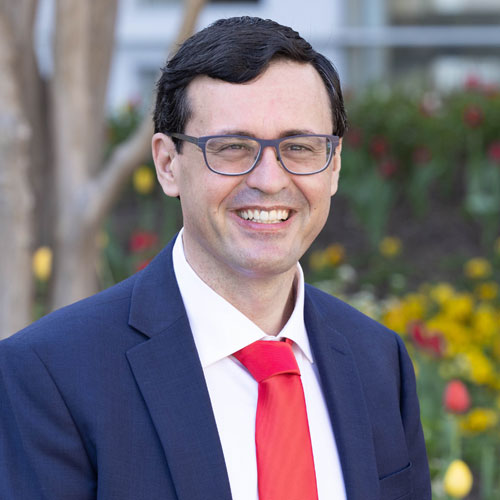
Enrique Martínez García is an assistant vice president in the Research Department and co-director of the Global Institute at the Federal Reserve Bank of Dallas.

Kei-Mu Yi is a senior vice president and co-director of the Global Institute at the Federal Reserve Bank of Dallas.