
Momentum builds in the Texas economy; wage pressures broaden
The Texas economy strengthened in the second quarter, with job growth accelerating and business activity expanding. A pickup in hiring of temporary workers is a positive signal for Texas’ labor market.
At the same time, cost pressures are elevated and wage pressures are building.
Employment growth accelerates
Texas regained job growth momentum in the second quarter, with employment increasing an annualized 2.4 percent, up from 1.5 percent in the first quarter (Chart 1).
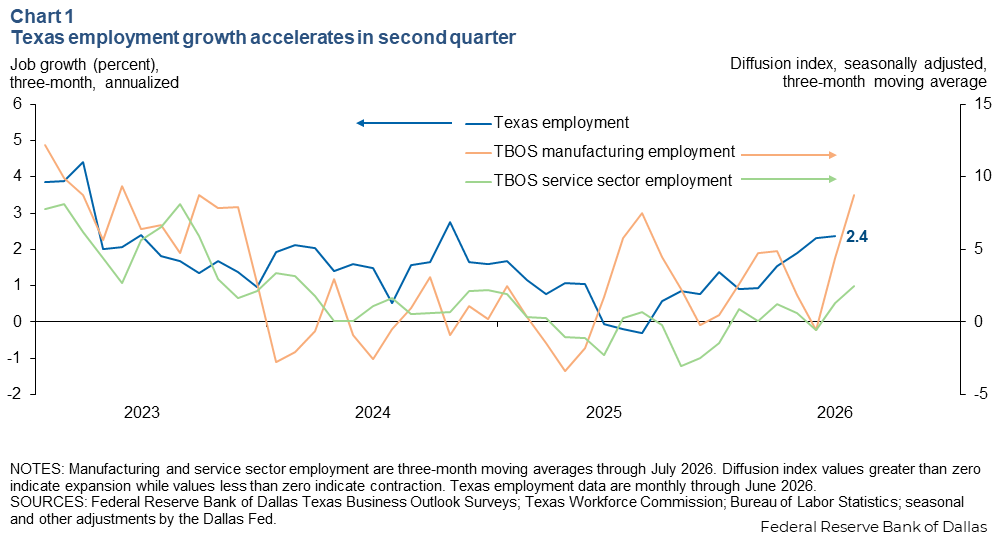
During the first half of 2026, Texas employment expanded an annualized 1.9 percent, in line with the state’s long-run 2 percent average and an improvement from 2025 increases. The state has regained its usual 1 percentage-point job growth premium over the U.S., where employment increased 0.6 percent during the same period.
The Federal Reserve Bank of Dallas Texas Business Outlook Surveys (TBOS) confirm the positive employment trend, with survey data suggesting hiring accelerated in June and July. The three-month moving average of the TBOS manufacturing sector employment index climbed to its highest level since early 2023, and the smoothed service sector employment index signaled renewed hiring momentum after weakness earlier in the year. Several survey contacts noted that persistent, solid demand prompted employment increases, particularly among firms that had delayed hiring earlier due to economic uncertainty.
The job growth pickup was broad based, with strong gains in leisure and hospitality, construction and staffing services. The data center building boom in Texas likely boosted construction hiring, while the FIFA World Cup, with matches held in Arlington and Houston in June and July, likely buoyed leisure and hospitality services job gains.
Staffing services payrolls surged an annualized 22.0 percent (32,000 jobs) in Texas in the first half of the year, outpacing the nation’s 3.8 percent increase (59,000 jobs). Staffing employment is often considered a leading indicator of economic activity due to its flexibility to quickly adapt to changes in the economy, particularly the temporary worker subcomponent.
Texas firms say they are increasingly turning to temporary hires to keep up with demand amid labor shortages rather than hedging against uncertainty. A recruiting firm noted, “[There is] real difficulty finding the right talent when a need does arise,” and another said, “The past two to three months have been very busy. Many companies…can't find the right talent on their own.”
Other businesses said that the data center building boom is leading to shortages of skilled workers such as concrete workers and electricians. Contacts also noted a high level of poaching of these in-demand trades is increasing turnover, prompting firms to repost jobs filled three to six months earlier.
A dwindling supply of immigrant labor is also boosting demand for temporary and contract workers. In response to a July 2026 TBOS special question, 14 percent of firms said changes to immigration policy over the past year affected their company’s ability to hire and retain foreign-born workers, and many of those reported increasing reliance on contract labor, subcontracting or outsourcing as a result.
The unemployment rate in Texas has remained low. It was 4.4 percent in June, slightly above the U.S. rate, which fell to 4.1 percent in July. More notably, Texas labor force growth has stalled. The labor force contracted an annualized 0.7 percent in the first half of the year, compared with 1.2 percent growth over the same period last year. If this trend continues, workforce availability will be further constrained.
Business output expands broadly; outlooks turn positive
TBOS also points to an ongoing expansion in business output in the manufacturing and service sectors. The headline manufacturing production index remains positive, indicating continued growth (Chart 2). In addition, the new orders index indicates an ongoing, moderate expansion in demand.
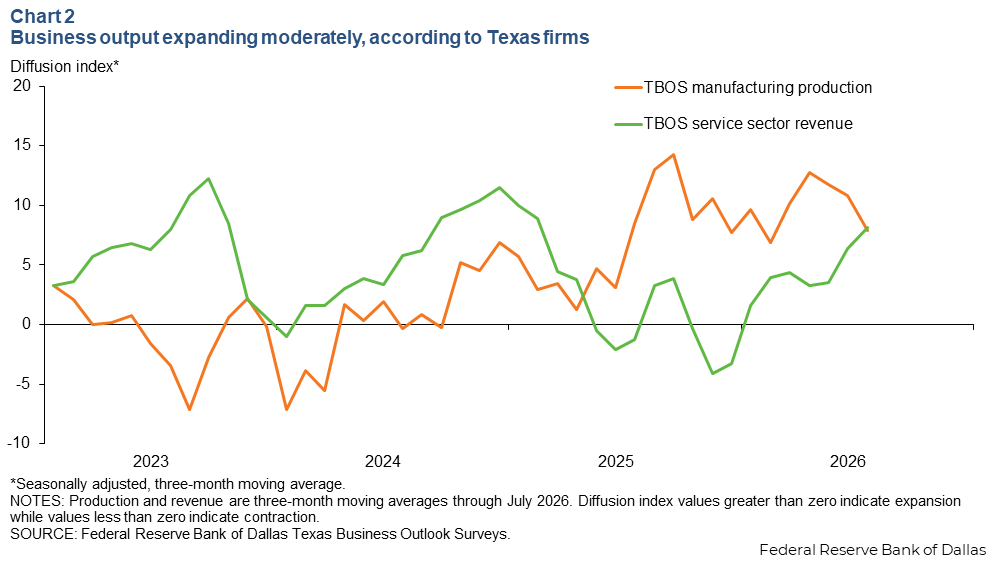
Meanwhile, the service sector revenue index rose, posting its highest readings in a year and a half. This positive momentum is particularly notable given the sector's substantial footprint in the economy and its typical role as a steady growth driver compared with the more volatile manufacturing sector.
Other regional Fed business surveys and the Institute for Supply Management’s (ISM’s) Purchasing Managers Index also indicate continued expansion in both manufacturing and services.
TBOS company outlooks grew more optimistic in July after improving in June. They were weak early in the year. Despite significant uncertainty about inflation, geopolitical developments and tariffs, Texas firms appear to be pushing ahead amid firming demand for goods and services.
Inflation worries rise, but expectations remain stable
Inflation has now become the top outlook concern among Texas businesses, with nearly half of respondents ranking it among their three biggest worries in June, up from 40 percent in March (Chart 3). This is the largest share since the question was introduced in September 2022.
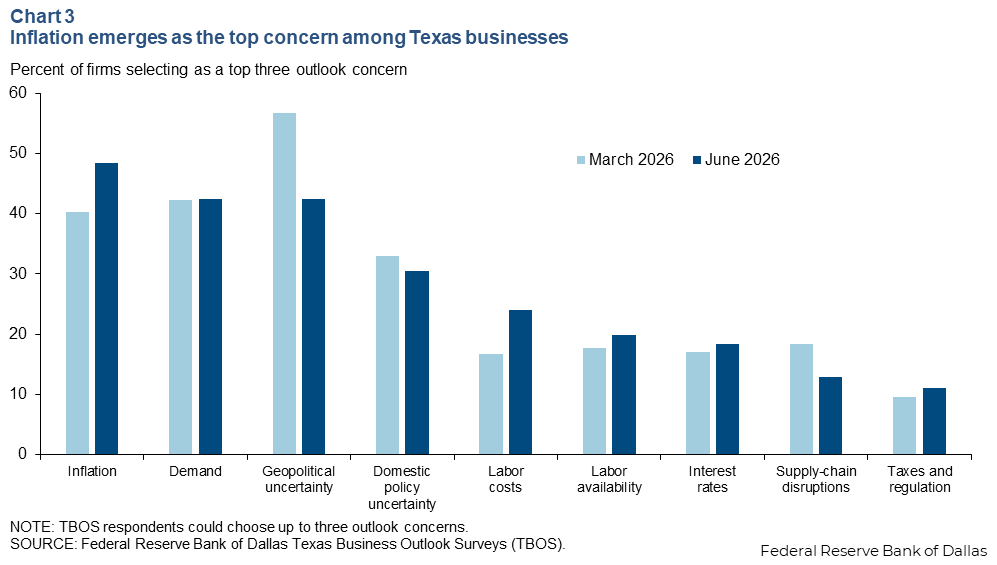
A national CFO survey conducted by the Atlanta and Richmond Feds and the survey of small businesses from the NFIB (National Federation of Independent Business) in June also show rising inflation concerns among business executives.
However, aggregate expectations among Texas business executives for input cost and selling price growth over the next 12 months have remained stable. As of June, TBOS firms expected input costs to increase 3.7 percent, on average, and selling prices to grow 2.8 percent. These are at or slightly below 12-month-ahead expectations in March.
Such relative stability is mirrored in other business surveys. Firms in the Philadelphia Fed’s second quarter Price and Inflation Expectations Survey expected selling prices to increase 2.8 percent, on average, over the next year, slightly lower than the 3.1 percent reported in the first quarter. The Richmond Fed’s surveys of manufacturing and service sector firms average expectations for selling price growth ticked up to 3.6 percent in June from 3.4 percent in March.
Taken together, these findings suggest that firms increasingly view inflation as an upside risk to monitor rather than an inevitable outcome embedded in their pricing plans. It could be that some of the driving forces behind recent inflation fears—the Iran war and tariffs—are expected to be temporary or only affect a limited number of firms.
In fact, TBOS firms that reported a negative impact from the Iran war in April reported significantly higher selling price expectations than those saying the Iran war caused no effects (Chart 4). A similar outlook arose among firms that reported a negative impact from tariffs in August 2025.
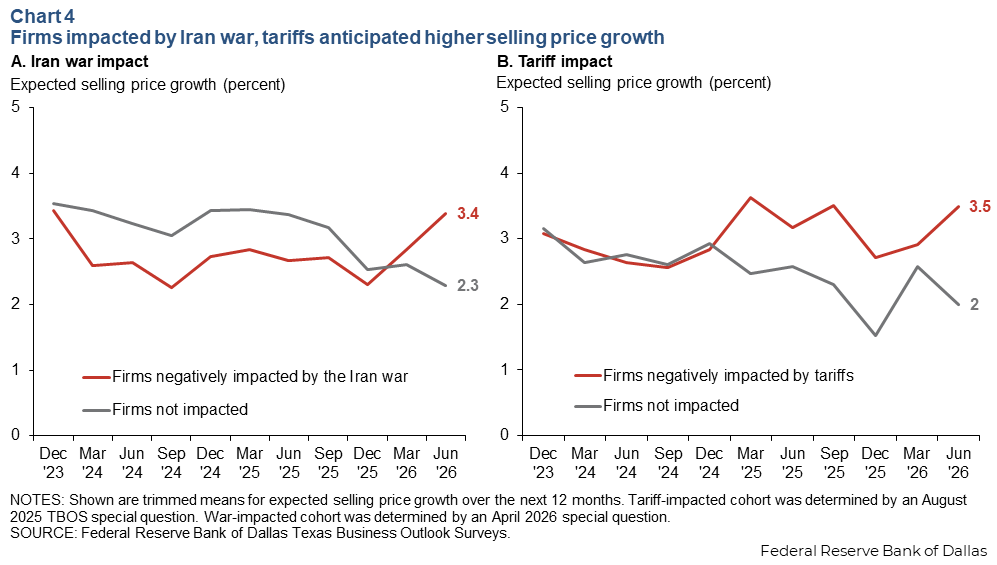
Many firms did not report impacts from tariffs or the Iran war, keeping overall expectations stable. However, unimpacted firms are not immune from higher commodity prices or trade disruptions, as higher costs can spread through supply chains. Business executives’ growing concerns reflect this risk.
Wage pressures accelerate, broaden across sectors
Mounting wage pressures, concentrated in manufacturing earlier in the year, are spreading to services. Average annual wage growth accelerated from 3.5 to 4.0 percent between March and June, according to TBOS.
Texas manufacturers continue to face the most intense pressure, reporting wage growth of 4.8 percent over the past year, the strongest pace since December 2023. Service sector wage growth reversed a downward trend and, in June, moved higher to 3.8 percent, signaling that worker demand for higher pay is no longer confined to manufacturing. Expectations for service sector wage growth over the next 12 months accelerated to 3.5 percent from 3.0 in March 2026.
Dallas Fed contacts reported a tightening labor market. More restrictive immigration policy is playing a role, though difficulty hiring and retaining workers is not limited to firms that typically depend on immigrant labor. Rather, many firms reported a shortage of skilled labor and ongoing competition for workers, particularly for roles related to data center construction. Additionally, contacts said employees demanded higher pay to offset higher fuel costs and general inflationary pressures.
A heavy industrial construction contractor said, “We have been paying what I believe to be a very competitive wage for skilled concrete workers, $28–32 per hour. The data centers are offering $45 per hour and a $150 per diem for concrete workers.” A specialty coffee company said, “We are really beginning to see resistance to current wage levels in the café environment, from entry level baristas to café managers. We are also having a very difficult time hiring equipment technicians.”
Looking ahead: Growth solid, but risks remain
The Texas economy has gathered momentum this year despite elevated uncertainty. Employment growth has accelerated notably, prompting an upward revision of the 2026 Texas job growth forecast to 2.0 percent, up from 1.1 percent at the beginning of the year. Improving company outlooks among Dallas Fed survey contacts reinforce this positive trajectory, signaling continued expansion in business activity across key sectors.
Yet, the strength of the labor market recovery is creating new pressures. As hiring accelerates, it's colliding with tight labor supply, pushing wages higher and broadening pay demands. Meanwhile, inflation is a growing risk amid geopolitical disruptions tied to the Iran war and uncertainty surrounding tariffs.
Key indicators to monitor include whether robust growth among staffing services translates into permanent hiring, whether shortages for skilled workers persist, keeping wage pressures elevated, and how trade policy developments affect business investment decisions in coming months.
About the authors

Laila Assanie is a senior business economist in the Research Department of the Federal Reserve Bank of Dallas.

Robert Leigh is a research analyst in the Research Department at the Federal Reserve Bank of Dallas.