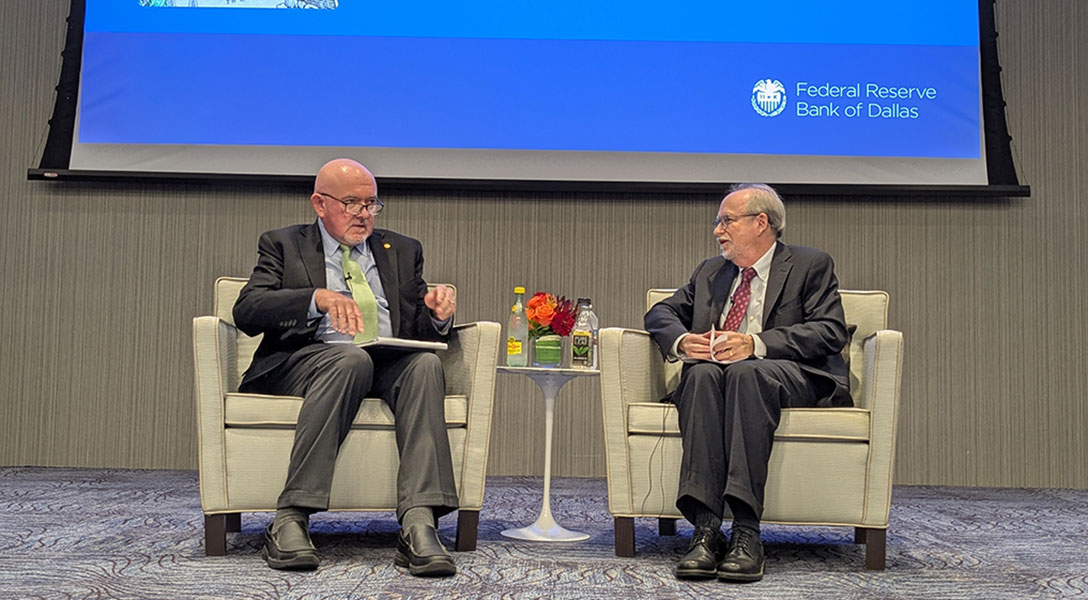
Global Institute presentation: Steve Kamin on the dollar’s status
The Global Institute at the Federal Reserve Bank of Dallas hosted Steve Kamin, senior fellow at the American Enterprise Institute and a former director of the Division of International Finance at the Federal Reserve Board.
During a presentation and discussion last month, Kamin discussed how tariffs, volatility and evolving payment technologies are challenging—but not yet dislodging—the dollar’s position as a reserve currency at the center of the global financial system.
Enrique Martínez García, assistant vice president and deputy director of the Global Institute, delivered introductory remarks. Mark Wynne, vice president, associate director of Research and director emeritus of the Global Institute, moderated. The following are excerpts of Kamin’s remarks, edited in narrative form for clarity and presented by topic.
The dollar as a dominant currency
The core functions of any currency are as a medium of exchange, a unit of account and a store of value. “The dollar performs those functions domestically, but the focus of my talk today is how the dollar performs those functions internationally,” Kamin said. The international role brings enormous efficiencies to the global economy, and Kamin highlighted three:
- Unit of account. Nearly all major commodities— including oil, copper, wheat and many industrial metals—are priced in dollars. “This makes it easier to compare prices across countries, increases transparency and reduces financial risks.”
- Medium of exchange. The dollar accounts for the majority of export invoicing in the Asia-Pacific, the Americas and much of the developing world. “A Colombian exporter might not want Korean won, and a Korean exporter does not want Colombian pesos. But both will accept U.S. dollars.”
- Store of value. The dollar also remains the world’s primary reserve asset. Roughly 57 percent of global foreign exchange reserves are held in U.S. dollars, far surpassing the euro (20 percent) and the Chinese renminbi (less than 3 percent).
The dollar’s dominance is also visible in financial markets. Though the U.S. accounts for about 10 percent of global trade and 25 percent of global GDP, the dollar accounts for well over half of global financial transactions. These include cross-border bank loans, bond issuance, foreign exchange turnover, SWIFT network interbank transactions and international invoicing.

“There are also powerful network effects supporting the dollar’s role,” Kamin said. “People use the dollar because everyone else uses the dollar.” Such effects help explain why dominant currencies persist long after the economic share of their home countries declines—a historical pattern observed, for example during the long twilight of the British pound sterling.
What makes money essential and why trust matters
From gold coins to paper money to algorithmic tokens, the value of money has never rested on its physical attributes. Rather, it lies in what money does: It solves the “double coincidence of wants,” enabling exchange, specialization and ultimately economic prosperity.
Non-stable cryptocurrencies, such as bitcoin “pose no real challenge to the dollar,” given their extreme price volatility. Stablecoins are more interesting. Because they are backed by safe U.S. assets, “stablecoin purchases could in principle support global demand for U.S. Treasuries,” Kamin said. However, the quantitative impact is difficult to assess. Moreover, if trust in Treasuries were to decline, so, too, would demand for stablecoins backed by Treasuries.
Central bank digital currency, which shares a central bank’s backing much like physical currency, poses no meaningful challenge to the dollar’s international role—not because of its design, but because payment technology is not what makes a currency dominant. “The key feature of a global currency is its safety and liquidity, not its payment technology,” Kamin said, and central bank digital currencies do not alter those fundamentals in countries seeking to rival the U.S.
Benefits, limits of dollar dominance
The dollar’s dominance brings benefits to the U.S., though these advantages are often overstated.
- Seigniorage and borrowing costs. Foreigners hold about $1 trillion in U.S. currency, which pays no interest. This benefits the U.S., though the savings to the U.S. Treasury “are much less than 1 percent of GDP—good, but not huge.” A bigger potential benefit is lower borrowing costs. Global demand for Treasuries may reduce U.S. interest rates somewhat, though precise estimates are hard to pin down.
- Geopolitical leverage. Because international financial transactions in dollars must clear U.S. or U.S.-supervised institutions, the U.S. government can enforce financial sanctions against foreign actors. “This gives us tools of pressure that fall short of more aggressive military options,” Kamin said. It also reinforces the importance of maintaining global trust in U.S. financial governance and rule of law. It also underscores why trust in U.S. institutions—not technology—remains the ultimate foundation of dollar dominance.
Three future dollar outcomes
Kamin outlined three scenarios for the dollar’s future.
- The good scenario: gradual diversification. Global investors diversify portfolios, and new financial technologies make cross-border payments in other currencies easier. Dollar use declines slowly, but within a context of healthy global growth. “This scenario is benign for the U.S. and the world,” Kamin said.
- The bad scenario: geopolitical fragmentation. Rising tensions—particularly between the U.S. and China—threaten to split the world into competing economic blocs. Countries with close economic ties to China might shift reserves away from the dollar to avoid sanctions or political risk. “This is a less desirable scenario, not because the dollar declines, but because global efficiency and productivity decline.”
- The ugly scenario: U.S. policy missteps. In the most concerning scenario, chronic fiscal deficits, rising debt, policy unpredictability or weakened rule of law erode trust in the safety and liquidity of U.S. assets. “If this were to happen, the loss of dollar dominance would be the least of our worries.”
A real-time stress test: Liberation Day
“Liberation Day,” what the administration called its announcement on April 2, 2025, of unexpectedly large and sweeping tariffs across major trading partners, provided useful insights. The immediate effects of the announcement were unusual: U.S. equity markets plunged, the VIX volatility index spiked and the dollar fell instead of strengthening, a break from its usual safe-haven characteristic.
Kamin estimated a simple model linking the dollar to interest-rate differentials and market volatility to evaluate changes in investor attitude toward the dollar. The dollar behaved abnormally for several months after the announcement, falling instead of rising in response to increased market volatility, temporarily resembling an emerging-market currency.
“It seemed that investors were so shocked by the actions that they abandoned the dollar as a safe haven,” Kamin said.
As markets stabilized, the dollar eventually reassumed its normal behavior, suggesting the dollar’s safe-haven role had been temporarily shaken but not permanently altered. The episode underscored that the world’s trust in the dollar cannot be taken for granted.
Technological change, geopolitics and the dollar’s future
Kamin said reshoring may be justified in strategic sectors, such as advanced semiconductors or defense industries. However, the labor market benefits of more widespread reshoring will be limited, as productivity gains from technological advances will constrain the growth of manufacturing employment.
Despite China’s global economic rise, the renminbi faces major obstacles to truly rivaling the dollar: capital controls, weak investor protections and government unpredictability. “You cannot liquidate assets freely or trust the rule of law in the same way as in the United States,” Kamin said.
Whether through stablecoins or other digital innovations, technological change may reinforce the dollar’s role if it increases global demand for safe U.S. assets. However, such change could disrupt traditional banking and monetary transmission if it moves the system toward narrow banking structures and financial disintermediation.
The dollar’s past and its future
Despite previous challenges, the dollar remains deeply entrenched in global finance. Strong network effects, deep U.S. financial markets and robust institutions support its standing.
Kamin said the dollar’s future hinges on policy choices today. Fiscal sustainability, regulatory predictability, rule of law and continued openness to global markets all matter.
“The dollar’s supremacy is rooted in the high quality of U.S. policies,” Kamin said. “If the policies turn for the worse, that will tend to undermine the dollar’s dominance.”
About the authors
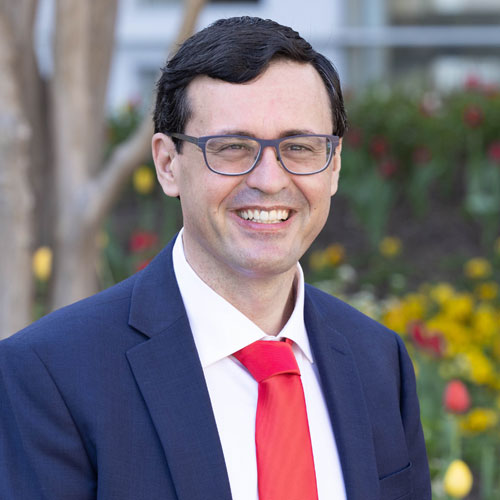
Enrique Martínez García is an assistant vice president in the Research Department and co-director of the Global Institute at the Federal Reserve Bank of Dallas.

Mark A. Wynne is a vice president and associate director of research in the Research Department at the Federal Reserve Bank of Dallas.

