Manufacturing momentum paces Texas economic growth
Texas’ economic growth was steady in the third quarter despite few job gains. Robust manufacturing expansion offset slower service sector growth.
Price and wage pressures rose, particularly in manufacturing, and Texas firms expect further price increases.
Solid expansion is anticipated through year-end, but job growth will likely remain well below the state's typical 2 percent annual pace. Data center development and the oil and gas sector should boost growth, while labor supply constraints will continue weighing on hiring.
Job growth slows in third quarter amid few labor gains
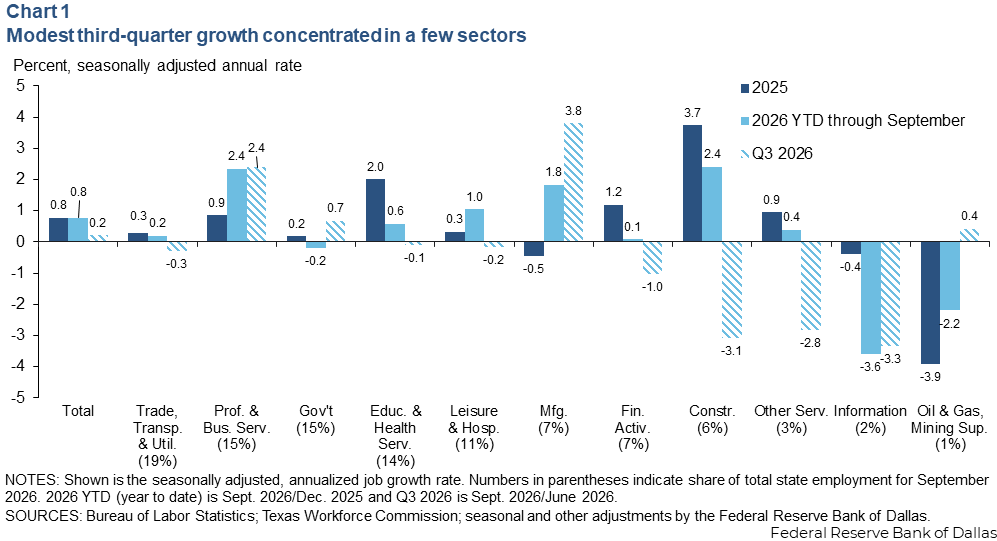
Texas employment grew at an annualized 0.2 percent rate in the third quarter, down from 2 percent in the second quarter. Manufacturing and professional and business services drove growth in the most recent period (Chart 1). Most other sectors were either unchanged or contracted. Year-to-date employment growth stood at 0.8 percent through September, similar to last year.
Job growth in 2026 has outpaced labor force expansion, according to the Bureau of Labor Statistics. More restrictive immigration policy partly underlies the diminished labor force growth. The Texas labor force grew about 1 percent in 2025, compared with 2.5 percent or higher in 2021–24. Employment growth outstripping labor supply can stymie hiring and lead to upward wage pressure.
Although the Texas labor supply hasn’t increased this year, labor market indicators suggest continuing demand for workers. Job posting measures from several sources—Indeed, Lightcast and Revelio Labs—have held steady throughout 2026. The unemployment rate remained at 4.4 percent in September.
The broadest measure of Texas unemployment (U-6), which includes those marginally attached to the workforce and working part-time for economic reasons, is below where it began in 2026 on a seasonally adjusted basis. The four-week moving averages of initial and continuing claims for unemployment benefits rose in October but remain at low levels.
Taken together, these indicators suggest solid Texas labor demand, with the slowdown in Texas job growth driven primarily by constrained labor supply rather than collapsing labor demand.
State manufacturing activity booms
The manufacturing sector has been a bright spot, with job growth reaching 3.8 percent in the third quarter. The Texas Manufacturing Outlook Survey (TMOS) production index pointed to expanding output through October (Chart 2). The latest index reached highs last experienced in 2021.
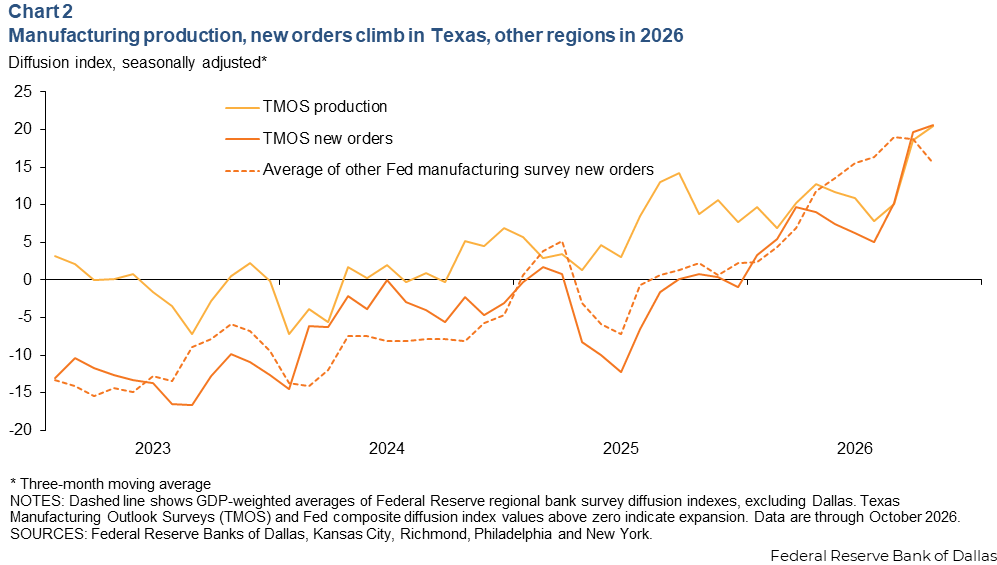
Texas manufacturers also reported increased new orders, a forward-looking indicator of demand. Surveys at other Federal Reserve regional banks have similarly noted new order gains.
The acceleration reflects artificial intelligence/data center and oil and gas industry activity. It largely consists of durable goods manufacturing, particularly fabricated metals and machinery. Durables are typically long-lasting products designed to be used repeatedly over an extended period such as electronics, vehicles and machinery.
A TMOS respondent said, “Data centers have consumed much of the available stock [of steel]” and “oil companies are spending more money at a much higher rate than expected.” Texas leads the nation in data center construction activity in 2026 in terms of contract values and square footage, according to the Dodge Construction Network.
Broader U.S. manufacturing strength reflects demand for defense and data center-related orders, according to recent Beige Book reports.
Wage increase led by manufacturing sector
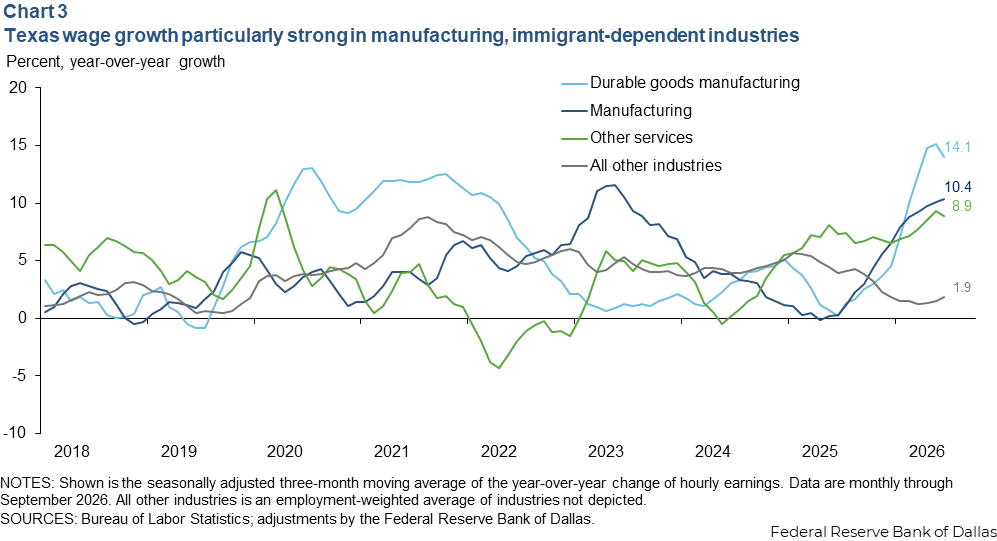
Manufacturing is leading statewide wage growth, as companies seek to expand operations in the tight labor market. Manufacturing wages increased 10.4 percent year over year in September. Statewide, the wage rise follows slower growth in 2025 and early 2026.
Durable goods manufacturing drove much of the recent increase as hourly earnings rose 14.1 percent from a year earlier (Chart 3).
A TMOS respondent said: “We’ve increased the top people’s wages to keep them competitive with other companies, so we don’t lose our key personnel.”
Immigration policy changes added to Texas wage pressures, particularly notable in the "other services" sector, which covers industries that have historically relied heavily on immigrant labor, such as repair and maintenance, personal and laundry services, and private household services. Roughly a quarter of the sector’s workforce is foreign born.
More restrictive federal immigration policies and increased enforcement have reduced the sector’s labor supply, pushing up hourly wages 8.9 percent year over year in September. Competition from data center development also contributed to wage pressures.
Firms expect higher prices
Texas firms’ input costs rose faster in the third quarter than in the second, and business executives expect further acceleration in 2027. In September, firms’ expectations for 12-month-ahead input cost growth moved up markedly, according to respondents to TMOS and to the Texas Service Sector Outlook Survey (TSSOS) (Chart 4). Firms frequently cited concern about fuel prices and difficulty passing along those costs to customers.
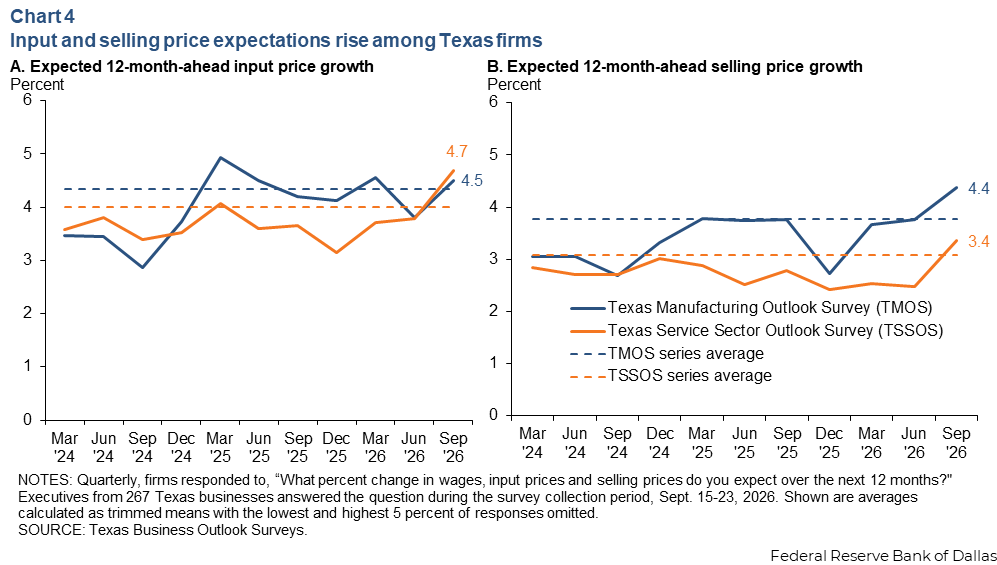
Growth in firms’ selling prices—what customers pay for goods and services—has been more stable in recent months but may rise. Among both manufacturers and services firms surveyed, selling price growth expectations stepped up in September and are now well above average levels.
Inflation was the top concern for the upcoming six months among manufacturing and services outlook survey respondents in September. Inflation was cited by half of them, the largest share since the question was first asked in September 2022. Geopolitical uncertainty was the second-greatest concern.
Higher cost of credit restrains capital expenditures
More than one-third of business executives responding to the October TBOS special questions said their cost of credit had increased over the past year. The share rose to 65 percent among firms actually accessing credit.
Among Texas firms reporting higher credit costs, more than half increased their reliance on internal funds, and 40 percent reduced capital expenditures. Just over a quarter pulled back on hiring or raised prices for their products or services, with nearly a third planning to raise prices in the future.
A beverage and tobacco product manufacturing respondent said the firm deferred acquiring real estate for an additional location because of elevated borrowing costs.
Economic expansion through year-end
Job growth slowed in the third quarter, though momentum continues to build in the manufacturing sector, a leader in overall economic activity. Texas business outlooks improved in October with continued data center-led growth expected.
Inflation remains a top concern for Texas businesses along with geopolitical uncertainty. Pockets of strength in the Texas economy, such as durable goods manufacturing, will likely continue to face wage pressures due to tight labor supply.
The Dallas Fed Texas Employment Forecast projects that employment growth in the fourth quarter will pick up slightly from the third quarter to 0.9 percent for 2026. Thus, the state is poised to undershoot its long-run average of 2 percent annual job growth for a second year in a row, constrained largely by sluggish labor force growth.
About the authors

Luis Torres is a senior business economist in the San Antonio Branch of the Federal Reserve Bank of Dallas.

Jackie Balanovsky is a research analyst in the Research Department at the Federal Reserve Bank of Dallas.