
AI is simultaneously aiding and replacing workers, wage data suggest
Artificial intelligence’s impact on the labor market will depend on whether the technology automates or augments worker tasks. Early data on employment and wages in AI-affected industries suggest it may be doing both.
The distinction between codified knowledge (for example, established information gleaned from textbooks) and tacit knowledge (understanding gained through experience) is important. If AI can replicate codified knowledge but not tacit knowledge, AI will automate jobs requiring codifiable (textbook) knowledge but complement jobs demanding experiential tacit knowledge.
The distinction between codifiable and tacit knowledge further suggests that AI may substitute for entry-level workers but augment the efforts of experienced workers. The data indicate that wages are rising in AI-exposed occupations that place a high value on a worker’s tacit knowledge and experience.
Employment in AI-exposed sectors lags
Total U.S. employment increased approximately 2.5 percent since ChatGPT's release in fall 2022. However, employment trends vary significantly across sectors. Employment in the computer systems design and related services sector has declined 5 percent. More broadly, employment has declined 1 percent since late 2022 in the 10 percent of sectors most exposed to AI, according to an index developed by Edward W. Felten, Manav Raj and Robert Seamans (“Occupational, industry, and geographic exposure to artificial intelligence: A novel dataset and its potential uses,” 2021) (Chart 1).
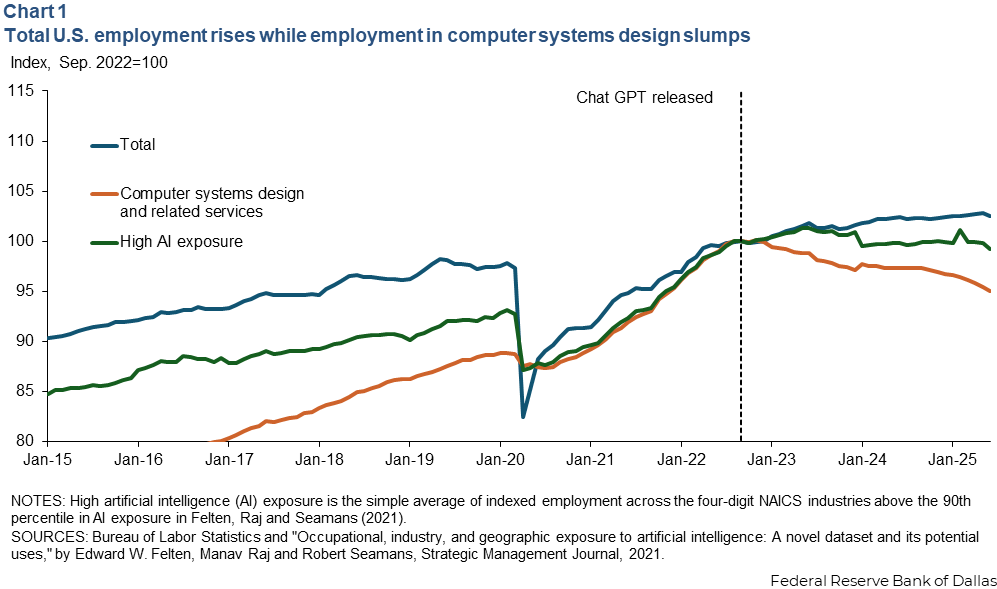
This employment decline in AI-exposed industries is falling disproportionately on young employees. Stanford University researchers Erik Brynjolfsson, Bharat Chandar and Ruya Chen show that the recent decline in employment in AI-exposed sectors is particularly pronounced for those under age 25. Employment totals for older workers have not declined.
In a recent article, Federal Reserve Bank of Dallas economist Tyler Atkinson argues that this fall in employment for those under 25 is not due to layoffs but to a low job finding rate for young workers entering the labor force. Basically, the job market is getting very tough for new graduates in AI-exposed fields.
Wages in AI-exposed sectors are not falling
Although employment in computer systems design and other AI-exposed sectors trails the rest of the economy, wage growth in these sectors outpaces national averages. Since fall 2022, nominal average weekly wages nationwide have increased 7.5 percent, while the computer systems design sector has risen 16.7 percent. Among the top 10 percent of AI-exposed industries, wages grew 8.5 percent (Chart 2).
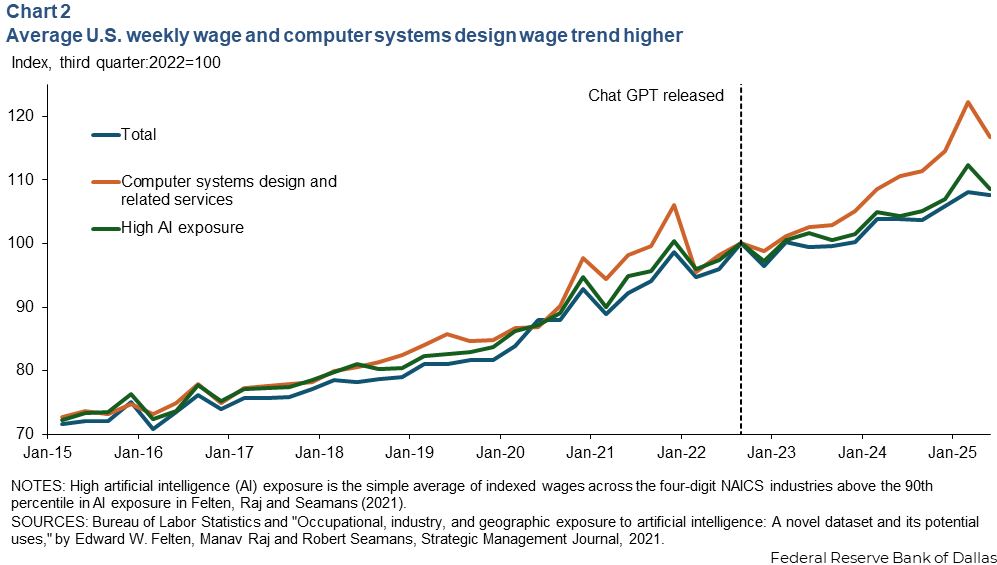
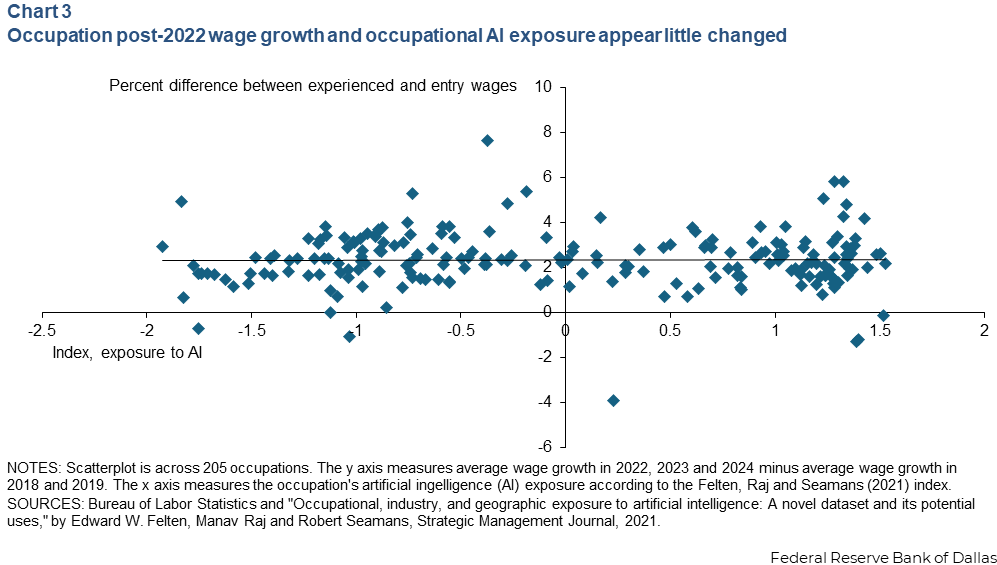
Chart 3 plots annualized trend wage growth since fall 2022 against AI exposure for 205 occupations. The trend line through this scatterplot is nearly perfectly horizontal, showing there is no relationship between an occupation’s AI exposure and post-2022 wage growth.
How to explain these employment and wage trends?
How can we explain decreasing employment alongside unchanged wages in AI-exposed sectors? If AI were simply automating jobs, we would expect both wages and employment to decline.
As in any technological innovation, AI can either augment labor or automate it. Augmentation innovations complement worker expertise, while automation innovations substitute for workers. Economist David Autor and coauthors use natural language processing (a subfield of computational science combining AI and linguistics) to connect U.S. patent applications to occupation descriptions. The authors demonstrate that patents for augmenting products increase labor demand while automating patents reduce it.
Autor and Neil Thompson model jobs as bundles of tasks. The same technological innovation might automate the expert components of one job's task bundle, rendering worker skills obsolete, while automating the routine components of another job, thereby enhancing the value of worker expertise by allowing workers to spend time on higher value-added tasks.
When speculating why AI-induced employment changes are falling principally on young workers, Brynjolfsson and his coauthors suggest AI may automate codified knowledge (book learning) but not the tacit knowledge coming from experience.
For entry-level employees, tasks requiring codified knowledge represent the expert part of their jobs. However, for experienced employees these same tasks constitute the inexpert aspect of their work. In this way AI can substitute for entry-level workers—new graduates with book-learning but no experience—and at the same time complement experienced workers, who have tacit knowledge that cannot be replicated by AI.
Deriving the returns to experience and AI exposure
To assess whether a job primarily requires codifiable knowledge or tacit knowledge gained through experience, I examine the Bureau of Labor Statistics modeled wage estimates, which provide entry and experienced worker wage estimates for over 200 occupations. For each occupation, I calculate the experience premium, the percentage difference between experienced and entry-level wages.
Chart 4 plots occupation experience premiums against their AI exposure for the same 205 occupations. The experience premium positively correlates with AI exposure, indicating that occupations most exposed to AI typically have higher experience premiums, though considerable variation exists.
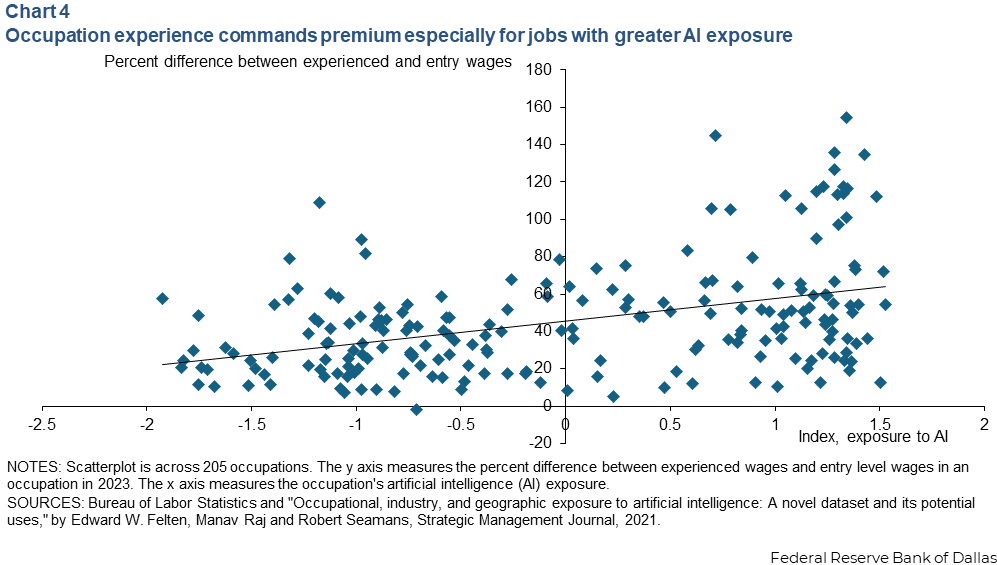
The median experience premium is 40 percent, ranging from less than 10 percent for occupations such as fast-food cooks, ticket agents and dry cleaners to more than 100 percent for professions such as lawyers, insurance underwriters, credit analysts and marketing specialists.
Previously, Chart 3 indicated no relationship between an occupation’s AI exposure and post-2022 wage growth. Now, with the estimate of the experience premium in each occupation, we can modify that estimation. In a regression of post-2022 wage growth on AI exposure, I add the interaction between the occupation’s experience premium and AI exposure. This allows the estimated effect of AI exposure on wage growth to be a function of the experience premium.
Chart 5 presents the estimated effect of a one-standard-deviation increase in an occupation’s AI exposure on an occupation’s post-2022 wage growth. On average across the 205 occupations, wage growth was about 2.2 percentage points higher post-2022 than the prepandemic trend.
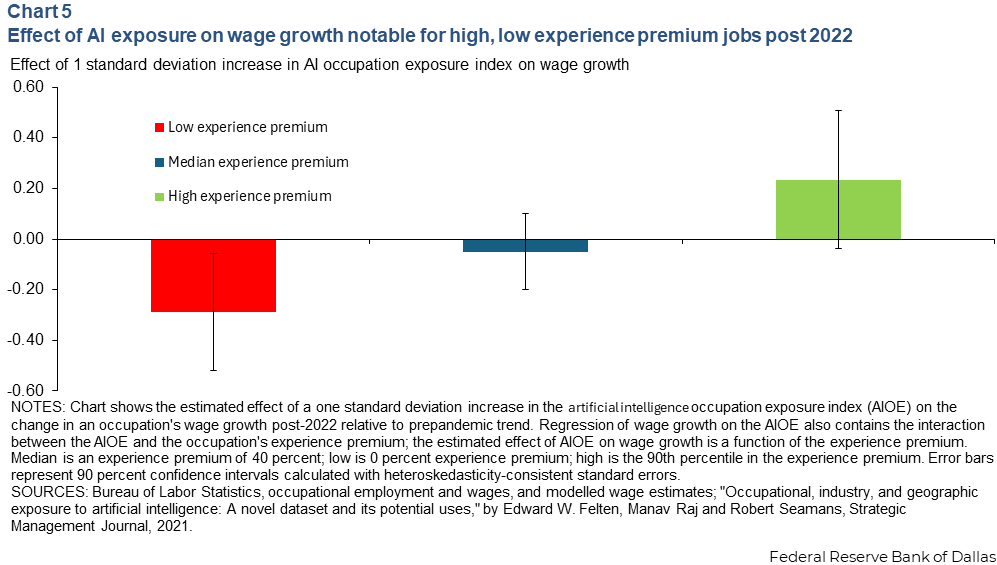
For occupations with the median experience premium (40 percent), a one-standard-deviation increase in AI exposure is associated with a 0.05 percentage point decline in wage growth. The 90 percent confidence interval for this estimate clearly includes zero, indicating that for an occupation with the median experience premium, AI exposure doesn’t much affect wage growth.
However, for an occupation with a 0 percent experience premium, increased AI exposure is associated with a 0.28 percentage point reduction in wage growth. The confidence interval for this estimate is clearly negative. For occupations with a very low experience premium, AI exposure has a more negative effect on wage growth since AI substitutes for both entry and experienced workers. The low experience premium suggests there is not much tacit knowledge required for the occupation, so experienced workers are easily substituted by AI.
Conversely, for occupations in the 90th percentile of the experience premium distribution, increased AI exposure is associated with a 0.2 percentage point increase in wage growth. For these occupations, AI exposure has less of a negative effect, and likely even a positive effect on wages, as AI substitutes for entry level workers but complements experienced workers.
Young jobseekers may face tough going
Returns on job experience are increasing in AI-exposed occupations. Young workers with primarily codifiable knowledge and limited experience will likely face challenging job markets.
However, there appears to be less cause for concern about widespread job displacement for older, experienced workers, particularly those in occupations with high experience premiums in which AI is likely to complement the worker’s tacit knowledge.
The fact that AI can both substitute for entry level workers and complement experienced workers has implications for society and the way we organize work.
The current model of white-collar career progression involves taking an entry level job right out of school and doing codifiable tasks while slowly learning the tacit knowledge to become an experienced worker. Firms are going to find that AI is making this method of employee development cost-ineffective, at least in the short run.
Of course, leaving new employees off the job ladder is not sustainable in the long run. In the long run, AI adoption will require rethinking how entry-level employees gain experience on the job.
About the authors

Scott Davis is an assistant vice president in the Research Department of the Federal Reserve Bank of Dallas.