Amarillo: Services take root in panhandle’s ranching, transportation center
At a glance
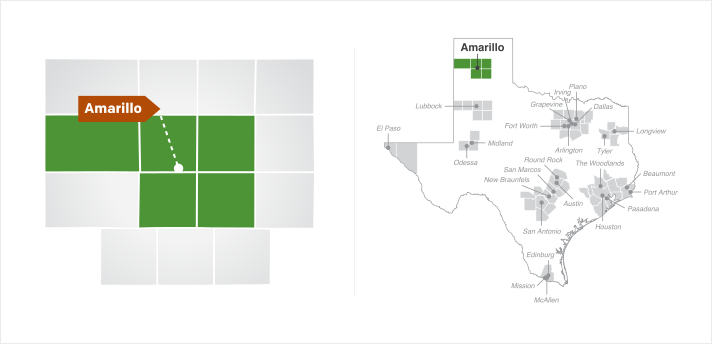
Population (2023): |
273,100 |
Population growth (2016–23): |
3.6 percent (Texas: 9.5 percent) |
Median household income (2023): |
$66,571 (Texas: $76,292) |
National MSA rank: |
No. 184* |
| *The Amarillo metropolitan statistical area (MSA) encompasses Armstrong, Carson, Oldham, Potter and Randall counties. | |
- Amarillo initially flourished as a cattle-market hub, connecting ranches in the Panhandle to major urban markets by railroad. Large industrial plants, built after World War I to produce helium and weapons for the military, transformed the area, as did the discovery of oil and gas.
- Services have become the cornerstone of the economy while many manufacturing plants still thrive, contributing to relatively low poverty and unemployment rates.
- The median household income and educational attainment trail the Texas average. The population is less diverse than that of the state. Tight labor markets, outmigration of younger workers and low population growth limit near-term growth prospects.
History: From ranching and trade hub to industrial complex
Amarillo has its origins in 1887 with the arrival of rail freight service, helping create a cattle-market center in the Texas Panhandle, serving area ranches and those in the South Plains and eastern New Mexico. Additional rail service after the turn of the century strengthened Amarillo’s role in cattle shipping, and the city’s standing as a transportation hub rose during the 1930s with the convergence of four U.S. highways, including the famous Route 66.[1]
The community was originally named Oneida and later renamed Amarillo after the nearby lake and creek, which likely derived their names from the yellow soil along their banks or the yellow wildflowers plentiful during the spring and summer.
The area gained an industrial base with the discovery of natural gas in 1918 and oil three years later. Oil refineries and shipping facilities followed. Most significantly, the Cliffside Gas Field discovery in 1928 included helium-rich deposits, leading to the federal government’s establishment of the U.S. Bureau of Mines’ Amarillo Helium Plant. In 1942, the Pantex Ordinance Plant was opened for the production of bombs and ammunition. It subsequently became the nation’s premier nuclear weapons facility, today housing most of the national plutonium repository, encompassing 18,000 acres and 650 buildings.[2]
Industry clusters: Varied mix drives growth
Location quotients (LQs), which compare the relative concentration of various industry clusters locally and nationally, are a convenient way of assessing key drivers in a regional economy. An LQ exceeding 1 indicates that a specific industry cluster carries more relative weight locally than nationally. Industry cluster growth is measured by the percentage-point change in the cluster’s share of local employment from 2016 through 2023 (Chart 10.1).
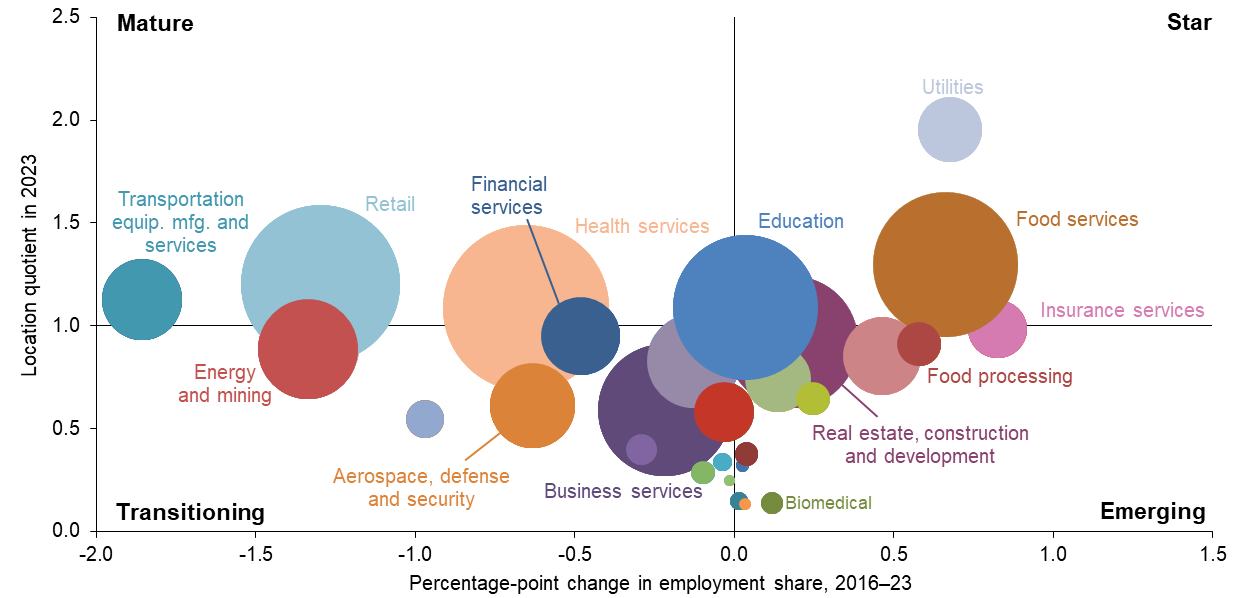
NOTES: Bubble size represents cluster share of metropolitan statistical area employment. Clusters with employment shares less than 0.1 percent are not displayed.
SOURCES: Texas Workforce Commission; Bureau of Labor Statistics.
Clusters in the top half of Chart 10.1 are generally vital to the area’s economy and can be expanding rapidly relative to other clusters (“star”) or losing ground to other clusters (“mature”). Those in the bottom half are less dominant locally than nationally and have an LQ less than 1.
Manufacturing has dominated Amarillo employment, led by transportation, defense-related and food processing industries. In recent years, the service sector has gained prominence. The retail, health, education, utilities and food services industry clusters have LQs exceeding 1, indicating their outsized local contribution. Food services and utilities are in the “star” category, with growing shares of the metro’s employment. Education employment expanded with the addition of the Texas Tech School of Veterinary Medicine in 2021, and the university’s Health Sciences Center is a top employer in the region.
Other major employers include the Amarillo Independent School District, the city of Amarillo, and health care providers such as the BSA Health System (which opened the Harrington Cancer Center in 2021) and the Northwest Texas Healthcare System.[3]
The utilities cluster employs 2.0 percent of metro workers, and its high LQ and above-average growth indicate its significance (Chart 10.2).[4] Amarillo-based Southwestern Public Service, a large regional electric utility company with more than 1,400 employees, is a subsidiary of Xcel Energy Inc. of Minneapolis, Minnesota. The region is also home to several wind farms that provide power across the state, including Panhandle Wind in Carson County and the Wildorado Wind Ranch, 25 miles west of Amarillo. The food processing cluster, employing 0.9 percent of area workers, was the fastest-growing cluster from 2016 through 2023, nearly tripling its employment over the period.
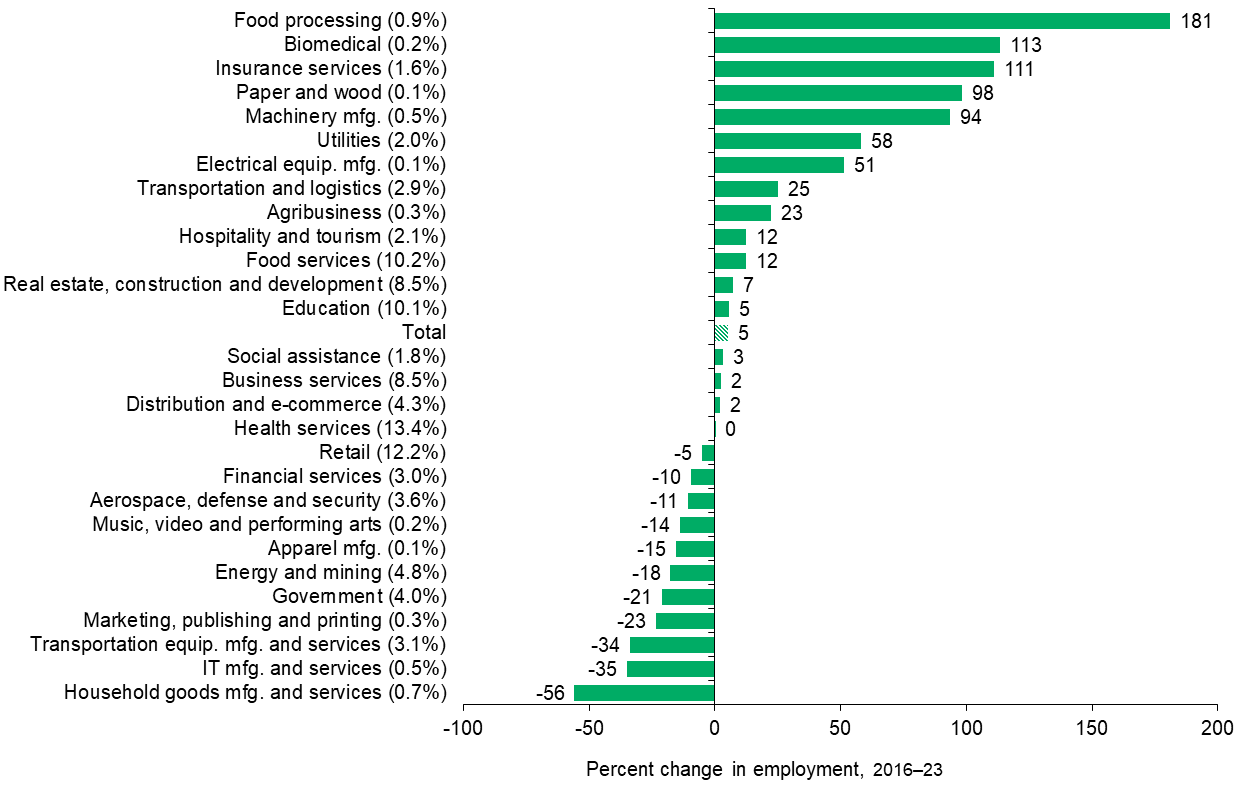
NOTES: Percent change in employment is shown in whole numbers. Each cluster's share of total jobs is shown in parentheses (rounded to one decimal place).
SOURCES: Texas Workforce Commission; authors' calculations.
The metro’s production plants are among the largest private sector employers. The area is home to CNS Pantex, the nation’s primary facility for the final assembly, dismantling and maintenance of nuclear weapons, which is managed and operated privately but overseen by the Department of Energy and National Nuclear Security Administration. It employed 4,600 people in 2025.[5] The plant is partly powered by Pantex Renewable Energy Project (PREP) Wind Farm—the largest in the U.S.[6] Additionally, Bell Helicopter’s production plant employs 900 workers. Amarillo’s Tyson Foods beef plant is one of the largest in the country, with 4,000 employees, and construction is underway on a $670 million plant operated by Producer Owned Beef.[7]
Average annual real (inflation-adjusted) earnings in Amarillo grew only 3.9 percent from 2016 through 2023 (Table 10.1); this was below the state’s 4.6 percent wage growth rate. The metro’s wages are well below the U.S. average in every industry cluster, and overall wages are 20 percent lower in Amarillo than in the U.S. Lower average wages in Amarillo partly reflect the low cost of living and lower educational attainment; adjusting wages for lower housing costs in particular would significantly reduce the wage gap vis-à-vis state and national wages. Adjusting also for education levels shows Amarillo jobs pay relatively well on average, reflecting high-paying manufacturing jobs for mid-skill workers.
| Cluster | Amarillo | U.S. | |||
| 2016 | 2019 | 2021 | 2023 | 2023 | |
| Utilities | 92,931 | 84,334 | 76,871 | 78,570 | 106,251 |
| Food services | 19,472 | 20,163 | 21,123 | 21,128 | 25,821 |
| Retail | 34,384 | 35,425 | 37,279 | 35,756 | 39,817 |
| Transportation equipment manufacturing and services | 47,817 | 49,955 | 52,736 | 62,225 | 66,929 |
| Education | 49,042 | 48,343 | 48,389 | 45,896 | 66,490 |
| Health services | 60,150 | 61,705 | 63,400 | 64,272 | 69,397 |
| Clusters with location quotient > 1 | 55,304 | 54,047 | 52,523 | 51,308 | - |
| Clusters with location quotient <= 1 | 54,556 | 57,594 | 57,924 | 58,853 | - |
| Average earnings (total) | 53,804 | 55,584 | 56,390 | 55,891 | 70,033 |
| NOTES: Clusters are listed in order of location quotient (LQ); clusters shown are those with LQs greater than 1 in 2023. Earnings are in 2023 dollars. SOURCES: Texas Workforce Commission; Bureau of Labor Statistics; authors' calculations. |
|||||
Demographics: High income relative to education
At $66,571, Amarillo’s median household income was 12.7 percent below the state median of $76,292 in 2023, as rural and small-town wages are lower than their urban counterparts. About 11.7 percent of the local population lived below the poverty line in 2023.
Amarillo had the second-lowest unemployment rate of Texas metros in 2024, behind only Midland. Its persistently low unemployment rate is a sign that employers are operating in a tight labor market and are often unable to find the workers they need.
More than 50 percent of the population is non-Hispanic white; 31.0 percent of the population is Hispanic or Latino. The population rose in 2023, though its growth has traditionally trailed Texas and the nation overall.
Amarillo’s postsecondary educational attainment among those ages 25 and older lags the state, with 26.5 percent possessing a bachelor’s degree or higher, compared with 34.2 percent statewide.
Looking ahead, defense and security manufacturing, wind energy and cattle production will remain mainstays of Amarillo’s economy. However, the struggle to find and retain workers—especially skilled workers—remains a headwind to the area’s growth.Notes
- The history of Amarillo has been adapted from the Texas State Historical Association’s Handbook of Texas.
- Detail about Pantex’s current operations is from the company's website.
- Data about major employers in Amarillo have been obtained from the Amarillo Chamber of Commerce.
- The percentage shares of individual clusters are normalized to add up to 100 and differ from individual industry share totals. Some industries are included in multiple clusters, while some others are omitted because they fall outside revised cluster definitions (See the appendix for more information.)
- See note 2.
- Information taken from Meet PREP – the largest federal wind farm in America!
- See Tyson Foods Invests $200 Million in Amarillo Beef Plant and Governor Abbott Announces New Producer Owned Beef Facility In Amarillo.