Midland–Odessa: Riding the shale oil wave, navigating the periodic bust
At a glance
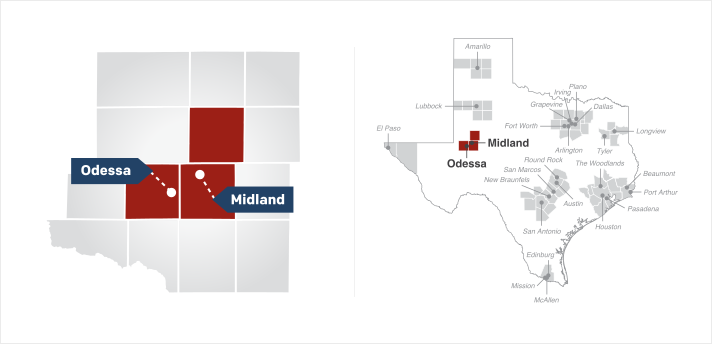
Population (2023): |
346,926 |
Population growth (2016–23): |
6.5 percent (Texas: 9.5 percent) |
Median household income (2023): |
$82,804 (Texas: $76,292) |
National MSA rank (2023): |
Midland, No. 242*; Odessa, No. 265* |
| * Midland–Odessa refers to the Midland and Odessa metropolitan statistical areas (MSAs). The MSAs encompass Ector, Martin and Midland counties. | |
- Midland and Odessa began as railroad towns and together evolved into a cattle shipping center and regional financial hub. The Permian Basin oil boom in the mid-1920s shifted the economic focus to energy.
- The shale boom in the early 2010s boosted household income and spurred economic and population growth. The manufacturing, transportation and construction sectors largely support the area’s dominant energy industry.
- The economy has ridden the ups and downs of energy, with the 2015–16 oil bust and the onset of the 2020 pandemic depressing a broad range of activity.
- Midland has sought diversification to lessen its reliance on traditional energy as the region’s economic driver. A growing distribution and e-commerce cluster, abundant clean energy resources and the Midland International Air & Space Port all present opportunities for the metro to broaden its economic base.
History: Heart of the Permian Basin
Midland and Odessa are sibling cities about 20 miles apart and jointly promoted as “Two Cities, No Limits.”.[1] Like many other Texas communities, Midland and Odessa began as stations along a railroad—halfway points between Dallas and El Paso along the Texas and Pacific Railway. Early on, the area relied primarily on ranching. Midland became a prominent cattle shipping center for Texas as well as a regional financial hub by 1890.
The beginnings of the oil boom in the Permian Basin—which encompasses two counties in New Mexico and 55 counties in West Texas—arrived in the 1920s. Scores of investors and oilfield workers moved to the area, and, by 1929, a total of 36 oil companies had established offices in Midland. Demand for oil and petrochemicals rose during World War II, helping transform Odessa into the world’s largest inland petrochemical complex.
From that point forward, the area’s economy was closely tied to the energy industry, rising with the oil booms and contracting with the busts. After years of decline that began with the 1980s oil bust, the Permian Basin and its economic center, Midland–Odessa, were regenerated by the shale oil boom, which took off in the early 2010s. Investment grew in the prolific formation even during periods of soft oil and gas prices, as its infrastructure, industry know-how and technological advancement helped make retrieving energy deposits relatively inexpensive.
Industry clusters: Energy-driven economy
The composition of industry clusters in Midland–Odessa is shown in Chart 8.1. The chart is organized by location quotient (LQ)—a measure of a cluster’s share of local employment relative to its share nationally—and the change in employment share between 2016 and 2023.[2]
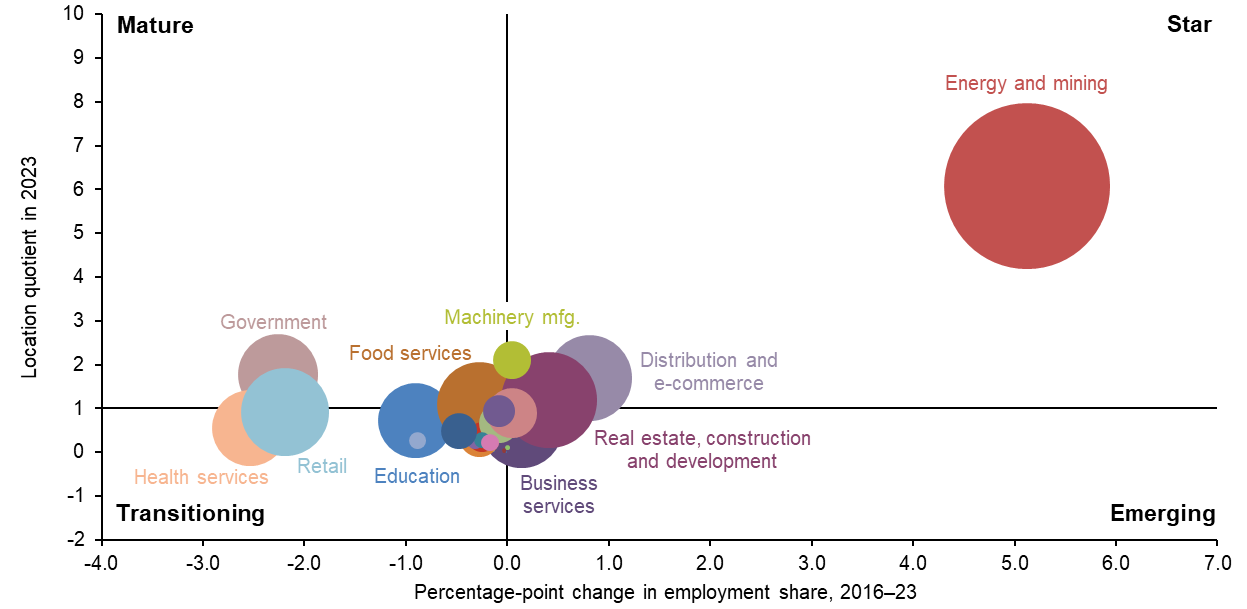
NOTE: Bubble size represents cluster share of metropolitan statistical area employment.
SOURCES: Texas Workforce Commission; Bureau of Labor Statistics.
Clusters in the “star” quadrant, such as energy and mining, have a large share of employment relative to the nation (an LQ far exceeding 1, in this case) and are relatively fast growing. “Emerging” clusters, such as business services, are relatively smaller compared with the nation (an LQ less than 1) but are fast growing. “Mature” clusters, such as government, are more concentrated relative to the U.S. (an LQ exceeding 1) but are slower growing; “transitioning” clusters, such as health services, are smaller relative to the nation and are slower growing or declining.
Midland–Odessa lies in the heart of the Permian Basin, a region that accounts for roughly half of domestic oil production and 25 percent of U.S. natural gas production. The metro is a base for labor and logistics within the region. A number of energy companies are based in Midland, including DiamondBack Energy, Dawson Geophysical and Permian Resources. Among the city’s largest private employers are firms such as Conoco Phillips, XTO Energy (a subsidiary of Exxon Mobil Corp.) and Chevron.
Odessa’s top private employers include Saulsbury Industries, Halliburton and NexTier Completion Solutions. Combined, these oilfield firms employ more than 6,000 people. Many companies bring in additional labor on assignment from other regions, such as Houston.[3]
Energy and mining, accounting for more than a quarter of the region’s jobs, has been fast growing in recent years, expanding 51 percent from 2016 through 2023 (Chart 8.2). The period began with a sectoral downturn and ended with an upswing, accounting for some of the magnitude of the increase. Other clusters that support energy and mining—machinery manufacturing; metal manufacturing and products; and real estate, construction and development—have grown significantly as the energy cluster has expanded.
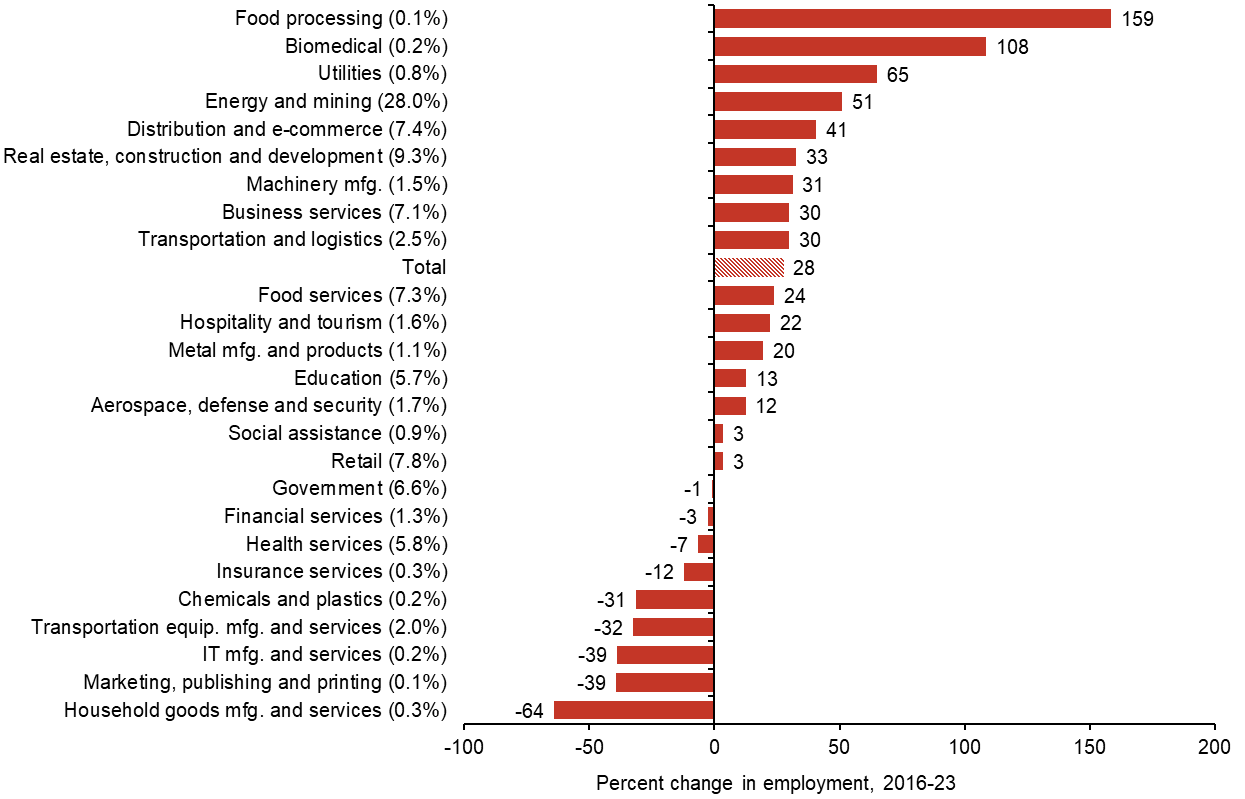
NOTES: Percent change in employment is shown in whole numbers. Each cluster’s normalized share of total jobs is shown in parentheses (rounded to one decimal place). Clusters with employment shares less than 0.1 percent are not displayed.
SOURCES: Texas Workforce Commission; authors’ calculations.
The distribution and e-commerce cluster employs 7.4 percent of the Midland-Odessa workforce and is the fifth-fastest-growing cluster in the region. This partially reflects the efforts of the Midland Development Corp., an economic development agency, to bring distribution centers to the city to supply the region and take advantage of its location between El Paso and Dallas–Fort Worth.
The transportation and logistics cluster, employing 2.5 percent of the workforce, grew 30 percent from 2016 through 2023. A $4.3 billion Texas Department of Transportation roadway expansion and upgrade is aiding the sector while improving infrastructure taxed by heavy energy-related usage.
Additionally, utilities, long associated with the area’s energy sector, expanded rapidly during the period as oil fields were electrified at such a rapid rate that service providers struggled to keep pace.[4] Moreover, statewide proliferation of electricity-intensive data centers continues, promising support for additional utility investment.
Midland-Odessa’s health services cluster is smaller compared to the nation and declining. Attracting and retaining workers outside of energy and its adjacent industries is a challenge for local leaders. The Permian Strategic Partnership has invested in programs at Odessa College and University of Texas Permian Basin to support the training of nurses and behavioral health professionals. The organization also supports physician residency fellowships at Texas Tech. These programs and a new behavioral health hospital currently under construction may promote growth in this cluster.[5]
The combination of the well-paying oil and gas sector and a tight labor market in the postpandemic period supported high wages in Midland and Odessa. Inflation-adjusted annual average wages grew 13.1 percent between 2016 and 2023 (Table 8.1). Midland-Odessa’s increase was driven by energy and mining and distribution and e-commerce.
| Cluster | Midland–Odessa | U.S. | ||||
| 2016 | 2019 | 2021 | 2023 | 2023 | ||
| Energy and mining | 110,077 | 119,333 | 114,427 | 119,514 | 107,531 | |
| Machinery manufacturing | 93,951 | 105,002 | 102,517 | 107,840 | 80,744 | |
| Government | 61,922 | 65,479 | 63,779 | 64,197 | 67,435 | |
| Distribution and e-commerce | 88,435 | 102,176 | 92,350 | 100,262 | 83,656 | |
| Real estate, construction, and development | 76,257 | 87,028 | 77,841 | 82,079 | 75,369 | |
| Food services | 23,248 | 26,569 | 25,888 | 26,094 | 25,821 | |
| Clusters with location quotient > 1 | 68,797 | 82,675 | 74,173 | 83,331 | - | |
| Clusters with location quotient <= 1 | 59,213 | 65,745 | 65,979 | 67,676 | - | |
| Average earnings (total) | 72,185 | 83,612 | 76,928 | 81,654 | 70,033 | |
| NOTES: Clusters are listed in order of location quotient (LQ); clusters shown are those with LQs greater than 1 in 2023. Earnings are in 2023 dollars. SOURCES: Texas Workforce Commission; Bureau of Labor Statistics; authors’ calculations. |
||||||
Demographics: High income but less education
Average earnings in Midland-Odessa were $81,654 in 2023, 14.3 percent above the state average. However, just 26.1 percent of residents have a bachelor’s degree or higher in the region, below the statewide average of 34.2 percent (Chart 8.3). Many oilfield jobs in the Permian Basin don’t require higher education. Wages in oil and gas extraction averaged $50.13 an hour in 2023, while the national average hourly wage was $33.70.[6]
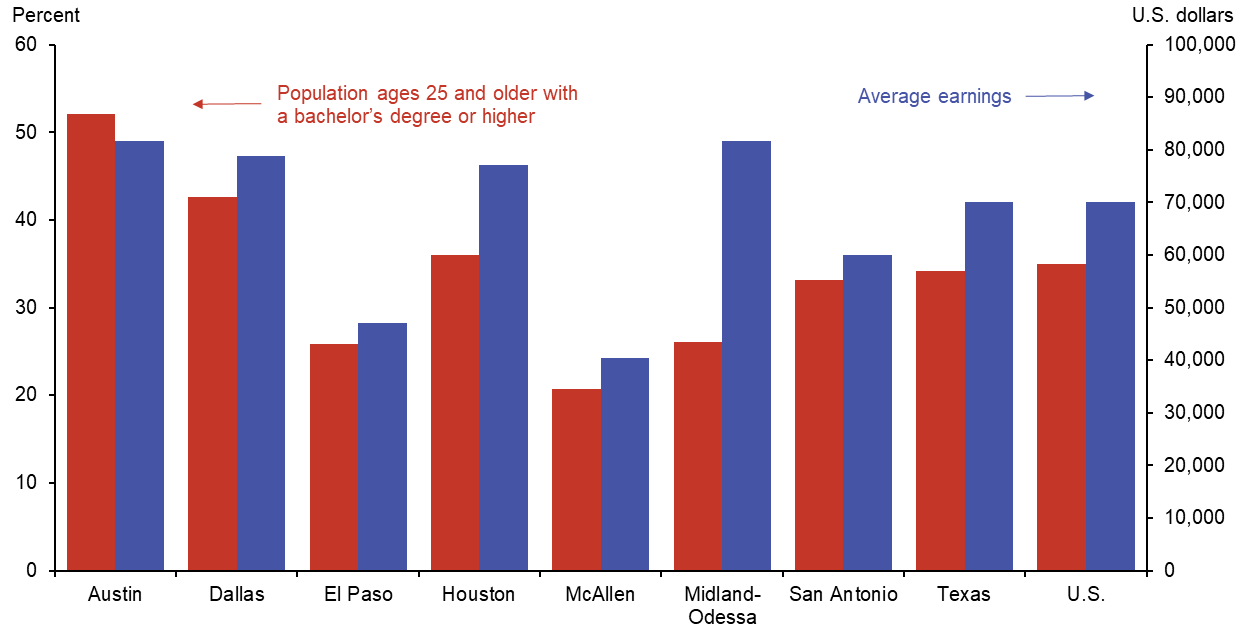
NOTE: Average earnings are for 2023.
SOURCES: Census Bureau, 2023 American Community Survey 1-year estimates; Bureau of Labor Statistics; authors’ calculations.
Midland-Odessa’s lower levels of educational attainment are a longstanding characteristic of the region, although high school completion rates have risen. About 85 percent of residents age 25 or older had at least a high school diploma in 2023—only 1 percentage point below the state average. Midland-Odessa is tied with Amarillo for fifth-lowest population share with a bachelor’s degree or higher (26 percent) among the Texas metros in this report.
To address these challenges and boost the growth of a skilled local labor force, area organizations like the Permian Strategic Partnership have advocated for, and contributed funding to, educational institutions across the region. These facilities include Ector County Independent School District’s career and technical education center and a third campus for the STEM-focused charter school district Harmony Public Schools.[7]
A larger share of the Midland-Odessa population lived in poverty in 2023 (12.9 percent) than in 2016 (10.4 percent). Still, the metro fared better than the state (13.7 percent) in 2023.
Employment: Mergers and acquisitions follow pandemic
The energy sector to which Midland-Odessa’s economy is aligned undergoes cyclical booms and busts. Booms occur when energy companies increase their production in response to higher prices, expanding drilling and the workforce in extraction, distribution and refining. Declining prices have the opposite effect.
The onset of the pandemic halted much economic activity worldwide, causing an oil price collapse that reverberated through Midland-Odessa’s economy. From mid-2016 through mid-2019, Midland and Odessa’s employment grew strongly, as the energy market worked its way out of the mid-decade oil bust. During the pandemic’s early months, those job gains disappeared. Relative to January 2020, just before the pandemic, Midland lost 20 percent of its total employment in six months; Odessa similarly dropped close to one-fifth of its workforce within eight months, by September 2020.
Employment recovered once oil prices rose, and the economy and energy markets normalized. Massive mergers and acquisitions and industry consolidation have dominated the region’s postpandemic energy economy. Exxon Mobil completed its $59.5 billion acquisition of Pioneer Natural Resources in May 2024. Occidental Petroleum closed on its purchase of CrownRock in August 2024, and DiamondBack Energy acquired Endeavor Energy Resources in September 2024.
In recent years, oilfield operations have become highly efficient, and consolidations are unlikely to result in significant additional layoffs of production workers within the region. In fact, future energy-related employment may become less responsive to changes in oil price due to increasing productivity, efficiency and a shift toward business models that focus on profitability over production growth.
Outlook: ‘Energy transition’ could hasten diversification
The Permian Basin, with its abundant fossil fuel deposits, will retain its energy emphasis well into the future. Oil companies operating in the region enjoy a cost advantage that comes from technological advances, a shale oil-rich geography and established workforce and infrastructure. Ongoing improvements to oilfield efficiency will likely continue driving production while tempering job growth. As such, the next time oil prices rise, employment gains are likely to be more modest compared with prior upturns.
The Energy Information Administration (EIA) projects growing global demand for oil and gas through 2050, even as consumption is expected to decline in the U.S. and exports abroad to increase.[8] Meanwhile, the “energy transition” from fossil fuels to more renewable resources holds promise for the region. Twenty nine percent of Texas’ electricity generation came from renewable sources in 2024, principally wind and solar, according to the EIA. Texas led the nation in wind-power generation and in utility-scale solar energy.[9]
The West Texas plains that include Midland Odessa are well suited for such alternative power generation. Counties within the Permian Basin have just over 16 gigawatts (GW) of installed wind generating capacity—40 percent of Texas’ total wind generation capacity (41 GW) and 11 percent of total U.S. wind capacity (148 GW). The Permian Basin has 8 GW of untility-scale solar capacity, 25 percent of the state’s total solar capacity (34 GW) and 9 percent of the nation’s (91 GW ).[10], [11]
Ongoing electrification of the oilfield and a growing number of data centers has created surging demand for electricity from all sources. Several data center companies have facilities at various stages of completion in the metro, some saying the availability of abundant natural gas could allow operations to proceed with onsite power generation before regular, grid electricity is available.
Energy companies are also increasing their demand for electricity, primarily as a way to reduce their emissions in the oil field. Similar to data centers, some firms are relying on generators or creating their own local microgrids, while others are tapping directly into the electric grid. However, some estimates show the existing grid infrastructure cannot handle the expected demand, meaning that wider electrification of oil fields will require additional generation and distribution infrastructure.[12]
Recent attempts to diversify the Midland-Odessa economy may help the region better weather inevitable oil price swings, but emerging industries are likely to pay workers less than traditional energy firms. Development of additional utility-scale wind and solar plants will create jobs in the construction and operation of the facilities. However, while solar and wind plant jobs are less cyclical, the installations don’t require a large, ongoing employee presence.
Local leaders have targeted aerospace as an opportunity for further economic development. The Midland International Air & Space Port combines commercial aviation and spaceport facilities. A nearby business park hosts firms developing satellite technology as well as researching advanced aerospace technology, rocket engines and missiles. The area recently won a grant to support the development of a vertical rocket launch site in Reeves County.[13]
Low business costs, remote airspace and an existing manufacturing industry may support the growth of an aerospace cluster in Midland-Odessa. Workforce will also be important. The University of Texas–Permian basin opened its College of Engineering building in 2019 as part of efforts to broaden its engineering programs, ultimately to deepen and diversify the local employment base.[14]
| Midland–Odessa growth outlook | |
| Drivers | Challenges |
|
|
Notes
- The histories of Midland and Odessa are adapted from the Texas State Historical Association’s Handbook of Texas.
- The percentage shares of individual clusters are normalized to add up to 100 and differ from individual industry share totals. Some industries are included in multiple clusters, while some others are omitted because they fall outside revised cluster definitions. (See the appendix for more information.)
- Detail regarding Midland’s and Odessa’s top employers was compiled from several local websites.
- See “Electrifying the Permian Basin,” a report from S&P Global prepared for the Electric Reliability Council of Texas, March 22, 2023.
- Permian Strategic Partnership 2024 Annual Report.
- Data are from Bureau of Labor Statistics Current Employment Statistics Survey.
- See note 5.
- Data are from “Analysis & Projections” from the U.S. Energy Information Administration.
- See “Texas state profile and energy estimates, analysis,” Energy Information Administration, Aug. 21, 2025.
- Electricity data are from the U.S. Energy Information Administration.
- Data are from the November 2025 Monthly Outlook for Resource Adequacy report, Resource Adequacy, Electric Reliability Council of Texas (ercot.com).
- See note 4.
- See “Midland awarded $5M grant to support vertical launch site development,” Midland International Air & Space Port.
- See “UT Permian Basin engineering building grand opening ceremony,” UT Permian Basin Blogs, Oct. 22, 2019, and “University of Texas of the Permian Basin College of Engineering,” Midland Development Corp.,” accessed Oct. 20, 2025.